Stablecoin Payments for Merchants: The Operator’s Guide to Checkout, Settlement, and Reconciliation

Stablecoin payments for merchants sound simple until the first buyer sends the wrong amount, uses the wrong network, or opens a support ticket asking why the order still says pending.
The storefront says crypto is enabled. The wallet received funds. The warehouse team is waiting. Accounting is asking which order the transaction belongs to. Support is guessing.
Teams think the problem is accepting USDC or USDT at checkout. The real problem is building a payment workflow that can survive irreversible settlement, network variance, buyer mistakes, and high-risk merchant operations.
That changes the conversation. Stablecoins are not just another payment button. For peptide sellers, research product merchants, and other high-risk ecommerce teams, they become part of order state, treasury, compliance boundaries, refunds, and customer trust.
Table of contents
- Why stablecoin payments for merchants are an operations problem
- Stablecoin payments for merchants versus card rails
- The merchant payment state machine
- Stablecoin selection and chain support
- Wallet, custody, and treasury boundaries
- Webhooks, retries, and reconciliation
- Fraud, support, and buyer trust
- What breaks when implementation is poor
- Metrics operators should watch
- Where coinpayportal.com fits
Why stablecoin payments for merchants are an operations problem
The checkout widget is not the system
The mistake teams make is treating stablecoin checkout like a frontend integration. Add a button, show a wallet address, wait for funds, mark the order paid.
That works in a demo. It fails in production because payments are not a single event. They are a sequence of states with failure modes between each step. The buyer can abandon the invoice. The chain can be slow. The payment can arrive after expiration. The buyer can send USDT on a network you do not support. A webhook can fail. Your order system can mark the order paid twice.
The practical question is not whether stablecoins can move value. They can. The practical question is whether your ecommerce operation can prove which order was paid, when it was paid, whether the amount was correct, who touched the wallet, and what support should tell the buyer.
Related reading from our network: teams making infrastructure decisions in decentralized compute face a similar architecture problem where the UI is only the entry point, not the operating system, as covered in cloud computing explained for decentralized compute and workload builders.
Practical rule: If a payment method cannot be reconciled without opening a block explorer manually, it is not ready for serious merchant volume.
Why high-risk merchants feel the pain first
High-risk merchants do not have the luxury of loose payment operations. Peptide sellers, regulated research product merchants, nutraceutical brands, and other category-sensitive businesses often deal with processor instability, rolling reserves, frozen accounts, higher support pressure, and stricter documentation needs.
Stablecoins can reduce dependency on card processors, but they do not remove operational risk. They move the risk. Instead of chargebacks, you get irreversible payments and refund complexity. Instead of processor settlement reports, you need wallet-level reconciliation. Instead of card decline codes, you get buyer confusion about networks, gas, and confirmations.
For a deeper adjacent breakdown, our earlier guide on peptide payment processing crypto architecture covers why high-risk checkout is mostly about state, settlement, reconciliation, and support rather than just adding crypto as a payment option.
A useful way to think about it is this: stablecoin payments are a rail, but merchant operations are the product. If the rail is fast and the operation is messy, buyers still experience failure.
Stablecoin payments for merchants versus card rails
What changes when settlement is final
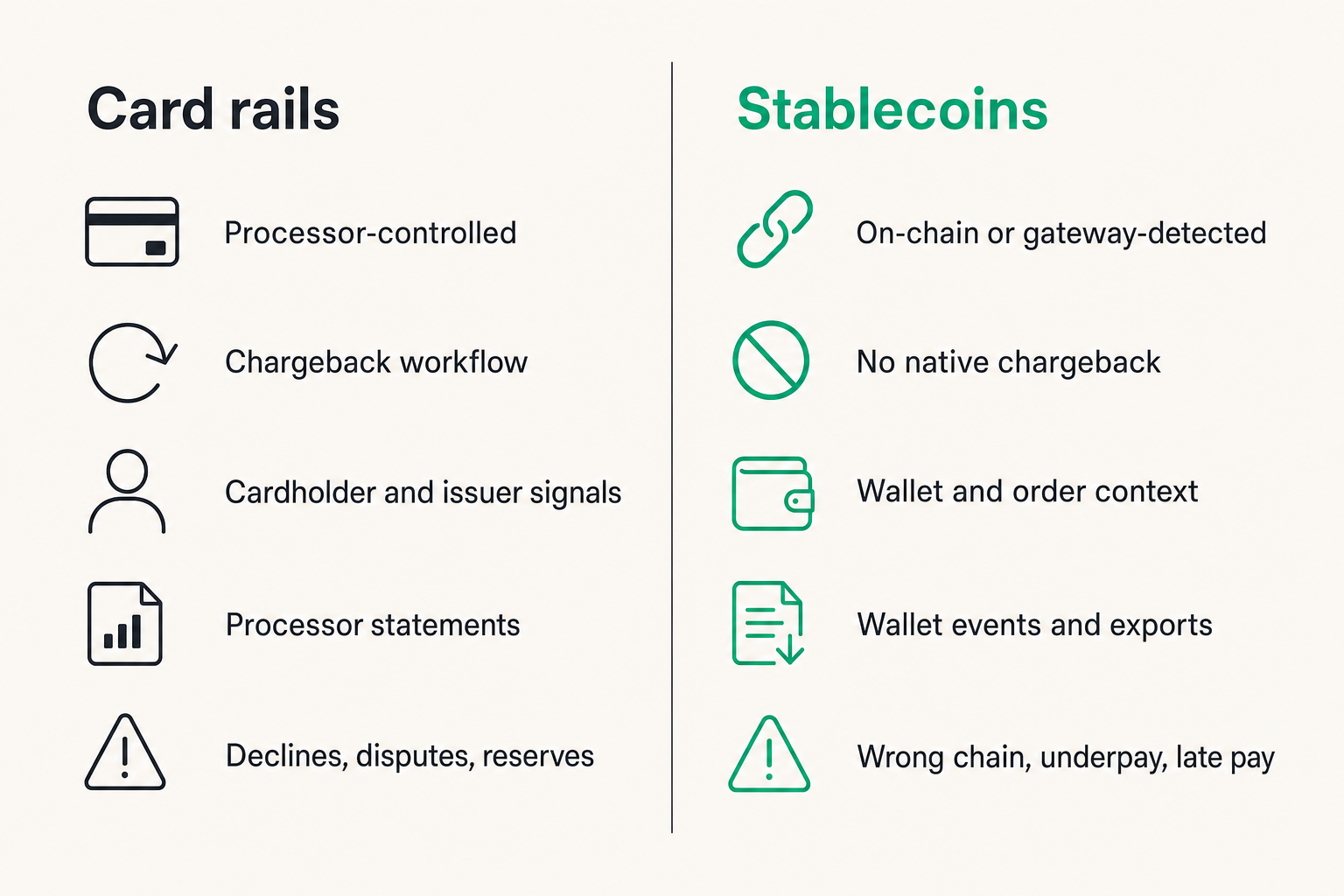
Stablecoin payments for merchants change the payment contract. Card payments are reversible through disputes and chargebacks. Stablecoin payments are generally final once confirmed on-chain. That can be useful for high-risk merchants, but it also increases the cost of mistakes.
With cards, a bad fulfillment decision may come back as a dispute. With stablecoins, a bad checkout decision may require manual refund handling, wallet investigation, or a support escalation. The failure moves earlier in the workflow.
| Area | Card rails | Stablecoin rails | Operator impact |
|---|---|---|---|
| Settlement | Processor-controlled | On-chain or gateway-detected | Merchant needs clear confirmation rules |
| Disputes | Chargeback workflow | No native chargeback | Refund policy must be explicit |
| Identity | Cardholder and issuer signals | Wallet and order context | Merchant needs fraud rules outside card data |
| Reporting | Processor statements | Wallet events and exports | Reconciliation must be designed |
| Failure mode | Declines, disputes, reserves | Wrong chain, underpay, late pay | Support scripts must change |
That changes the conversation. Stablecoins are not automatically better or worse. They have a different operating model.
Where stablecoins help and where they do not
Stablecoins help when the merchant needs faster settlement, global buyer access, fewer card network dependencies, and reduced exposure to card chargebacks. They are especially useful when buyers already understand crypto and want a dollar-denominated asset rather than volatile coins.
They do not solve poor fulfillment, unclear refund policies, weak compliance controls, or bad customer communication. A merchant with chaotic order management will not become stable because payments arrive in USDC.
Practical rule: Stablecoins reduce some processor risk, but they increase the need for internal payment discipline.
What works:
- Clear invoices with exact asset, network, amount, and expiration time.
- Automated order state updates after confirmation.
- Support tools that show transaction hash, amount, network, and status.
- Daily reconciliation between orders, invoices, and wallet activity.
- A documented refund process before the first refund request arrives.
What fails:
- One shared wallet address for all orders with no reliable memo or attribution.
- Manual screenshots from buyers as proof of payment.
- Support agents checking block explorers without a standard process.
- Marking orders paid before confirmation rules are met.
- Offering too many networks and hoping buyers choose correctly.
The merchant payment state machine
Minimum states every checkout needs
The payment state machine is the core of stablecoin checkout. If you skip it, every downstream system becomes unreliable.
At minimum, an order should separate commercial order state from payment invoice state. An order can exist before payment. An invoice can expire while the order remains unpaid. A payment can arrive late and require review. A refund can exist after fulfillment is canceled.
A practical state model looks like this:
- Created: order exists, no payment invoice yet.
- Invoice issued: amount, asset, network, address, and expiry are locked.
- Pending payment: waiting for on-chain detection.
- Detected: transaction seen but not yet confirmed enough.
- Paid: amount and confirmation rules satisfied.
- Underpaid: received amount below tolerance.
- Overpaid: received amount above expected.
- Expired: invoice window closed without valid payment.
- Review required: ambiguous or late payment.
- Refunded: outbound refund completed and recorded.
The mistake teams make is using only unpaid and paid. That binary model cannot represent real stablecoin behavior.
Expiration, underpayment, and overpayment
Invoice expiration is not just a countdown timer. It protects pricing, inventory, and operational certainty. If a buyer pays six hours late, should the order ship? Maybe. But the system should not decide silently.
Underpayment often happens because the buyer subtracts network fees from the amount or uses an exchange withdrawal that charges a fee. Overpayment happens when buyers round up, send from a custodial exchange with minimum withdrawal rules, or reuse a previous amount.
You need tolerances, but tolerances should be explicit. For example:
- Small dust underpayment: auto-accept within a defined threshold.
- Meaningful underpayment: hold order and request additional payment.
- Small overpayment: record and optionally credit.
- Large overpayment: flag for manual review and refund workflow.
Practical rule: Do not let payment edge cases mutate order state without an audit trail.
Idempotency and duplicate events
Crypto payment systems are event-driven. Your gateway or chain watcher may send a payment detected event, a confirmation event, and a paid event. Network reorgs are rare on many commonly used chains but event duplication is common in distributed systems. Webhooks retry. Workers restart. Queue consumers process messages twice.
Idempotency means your system can receive the same event multiple times without creating duplicate shipments, duplicate accounting entries, or duplicate customer emails.
For merchant developers, every webhook handler should answer three questions:
- Have we seen this event ID before?
- Does this event move the invoice forward from its current state?
- Is the side effect safe to run once and only once?
The practical pattern is to store events first, validate signatures, lock the invoice row, apply state transitions, then emit internal events for fulfillment or notifications. Do not let the webhook directly ship the order.
Related reading from our network: payment webhooks have the same weak points as CI/CD integrations in one important sense: secrets, provenance, and event trust matter, which is why security questions for CI/CD and supply chain reviews is useful adjacent reading for teams hardening developer workflows.
Stablecoin selection and chain support
USDC, USDT, and buyer expectations
Most merchants start with a simple question: should we accept USDC, USDT, or both? The practical answer depends on buyer demand, jurisdictional exposure, treasury preferences, and support burden.
USDC is often favored by merchants that want cleaner treasury handling and clearer issuer positioning. USDT has strong global recognition and liquidity. Buyers in some regions expect USDT first. Developers may prefer networks with lower fees and mature tooling.
The wrong answer is supporting assets because they look popular on a list. Every asset creates documentation, QA, support scripts, wallet processes, and reconciliation columns.
Network fees, confirmation times, and buyer mistakes
Stablecoins are not network-neutral. USDC on Ethereum is not the same operational experience as USDC on a lower-fee network. USDT on Tron is not the same as USDT on Ethereum. Buyers often know the token name but not the network.
What breaks in practice is the label. A buyer sees USDT and sends from an exchange using the default network. If your checkout page does not make the network obvious, support inherits the problem.
Good checkout copy should include:
- Token symbol and full asset name.
- Network name in plain language.
- Exact amount due.
- Address or QR code.
- Expiration time.
- Warning not to send on unsupported networks.
- Instruction that exchange withdrawals may deduct fees.
Do not support every chain on day one
Many teams overbuild chain support. They assume more options mean more conversions. In production, more options often mean more mistakes.
A better rollout is narrow and measurable. Start with the asset and network your buyers are most likely to use correctly. Add another only when support volume, failed payments, and buyer requests justify it.
A useful decision matrix:
| Decision | Good reason to add support | Bad reason to add support |
|---|---|---|
| New stablecoin | Buyers request it and treasury can handle it | It is trending online |
| New network | Lower fees and clear wallet compatibility | A competitor lists it |
| New wallet flow | Reduces support tickets | Looks more advanced |
| New confirmation rule | Matches real settlement risk | Default copied from a forum |
The practical question is not how many chains you can list. It is how many you can operate without confusing buyers or accounting.
Wallet, custody, and treasury boundaries
Non-custodial does not mean no process
Non-custodial payment architecture can be valuable because the merchant keeps control over funds instead of relying on a provider to custody balances. But non-custodial does not mean unmanaged.
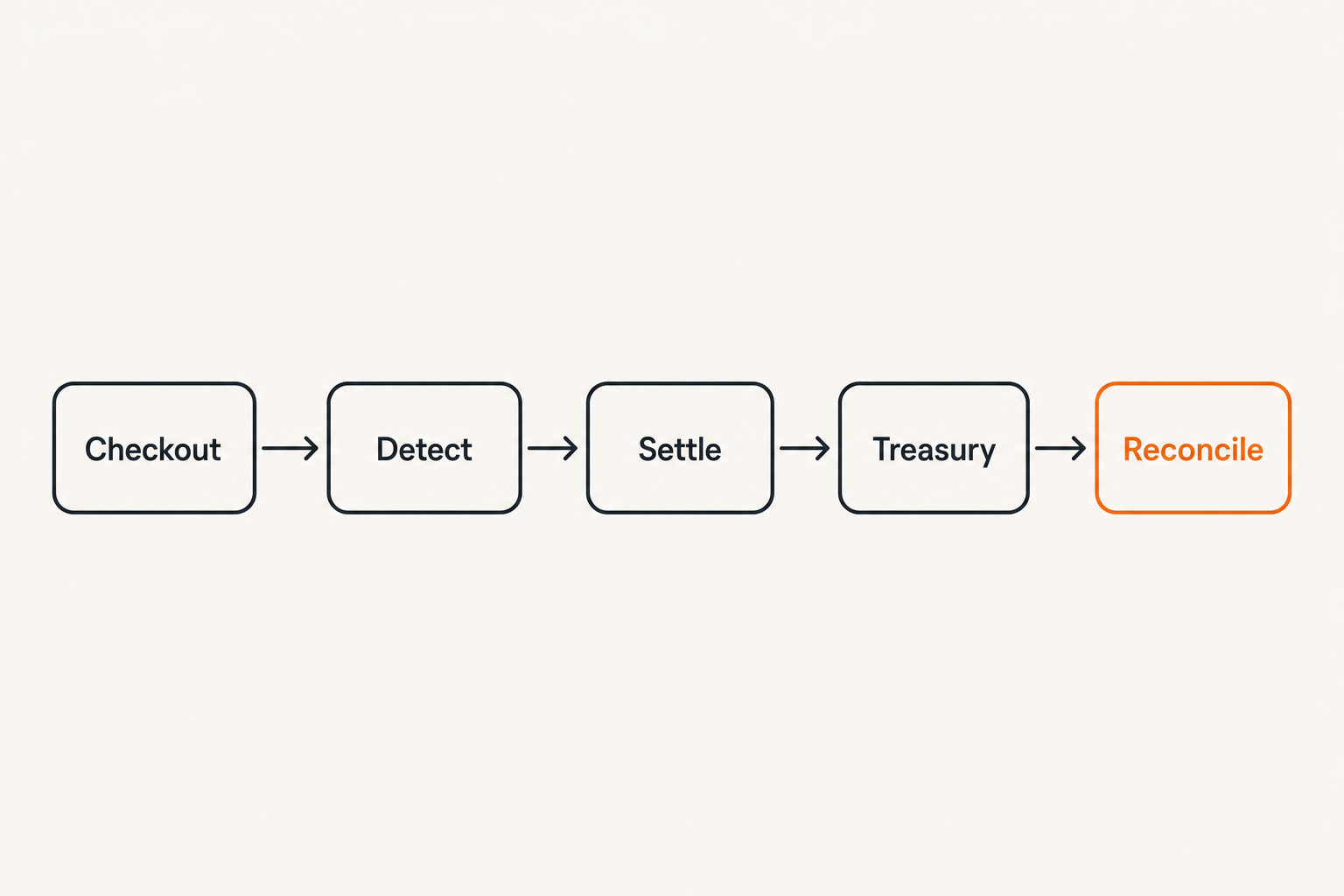
You still need policies for address generation, key access, wallet monitoring, settlement movement, backups, and internal approvals. The payment gateway may detect and route payment state, but the merchant must decide how funds move after receipt.
CoinPayPortal is built around non-custodial crypto checkout patterns, and merchants evaluating that model can review the non-custodial crypto payment gateway approach in the context of their own wallet and operations requirements.
Hot wallets, settlement wallets, and access control
A mature setup separates payment receipt from long-term storage. Payment addresses collect funds. Operational wallets handle refunds or small movements. Treasury wallets hold larger balances. Access should be scoped.
For high-risk ecommerce, this matters because payment operations often touch multiple teams: support, finance, founders, developers, fulfillment, and sometimes compliance advisors. Not everyone needs wallet access. Most users need visibility, not signing authority.
A practical boundary model:
- Support can view invoice and transaction status, but cannot move funds.
- Finance can export reports and reconcile deposits.
- Operators can approve refund requests.
- Wallet signers can execute approved transactions.
- Developers can inspect events, but cannot access private keys.
Practical rule: Give teams the payment visibility they need without giving them custody power they do not need.
Treasury conversion and accounting handoff
Stablecoins reduce volatility compared with non-stable crypto assets, but they do not eliminate treasury decisions. Merchants still need to decide whether to hold stablecoins, convert to fiat, pay vendors in crypto, or split balances across wallets.
Accounting needs consistent records: order ID, invoice ID, asset, network, gross amount, fees if applicable, transaction hash, timestamp, refund status, and settlement wallet movement. If conversion happens later, that is a treasury event, not the original customer payment.
The mistake teams make is blending checkout, custody, and treasury into one mental bucket. Keep them separate:
- Checkout proves the buyer paid.
- Custody controls where funds are held.
- Treasury decides what happens after settlement.
- Accounting records the business event.
That separation prevents support questions from becoming wallet questions and wallet questions from becoming accounting emergencies.
Webhooks, retries, and reconciliation
Build for event loss, not happy paths
A stablecoin payment integration should assume webhooks will fail. Your server may be down. DNS may be misconfigured. A firewall may block the request. A deployment may return 500 errors for ten minutes. The gateway may retry, but retries do not remove your responsibility to process safely.
Webhook design should include:
- Signature verification.
- Idempotency keys or event IDs.
- Durable event storage.
- Retry-safe state transitions.
- Alerting for repeated failures.
- A backfill or polling job to recover missing state.
The practical question is not whether the first webhook works in staging. It is whether the order system heals after the webhook fails in production.
Reconciliation as daily control
Reconciliation is where stablecoin payments become real business infrastructure. It proves that paid orders match detected payments and wallet balances.
Daily reconciliation should answer:
- Which invoices were issued?
- Which invoices were paid?
- Which on-chain transactions matched invoices?
- Which payments are underpaid, overpaid, expired, or late?
- Which refunds were approved and executed?
- Which wallet movements are not customer payments?
This is not just finance hygiene. It reduces support time and fulfillment risk. If fulfillment ships based on a paid status that finance cannot reconcile, the operation is drifting.
Related reading from our network: operational software decisions in field teams have the same lesson, because tools fail when scheduling, invoicing, inventory, and support are not connected; see field service management software as a workflow guide for the same workflow-first lens in another category.
Implementation sequence for developers
A practical stablecoin checkout implementation should be boring. Boring is good. It means states are explicit and side effects are controlled.
- Create an order in your commerce system with unpaid status.
- Request a payment invoice with asset, network, amount, order ID, and expiry.
- Show the buyer clear payment instructions and warnings.
- Store the invoice ID and expected payment details locally.
- Receive webhook events and verify the signature.
- Persist the raw event before applying business logic.
- Lock the invoice record and apply a valid state transition.
- Mark the order paid only after confirmation rules are satisfied.
- Trigger fulfillment through an internal queue, not directly from the webhook.
- Reconcile invoices, orders, and wallet activity daily.
A simple internal event model can be enough:
- invoice.created
- payment.detected
- payment.confirmed
- invoice.paid
- invoice.expired
- payment.review_required
- refund.requested
- refund.completed
The names matter less than the discipline. Each event should mean one thing. Each state transition should be auditable.
Fraud, support, and buyer trust
Final settlement changes support scripts
Stablecoin support is different from card support. Agents cannot tell buyers to call the issuing bank. They need to know how to read invoice status, transaction hash, asset, network, and confirmation state.
Good support tooling should show:
- Order ID and invoice ID.
- Expected asset and network.
- Expected amount and received amount.
- Payment address.
- Transaction hash.
- Current payment state.
- Expiration time.
- Refund eligibility and status.
Support scripts should avoid vague promises. Do not say funds are lost unless someone has verified the transaction. Do not promise instant refunds if wallet signing requires approval. Do not ask buyers to send screenshots as the primary proof.
KYC and compliance boundaries
Stablecoin payments do not make a merchant exempt from compliance duties. For high-risk categories, the payment method is only one part of the business risk model. Product claims, shipping restrictions, buyer eligibility, sanctions exposure, refund rules, and recordkeeping still matter.
The practical boundary is to define what your payment system enforces and what your business process enforces. The checkout may validate payment state. Your order workflow may validate shipping restrictions. Your compliance process may review unusual orders or geographies.
The mistake teams make is expecting the payment rail to solve category risk. It will not. Stablecoin acceptance can improve payment resilience, but it does not replace merchant diligence.
Refunds, chargebacks, and disputes
Stablecoins have no native card-style chargeback. That can reduce abusive dispute patterns, but it also means the merchant must own refund policy clearly.
Refund rules should define:
- Who approves refunds.
- Which wallet sends refunds.
- Whether refunds return the same asset and network.
- How network fees are handled.
- How to verify the refund destination.
- What happens if the buyer paid from an exchange.
- How refunds are recorded in accounting.
For high-risk merchants, this needs to be written before launch. A refund policy created during the first angry ticket will be inconsistent and risky.
What breaks when implementation is poor
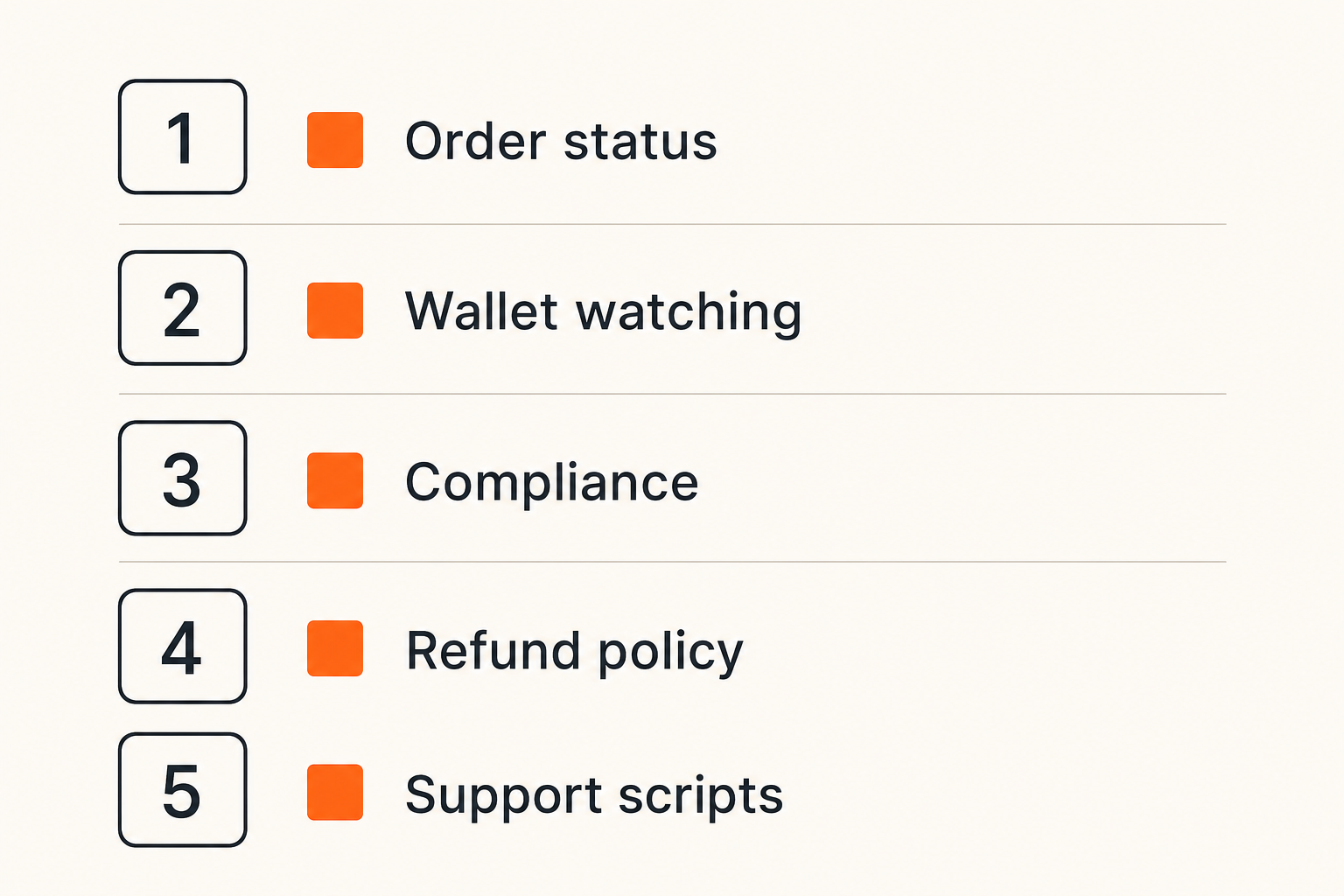
Failure mode one: ambiguous order status
Ambiguous order status is the most common operational failure. The buyer thinks they paid. The wallet shows funds. The order says pending. Support cannot tell whether to ship.
This usually happens when the payment system and commerce system are loosely connected. Maybe the webhook failed. Maybe the transaction was detected but not confirmed. Maybe the buyer underpaid. Maybe the order expired. Without explicit states, every case looks the same.
What works is a review queue with reason codes. Review required because late payment is different from review required because wrong amount. Operators need the reason, not just the label.
Failure mode two: manual wallet watching
Manual wallet watching is not an operating model. It is a temporary crutch. It creates delays, mistakes, and key-person dependency.
When teams rely on a person to check a wallet, three things happen:
- Orders wait for human confirmation.
- Support tickets increase because buyers see no status change.
- Accounting cannot reliably prove which transaction matched which order.
Manual review should exist for exceptions, not normal payment completion. If most paid orders require a person to inspect a block explorer, the system is incomplete.
Failure mode three: unmanaged compliance expectations
Some merchants adopt stablecoins because card processors made life difficult. That is understandable. But payment resilience is not the same as compliance immunity.
What breaks in practice is messaging. If the site implies crypto payments make everything frictionless, buyers expect instant shipment, instant refunds, and no review. If the operation still needs order checks, inventory validation, or shipping restrictions, the promise and workflow conflict.
A better posture is direct: stablecoin checkout is available, payments are verified on-chain, orders ship after payment confirmation and internal order review, and refunds follow the published policy.
Practical rule: Use crypto to make payment acceptance more resilient, not to hide weak operations.
Metrics operators should watch
Payment completion rate
Payment completion rate measures how many issued invoices become valid paid orders. If completion is low, the problem may be checkout copy, network choice, wallet compatibility, expiration windows, or buyer education.
Segment it by asset and network. A high overall completion rate can hide one network that creates most support tickets. A low completion rate on a new option may not mean buyers dislike crypto. It may mean the instructions are confusing.
Useful cuts:
- Completion by asset.
- Completion by network.
- Completion by device type.
- Completion by new versus returning buyer.
- Expired invoices by checkout step.
Time to reconcile
Time to reconcile is an operator metric, not a finance vanity metric. If reconciliation takes hours every day, your system is leaking context.
The goal is not to eliminate human review completely. The goal is to make normal cases automatic and exceptions obvious. An operator should be able to see what matched, what did not, and why.
Measure:
- Number of unmatched transactions.
- Number of review-required invoices.
- Average time to close review items.
- Refunds pending approval.
- Wallet movements without linked business purpose.
Support contacts per paid order
Support contacts per paid order tells you whether checkout is understandable. If buyers constantly ask whether payment was received, the status experience is weak.
Track contact reasons:
- I sent payment but order is pending.
- I used the wrong network.
- I sent too little.
- I paid after expiration.
- I need a refund.
- I paid from an exchange and cannot see the source wallet.
This metric turns anecdotes into product decisions. If wrong-network tickets spike, change checkout copy or reduce options. If late-payment tickets spike, adjust expiration warnings. If refund tickets spike, improve policy visibility.
Where coinpayportal.com fits
Product fit for high-risk checkout teams
coinpayportal.com is built for merchants and operators who need resilient crypto checkout infrastructure, especially in high-risk categories like peptides and regulated research products.
The product fit is strongest when the merchant already understands that the UI is not the whole system. You need payment state, real-time processing, automatic fee handling where applicable, webhook-driven order updates, wallet boundaries, and reconciliation workflows that reduce manual effort.
For a peptide seller or research product merchant, the goal is not to look like a crypto company. The goal is to accept stablecoin payments without turning support, fulfillment, and accounting into a guessing game.
When to build versus use a gateway
Building in-house can make sense if payments are core IP, your team has blockchain infrastructure experience, and you are ready to maintain chain monitoring, webhook reliability, address management, reconciliation, refunds, and support tooling.
Using a gateway makes sense when you want to focus engineering time on commerce operations rather than rebuilding payment plumbing. That is especially true for high-risk merchants where processor redundancy, buyer trust, and operational control matter more than experimenting with every new chain.
The practical question is ownership. If you build, you own every edge case. If you use a gateway, you still own your business process, but the payment workflow has more structure from day one.
Stablecoin payments for merchants work best when the architecture is explicit: state machine first, checkout second, wallet boundaries third, reconciliation always.
Try coinpayportal.com
coinpayportal.com helps merchants and operators build resilient crypto checkout infrastructure for high-risk ecommerce, including peptide and regulated research product categories.
Try coinpayportal.com for stablecoin payments for merchants that need practical checkout, settlement, and reconciliation workflows.
Try CoinPay
Crypto payments, escrow, and wallets — multi-chain, Lightning-ready, and fast to integrate.
Get started →