Peptide Payment Processing: A Practical Crypto Architecture for High-Risk Merchants

Peptide payment processing breaks in boring places: a customer sends the wrong amount, a wallet payment confirms after the order expires, support cannot tell whether a shipment should be released, and finance has to reconcile deposits across wallets, invoices, and fees.
Teams think the problem is getting approved by a processor. The real problem is building a payment workflow that still works when conventional processors are unstable, crypto settlement is irreversible, and every failed state becomes a support ticket.
That changes the conversation. Peptide payment processing is not a checkout button decision. It is an architecture decision around order state, settlement timing, custody boundaries, reconciliation, refunds, and merchant operations.
The practical question is not whether crypto can be used for peptide merchants. It can. The question is whether your system can make crypto payments predictable enough for customers, staff, and finance to operate without improvising every day.
Table of contents
- Peptide payment processing is an architecture problem
- Map the payment states before you pick rails
- Choose rails around settlement, not trend
- The production workflow for peptide payment processing
- Reconciliation is where peptide merchants lose money
- Compliance, trust, and support are part of the payment stack
- What breaks when teams implement it badly
- What works in production
- Implementation checklist for developers and founders
- Where coinpayportal.com fits
Peptide payment processing is an architecture problem
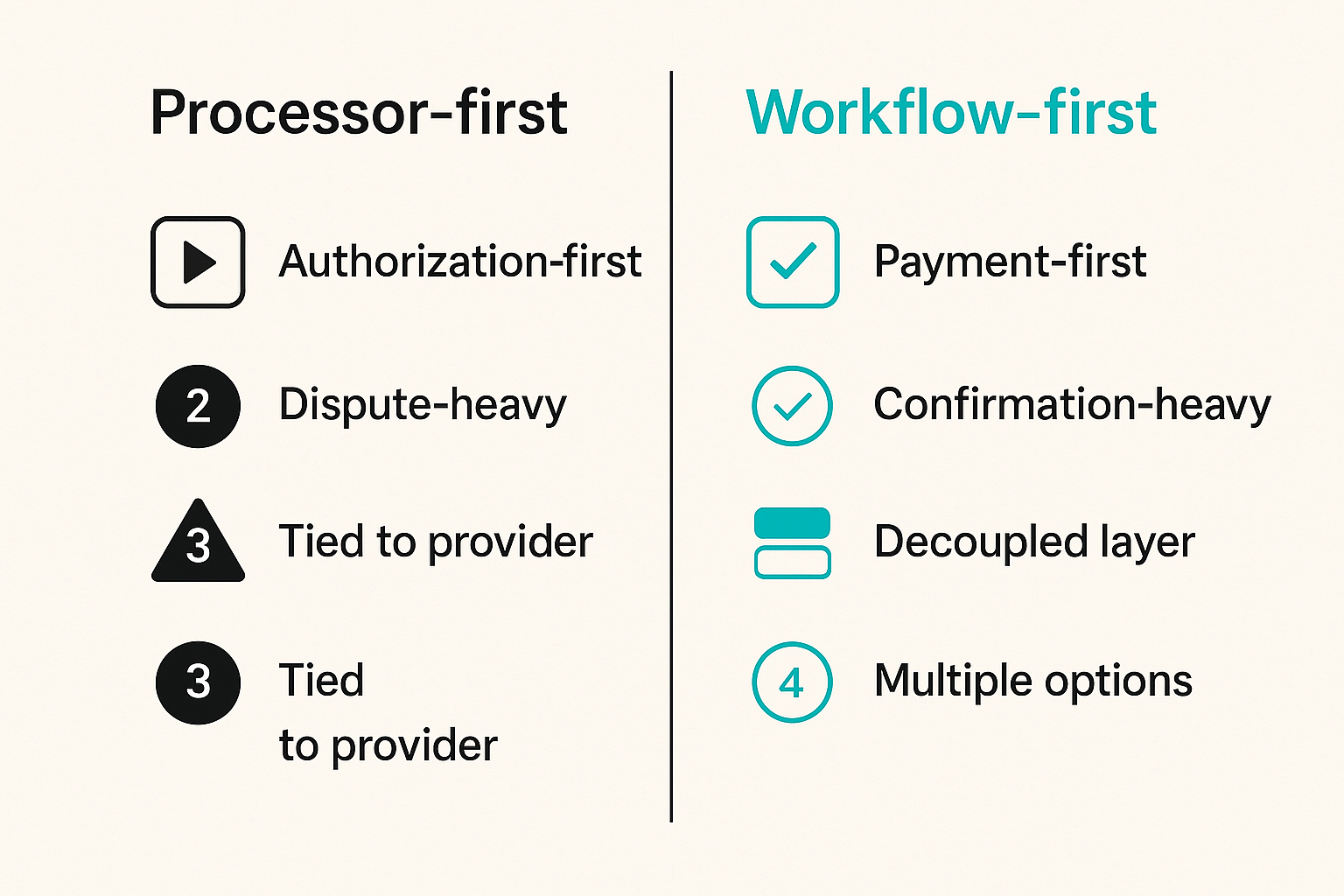
Peptide merchants often arrive at crypto payments after conventional options become brittle. A card processor requests more documentation, reserves increase, payout timing gets worse, or the account is terminated. The obvious reaction is to add a crypto checkout option as fast as possible.
The mistake teams make is treating crypto as a replacement processor instead of a different settlement model. Cards are authorization-first and dispute-heavy. Crypto is payment-first and confirmation-heavy. That difference changes how orders, fulfillment, refunds, and support need to work.
The processor-risk issue is only the symptom
Processor instability is painful, but it is not the whole problem. A peptide merchant needs continuity when one rail fails. That means the payment layer should not be welded to one provider, one wallet, one chain, or one manual reconciliation process.
A useful way to think about it is resilience by workflow design. If the card account fails, can customers still pay? If a blockchain network is congested, can checkout quote another option? If finance needs proof of payment, can the system show invoice, address, transaction hash, confirmation count, and order status in one place?
For a deeper merchant-specific baseline, the existing peptide payments infrastructure guide covers why these businesses need payment continuity rather than another fragile checkout patch.
The system has to carry commercial context
A payment address alone is not enough. Your system needs to know which order a payment belongs to, which customer initiated it, what quote was shown, when the quote expires, what asset was selected, what chain was used, and whether the amount was exact.
That commercial context is what lets operations answer practical questions:
- Can this order be released to fulfillment?
- Is this transaction underpaid, overpaid, late, or duplicated?
- Did network fees reduce the received amount?
- Is the customer asking for a refund before or after settlement?
- Does support have enough evidence to resolve the ticket?
Practical rule: In peptide payment processing, the transaction hash is evidence. It is not the workflow. The workflow is the state machine that connects the hash to an order, customer, policy, and settlement decision.
Map the payment states before you pick rails
Before debating Bitcoin versus USDT, define the states your business will support. Payment rails are implementation details. Order state is the operational contract between checkout, fulfillment, support, and finance.
A minimal state model for peptide orders
For most peptide merchants, a workable payment state model looks like this:
| State | Meaning | Operational action |
|---|---|---|
| created | Order exists, no payment quote yet | Show payment options |
| quoted | Amount, asset, address, and expiry generated | Wait for customer payment |
| detected | Incoming transaction seen but not final | Do not ship yet |
| confirming | Transaction has confirmations but not enough | Monitor chain |
| paid | Payment meets amount and confirmation policy | Release order workflow |
| underpaid | Received amount is below tolerance | Ask for top-up or review |
| overpaid | Received amount exceeds invoice | Queue refund policy |
| expired | Quote expired before valid payment | Requote or cancel |
| refunded | Refund completed or recorded | Close exception |
| failed | Payment cannot be matched or accepted | Escalate support |
This is not academic modeling. It prevents staff from inventing rules during busy days. It also gives developers a stable API contract.
Why pending and underpaid states matter
What breaks in practice is the assumption that payment is binary. Crypto payments are often not simply paid or unpaid. A transaction may be detected in the mempool, confirmed once, confirmed enough to accept, sent on the wrong network, or sent with a shortfall caused by exchange withdrawal fees.
If your system has no pending state, support will ask engineering to inspect wallets manually. If your system has no underpaid state, finance will either ship orders that should be held or hold orders that should be released under tolerance.
For teams designing deeper state handling, the prior guide on peptide transaction state management is directly adjacent because it focuses on what happens between checkout intent and settled order.
Practical rule: Never let fulfillment read directly from a blockchain explorer. Fulfillment should read from your payment state, and your payment state should be derived from validated chain events.
Choose rails around settlement, not trend
Rail selection is usually argued as a branding question: which coins should we accept? That is the wrong starting point. The practical question is which settlement behavior your customers can use and your business can reconcile.
Bitcoin, stablecoins, and Lightning have different jobs
Different rails serve different payment jobs:
| Rail | Good fit | Watchouts |
|---|---|---|
| Bitcoin on-chain | Higher-value payments, broad wallet support, durable settlement | Confirmation time, fee volatility, exchange withdrawal delays |
| Stablecoins | USD-denominated pricing, easier accounting, lower customer price confusion | Chain selection errors, token contract differences, compliance expectations |
| Lightning | Fast smaller payments, low fees, simple customer experience when wallets support it | Liquidity, invoice expiry, routing failures, operational maturity |
| Altcoin checkout | Customer preference in niche communities | Liquidity, support complexity, volatility, poor accounting hygiene |
The mistake teams make is accepting too many assets too early. Every additional asset adds support scripts, reconciliation rules, refund paths, monitoring, and accounting questions.
Custody boundaries change your risk profile
Custody is not just a legal word. It changes how keys, refunds, settlements, and internal controls work. A custodial processor may simplify operations but introduces dependency and account risk. A non-custodial gateway keeps merchant control closer to the business but requires clear operational discipline around wallets and policy.
A useful custody decision table:
| Model | Control | Operational burden | Best for |
|---|---|---|---|
| Fully custodial processor | Lower merchant control | Lower wallet operations | Teams optimizing for simplicity |
| Non-custodial gateway | Higher merchant control | Moderate wallet operations | Merchants reducing processor dependency |
| Direct self-built wallets | Maximum control | Highest engineering and support load | Teams with strong blockchain engineering |
For peptide payment processing, the middle path is often the most realistic: use gateway infrastructure for quotes, webhooks, and order mapping while retaining a non-custodial settlement posture.
The production workflow for peptide payment processing
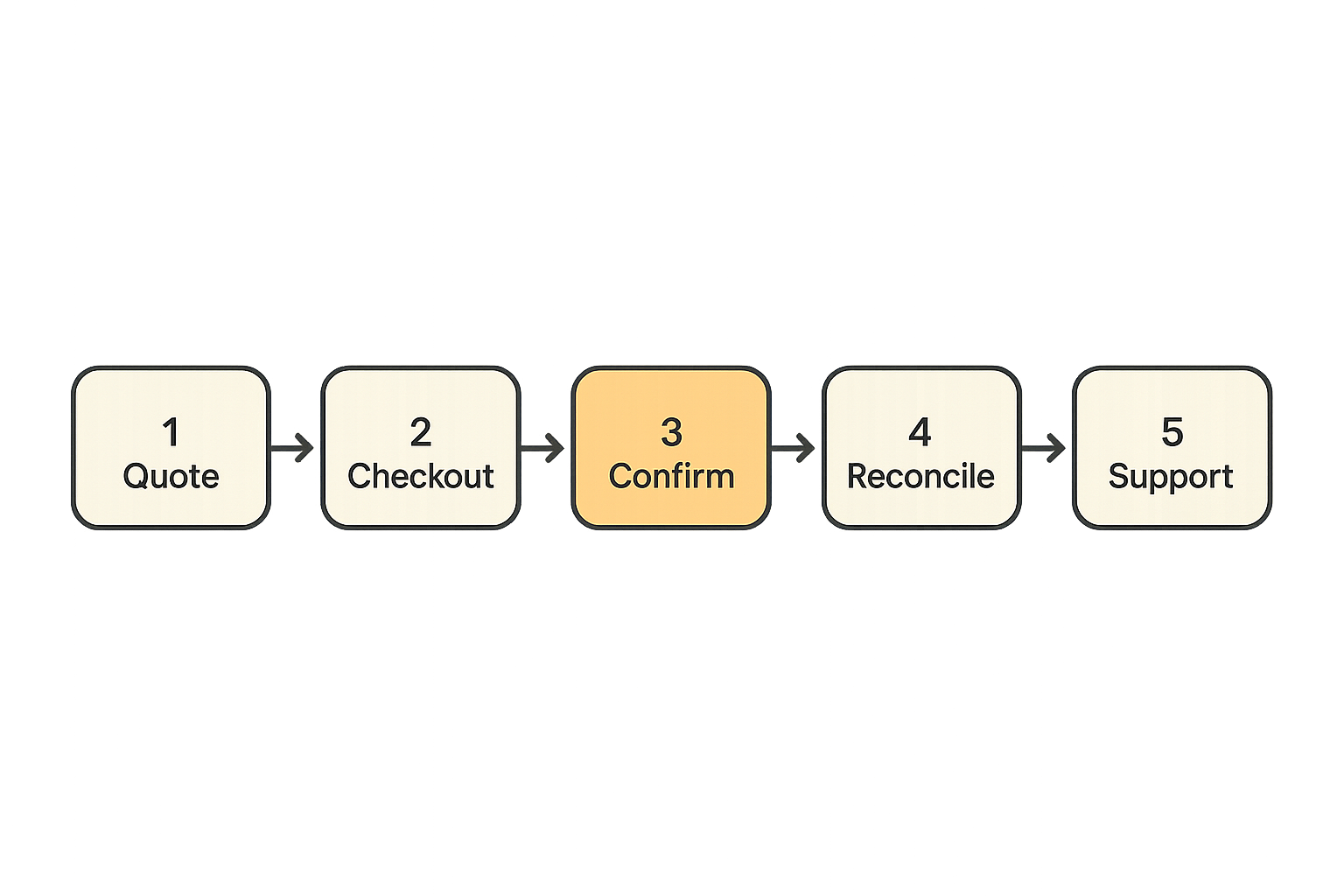
A crypto checkout page is only the visible part. The real system is quote generation, address assignment, chain monitoring, event validation, order update, reconciliation, and exception handling.
Step-by-step checkout sequence
A production sequence should be explicit:
- Customer creates an order and selects crypto payment.
- Backend creates a payment intent with order ID, customer ID, asset, chain, amount, and expiry.
- Gateway returns a payment address or invoice plus exact amount.
- Checkout displays amount, network, expiry, and instructions.
- Chain monitor detects incoming payment and emits a detected event.
- Confirmation policy moves the payment through confirming to paid.
- Order service releases fulfillment only after paid state.
- Reconciliation service records received amount, fees, transaction hash, and wallet destination.
- Exception queue captures underpaid, overpaid, expired, duplicated, or wrong-network cases.
- Support dashboard exposes the payment timeline without requiring explorer guesswork.
This sequence sounds basic. In production, missing any one of these steps creates manual work.
Webhooks, retries, and idempotency
Webhooks are where many crypto payment integrations become unreliable. Your webhook handler must assume duplicate events, delayed events, out-of-order events, and temporary API failures.
A simple event contract can look like this:
event_id: evt_8f31
payment_id: pay_1042
order_id: ord_7781
status: confirming
asset: USDC
chain: ethereum
expected_amount: 250.00
received_amount: 250.00
tx_hash: 0xabc123...
confirmations: 5
occurred_at: 2026-05-29T14:03:22Z
Implementation rules:
- Store every event by event ID before processing side effects.
- Make status transitions idempotent.
- Reject impossible transitions, such as paid back to detected, unless handled as corrections.
- Retry downstream updates with backoff.
- Keep the raw payload for audit and debugging.
Practical rule: A webhook should update a ledger-like payment record. It should not directly ship an order, send a refund, and email the customer in one untracked function.
Reconciliation is where peptide merchants lose money
Checkout gets attention because customers see it. Reconciliation gets neglected because only the operator sees it. That is why it is usually where margin leaks, support backlog grows, and finance loses confidence in the crypto rail.
Match orders, deposits, fees, and refunds
Reconciliation for peptide merchants needs to connect four records:
- The order total shown to the customer.
- The payment intent and quoted crypto amount.
- The blockchain transaction or Lightning settlement.
- The accounting entry for revenue, fee, refund, or adjustment.
If those records do not share stable identifiers, the team will fall back to screenshots and explorer links. That does not scale. It also fails during disputes with customers who claim they paid, paid twice, or paid from an exchange that batched withdrawals.
Build an exception queue, not a spreadsheet
The practical answer is an exception queue. Not a shared spreadsheet, not a Slack thread, not a folder of screenshots.
Exception types should include:
- Underpaid amount outside tolerance.
- Overpaid amount requiring refund review.
- Payment received after quote expiry.
- Wrong asset or wrong network.
- Duplicate payment for same order.
- Payment detected with insufficient confirmations for too long.
- Refund requested after fulfillment lock.
Each exception should have owner, status, customer-facing note, internal note, and resolution outcome. This is how payment operations becomes manageable.
Related reading from our network: peptide founders solving go-to-market and trust problems face similar operational constraints in peptide startup growth, especially when payment reliability becomes part of customer confidence.
Compliance, trust, and support are part of the payment stack
Peptide merchants cannot treat payments as isolated plumbing. The product category already forces more scrutiny than ordinary e-commerce. Your payment workflow needs to support policy, customer clarity, and evidence.
Product policy belongs in the workflow
Payment processing should not approve orders that the business would not fulfill. That sounds obvious, but many teams bolt crypto checkout onto a storefront without connecting it to catalog rules, jurisdiction rules, or internal review.
You may need gates for:
- Research-use-only product acknowledgments.
- Restricted jurisdictions.
- Manual review for high-value orders.
- Customer verification before fulfillment.
- Shipping constraints.
- Refund eligibility windows.
These gates should happen before irreversible payment where possible. If you collect payment first and reject later, support and refund work increase.
Related reading from our network: teams in peptide security operations deal with similar ownership problems around assets, alerts, and response; the SOC framing in peptide security operations architecture maps well to payment event ownership.
Customer education reduces failed transactions
Customers who are new to crypto make predictable mistakes. They send from an exchange that delays withdrawals. They choose the wrong network. They copy only part of an address. They send after expiry. They assume a transaction hash means the merchant has usable funds.
The checkout page should be boring and explicit:
- Show the exact asset and network.
- Show the exact amount and quote expiry.
- Warn that wrong-network payments may not be recoverable.
- Explain confirmation timing.
- Provide a support reference tied to the order.
- Avoid forcing customers to interpret blockchain jargon.
Trust is not created by adding twenty coin logos. Trust is created when customers know what to do and support knows what happened.
What breaks when teams implement it badly
Bad peptide payment processing usually fails through ambiguity. The chain may have settled, but the business does not know what to do with that settlement. Or the business knows what it wants, but the software cannot express it.
Failure modes in checkout and confirmation
Common checkout failures include:
| Failure | Cause | Result |
|---|---|---|
| Reused addresses | No unique address or invoice mapping | Payments cannot be matched confidently |
| No quote expiry | Crypto price moves after checkout | Margin and customer disputes |
| Wrong network selection | UI hides chain differences | Lost or delayed funds |
| No confirmation policy | Any detected tx marks order paid | Fulfillment risk |
| No idempotency | Duplicate webhooks create duplicate actions | Double emails, wrong order states |
What breaks in practice is not one dramatic outage. It is dozens of small ambiguities that require human judgment.
Failure modes after settlement
After settlement, the failures become more expensive:
- Finance cannot match wallet deposits to orders.
- Support cannot see why an order is held.
- Refunds are sent without linking to the original payment.
- Operations ships an order after an underpayment.
- A late payment arrives for a canceled order.
- A customer sends a second payment because the first one looked stuck.
The fix is not more Slack coordination. The fix is a payment record that becomes the source of truth.
Related reading from our network: even local coordination systems hit the same problem of ambiguous asks, offers, and ownership; peptide asks and offers is a useful adjacent example of turning informal activity into trackable workflow.
What works in production
The best crypto payment systems for high-risk merchants are not flashy. They are explicit, observable, and hard to misinterpret. They reduce the number of decisions that staff must make manually.
Keep the UI boring and the ledger precise
A good checkout UI should do three things:
- Tell the customer exactly how to pay.
- Tell them what happens next.
- Prevent avoidable mistakes.
The backend ledger should do more:
- Store quoted fiat amount and crypto amount.
- Store asset, chain, address, expiry, and tolerance.
- Store received transactions and confirmation history.
- Store fees and settlement destination.
- Store status transitions with timestamps.
- Store operator actions and notes.
This split matters. UI should simplify. Ledger should preserve detail.
Instrument the operational metrics that matter
Do not measure crypto checkout only by total volume. Measure workflow health:
| Metric | Why it matters |
|---|---|
| Quote-to-payment conversion | Shows whether customers can complete checkout |
| Payment detection time | Shows monitoring and network latency |
| Confirmation-to-release time | Shows operational delay after settlement |
| Exception rate | Shows how often humans intervene |
| Underpayment rate | Shows fee and UX problems |
| Support tickets per paid order | Shows customer confusion |
| Refund cycle time | Shows back-office readiness |
That changes the conversation with founders and operators. Instead of asking whether crypto is working, you can ask where the payment workflow is leaking.
Implementation checklist for developers and founders
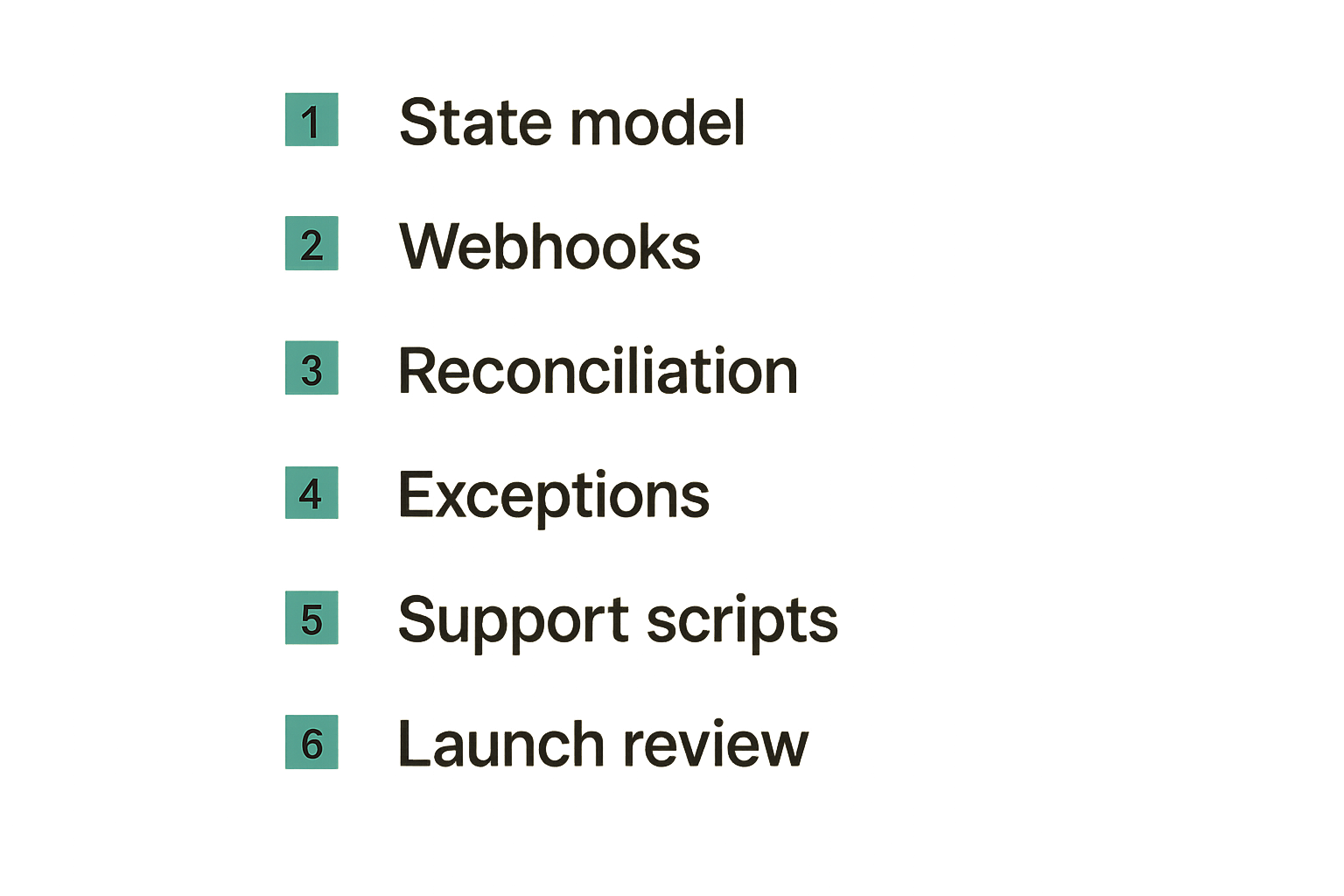
This is the part to slow down. A rushed implementation may accept funds, but accepting funds is not the same as operating a payment system.
Data model and API contract
Start with a clear data model. At minimum, define these objects:
- Customer.
- Order.
- Payment intent.
- Quote.
- Address or invoice.
- Chain transaction.
- Payment event.
- Ledger entry.
- Exception case.
- Refund record.
Then define the API contract between commerce and payments:
create_payment_intent:
  input:
    order_id: required
    amount_fiat: required
    currency: USD
    allowed_assets: BTC, USDC
    customer_reference: optional
  output:
    payment_id: required
    status: quoted
    expires_at: required
    payment_instructions: required
Your commerce system should not need to understand every blockchain edge case. It should create intents, receive status, and act only on accepted states.
Developers integrating a gateway should start with the CoinPayPortal docs and validate the event model in staging before connecting fulfillment or customer notifications.
Launch sequence for the first 30 days
A sane launch sequence looks like this:
- Launch crypto payment for a limited product set or customer segment.
- Accept one or two assets maximum.
- Run daily reconciliation manually against system records.
- Track every exception in a queue with owner and resolution.
- Review support transcripts for recurring confusion.
- Tighten checkout copy and network warnings.
- Add automation only after the manual workflow is understood.
- Expand assets or chains only when exception rates are stable.
Practical rule: Do not automate a payment exception until you can describe the manual resolution clearly. Automation hides unclear policy; it does not fix it.
Where coinpayportal.com fits
Peptide payment processing is a good example of why merchant crypto infrastructure needs to be more than a wallet address generator. Developers need APIs, webhooks, state transitions, and reconciliation hooks. Merchants need control, clarity, and fewer processor dependencies.
When a non-custodial gateway is the right fit
A non-custodial gateway is a strong fit when the merchant wants crypto payment acceptance without handing the entire settlement relationship to a third-party custodian. It is especially useful when the business needs:
- Checkout infrastructure that maps payments to orders.
- Real-time payment status updates.
- Webhooks for commerce and fulfillment systems.
- Clear custody boundaries.
- Support-friendly payment records.
- Merchant-side control over settlement destinations.
It is not magic. You still need policy, operations, and reconciliation discipline. But it gives developers and founders a better starting point than building every chain monitor, payment intent, and event handler from scratch.
The mistake teams make is waiting until a processor failure to design the workflow. Build the crypto payment path before it becomes an emergency. Then peptide payment processing becomes an operational capability, not a panic project.
Try coinpayportal.com
coinpayportal.com is for developers and merchants building crypto payment infrastructure. If you are designing peptide payment processing with real checkout state, webhooks, and non-custodial settlement, Try coinpayportal.com.
Try CoinPay
Crypto payments, escrow, and wallets — multi-chain, Lightning-ready, and fast to integrate.
Get started →