Skye Peptides Payment Infrastructure: Crypto Checkout Architecture for High-Risk Peptide Merchants

If you run, integrate, or benchmark a skye peptides-style storefront, the payment problem usually shows up at the worst moment: a processor review, a frozen balance, a missing settlement, or a support ticket from a customer who paid but never got an order update.
Teams think the problem is finding a checkout button that will accept the category. The real problem is building a payment workflow that can keep operating when card rails, bank policies, and high-risk merchant reviews are unstable.
That changes the conversation. Skye peptides is not only a search term or a product catalog issue. For developers and merchants, it is an architecture problem: invoice state, wallet routing, blockchain confirmations, webhooks, reconciliation, refunds, escrow, and support evidence.
The practical question is not whether crypto can replace a processor overnight. It is whether your payment system has enough operational structure to survive production.
Table of contents
- Why skye peptides is a payment architecture problem
- The real checkout boundary for skye peptides orders
- Processor risk and account continuity
- Payment flow that survives production
- Reconciliation for peptide merchants
- Support, refunds, and disputes
- Compliance and product catalog controls
- What works vs what fails for skye peptides merchants
- Implementation checklist for developers
- Product fit: using coinpayportal.com for skye peptides-style merchants
Why skye peptides is a payment architecture problem
The mistake teams make is treating skye peptides payment processing as a vendor search. They ask which gateway will approve them, which processor is lenient, or which checkout widget can be embedded quickly. Those questions matter, but they are too narrow.
If the business sits in a sensitive or high-risk category, the payment layer needs to be designed like an operational system. It has to answer basic production questions: Did the customer pay? Was the amount correct? Which wallet received funds? Can support prove the timeline? Can finance reconcile the order? What happens if a webhook is delayed, duplicated, or missed?
A useful way to think about it is this: checkout is the user interface for a ledger workflow.
The visible checkout is not the system
The checkout page is where the customer acts. The system is everything that happens after that action. For skye peptides-style merchants, that distinction matters because failed payment infrastructure often looks fine from the outside until money starts moving.
A clean payment page can still hide weak state handling. The cart may say paid while the chain has zero confirmations. The order may be marked complete before the amount is verified. A support agent may have no transaction hash, wallet address, or invoice history to inspect.
Practical rule: never let the storefront be the source of truth for crypto payment status. The invoice and the verified payment event should drive fulfillment.
If you need a deeper category-specific walkthrough, the prior guide on peptide payments and crypto infrastructure covers the broader merchant reality around processors, risk, and payment continuity.
Why high-risk categorization changes the design
Peptide merchants often operate in a category where processors apply extra review, reserve requirements, or sudden termination. That creates an engineering requirement: the payment stack must be portable and observable.
Portable means you can change wallet routing, supported assets, and settlement rules without rebuilding the store. Observable means every order has a payment trail that support, finance, and operations can inspect.
What breaks in practice is not always the chain transaction. More often, it is the missing bridge between customer intent and merchant operations.
The operator goal
The operator goal is not to make crypto feel magical. It is to make it boring.
A boring skye peptides checkout does three things well:
- Creates a unique payable invoice for each order.
- Watches the chain and updates status based on verified events.
- Gives humans enough context to resolve exceptions without guessing.
That is the architecture standard. Anything less becomes support debt.
The real checkout boundary for skye peptides orders
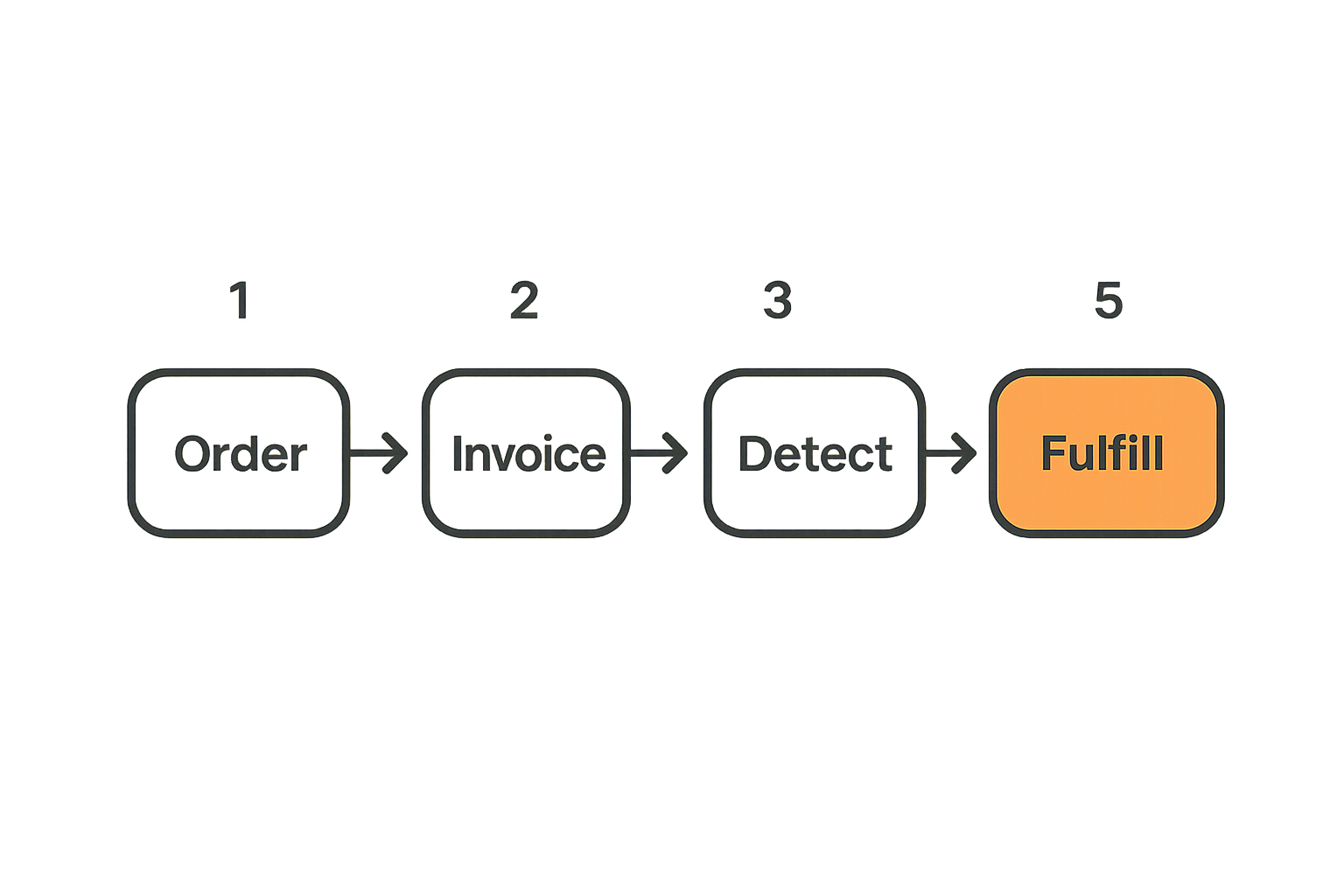
A common implementation mistake is letting the cart, not the invoice, define the payment boundary. In card payments, the authorization and capture flow is abstracted by the processor. In crypto, you have to model more of the state yourself or use a gateway that models it for you.
For skye peptides orders, the checkout boundary starts when an invoice is created and ends when the payment is confirmed, reconciled, and eligible for fulfillment.
Invoice state, not cart state
The cart contains product selections, shipping details, taxes, discounts, and customer intent. The invoice contains the payment obligation.
You want a structure like this:
cart_id: the shopping session.order_id: the merchant order record.invoice_id: the payment request.asset: BTC, ETH, USDT, USDC, or another supported currency.expected_amount: amount required in the selected asset.destination_address: wallet or derived address.expires_at: deadline for the quoted amount.status: pending, detected, confirmed, underpaid, overpaid, expired, refunded.
The invoice should be immutable enough to audit. If the customer changes shipping or product quantity, create or update the order before issuing a fresh invoice. Do not silently mutate a live payment request.
Wallet assignment and expiration
For production crypto checkout, address management is not a detail. You need deterministic rules for where funds go and how long a quote remains valid.
Expiration solves two problems. First, it limits price exposure when the invoice is denominated in fiat but paid in crypto. Second, it gives support a clean boundary when a customer sends funds too late.
A practical invoice expiration policy should define:
- Quote duration.
- Accepted assets and networks.
- Minimum confirmation count.
- Late payment handling.
- Refund or manual review process.
Practical rule: every crypto invoice needs an expiration timestamp and a documented late-payment path. Without both, support becomes the policy engine.
Idempotency across retries
Customers refresh pages. Browsers retry requests. Mobile wallets behave inconsistently. Webhooks can be delivered more than once. Your API must assume duplicate events.
Use idempotency keys when creating invoices and when processing callbacks. A retry should return the existing invoice, not create a second payable address for the same order.
A simple rule works well:
- One active invoice per unpaid order.
- Multiple chain observations may attach to that invoice.
- Only one transition may mark the order as fulfillable.
Related reading from our network: teams building decentralized infrastructure face a similar boundary problem between user intent, routing, and settlement; this IaaS in cloud computing architecture guide is a useful adjacent comparison.
Processor risk and account continuity
Skye peptides merchants usually do not fail because they forgot to add a payment button. They fail because their payment continuity depends on one approval decision from one institution.
That is fragile. A merchant account can be reviewed. A payout can be delayed. A processor can change risk appetite. A platform can decide the category is not worth supporting. If every order, subscription, customer record, and reconciliation process depends on that single rail, the business has no operating margin.
What banks and cards dislike
Banks and card networks tend to care about chargebacks, product category risk, regulatory exposure, deceptive claims, fulfillment evidence, refund behavior, and consumer complaint history. Peptide merchants may trigger extra review even when they are trying to operate carefully.
The practical response is not to hide the category. It is to build infrastructure that can tolerate scrutiny.
That means you should maintain:
- Clear product metadata.
- Payment event logs.
- Refund records.
- Shipping and fulfillment evidence.
- Customer support timelines.
- Internal review notes for exceptions.
The prior post on peptide merchant account continuity goes deeper on why replacing one lenient processor with another does not solve the underlying dependency problem.
What crypto does and does not solve
Crypto can reduce dependence on card acceptance and processor underwriting. It can make settlement faster and give merchants direct visibility into incoming funds. It can also support international customers who prefer digital assets.
But crypto does not remove operational obligations. It does not write your refund policy. It does not verify product compliance. It does not reconcile your orders automatically unless you build or buy that layer.
The mistake teams make is assuming that direct payment equals simple operations. In production, direct payment shifts some responsibility from the processor to your system.
Custody boundaries matter
Custody is the line between who controls funds and who only coordinates payment state.
A custodial model may simplify some operations but introduces trust, regulatory, and counterparty questions. A non-custodial model can keep merchants in control of funds while still using software to create invoices, monitor payments, and update order state.
For peptide merchants, the custody boundary should be explicit. Your team should know who holds keys, who can initiate refunds, who can view balances, and what happens if the gateway is unavailable.
Practical rule: decide custody before you design checkout. Custody determines security controls, refund workflows, finance access, and incident response.
Payment flow that survives production
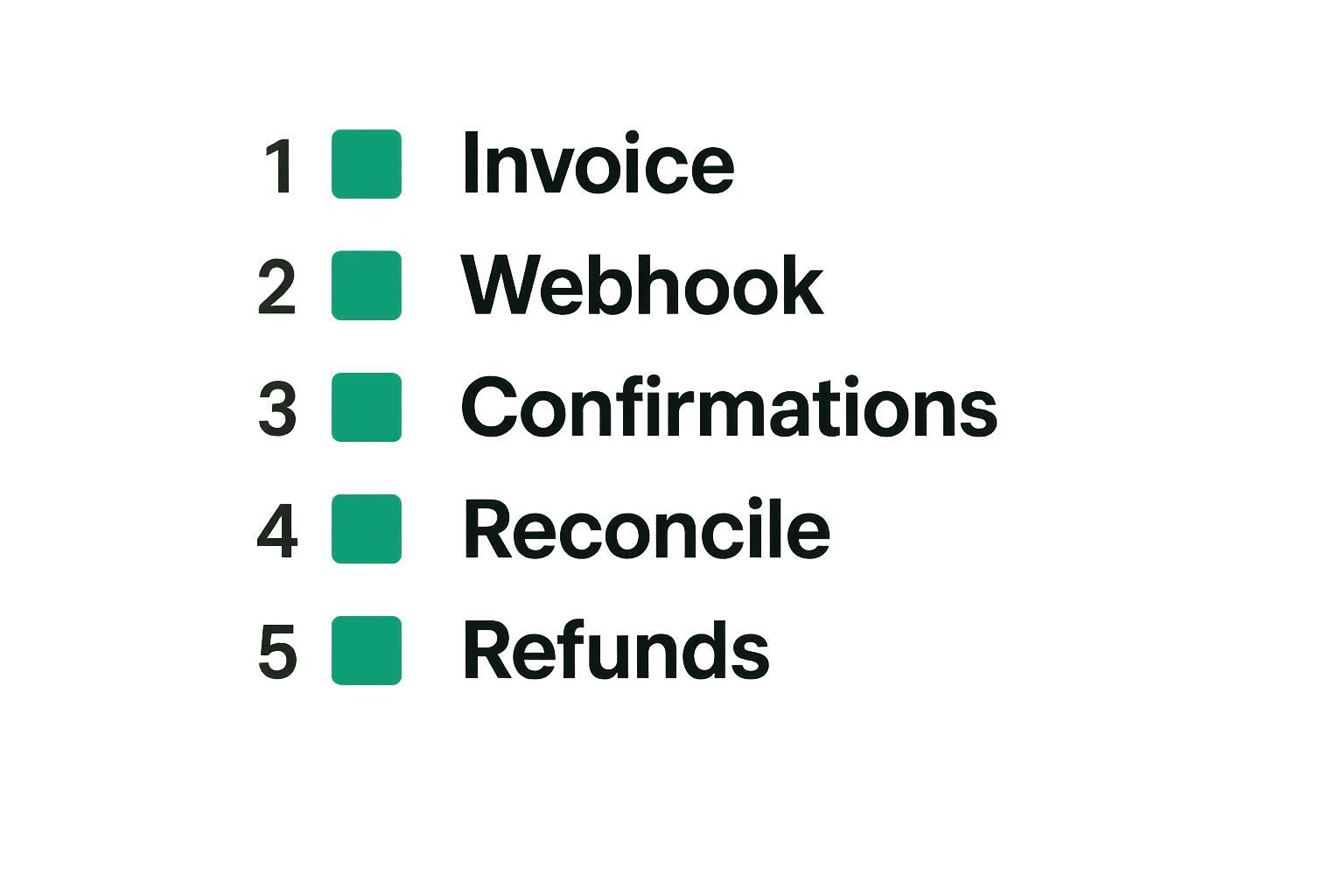
The payment flow should be boring, repeatable, and resilient to partial failure. If it only works when every system responds instantly, it is not production-ready.
The practical question is: what happens when the customer pays, the chain confirms, but your storefront never receives the first webhook?
Step-by-step implementation
A solid skye peptides crypto checkout can be implemented as a sequence:
- Customer submits checkout with cart, shipping, and contact details.
- Server creates an order in
awaiting_paymentstate. - Server requests a crypto invoice with order ID, fiat amount, asset options, and expiration.
- Customer receives a payment address or payment URI.
- Payment watcher detects an incoming transaction.
- System marks invoice as
detectedbut not yet fulfillable. - Required confirmations are reached.
- Webhook updates invoice to
confirmed. - Order moves to
paid_pending_revieworpaid_ready_to_fulfill. - Reconciliation job verifies the order and payment record later.
Do not skip the intermediate states. They are useful for support and essential for exception handling.
Webhook validation and replay
Webhooks are not commands from the internet that you blindly trust. They are signed event notifications that your system should verify, store, and replay safely.
At minimum, a webhook handler should:
- Verify the signature.
- Check timestamp tolerance.
- Parse event type.
- Store the raw payload.
- Deduplicate by event ID.
- Fetch or verify invoice state server-side.
- Apply a legal state transition.
- Return success only after durable storage.
Related reading from our network: synonyms of standards in AI agent systems is not about payments, but the same lesson applies here: schemas, contracts, and conventions are what keep distributed systems from turning into guesswork.
Confirmation policy by asset
Not every asset should have the same confirmation rule. A small stablecoin payment on a fast network may have different operational risk than a large BTC payment. Your policy should consider value, network finality, volatility, and fulfillment reversibility.
A simple policy table might look like this:
| Payment type | Example policy | Fulfillment action |
|---|---|---|
| Low-value stablecoin | Network observed plus gateway validation | Queue for normal fulfillment |
| Medium-value stablecoin | Required confirmations met | Mark paid pending review |
| BTC or high-value order | Higher confirmation threshold | Manual review before shipment |
| Late or mismatched payment | Manual review | Hold fulfillment |
The exact thresholds depend on your business. The important part is that the policy exists before a support ticket arrives.
Reconciliation for peptide merchants
Reconciliation is where many crypto checkout projects become expensive. The customer paid. The order page updated. Then finance asks a basic question: which deposits map to which orders, fees, refunds, and settlement records?
If your system cannot answer that quickly, the checkout is incomplete.
Match orders to chain events
Every order should have a chain evidence bundle:
- Invoice ID.
- Expected amount.
- Asset and network.
- Destination address.
- Transaction hash.
- Detected amount.
- Confirmation count.
- Timestamp history.
- Final invoice status.
This lets operations answer payment questions without logging into five tools. It also reduces the chance that a manual spreadsheet becomes the real ledger.
Handle underpayments and overpayments
Underpayments happen when customers send the wrong amount, fees are misunderstood, or exchange quotes shift. Overpayments happen when customers round up, reuse old payment instructions, or send multiple transactions.
Do not treat these as rare edge cases. Build explicit states:
underpaid_pending_customerunderpaid_manual_reviewoverpaid_refund_dueoverpaid_store_creditlate_payment_review
Each state should map to a support action. For example, an underpaid order might generate a new invoice for the difference. An overpayment might require a refund address confirmation.
Exportable records for finance
Finance does not want blockchain poetry. Finance wants records.
Useful exports include:
- Orders paid by asset.
- Payment amounts in crypto and fiat reference value.
- Network fees where applicable.
- Refund transactions.
- Open exceptions.
- Settlement wallet destinations.
- Daily or monthly totals.
The output can be CSV, API, or warehouse sync. The format matters less than consistency. If finance cannot reconcile the business, the engineering team will be pulled into manual operations.
Support, refunds, and disputes
Support is where weak payment architecture becomes visible to customers. A customer does not care that the webhook provider had a delay. They care that they paid and the order still says unpaid.
Skye peptides merchants should design support tooling as part of checkout, not after launch.
Build a support timeline
A support agent should see a timeline like this:
- Order created.
- Invoice issued.
- Customer selected asset.
- Payment detected.
- Confirmations reached.
- Invoice confirmed.
- Order moved to fulfillment.
- Shipment or review status updated.
- Refund issued if applicable.
This timeline should be readable by a non-engineer. It should also link to technical evidence such as transaction hashes and webhook event IDs.
Refunds are a separate transaction
Card systems train merchants to think of refunds as reversing a payment. Crypto refunds are new transactions. That means you need a refund workflow, not just a button.
A safe refund workflow includes:
- Confirm refund eligibility under merchant policy.
- Verify the customer refund address.
- Check asset and network compatibility.
- Record who approved the refund.
- Broadcast the refund transaction.
- Store the refund hash and status.
- Notify the customer.
The dangerous shortcut is refunding to whatever address appears in the original transaction. That may be an exchange hot wallet, not the customer.
Escrow for trust-sensitive orders
Some orders benefit from a staged trust model, especially when the buyer wants assurance before release or the merchant wants cleaner evidence around delivery milestones. In those cases, crypto escrow for merchant workflows can help separate payment commitment from final release.
Escrow is not necessary for every peptide transaction. It adds workflow overhead. But for larger orders, wholesale relationships, custom fulfillment, or high-support-risk purchases, it can reduce ambiguity.
Related reading from our network: consumer media systems face different risks, but the operational lesson is familiar; this guide to information technology for cord cutters shows how routing, support, privacy, and troubleshooting become architecture problems outside payments too.
Compliance and product catalog controls
Payment infrastructure cannot fix a bad catalog policy. It can, however, enforce cleaner operational boundaries.
The practical question is not whether a gateway can process a payment for a product page. It is whether the merchant can demonstrate that payment, catalog, claims, geography, and fulfillment rules are under control.
Separate payments from claims
Your payment system should not be the place where product claims are invented, modified, or hidden. Keep product descriptions, disclaimers, and eligibility rules in the catalog and compliance layer. Send only necessary order metadata into the payment layer.
This reduces leakage of sensitive or irrelevant data and keeps the payment workflow focused on money movement.
Flag restricted geographies and items
Before invoice creation, apply catalog and shipping rules. Do not wait until after payment to discover that an order cannot be fulfilled.
Useful controls include:
- Country and region restrictions.
- Product-specific shipping eligibility.
- Quantity thresholds.
- Manual review triggers.
- Customer attestation where appropriate.
- Blocklists for unsupported jurisdictions.
These controls should run before a payable invoice is generated. If you collect funds for an order you already know you cannot fulfill, you create refund work and customer frustration.
Audit trails reduce chaos
Audit trails are not only for regulators or lawyers. They are operational tools.
An audit trail should answer:
- Who changed the order status?
- What payment event caused the change?
- Which policy triggered manual review?
- Who approved a refund?
- Was the customer notified?
When something breaks, the audit trail shortens investigation time. Without it, every exception becomes a Slack archaeology project.
What works vs what fails for skye peptides merchants
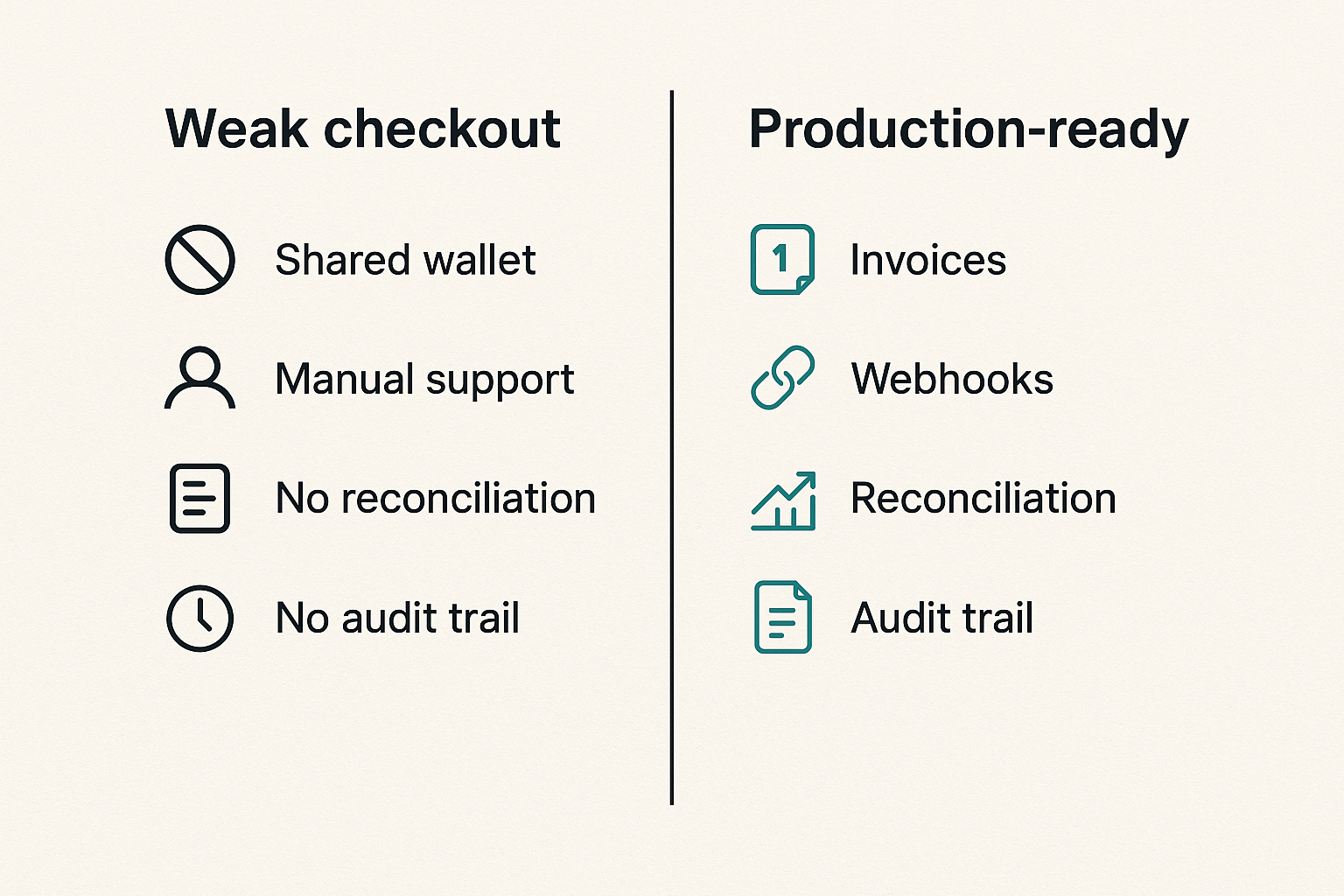
Skye peptides merchants do not need a theoretical payment architecture. They need patterns that hold up under messy customer behavior, volatile rails, and internal handoffs.
Here is the simple split.
What works
What works is boring and explicit:
- Server-side invoice creation.
- Unique payment references per order.
- Signed webhook validation.
- Idempotent state transitions.
- Confirmation policies by asset and order value.
- Clear underpayment and overpayment states.
- Refund address verification.
- Exportable reconciliation records.
- Support timelines with transaction evidence.
This is not overengineering. It is the minimum structure required when the processor is no longer abstracting every edge case.
What fails
What fails is usually optimistic architecture:
- Reusing one wallet address for all orders with no invoice mapping.
- Marking orders paid after detecting any incoming transaction.
- Trusting client-side callbacks.
- Treating webhooks as guaranteed exactly-once delivery.
- Ignoring late payments.
- Refunding to unsafe addresses.
- Keeping reconciliation in a spreadsheet only one person understands.
- Shipping before payment policy is satisfied.
The failure mode is not always theft or fraud. Often it is operational drag: support tickets, delayed fulfillment, finance cleanup, and customer distrust.
Comparison table
| Area | Weak implementation | Production-ready implementation |
|---|---|---|
| Invoice creation | Client-side amount and shared address | Server-side invoice with unique ID |
| Payment detection | Any transfer means paid | Verified amount, asset, network, confirmations |
| Webhooks | Blind trust and no replay | Signature validation, dedupe, durable storage |
| Order status | Paid or unpaid only | Pending, detected, confirmed, exception states |
| Refunds | Manual wallet send | Approved workflow with address verification |
| Reconciliation | Spreadsheet after the fact | Exportable order-payment ledger |
| Support | Ask engineering to check | Timeline with hashes and events |
Practical rule: if a support agent cannot explain the payment state without asking engineering, the payment system is not finished.
Implementation checklist for developers
The fastest way to build a brittle crypto checkout is to start with UI. Start with objects, state transitions, and failure modes.
The UI becomes easy once the workflow is clear.
API objects you need
At minimum, model these objects:
Order: customer, cart, shipping, fulfillment state.Invoice: payment request, asset options, expiration, amount.PaymentEvent: detected transactions, confirmations, raw payloads.Refund: approval, destination, transaction hash, status.AuditLog: who or what changed state.
A minimal invoice creation request might look like this:
{
  'order_id': 'ord_10492',
  'amount_fiat': '248.00',
  'currency': 'USD',
  'allowed_assets': ['BTC', 'USDC'],
  'expires_in_minutes': 20,
  'metadata': {
    'store': 'research-store',
    'risk_review': 'standard'
  }
}
Use metadata carefully. Include operational references, not unnecessary customer or product data.
Minimal webhook handler
A simple webhook handler should be boring:
function handlePaymentWebhook(request):
  signature = request.headers['x-signature']
  if not verifySignature(request.body, signature):
    return 401

  event = parse(request.body)

  if eventStore.exists(event.id):
    return 200

  beginTransaction()
    eventStore.saveRaw(event)
    invoice = invoiceStore.find(event.invoice_id)
    if not invoice:
      alert('unknown_invoice', event.id)
      commit()
      return 200

    nextState = transition(invoice.status, event.type, event.data)
    if nextState.allowed:
      invoiceStore.update(invoice.id, nextState.value)
      auditLog.write(invoice.order_id, event.id, nextState.value)
  commit()

  return 200
The important part is not the syntax. It is the sequence: verify, dedupe, store, transition, audit.
For teams integrating a gateway instead of building everything from scratch, the CoinPay developer documentation is the place to map invoices, callbacks, and merchant-side payment operations into your application.
Operational alerts
Alerting should focus on business-impacting exceptions, not every normal chain event.
Useful alerts include:
- Invoice paid after expiration.
- Underpayment above tolerance.
- Overpayment requiring refund.
- Webhook signature failure.
- Unknown invoice event.
- Confirmation delay beyond policy.
- Refund stuck pending.
- Reconciliation mismatch.
Noise kills alerting. If every payment event pages someone, alerts will be ignored. Route normal state changes to logs and dashboards. Route exceptions to the right owner.
Product fit: using coinpayportal.com for skye peptides-style merchants
The build-versus-buy question is not philosophical. It is about where your team should spend scarce engineering time.
If you are a fintech founder or blockchain engineer, you can build invoice creation, wallet routing, chain monitoring, webhooks, reconciliation, refunds, and audit logs yourself. The question is whether that is your product or just plumbing your business needs to survive.
Where CoinPay fits
CoinPayPortal is useful when the merchant wants crypto payment infrastructure without turning the entire engineering roadmap into payment operations.
The fit is strongest when you need:
- Non-custodial payment flow.
- Merchant-controlled settlement boundaries.
- Real-time payment processing.
- Checkout integration for ecommerce or custom apps.
- Fee handling and operational payment state.
- Developer-facing docs and implementation support.
The point is not to hide the complexity. The point is to put the complexity in the right layer so your storefront, support team, and finance process can operate cleanly.
When to build instead
Build in-house if payment infrastructure is a core differentiator, you have chain monitoring expertise, you can staff incident response, and you are ready to maintain reconciliation and refund tooling over time.
Do not build in-house because the first demo looks simple. A QR code and a wallet address are not a payment system. They are the beginning of one.
The mistake teams make is underestimating long-tail operations. Late payments, duplicated callbacks, unsupported networks, customer refund mistakes, and finance exports are not edge cases once volume grows.
Closing thought on skye peptides payments
Skye peptides payment infrastructure should be designed around continuity, evidence, and exception handling. Crypto can help merchants reduce dependence on fragile processor approvals, but only if the workflow is built correctly.
The closing rule is simple: treat skye peptides checkout as a ledger workflow, not a button. The more explicit your invoice states, webhook handling, reconciliation, refunds, and custody boundaries are, the less your team has to improvise when real money is moving.
Try coinpayportal.com
CoinPayPortal is for developers and merchants building crypto payment infrastructure. Try coinpayportal.com.
Try CoinPay
Crypto payments, escrow, and wallets — multi-chain, Lightning-ready, and fast to integrate.
Get started →