Peptide Payments in 2026: Crypto Checkout Architecture for High-Risk Merchants

Peptide payments are not failing because merchants forgot to add another checkout option. They fail because the payment workflow was built like a page element instead of an operating system.
A peptide merchant can have traffic, repeat buyers, clean fulfillment, and still lose the business when a card processor freezes funds, rejects transactions, or terminates the account with little operational warning. Adding crypto can help, but only if the merchant treats it as payment infrastructure, not a badge on the checkout page.
Teams think the problem is payment acceptance. The real problem is state, trust, settlement, reconciliation, and support under high-risk conditions.
That changes the conversation. The practical question is not whether peptide payments can use Bitcoin, stablecoins, or another token. The question is whether your checkout, webhooks, accounting, refund policy, custody model, and support desk can agree on what happened after a customer sends funds.
Table of contents
- Peptide payments are an operating system not a button
- Map the peptide payment lifecycle before picking tools
- Choose assets based on settlement behavior not hype
- Design invoices as state machines
- Webhooks retries and idempotency are the real payment gateway
- Custody boundaries decide operational risk
- Reconciliation is where peptide payments become real
- What breaks when peptide payments are implemented badly
- Implementation workflow for developers
- Where coinpayportal.com fits
- Closing the loop on peptide payments
Peptide payments are an operating system not a button
Why the checkout page is only the visible layer
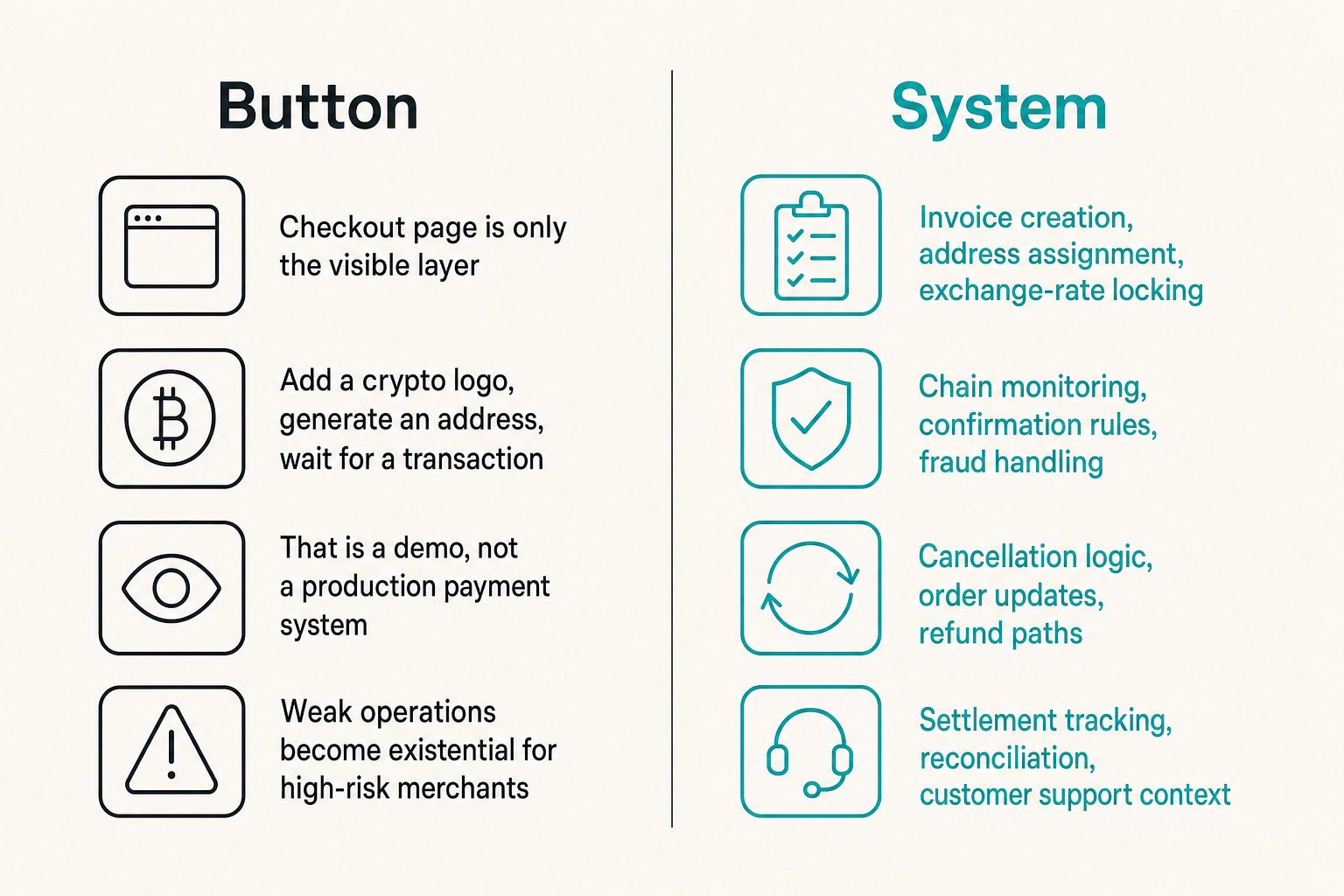
The mistake teams make is treating peptide payments like a front-end integration. Add a crypto logo, generate an address, wait for a transaction, mark the order paid. That is a demo, not a production payment system.
The checkout page is only the part the buyer sees. Behind it, you need invoice creation, address assignment, exchange-rate locking, chain monitoring, confirmation rules, fraud handling, cancellation logic, order updates, settlement tracking, refund paths, and customer support context.
For ordinary low-risk retail, weak payment operations may limp along. For peptide, research chemical, and adjacent high-risk merchants, weak operations become existential. You may not get multiple chances with processors, banks, customers, or fulfillment partners.
Why peptide merchants have less margin for payment errors
Peptide merchants often operate in a category where traditional processors are conservative. Even when the business is legitimate and compliance-minded, acquiring banks may treat the category as risky. That creates pressure to diversify payment rails.
Crypto can reduce dependency on card networks, but it does not remove operational responsibility. Customers still mistype amounts. Networks still congest. Exchange rates still move. Wallets still send from unexpected chains. Support still receives screenshots at midnight.
A useful way to think about it is this: crypto removes some card-network failure modes and introduces a different set of workflow failure modes.
The architecture lens
The right architecture starts with the business event, not the token. The business event is simple: customer placed an order, merchant needs confidence that payment is received, and the fulfillment team needs a safe release signal.
Everything else supports that event. If your system cannot answer whether an order is payable, partially paid, confirmed, expired, refunded, or manually reviewed, the asset choice will not save you.
Practical rule: Do not launch peptide payments until payment state, order state, and fulfillment state are separate but synchronized.
Related reading from our network: teams building decentralized workloads face a similar architecture problem where the visible interface hides scheduling, routing, metering, and operations; see cloud computing explained for decentralized compute builders.
Map the peptide payment lifecycle before picking tools
The minimum lifecycle states
Before choosing a gateway, wallet, or chain, map the payment lifecycle. At minimum, a peptide payment should move through these states:
- Created: the invoice exists but the buyer has not sent funds.
- Pending: funds are detected but not yet final enough for fulfillment.
- Confirmed: payment meets your confirmation and amount policy.
- Expired: the invoice window closed before valid payment.
- Underpaid: the buyer sent less than required.
- Overpaid: the buyer sent more than required.
- Refunded: funds were returned through a controlled process.
- Disputed or manual review: support must inspect before release.
This looks simple until you connect it to real orders. An ecommerce platform may only understand unpaid, paid, cancelled, and refunded. Your crypto payment layer needs more nuance than that.
Where crypto changes the workflow
Card payments usually provide authorization, capture, settlement reporting, and dispute machinery in one networked workflow. Crypto separates those concerns. A transaction may be visible before it is final. A transfer may arrive after invoice expiration. A buyer may pay from an exchange that delays withdrawal or batches transactions.
What breaks in practice is the assumption that transaction seen equals order paid. That may be acceptable for low-value digital goods. It is dangerous for physical shipment, high-ticket peptide orders, or restricted inventory.
What support needs to see
Support agents should not need a block explorer, spreadsheet, and developer Slack thread to answer basic payment questions. They need a single view of:
- Order ID and customer email.
- Invoice amount, asset, network, and expiration time.
- Detected transactions and confirmation count.
- Payment status and reason codes.
- Refund address if collected.
- Internal notes and manual decisions.
If support cannot see the lifecycle, support becomes an unofficial payment processor. That creates inconsistent decisions and avoidable escalations.
Choose assets based on settlement behavior not hype
Stablecoins versus volatile assets
For peptide payments, the asset decision is mostly a settlement decision. Volatile assets can work, but they create pricing, refund, and accounting complexity. Stablecoins often fit merchant operations better because the order total remains closer to the unit merchants think in.
That does not mean all stablecoin rails are equal. A stablecoin on one network may have low fees but more wallet confusion. Another may have better customer familiarity but higher congestion risk. The practical question is which assets your customers can actually send correctly and which networks your operations team can reconcile.
Network fees and confirmation policy
Network fees affect conversion. A customer who wants to buy a moderate order may abandon if fees feel disproportionate. Confirmation time affects fulfillment. A chain that is cheap but operationally unfamiliar can create more support tickets than it saves in fees.
Comparison should include more than transaction cost:
| Payment option | Strength | Operational risk | Best fit |
|---|---|---|---|
| Stablecoin on low-fee network | Predictable order value | Wrong-network deposits and wallet confusion | Repeat customers who follow instructions |
| Bitcoin | Broad recognition | Volatility and confirmation delay | Larger orders where buyer expects BTC flow |
| Lightning or instant rails | Fast user experience | Liquidity and tooling assumptions | Smaller orders with real-time checkout |
| Manual wallet transfer | Simple to start | Poor reconciliation and support load | Temporary fallback only |
Asset selection rules
Do not list every asset because the integration supports it. Every additional asset creates documentation, support, reconciliation, and refund paths.
Practical rule: Offer fewer assets with stronger operational clarity before offering more assets with weak support coverage.
A good initial set is usually one stable-value option, one widely understood asset if customers request it, and clear network instructions. If a network is easy for your engineering team but confusing for buyers, expect support volume.
Design invoices as state machines
Why invoice state matters
An invoice is not a static address. It is a contract between checkout, pricing, payment detection, and fulfillment. It says this order requires this amount, in this asset, on this network, before this expiration, under this confirmation policy.
Peptide merchants should avoid reusable addresses for checkout. They make reconciliation harder, expose customer behavior patterns, and force support to infer which transfer belongs to which order. Unique invoices give your system a clean matching primitive.
Suggested state model
A practical invoice record might include:
invoice_id: inv_8f31
order_id: ord_10492
asset: USDC
network: polygon
amount_due: 184.50
amount_received: 0
status: created
expires_at: 2026-08-18T19:30:00Z
confirmations_required: 20
payment_address: merchant_assigned_address
idempotency_key: order_ord_10492_checkout_v1
Your application should treat invoice updates as append-only events where possible. The current status is useful, but the event trail is what lets you debug disputes.
Handling underpayment overpayment and late payment
Underpayments are common when customers manually adjust fees, wallets subtract network costs, or buyers copy the wrong amount. Overpayments happen when buyers round up or send from systems that do not support exact decimals cleanly. Late payments happen when a buyer starts checkout, gets distracted, and sends after expiration.
Decide the policy before launch. For example:
- Underpayment below a small tolerance stays manual review.
- Overpayment above a threshold creates a refund task.
- Late payment creates manual review rather than automatic fulfillment.
- Wrong asset or wrong network is handled according to recovery feasibility.
Do not hide these rules in code comments. Put them in merchant operations docs.
Webhooks retries and idempotency are the real payment gateway
Webhook events to model
Checkout creates the invoice. Webhooks keep the rest of the business synchronized. The important events are not only paid and failed. In production, useful events include:
- invoice.created
- transaction.detected
- transaction.confirming
- invoice.confirmed
- invoice.expired
- invoice.underpaid
- invoice.overpaid
- refund.requested
- refund.completed
- manual_review.opened
Each event should carry enough context for your application to update order state without calling support or guessing from an address.
Idempotency keys and replay safety
Webhooks fail. Networks stall. Applications deploy mid-event. Providers retry. Your endpoint must accept duplicate events without double-shipping or double-refunding.
Use idempotency at two levels. First, when creating an invoice, provide a deterministic key tied to the order and checkout attempt. Second, when processing webhook events, store the event ID before applying side effects.
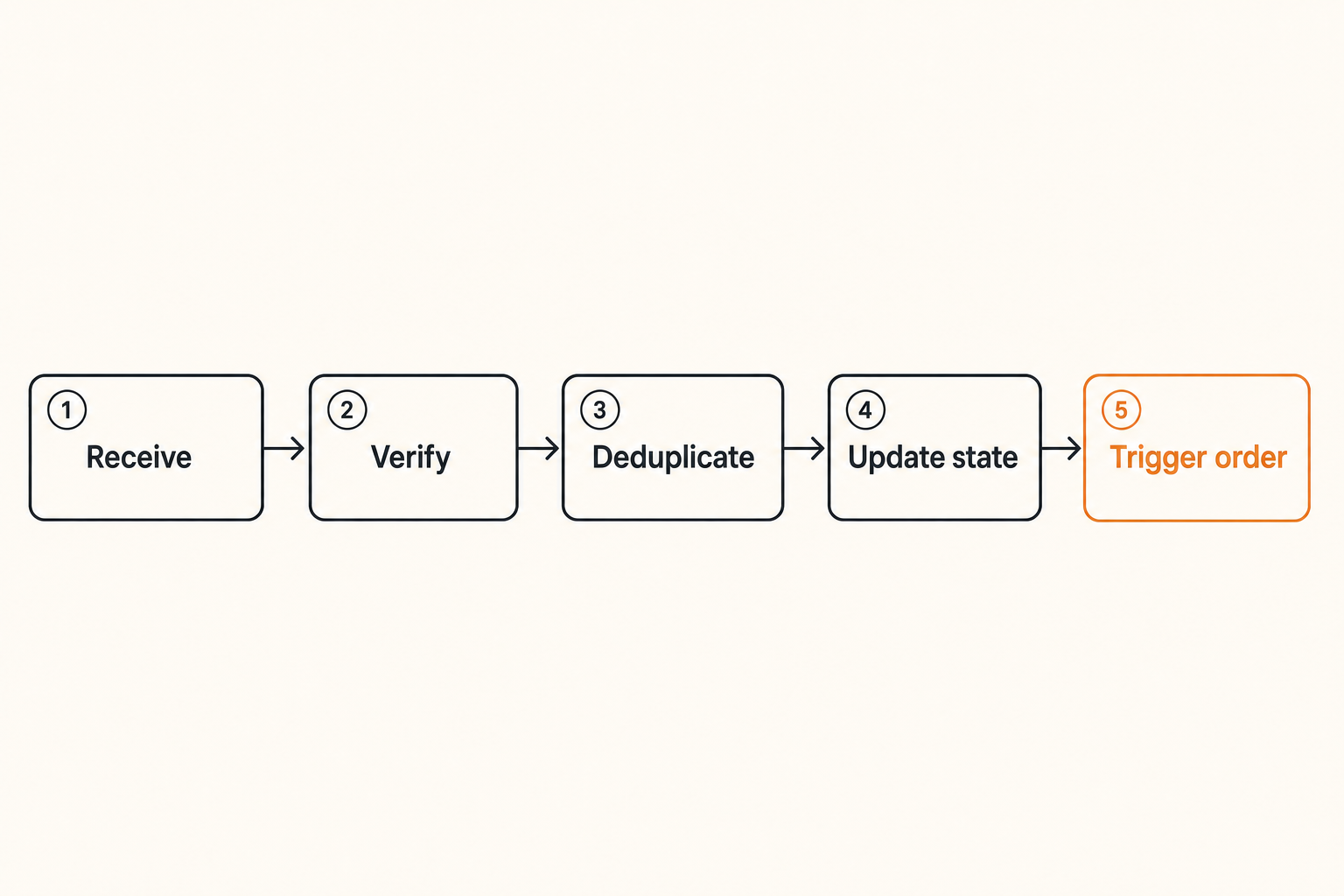
A simple processing sequence:
- Receive webhook.
- Verify signature.
- Check event ID against processed events.
- Load invoice and order.
- Apply allowed state transition.
- Write event log.
- Trigger side effect such as order paid or review opened.
- Return success only after durable write.
Practical rule: A webhook handler should be safe to run twice and boring to debug once.
Failure handling in production
What fails is not usually the happy path. It is the checkout tab closed after invoice creation, the customer sending from the wrong network, the webhook arriving during maintenance, or the ecommerce plugin timing out while the payment provider already confirmed funds.
Your retry strategy should include exponential backoff, dead-letter handling, and an admin replay option. Do not rely on the buyer refreshing the checkout page to update order state. The buyer is not part of your backend architecture.
Related reading from our network: app-platform teams face similar event, credential, and callback issues when shipping agent systems under platform rules; see Apple Developer Program architecture for AI agent standards.
Custody boundaries decide operational risk
Custodial versus non-custodial flow
Custody is where payment architecture becomes business risk. If a provider controls funds, you inherit counterparty and withdrawal risk. If you control funds directly, you inherit key management, monitoring, and refund execution risk.
Neither model is automatically correct. The right question is who can move money at each step, what happens during provider downtime, and how disputes are resolved. For peptide payments, those questions matter because processor disruption is often the reason merchants are exploring crypto in the first place.
CoinPay explains these boundaries directly on its non-custodial custody page, which is the kind of clarity merchants should demand from any crypto payment provider.
Who can move funds
Document who can move funds from each address, wallet, or settlement account. Include normal operations and failure scenarios:
- Buyer sends funds to invoice address.
- Gateway detects and reports payment.
- Merchant receives or controls settlement.
- Refund requires merchant action, gateway action, or both.
- Provider shutdown does or does not affect access to funds.
This is not just legal language. It shapes engineering decisions around address generation, wallet permissions, signing, and audit logs.
Disputes refunds and reversibility
Crypto payments are not card payments with a different logo. There is no card-network chargeback layer. That can be good for merchants dealing with abusive disputes, but it also means refund and customer-service policies need to be explicit.
Refunds should not be improvised from a shared wallet. Use refund requests, approval steps, address validation, and event logging. For peptide merchants, the refund decision may depend on order status, fulfillment status, product policy, and compliance review.
Reconciliation is where peptide payments become real
Match orders invoices and on-chain transfers
Reconciliation is the difference between accepting crypto and operating a business with crypto. Your system must match the ecommerce order, the payment invoice, the detected on-chain transfer, and the settlement record.
A practical reconciliation table includes:
| Field | Why it matters |
|---|---|
| order_id | Connects payment to customer purchase |
| invoice_id | Connects checkout attempt to payment request |
| transaction_hash | Provides on-chain evidence |
| asset and network | Prevents wrong-rail confusion |
| expected_amount | Shows what the buyer owed |
| received_amount | Shows what actually arrived |
| fiat_rate_snapshot | Supports accounting and refund decisions |
| settlement_destination | Shows where funds moved |
| status_reason | Explains manual review and exceptions |
For a deeper adjacent breakdown, CoinPay has covered peptide payment processing as crypto architecture with the same emphasis on state, settlement, and support.
Daily close process
Merchants should run a daily close process even if settlement is automatic. That process should compare orders marked paid, invoices confirmed, transactions detected, refunds initiated, and funds received in merchant-controlled wallets.
A daily close does not need to be complex at the start. It needs to be consistent. Export the records. Identify exceptions. Assign an owner. Resolve mismatches before they accumulate into a month-end archaeology project.
Accounting fields to store
Store the fiat value at invoice creation and at confirmation if your accounting process requires it. Store fees separately from received amount. Store refund transaction IDs. Store manual adjustments with user ID and timestamp.
The goal is not to make your checkout database an accounting system. The goal is to preserve enough payment evidence that accounting can do its job without reverse-engineering chain activity.
What breaks when peptide payments are implemented badly
The customer pays but the order stays unpaid
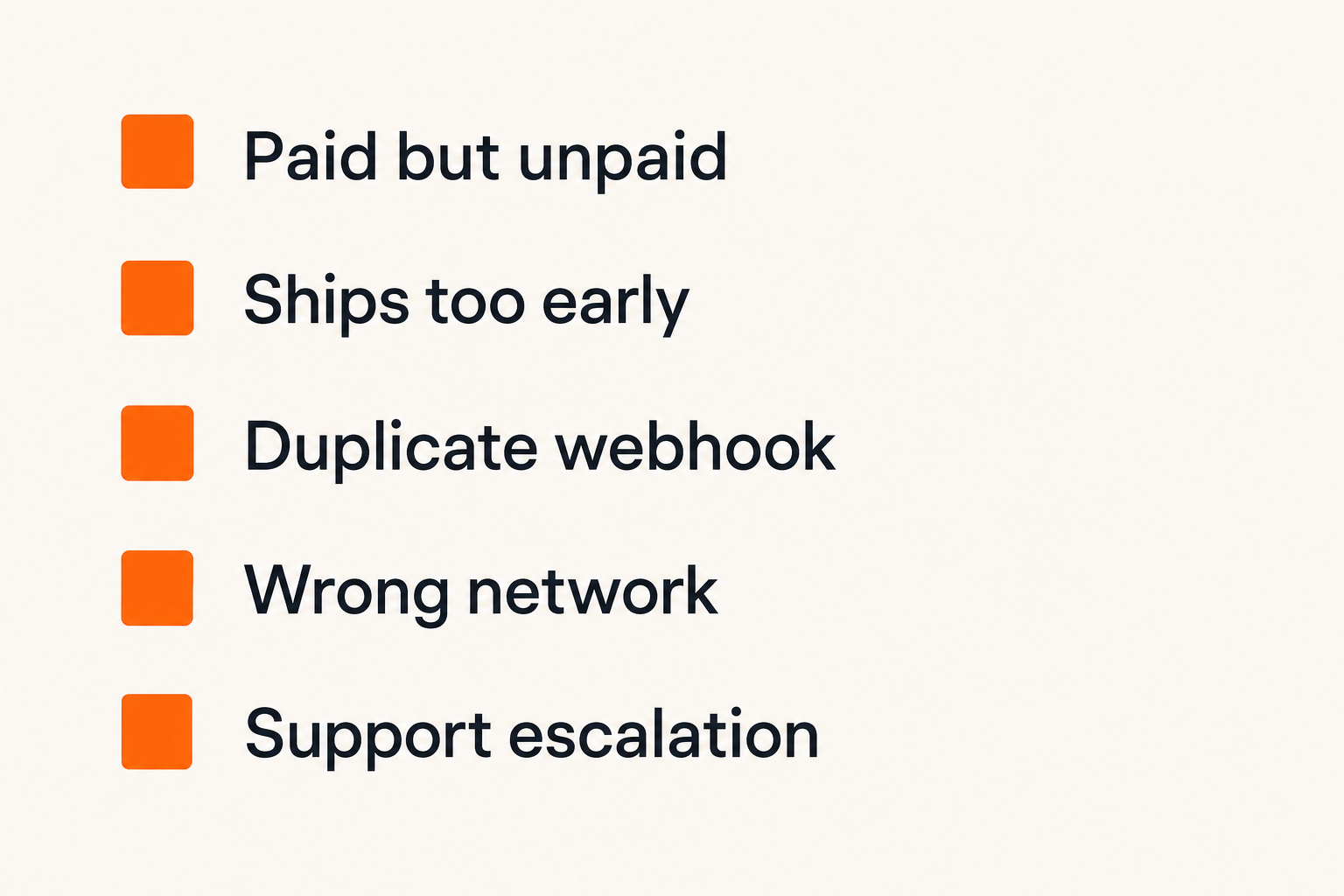
This is the classic broken implementation. The buyer sends funds. The transaction confirms. The ecommerce platform still shows unpaid because the webhook failed, the address was reused, or the status transition was not allowed.
Now the customer opens a ticket with a screenshot. Support asks engineering. Engineering checks a block explorer. Fulfillment waits. The customer loses trust. The merchant loses time.
What works is event-driven synchronization with replayable webhooks and a clear manual review queue. What fails is a checkout page that only updates while the buyer session is active.
The merchant ships before finality
The opposite failure is just as bad. The system sees a pending transaction and marks the order paid before it meets the confirmation policy. For some assets and networks, that may be acceptable for small orders. For peptide merchants shipping physical goods, it should be a deliberate risk decision, not an accidental default.
Finality policy should be configurable by asset, network, amount, and merchant risk tolerance. Higher-value orders may require more confirmations or manual review.
The support team becomes the payment processor
When payment state is unclear, support becomes the routing layer. Agents decide whether screenshots are enough, whether underpayments should pass, whether late payments count, and whether a refund is safe.
That is not fair to support, and it is not safe for the business. Support should operate inside a defined payment workflow, not invent one ticket by ticket.
Related reading from our network: even legal media workflows run into similar support and device-state problems when users cross platforms, subscriptions, and tracking boundaries; see AP Bio streaming in 2026 for an adjacent operational example.
Implementation workflow for developers
Step one define payment policy
Start with policy, not code. Decide which assets you accept, which networks are supported, how long invoices remain valid, how many confirmations are required, what tolerance applies to underpayment, and who approves refunds.
A minimal policy document should answer:
- Which products or order types can use crypto.
- Which countries or customer segments require extra review.
- Which assets and networks are supported.
- How exchange rates are locked.
- When fulfillment is released.
- How refunds are requested and approved.
This policy becomes your test plan.
Step two integrate checkout and callbacks
Build the integration around durable records. Create an invoice when the customer chooses crypto. Store the invoice before redirecting or rendering payment instructions. Subscribe to webhook events. Update order state only through validated transitions.
A good implementation sequence:
- Add crypto as a payment method in checkout.
- Create an invoice through the payment provider API.
- Store invoice ID, order ID, amount, asset, network, address, and expiry.
- Render payment instructions with exact amount and network warning.
- Receive signed webhook events from the provider.
- Update invoice state and append the event log.
- Move the order to paid only after confirmation policy is met.
- Send buyer receipt and release fulfillment.
- Reconcile invoices and settlement daily.
If you want broader context on the merchant category, CoinPay has a practical guide to accepting crypto payments for peptide and research chemical merchants that frames why processors drop these businesses and what crypto infrastructure has to handle.
Step three test operational edge cases
Do not test only the successful payment. Test the cases that will create tickets:
- Customer sends too little.
- Customer sends too much.
- Customer pays after invoice expiration.
- Customer sends on the wrong network.
- Webhook arrives twice.
- Webhook arrives before your order write completes.
- Provider retries after your endpoint times out.
- Refund address is invalid.
- Fulfillment system is down when payment confirms.
The mistake teams make is calling these edge cases. In production, they are normal cases with lower frequency.
Where coinpayportal.com fits
A payment gateway should make ownership explicit
A crypto payment gateway for peptide merchants should not ask you to trust magic. It should expose the operational primitives: invoice creation, payment detection, status updates, fee handling, custody boundaries, and merchant-controlled workflows.
For developers and merchants building crypto payment infrastructure, the value is not just accepting a token. The value is reducing the amount of custom glue code required to make checkout, settlement, and support agree.
Merchant operations need boring primitives
The best payment infrastructure is often boring. It gives you clean IDs, predictable webhooks, clear states, retry behavior, fee visibility, and a dashboard that support can use without escalating every case.
Boring is not a criticism. In high-risk payment operations, boring means the business can run without founders manually checking wallets all day.
When to build versus integrate
Build directly if payments are your core product, you have wallet engineering experience, and you are prepared to own monitoring, key management, refunds, customer education, and reconciliation. Integrate if you need reliable merchant operations faster and want to keep engineering focused on your store, fulfillment, and customer experience.
This is where coinpayportal.com fits: not as a hype layer, but as infrastructure for merchants who need crypto checkout to behave like a payment workflow.
Closing the loop on peptide payments
The standard for production readiness
Production-ready peptide payments should pass a simple test. If a customer pays, can the merchant prove what happened without asking a developer to inspect the chain manually? If the answer is no, the system is not ready.
A production system should provide invoice state, transaction evidence, confirmation policy, support context, refund workflow, and reconciliation output. It should make the normal path fast and the exception path controlled.
The final operating rule
Peptide payments are useful when they reduce processor dependency without creating operational chaos. They are risky when they move complexity from the card processor into unmanaged spreadsheets, wallets, and support tickets.
Practical rule: Treat peptide payments as infrastructure for state and settlement, not as an alternative checkout logo.
The teams that get this right do not obsess over the trendiest chain first. They define the workflow, control the states, make custody explicit, and give support a system they can operate.
Try coinpayportal.com
coinpayportal.com is for developers and merchants building crypto payment infrastructure. If you need peptide payments with practical checkout, state, custody, and settlement workflows, Try coinpayportal.com.
Try CoinPay
Crypto payments, escrow, and wallets — multi-chain, Lightning-ready, and fast to integrate.
Get started →