Peptide Payment Gateway Architecture: How to Build Crypto Checkout That Survives Real Merchant Risk

A peptide payment gateway is not just a crypto checkout page with a wallet address on it. For peptide merchants, the payment problem usually shows up as declined cards, frozen merchant accounts, processor reviews, and support tickets from buyers who paid but do not see an order update.
Teams think the problem is finding a processor willing to approve the category. The real problem is building a payment workflow that does not collapse when one provider, one chain, one wallet, or one confirmation path behaves differently than expected.
That changes the conversation. You are not only choosing a gateway. You are designing a system of invoices, payment state, wallet routing, confirmations, settlement, refunds, customer support, and auditability.
In 2026, peptide and research chemical merchants need to treat crypto payments as production infrastructure. The practical question is not whether crypto can process a payment. It can. The practical question is whether your peptide payment gateway can prove what happened, recover from edge cases, and keep the business operating when conventional processors say no.
Table of contents
- What a peptide payment gateway really has to solve
- Why peptide merchants get broken by standard checkout
- Payment gateway architecture for peptide businesses
- Checkout state for invoices, wallets, and expirations
- Webhooks, confirmations, and idempotency
- Settlement, custody, escrow, and refunds
- Compliance boundaries without pretending crypto removes risk
- What works and what fails in production
- Implementation workflow for developers
- Where coinpayportal.com fits
What a peptide payment gateway really has to solve

The gateway is not the checkout button
The mistake teams make is treating the gateway as a user interface problem. They ask whether the checkout page looks clean, whether the buyer can choose USDT or Bitcoin, and whether the merchant dashboard shows paid orders.
Those details matter, but they are not the hard part. The hard part is state.
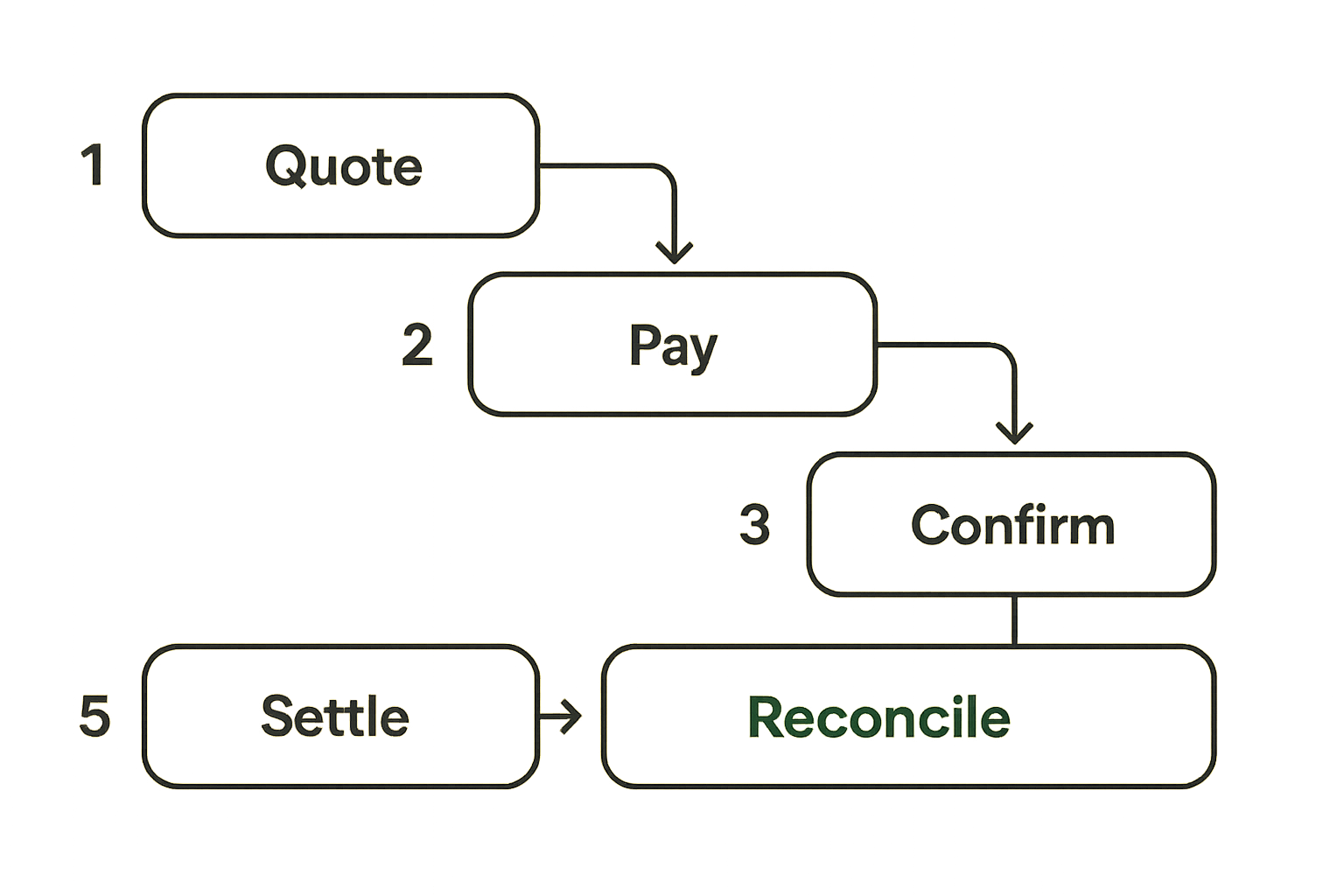
A buyer creates an order. A quote is generated. The crypto amount is locked for a limited time. The buyer sends funds from an exchange or wallet. The network sees a transaction. The gateway decides whether it matches the invoice. Confirmations arrive. The merchant order moves from pending to paid. Fulfillment begins. Later, finance reconciles order IDs to transactions and settlement wallets.
If any one of those steps is ambiguous, support inherits the mess.
Practical rule: If your team cannot explain every possible invoice state without opening the blockchain explorer manually, the gateway is not production-ready.
High-risk does not mean low-discipline
Peptide merchants often operate under pressure. Banks and processors may view the category as high risk. Ads may require careful claims discipline. Fulfillment may need tight documentation. Buyers may be technical, skeptical, or impatient.
None of that is an excuse for sloppy payments. In fact, high-risk categories need more operational discipline, not less. If you cannot use a traditional payment processor reliably, your crypto flow has to be more deterministic than a normal checkout.
That means clear payment instructions, exact invoice matching, confirmation thresholds, refund policy, audit trails, and escalation paths. It also means your gateway should not require your support team to become blockchain analysts for every delayed payment.
The architecture lens
A useful way to think about it is this: a peptide payment gateway is an order-state synchronization layer between your storefront, blockchain networks, wallets, and merchant operations.
That lens is better than the usual feature checklist. It forces you to ask harder questions:
- Who owns the invoice state?
- What happens when a buyer underpays by a small amount?
- Can the same payment update the order twice?
- Who holds funds while an order is being reviewed?
- How do refunds work if the customer paid from an exchange wallet?
- Can finance reconcile settlement without asking engineering for exports?
For a deeper category-specific overview, our prior guide on peptide payments and crypto infrastructure explains why payment resilience matters before you get into gateway implementation details.
Why peptide merchants get broken by standard checkout
Card processors optimize for reversibility
Card networks were designed around reversibility, dispute windows, chargebacks, fraud monitoring, and issuer controls. That works well for many retail categories. It is less stable for merchants that processors classify as high risk, especially where product claims, regulatory interpretation, shipping constraints, or customer disputes can trigger reviews.
The payment page may work for a while. Then volume increases, a reviewer asks for documents, reserves change, payouts slow down, or the account is terminated. The merchant does not just lose a feature. They lose revenue capture, fulfillment timing, customer trust, and sometimes working capital.
The practical question is not whether cards are useful. They are. The question is whether your business can afford to make card acceptance the only operating path.
The merchant account failure pattern
Many peptide businesses experience a similar sequence:
- Launch with a standard processor or a loosely matched merchant category.
- Process small volume without much attention.
- Increase order volume or advertising spend.
- Trigger underwriting review.
- Face document requests, reserves, rolling holds, or termination.
- Rush to find another processor under operational stress.
The mistake teams make is assuming the next processor solves the structural problem. Sometimes it buys time. Sometimes it does not. If the underlying business category remains sensitive, the same dependency remains.
We covered that failure pattern in more detail in the article on peptide merchant account crypto infrastructure, but the gateway-level takeaway is simple: do not build your checkout around a single approval decision you do not control.
Crypto changes the failure mode
Crypto payments do not magically remove business risk. They change the mechanics.
Instead of card declines and chargebacks, you deal with wallet UX, network fees, confirmations, underpayments, wrong-chain payments, refunds, volatility, and reconciliation. That is not a free lunch. It is a different operating model.
For peptide merchants, that difference can be valuable because final settlement does not depend on an acquirer deciding whether the category still fits its appetite. But the gateway has to handle the operational details cleanly. Otherwise, you replace processor fragility with support chaos.
Related reading from our network: peptide founders dealing with go-to-market trust, positioning, and operational credibility may find the launch-system perspective in Peptide Startup Growth useful because payments are only one part of buyer confidence.
Payment gateway architecture for peptide businesses
The minimum production components
A production peptide payment gateway needs more than an address generator. At minimum, expect these components:
| Component | Purpose | What breaks if missing |
|---|---|---|
| Invoice service | Creates amount, asset, expiration, and order reference | Orders cannot be matched reliably |
| Address or memo assignment | Gives the buyer a destination tied to the invoice | Payments collide or require manual lookup |
| Blockchain monitor | Watches for incoming transactions | Paid orders stay pending |
| Confirmation engine | Applies network-specific finality rules | Orders ship before payment is safe |
| Webhook dispatcher | Notifies storefront and back office | Payment state remains isolated |
| Reconciliation export | Connects orders to txids and settlements | Finance cannot close books |
| Refund workflow | Handles failed, canceled, or returned orders | Support improvises with wallets |
The UI is just the visible part. The system of record is the invoice ledger and the events that mutate it.
The trust boundary map
You need to know which system you trust for which fact. The storefront knows cart contents, shipping status, and customer account details. The gateway knows invoice amounts, payment asset, destination address, observed transaction, confirmation count, and settlement status. The blockchain knows whether a transaction exists, but it does not know your order ID or refund policy.
What breaks in practice is boundary confusion. A storefront marks an order paid because a customer uploaded a screenshot. A gateway accepts a transaction that was sent on the wrong network. Finance assumes a payout equals revenue without subtracting refunds or network costs.
Practical rule: Screenshots are not payment evidence. The invoice ledger, transaction hash, network, amount, and confirmation policy are payment evidence.
The data model that matters
You do not need a huge schema to start. You do need the right primitives:
- merchant_id
- order_id
- invoice_id
- asset and network
- quoted_fiat_amount
- quoted_crypto_amount
- exchange_rate_source
- expires_at
- destination_address or memo
- payment_status
- txid
- observed_amount
- confirmations
- settlement_wallet
- refund_status
This is the data that lets engineering debug, support answer buyers, and finance reconcile. If your gateway hides these fields behind a pretty dashboard without exportability, you will feel it later.
Checkout state for invoices, wallets, and expirations
Invoices must be state machines
A payment invoice should move through explicit states. Do not rely on a single boolean like paid.
A practical state model might look like this:
- created
- pending_payment
- detected
- underpaid
- overpaid
- confirming
- paid
- expired
- canceled
- refunded
- disputed_internal
Not every merchant needs every state on day one. But the architecture should allow nuance. Crypto payments are not always clean. Buyers send late. Exchanges batch withdrawals. Some wallets subtract fees from the sent amount. Some customers choose the wrong network because the token symbol looks the same.
The state machine protects the business from guessing.
Wallet address strategy
There are several address strategies, and each has tradeoffs:
| Strategy | Operational benefit | Operational risk |
|---|---|---|
| Unique address per invoice | Clean matching and easier support | Requires address management |
| Shared address plus memo | Efficient on some networks | Memo omissions create manual work |
| Static merchant address | Simple setup | Terrible attribution at scale |
| Hosted custody address | Easier dashboarding | Custody and withdrawal dependency |
| Non-custodial merchant wallet | Merchant keeps control | Requires careful key operations |
For peptide merchants, unique invoice attribution is usually worth the extra structure. The support cost of ambiguous payments is higher than the engineering cost of clean invoice assignment.
Pricing windows and underpayment
Crypto quotes should expire. If you quote an amount in USDT, expiration is less about volatility. If you quote BTC or another volatile asset, expiration protects margin. Either way, expiration gives the system a deterministic rule.
Underpayment needs policy, not improvisation. Decide what happens when the buyer pays 99.5 percent of the invoice. Some merchants accept small tolerances. Others require a top-up. The gateway should represent that as state, not a support note.
Example policy:
invoice_expiration_minutes: 20
underpayment_tolerance_percent: 0.5
overpayment_action: credit_or_refund
late_payment_action: manual_review
wrong_network_action: support_escalation
The exact values depend on your business. The important part is that they exist before volume arrives.
Webhooks, confirmations, and idempotency
Do not trust the first callback
Webhooks are delivery mechanisms, not truth. A webhook can be delayed, retried, duplicated, arrive out of order, or fail because your server was down for thirty seconds.
Your storefront should treat payment webhooks as events that need verification and idempotent handling. The gateway sends the event. Your application checks the signature, validates the invoice ID, reads the current order state, and applies a transition only if it is allowed.
A basic payment event should include:
event_id: evt_123
invoice_id: inv_456
order_id: order_789
status: confirming
txid: chain_tx_hash
asset: USDT
network: tron
amount: 120.00
confirmations: 12
occurred_at: 2026-05-28T10:15:00Z
No webhook should be able to mark a random order paid without matching the invoice and expected merchant.
Idempotency is not optional
Idempotency means processing the same event more than once has the same result as processing it once. Without it, retries cause duplicate fulfillment, duplicate emails, wrong inventory counts, or repeated internal notes.
The rule is simple: store event_id, invoice_id, and final order transition. If event_id was already processed, return success and do nothing. If the invoice is already paid, do not apply a weaker state like detected or confirming afterward.
Practical rule: Every payment webhook handler should be safe to run twice, late, and out of order.
This is not theoretical. In production, webhook endpoints fail during deploys, queue workers restart, and network providers retry aggressively. Idempotency is what makes those normal failures boring.
Confirmation policy by asset
Confirmation policy should depend on the network and asset. A low-value stablecoin payment on a fast network may need a different rule than a high-value BTC transaction. Your gateway should let you define policy by risk, not by wishful thinking.
Example considerations:
- order value
- network finality behavior
- asset liquidity
- history of failed or delayed withdrawals from exchanges
- fulfillment reversibility
- internal fraud posture
If you ship expensive, hard-to-recover products after one weak signal, you are not reducing friction. You are moving risk from checkout to fulfillment.
Settlement, custody, escrow, and refunds
Non-custodial settlement changes operations
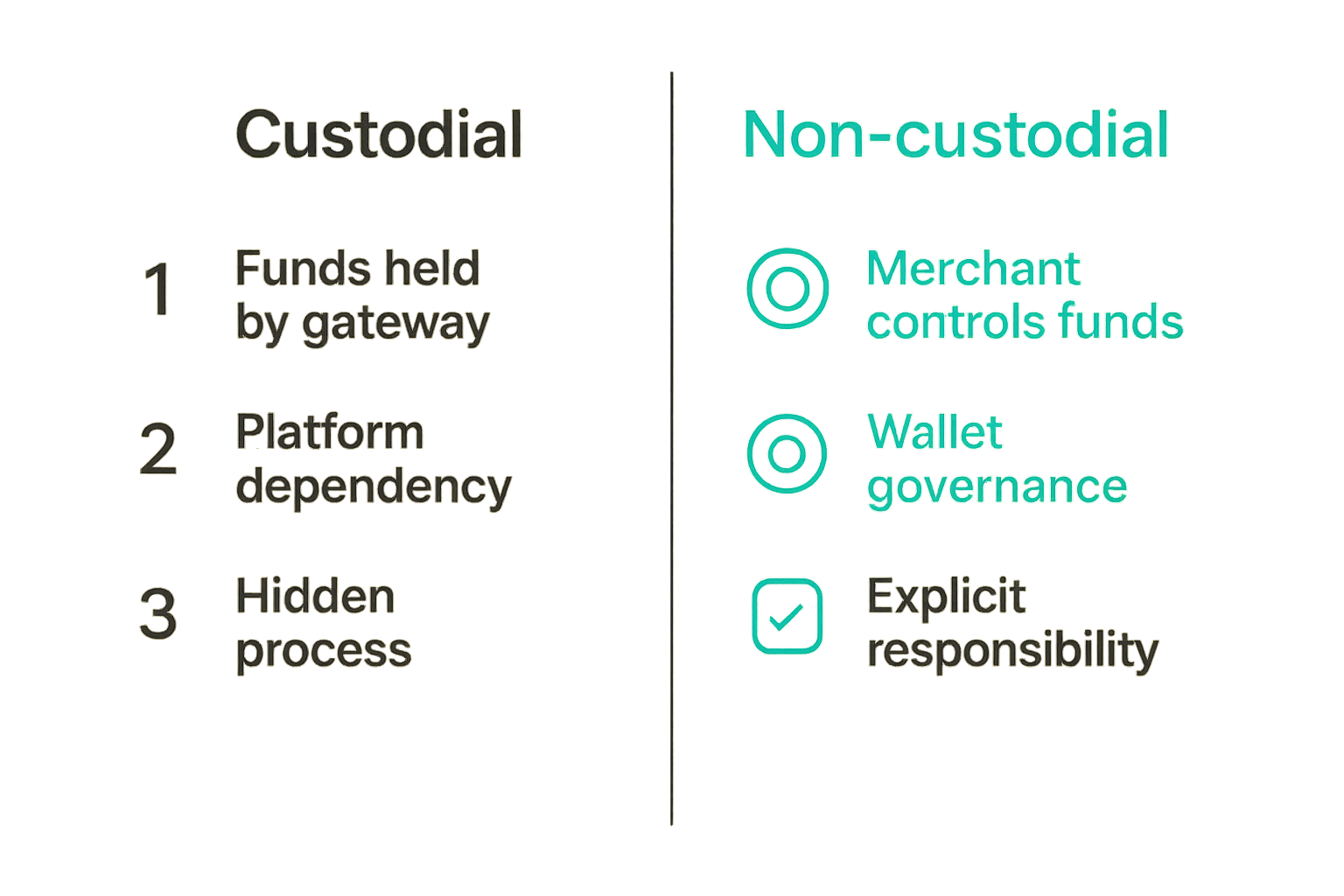
Non-custodial crypto payments mean the merchant controls the funds instead of leaving them with a gateway until withdrawal. That can reduce platform dependency, but it also changes operational responsibility.
You need wallet governance. Who can move funds? Is there a multisig? Are hot wallets capped? How often are funds swept? How are private keys stored? What happens if the finance lead leaves the company?
A payment gateway can help orchestrate invoices, monitoring, and notifications, but non-custodial does not mean no process. It means your process is explicit instead of hidden inside a processor account.
When escrow belongs in the workflow
Escrow is useful when the payment should be separated from immediate merchant release. That may apply to marketplaces, custom orders, buyer protection flows, higher-value B2B purchases, or cases where fulfillment validation matters.
The mistake teams make is forcing escrow into every payment because it sounds safer. Escrow adds states, dispute rules, release conditions, and support obligations. Use it when it solves a real trust problem.
If escrow is part of your buyer or seller model, evaluate it as a workflow layer, not a badge. CoinPay provides an escrow flow for crypto transactions when the payment relationship needs conditional release instead of immediate settlement.
Refunds need a separate path
Refunds in crypto are not card voids. You may not be able to send funds back to the originating address safely, especially if the buyer paid from an exchange. The refund address may need collection, verification, and support approval.
A reasonable refund workflow includes:
- Customer requests refund in the merchant portal or support channel.
- Merchant validates order eligibility.
- Customer provides refund asset, network, and address.
- System flags mismatch risks, such as unsupported network.
- Authorized operator approves transaction.
- Refund txid is attached to the original invoice.
Refunds should be linked to the original payment for auditability. If refunds happen from a separate wallet with no invoice reference, finance will eventually lose the thread.
Related reading from our network: teams responsible for biotech or lab environments face similar process-design pressure outside payments, and the SOC workflow view in Peptide Security Operations is a useful adjacent lens for ownership, escalation, and evidence.
Compliance boundaries without pretending crypto removes risk
Payments do not fix product governance
Crypto payment infrastructure can reduce dependence on fragile processors, but it does not make prohibited activity acceptable. Peptide merchants still need to handle product classification, claims, shipping restrictions, customer eligibility where relevant, documentation, and internal review.
The gateway should support disciplined operations. It should not encourage the merchant to ignore obligations because settlement is easier.
This is where many teams get the tone wrong. They talk about censorship resistance when the business actually needs boring controls: clean order records, visible policies, reliable support, and documented decisions.
Evidence beats hand-waving
If a processor, bank, vendor, auditor, or internal stakeholder asks what happened with an order, you need evidence. A good gateway helps assemble it quickly:
- invoice creation time
- displayed payment instructions
- quoted amount and asset
- transaction hash
- confirmation count
- status transition history
- refund or escrow record
- operator actions
This evidence is useful even when no external party asks for it. It lets your own team resolve disputes without guessing.
Support workflows are part of compliance
Support is often where payment architecture either holds or breaks. A buyer says they paid. The agent needs to know what to ask, what to check, and when to escalate.
Give support a decision tree:
- Is there an invoice ID?
- Is the invoice expired?
- Was a transaction detected?
- Is the asset correct?
- Is the network correct?
- Is the amount within tolerance?
- Are confirmations complete?
- Is this a refund request or payment-location issue?
A gateway that only exposes paid or unpaid leaves support blind. A gateway that exposes operational context reduces time-to-resolution.
What works and what fails in production
What works
The systems that work tend to be boring in the right ways. They have explicit invoice states. They separate payment detection from final confirmation. They use signed webhooks. They reconcile daily. They define refund policy before refunds become urgent.
They also keep the buyer experience simple. Buyers do not need to understand your whole architecture. They need clear instructions, supported assets, exact amounts, expiration time, and a way to get help if they send incorrectly.
What works is a narrow, reliable payment path before a broad, fragile one. Start with the assets and networks your customers can actually use. Add more only when support and reconciliation can absorb them.
What fails
What fails is usually predictable:
- Static wallet address pasted into checkout.
- Manual order approval from screenshots.
- No distinction between detected and confirmed.
- Webhook endpoint that updates orders without idempotency.
- No export for finance.
- Refunds handled through informal wallet transfers.
- Too many assets supported before operations are ready.
- No documented wrong-chain process.
The result is not just technical debt. It is merchant risk. Paid customers complain, unpaid orders ship, finance cannot reconcile, and founders spend time searching block explorers instead of running the business.
Common breakpoints to monitor
Monitor the parts of the system that create customer pain:
| Breakpoint | Symptom | Mitigation |
|---|---|---|
| Expired invoice paid late | Buyer claims payment but order is canceled | Late-payment review queue |
| Wrong network | Funds not detected by normal monitor | Clear network labels and support playbook |
| Underpayment | Order stuck pending | Tolerance or top-up flow |
| Webhook retries | Duplicate fulfillment attempts | Idempotent event processing |
| Confirmation delay | Buyer asks why order is not paid | Status page copy and estimated timing |
| Refund ambiguity | Funds sent to unsafe address | Verified refund address workflow |
The gateway should make these cases visible. If the only signal is an angry customer email, the system is under-instrumented.
Implementation workflow for developers
Step-by-step rollout
A practical implementation sequence looks like this:
- Define supported assets and networks based on buyer behavior, not hype.
- Create invoice states and allowed transitions in your application.
- Integrate the gateway invoice API in checkout.
- Store invoice_id, order_id, asset, network, amount, and expiration locally.
- Implement signed webhook verification.
- Add idempotency using event_id and invoice_id.
- Map gateway states to order states carefully.
- Build support views for detected, confirming, paid, expired, and underpaid.
- Test late payments, duplicate webhooks, wrong amount, and canceled orders.
- Reconcile settlement wallet activity against invoices before going live.
Do not skip the ugly tests. Happy-path testing proves the demo works. Edge-case testing proves the business can operate.
For implementation details and API behavior, start with the CoinPay developer documentation and map each gateway event to your own order-state model before sending production traffic.
Operational metrics to track
You do not need a huge analytics stack. You do need a few payment health metrics:
- invoice creation count
- payment completion rate
- expired unpaid invoices
- detected but unconfirmed payments
- underpayment rate
- wrong-network incidents
- webhook failure rate
- average time from detected to paid
- refund count and refund completion time
- reconciliation exceptions
These metrics tell you whether the gateway is reducing friction or creating hidden work. A high checkout conversion rate is not enough if support volume rises faster than revenue.
A small webhook contract
A clean webhook handler has a narrow contract:
receive_event: true
verify_signature: true
lookup_invoice: true
check_merchant_scope: true
apply_allowed_transition: true
record_event_id: true
return_2xx_on_duplicate: true
alert_on_invalid_transition: true
Invalid transitions should not be ignored silently. If an invoice moves from paid back to confirming, or a paid event arrives for an unknown order, create an alert. Quiet failures become reconciliation problems.
Related reading from our network: if your peptide business also relies on community coordination or local supply-demand matching, the workflow framing in Peptide Asks and Offers is an adjacent example of turning informal trust into trackable process.
Where coinpayportal.com fits
The product fit
coinpayportal.com is built for developers and merchants building crypto payment infrastructure, especially teams that care about the operational layer behind checkout. The fit is not that every merchant needs more buttons. The fit is that high-risk merchants need a gateway workflow that makes payment state, confirmations, escrow options, and settlement behavior understandable.
For peptide merchants, that means designing around the actual failure modes: processor instability, buyer payment mistakes, support escalation, refund complexity, and the need to keep funds moving without pretending risk has disappeared.
A good product fit looks like this:
- You want crypto checkout without giving up operational control.
- You need invoice-level payment tracking.
- You care about webhooks and developer integration.
- You want non-custodial payment infrastructure where appropriate.
- You may need escrow for specific transaction flows.
- You want support and finance to work from the same payment facts.
That is a more useful bar than asking whether a gateway supports a long list of coins.
How to evaluate before going live
Before you route real peptide orders through any gateway, run a sandbox or low-volume pilot. Test the cases that will happen in production:
- Buyer pays after expiration.
- Buyer sends a slightly wrong amount.
- Buyer sends on the wrong network.
- Webhook endpoint is down for ten minutes.
- Duplicate webhook arrives.
- Order is canceled after payment is detected.
- Refund is requested to a different address.
- Finance exports the day and matches every order to a transaction.
The mistake teams make is evaluating only the buyer-facing checkout. The better evaluation is end-to-end: buyer instruction, payment detection, order update, support visibility, settlement, refund, and reconciliation.
Closing view on the peptide payment gateway
A peptide payment gateway should be treated as infrastructure, not a workaround. If you build it as a quick escape hatch from card processor problems, you will recreate the same fragility in a different form. If you build it as a stateful payment workflow, it can become a durable operating layer for the business.
The practical question is not whether crypto can help peptide merchants. It can. The practical question is whether your architecture is specific enough to handle real payments, real buyers, real mistakes, and real settlement. That is what separates a checkout experiment from a production peptide payment gateway.
Try coinpayportal.com
coinpayportal.com is for developers and merchants building crypto payment infrastructure. Try coinpayportal.com.
Try CoinPay
Crypto payments, escrow, and wallets — multi-chain, Lightning-ready, and fast to integrate.
Get started →