Peptide Crafters Need Payment Infrastructure, Not Another Fragile Checkout

Peptide crafters usually discover the payment problem at the worst possible time: after a processor review, a frozen payout, a checkout outage, or a sudden request for documents that does not match how the business actually operates.
Teams think the problem is finding a more tolerant payment provider. The real problem is that peptide crafters are often running a payment workflow that depends on one fragile approval decision, one checkout integration, and one support inbox to hold the entire revenue operation together.
That changes the conversation. Crypto payments are not just an alternative payment method for this category. Used properly, they become part of a payment architecture: checkout state, order matching, customer instructions, confirmations, settlement, refunds, reconciliation, and risk controls.
The practical question is not “Can peptide crafters accept crypto?” It is: can the business accept payment without creating accounting chaos, support tickets, custody exposure, or compliance blind spots?
Table of contents
- Why peptide crafters need payment architecture, not another checkout button
- What makes peptide crafters different from normal ecommerce
- The crypto payment stack peptide crafters actually need
- Checkout design for peptide crafters
- Webhooks, confirmations, and order state
- Reconciliation and accounting for peptide crafters
- Risk, compliance, and custody boundaries
- Implementation workflow for developers
- What works and what fails in production
- Where coinpayportal.com fits for peptide crafters
Why peptide crafters need payment architecture, not another checkout button
The checkout is only the visible layer
A checkout page makes the payment feel simple. A customer selects crypto, receives an address or invoice, sends funds, and waits for confirmation. That is the part everyone sees.
What breaks in practice is everything behind that page. Did the payment arrive before the invoice expired? Was it the right chain? Was the amount exact after fees? Did the order system receive the webhook? Did fulfillment release too early? Can support explain the status without asking the customer for a transaction screenshot?
A useful way to think about it is that checkout is the user interface for a deeper payment state machine. If the state machine is weak, the checkout will eventually create disputes, missed orders, and manual accounting work.
For a deeper category-specific walkthrough, the prior CoinPay guide on peptide payments and crypto infrastructure covers why this merchant type needs more than a generic payment button.
Processor risk becomes an architecture problem
Peptide crafters often operate in a category where processors, banks, and card networks apply extra scrutiny. Even when the business is legitimate, the payment category may be treated as high-risk because of product claims, fulfillment patterns, chargeback concerns, or regulatory ambiguity.
Teams think the problem is approval. The real problem is continuity. If revenue depends on a single processor decision, then payment processing is not infrastructure. It is a permissioned dependency with no graceful fallback.
Crypto can reduce reliance on that dependency, but only if it is integrated as a proper payment rail with order state, ledger records, and operational controls.
The mistake teams make is treating crypto as a workaround
The mistake teams make is adding a wallet address to a checkout page and calling it crypto payments. That creates a new support queue, not a payment system.
A proper implementation needs:
- unique invoice references per order
- clear expiration windows
- confirmation thresholds by asset and chain
- webhook retries and idempotency
- refund and exception handling
- reconciliation exports
- customer-facing payment status
Practical rule: if a support agent cannot determine payment status without asking engineering or the customer, the payment architecture is not finished.
What makes peptide crafters different from normal ecommerce
Ambiguous category risk affects every payment decision
A normal ecommerce store can often optimize for conversion first and payment operations second. Peptide crafters do not have that luxury. Payment acceptance, product description, compliance review, fulfillment documentation, and support language are connected.
This does not mean every peptide business has the same risk profile. It means the payment architecture should assume more review, more exceptions, and more need for evidence than a low-risk retail store.
That is why the infrastructure needs to preserve context: order ID, invoice ID, asset, chain, expected amount, paid amount, timestamps, wallet destination, transaction hash, confirmation count, and settlement status.
Support and fulfillment need stronger evidence
When payments are irreversible, the evidence trail matters. A customer may claim they paid. A fulfillment team may ask whether to release an order. Finance may need to match a deposit to a batch of invoices.
If the only evidence is “the customer says they sent it,” the business will leak time and trust.
The payment system should provide a reliable answer to three questions:
- What invoice was expected?
- What transaction was detected?
- What action did the system take?
Related reading from our network: teams designing operational handoffs can borrow useful control ideas from remote team workflow patterns around permissions and handoff, even though the domain is different.
Customer education becomes part of checkout
Crypto checkout is not self-explanatory for every buyer. Some customers understand wallet fees and confirmations. Others do not.
Peptide crafters should avoid vague instructions like “send crypto to this address.” The checkout should explain:
- which asset is accepted
- which network is accepted
- whether the amount must be exact
- how long the invoice remains valid
- what happens after payment is detected
- where the customer can check order status
This is not cosmetic copy. It reduces failed payments, wrong-chain deposits, and support volume.
The crypto payment stack peptide crafters actually need
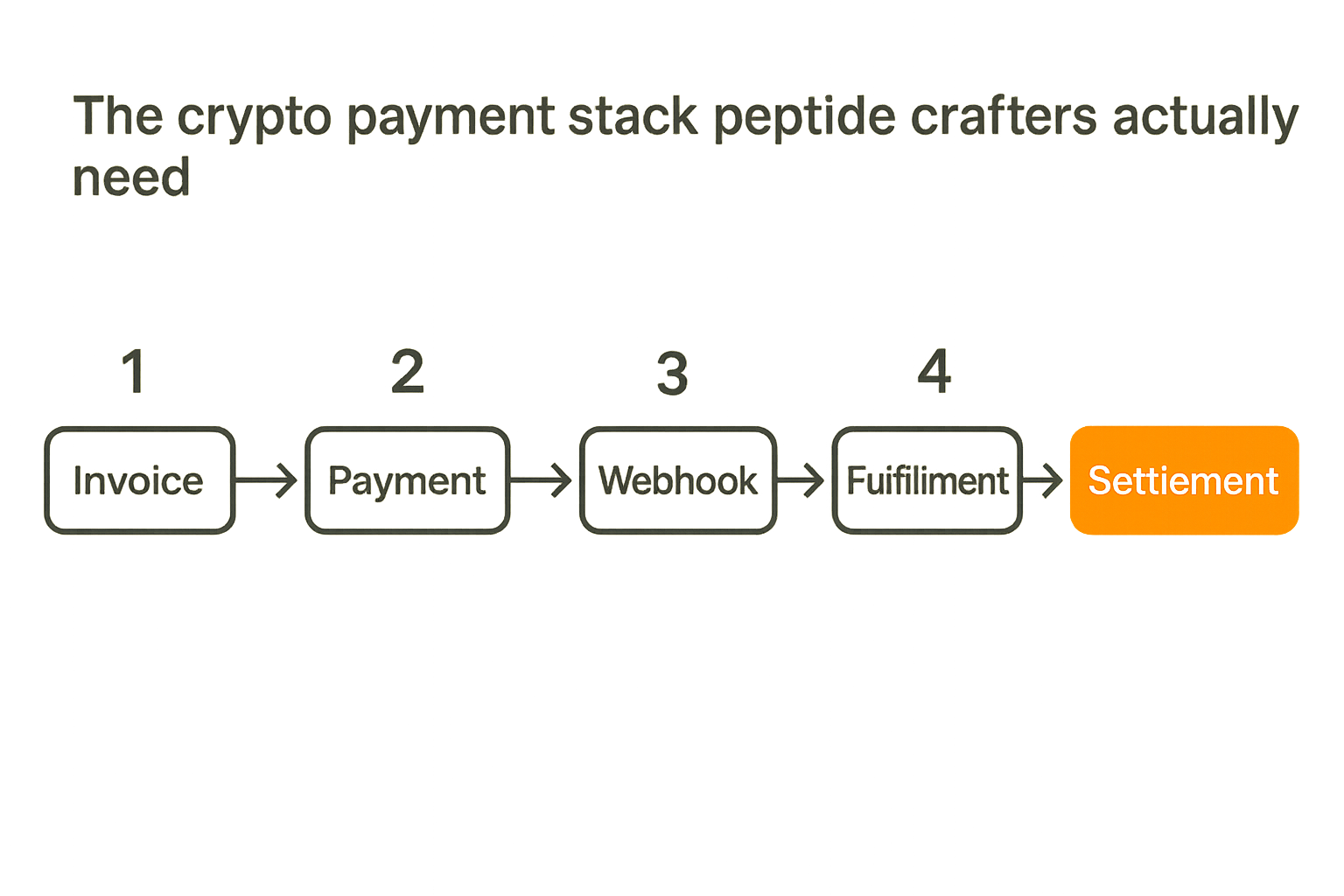
Checkout state must be explicit
The core object is not the wallet address. The core object is the invoice.
An invoice should have a lifecycle. For example:
| State | Meaning | Customer message | Internal action |
|---|---|---|---|
| created | Invoice generated, no payment seen | Awaiting payment | Hold order |
| detected | Transaction seen, not final | Payment detected | Do not fulfill yet |
| confirmed | Required confirmations reached | Payment confirmed | Queue fulfillment |
| underpaid | Payment below expected amount | Payment incomplete | Ask for resolution |
| overpaid | Payment above expected amount | Payment received with excess | Review refund or credit |
| expired | Payment window ended | Invoice expired | Require new invoice |
| refunded | Refund processed or approved | Refund completed | Close exception |
This state model gives engineering, support, fulfillment, and finance a shared language.
Webhooks are the control plane
In production, webhooks are how the payment gateway tells your commerce stack what changed. Treat them as critical infrastructure.
Good webhook handling includes signature verification, idempotency keys, persistent event storage, retry-safe processing, and alerting when delivery fails. A webhook should not directly trigger irreversible business actions without checking current state.
For example, a basic handler should follow this shape:
onWebhook(event):
  verifySignature(event)
  storeRawEvent(event.id, event.payload)

  if alreadyProcessed(event.id):
    return 200

  invoice = findInvoice(event.invoice_id)
  if not invoice:
    alertOps(event)
    return 200

  nextState = transition(invoice.state, event.type)
  saveState(invoice.id, nextState)
  enqueueSideEffects(invoice.id, nextState)
  markProcessed(event.id)
  return 200
The important part is not the syntax. It is the separation between receiving the event, validating it, updating state, and triggering side effects.
Settlement policy is a business decision
Settlement is not just “where the money goes.” It defines treasury exposure, refund capability, accounting workflow, and operational risk.
Peptide crafters need to decide:
- which assets they accept
- whether they hold crypto or convert later
- which wallets receive settlement
- who controls signing authority
- how refunds are funded
- how fees are recorded
Related reading from our network: infrastructure teams comparing payment and workload routing tradeoffs may find useful parallels in this builder guide to centralized, edge, and decentralized compute companies.
Practical rule: choose settlement policy before launch. If finance discovers the policy after the first busy sales week, engineering will be forced into manual cleanup.
Checkout design for peptide crafters
Payment instructions need to be deterministic
Deterministic checkout means the same order always maps to a clear payment request. The customer should not have to interpret anything.
A strong payment instruction set includes:
- order number
- invoice ID
- exact amount
- asset and network
- destination details
- expiration timestamp
- status URL
- support reference
The UI should also prevent common mistakes. If you accept USDT on one network, say the network clearly. If you do not support deposits from certain chains, say that before the customer sends funds.
Expired invoices must not become support debt
Crypto prices, network fees, and customer behavior change quickly. Invoice expiration protects both sides, but only if the system handles expiry cleanly.
When an invoice expires, the customer should be able to generate a fresh invoice without creating duplicate orders. The original invoice should remain visible internally so support can investigate late payments.
What fails is deleting expired invoices or overwriting them. You lose the audit trail exactly when you need it.
Partial and overpayments need defined handling
Partial payments are common enough that they deserve first-class handling. A customer may send less than required because of wallet fees, exchange withdrawal fees, or confusion over network costs.
Overpayments happen too. The customer may round up, use the wrong quote, or send from an exchange with fixed withdrawal behavior.
Your policy should define:
- minimum acceptable underpayment tolerance
- whether to request a top-up
- whether small overpayments become store credit
- refund thresholds
- required identity checks for refunds
- support scripts for each scenario
None of this should be decided in a Slack thread after funds arrive.
Webhooks, confirmations, and order state
Use idempotency before you need it
Payment events can be delivered more than once. They can arrive late. They can arrive after a customer refreshes checkout or after an admin manually updates an order.
Idempotency means processing the same event multiple times has the same result as processing it once. This is not optional for payment systems.
Use idempotency at several layers:
- invoice creation
- webhook event processing
- order status transitions
- fulfillment release
- refund initiation
- ledger posting
Practical rule: every payment-side effect should have a unique key. If you cannot name the key, you cannot safely retry the action.
Separate detected, confirmed, and settled
Many bad implementations collapse payment status into a single “paid” flag. That is too blunt.
Detected means a transaction appears on the network or through the gateway. Confirmed means it has reached your confirmation policy. Settled means funds are available according to your treasury and accounting process.
Those are different business moments. Fulfillment might wait for confirmed. Finance might wait for settled. Support might tell the customer payment is detected but still pending.
The payment state machine should support that nuance.
Design for retries and out of order events
Distributed systems do not deliver events in the order your business process diagram expects. A confirmation event may arrive after an expiration event. A retry may arrive after an admin resolved an exception.
The transition function should reject invalid moves. For example, a refunded invoice should not return to confirmed because an old webhook retried.
A simple transition table is often better than scattered conditionals:
allowedTransitions = {
  created: [detected, expired],
  detected: [confirmed, underpaid, expired],
  underpaid: [confirmed, refunded],
  overpaid: [confirmed, refunded],
  confirmed: [settled, refunded],
  settled: [refunded],
  expired: [detected_late, closed],
  refunded: []
}
Reconciliation and accounting for peptide crafters
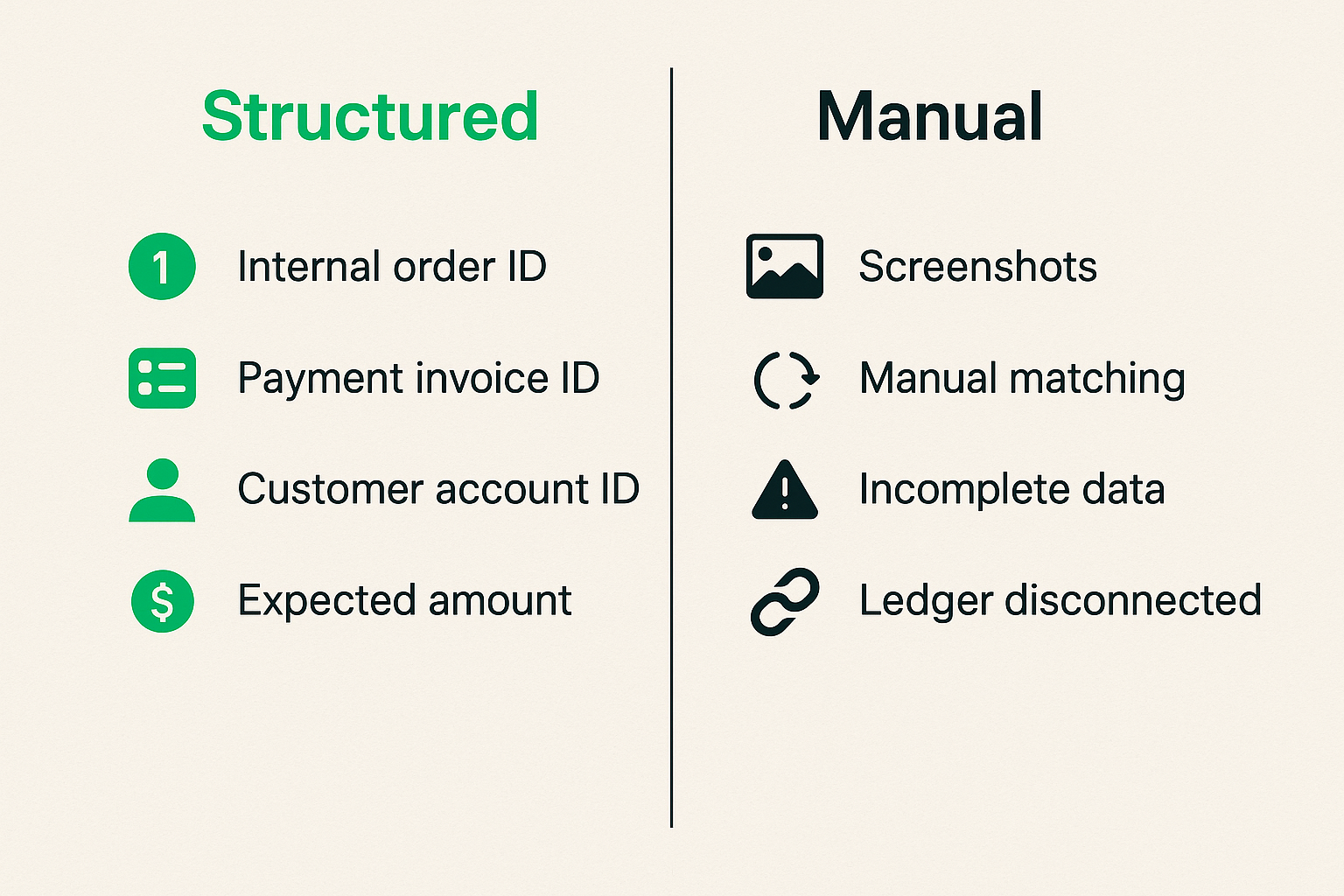
Every payment needs a durable reference
Reconciliation starts at invoice creation, not at month-end. Every payment should have a durable reference that survives exports, support tickets, refunds, and ledger imports.
At minimum, store:
- internal order ID
- payment invoice ID
- customer account ID if available
- expected amount and currency
- crypto amount and asset
- destination address or payment identifier
- transaction hash
- network
- timestamps for each state
- fee fields
- refund references
If you cannot join payment data to order data without manual guessing, your reconciliation process is not ready.
Do not reconcile from screenshots
Screenshots are useful as support evidence, not as accounting records. They are incomplete, easy to misread, and disconnected from the ledger.
Finance needs exports or API access that can answer:
- which orders were paid in a date range
- which payments are confirmed but not fulfilled
- which invoices expired after late payment
- which refunds are open
- which assets remain unsettled
This is where a gateway with usable developer documentation matters. If you are planning the integration, start from the CoinPay developer docs and design the database objects around durable payment references rather than UI screenshots.
Fees and network costs need their own ledger treatment
Crypto fees are not all the same. There may be network fees, gateway fees, exchange withdrawal fees, conversion spreads, and refund transaction costs.
Do not hide them inside gross revenue. Your accounting model should separate:
| Ledger item | Example | Why it matters |
|---|---|---|
| Gross order value | Customer invoice amount | Revenue reporting |
| Gateway fee | Processing fee | Margin visibility |
| Network fee | On-chain transfer cost | Treasury accuracy |
| Refund amount | Customer return | Support and liability |
| Conversion difference | Asset price movement | P&L clarity |
This is less exciting than checkout design, but it is where many merchant systems become untrustworthy.
Risk, compliance, and custody boundaries
Crypto does not remove merchant responsibility
Crypto payments do not remove obligations around product legality, customer communications, sanctions screening, fraud prevention, tax reporting, or refund policy. They change the payment rail, not the responsibility model.
For peptide crafters, this point matters because category risk is already sensitive. Avoid using crypto as a way to hide weak operations. That usually backfires.
The better approach is to make the payment trail more explicit than a generic card checkout would be.
Non-custodial is not the same as no controls
Non-custodial payment architecture can reduce dependency on a third party holding funds. It does not mean the business should avoid controls.
You still need:
- wallet access policies
- role-based permissions
- address management
- refund authorization
- audit logs
- invoice-level evidence
- treasury review
A non-custodial gateway can help merchants avoid unnecessary custody exposure, but the merchant still needs an operating model. For broader context on why processors and banks often create fragility for this category, see the CoinPay article on peptide merchant account crypto infrastructure.
Escalation paths matter when payments are irreversible
Irreversibility changes support. A card refund and a crypto refund are operationally different. A wrong-chain payment may require a different investigation path than an underpayment. A suspected fraud case may need escalation before fulfillment.
Define escalation rules before launch:
- who can approve refunds
- who can release delayed orders
- who investigates wrong-chain deposits
- who communicates with customers
- who owns accounting adjustments
- who reviews high-value orders
Related reading from our network: trust and coordination problems show up in many verticals, and this operating guide to local community platform alternatives is a useful adjacent example of designing around trust, routing, and follow-up.
Implementation workflow for developers
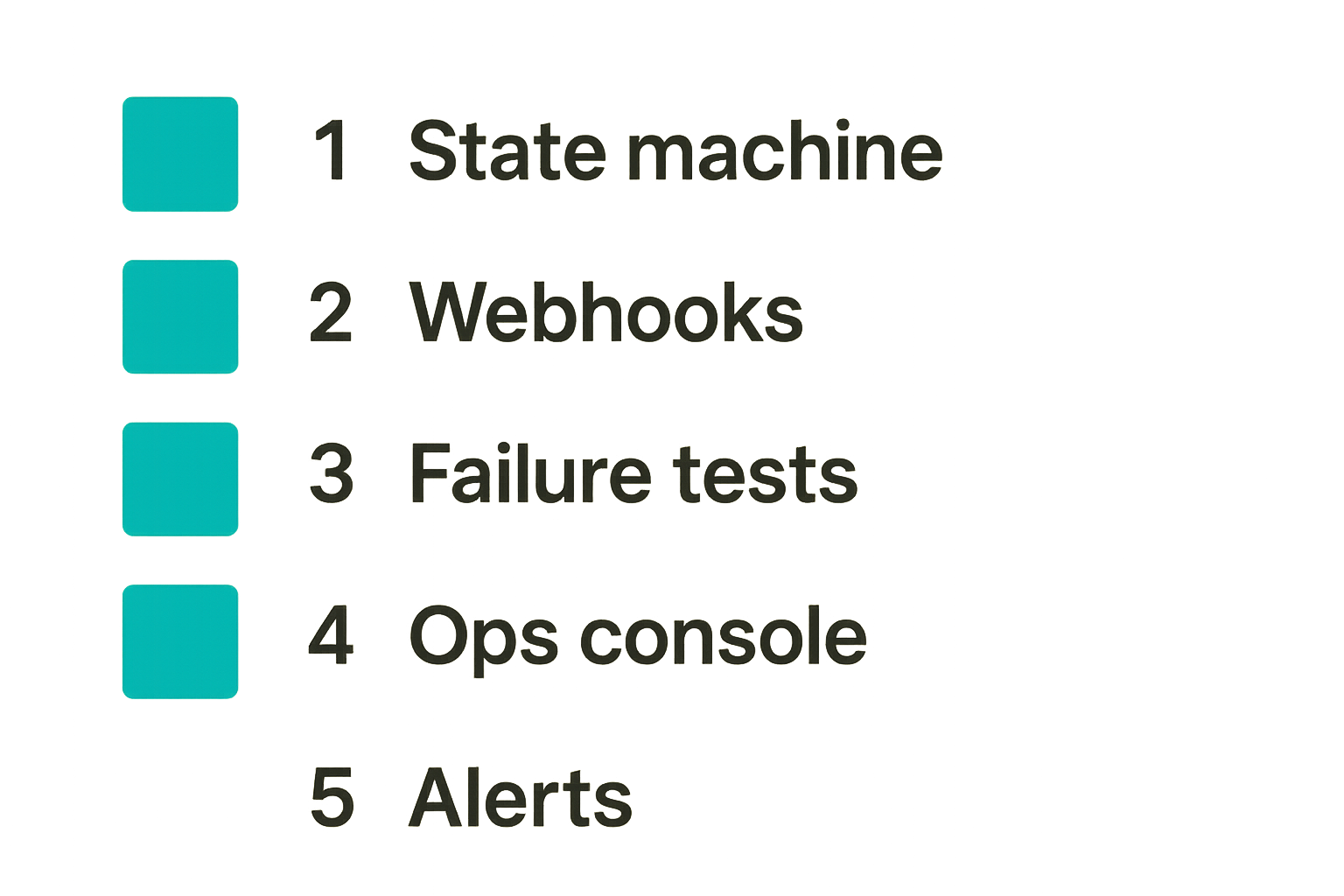
Build the payment state machine first
Do not start by styling the checkout component. Start by defining state.
A practical implementation sequence looks like this:
- Define invoice states and allowed transitions.
- Create payment database tables with durable IDs.
- Add invoice creation from the order system.
- Implement webhook verification and raw event storage.
- Add idempotent transition processing.
- Connect confirmed payment state to fulfillment queueing.
- Build customer-facing payment status pages.
- Build admin views for support and finance.
- Test late, duplicate, partial, and failed events.
- Launch with alerts on webhook failures and stuck invoices.
This sequence keeps the UI tied to the operational model. It also prevents the common failure where checkout looks finished but the back office cannot run it.
Test failure cases before launch
Happy-path testing is not enough. In crypto payments, the edge cases are the product.
Test these scenarios:
- customer sends too little
- customer sends too much
- customer pays after expiration
- webhook is delivered twice
- webhook is delayed
- confirmation arrives after manual cancellation
- wrong asset is attempted
- refund is requested after settlement
- customer disputes status with a transaction hash
A staging environment should simulate these outcomes. If the gateway cannot support realistic testing, your production launch will become the test plan.
Give operations a payment console
Developers often underestimate the operational interface. Support and finance need visibility without querying the database.
A useful payment console shows:
- invoice status
- order status
- customer reference
- transaction hash
- confirmation count
- expected versus received amount
- timestamps
- webhook event history
- refund status
- internal notes
This is not “admin polish.” It is how the business avoids engineering interruptions every time a customer asks about payment.
What works and what fails in production
What works
What works is boring, explicit, and observable.
Strong implementations usually have:
- one invoice per order attempt
- a clear state machine
- signed webhooks
- idempotent processing
- customer-visible status
- support-visible event history
- ledger-friendly exports
- documented refund policy
- defined custody boundaries
The pattern is simple: make every important payment event visible to the systems and people that need it.
What fails
What fails is treating crypto as a side channel.
Common failing patterns include:
- publishing a static wallet address
- manually matching payments to orders
- fulfilling on unconfirmed detection
- ignoring underpayments until support complains
- relying on screenshots for proof
- mixing refund approvals with wallet access
- letting finance discover fees after export
- hiding payment state inside gateway UI only
These failures do not always appear on day one. They appear when volume increases, staff changes, refunds happen, or a customer sends funds incorrectly.
Failure modes to watch weekly
Operators should review payment health weekly, especially after launch.
Watch for:
| Failure mode | Symptom | Fix |
|---|---|---|
| Stuck invoices | Created or detected for too long | Alert on aging states |
| Webhook drift | Gateway says paid, store says unpaid | Store and replay raw events |
| Manual refunds | Refunds tracked outside ledger | Require refund objects |
| Support ambiguity | Agents ask engineering for status | Improve admin console |
| Wrong network attempts | Customers send unsupported assets | Improve checkout warnings |
| Reconciliation gaps | Finance cannot match deposits | Add durable references |
Practical rule: if a failure happens twice, it should become a state, an alert, or a runbook. Repeated manual judgment is not an operating model.
Where coinpayportal.com fits for peptide crafters
Use the gateway as infrastructure, not decoration
For peptide crafters, coinpayportal.com should be treated as part of the payment infrastructure layer: invoice creation, payment detection, confirmation handling, webhook delivery, fee handling, and real-time processing.
The goal is not to add a crypto logo to checkout. The goal is to reduce dependency on fragile merchant account approvals while keeping the business operationally clean.
That means integrating the gateway with the order system, fulfillment queue, support tooling, and finance workflow. The crypto rail should be visible where decisions are made.
Keep ownership clear between checkout and fulfillment
Payment infrastructure breaks when ownership is unclear. Developers own integration reliability. Operations owns exception handling. Finance owns reconciliation. Leadership owns risk policy. The gateway provides payment rails and events, but the merchant still owns the workflow.
For peptide crafters, that ownership map is especially important because payment issues quickly become fulfillment, support, and compliance issues.
A useful way to think about it is this: the payment gateway should tell your system what happened. Your architecture should decide what that means for the order.
Peptide crafters that make this distinction build systems that are easier to support, easier to audit, and less dependent on any single payment provider decision.
Try coinpayportal.com
You are writing for developers and merchants building crypto payment infrastructure. Try coinpayportal.com if you need a practical crypto payment layer for peptide crafters, checkout workflows, webhooks, and merchant operations.
Try CoinPay
Crypto payments, escrow, and wallets — multi-chain, Lightning-ready, and fast to integrate.
Get started →