Crypto Payments in 2026: The Architecture Guide for Developers and Merchants

Crypto payments look simple until the first real customer sends the wrong amount, pays from an exchange, closes the checkout tab, and opens a support ticket before your webhook lands.
Teams think the problem is accepting coins. The real problem is operating a payment state machine across wallets, chains, confirmations, pricing, refunds, settlement, accounting, and customer support.
That changes the conversation. The practical question is not whether your checkout can display a QR code. It is whether your system can explain what happened, recover safely, and close the order without manual archaeology.
In 2026, crypto payments are less about hype and more about infrastructure discipline. Developers need deterministic APIs and idempotent webhooks. Merchants need clear settlement, support workflows, and custody boundaries. Founders need an architecture that can survive chargeback-free payments without pretending every edge case disappeared.
Table of contents
- Why crypto payments fail in production
- The payment architecture underneath crypto payments
- A production crypto payments workflow
- Custody, escrow, and settlement decisions
- Data model and API contracts
- What breaks in practice
- What works for developers
- What works for merchants
- Metrics that keep crypto payments honest
- Product fit: where CoinPay belongs
- Closing checklist for crypto payments in 2026
Why crypto payments fail in production
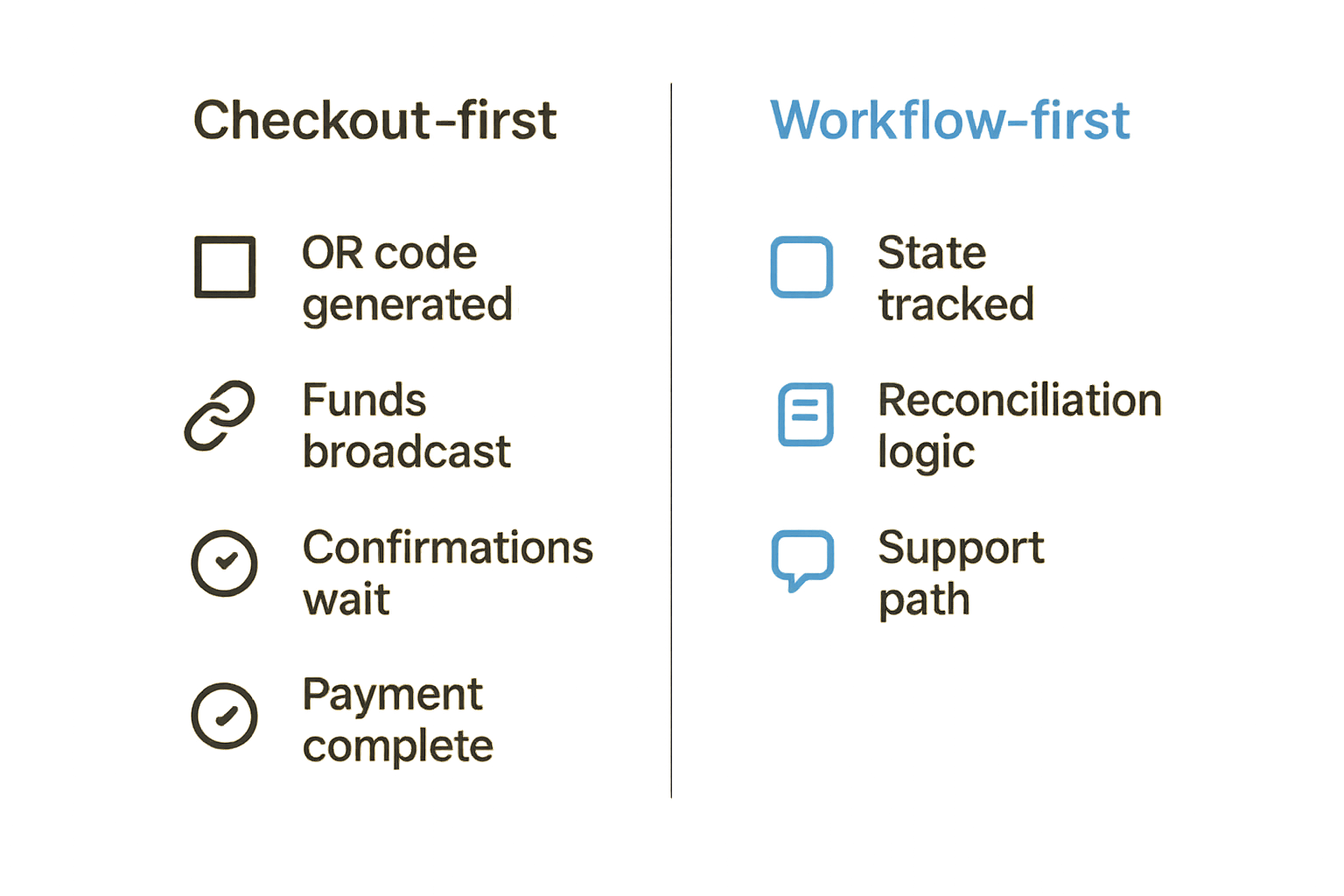
The checkout is only the edge
The mistake teams make is treating crypto payments as a front-end integration. They add a checkout option, generate a QR code, and assume the chain will do the rest.
That is the easy part. The hard part starts after the customer clicks pay.
A production payment has to answer several questions at once:
- What fiat price was quoted, and when does it expire?
- Which asset and network are acceptable?
- What address or invoice was assigned to this order?
- Has the customer paid enough?
- How many confirmations are required?
- Who owns the funds after payment?
- How does the merchant reconcile the transaction later?
If your system cannot answer those questions without opening a block explorer and a spreadsheet, you do not have payment infrastructure. You have a payment hint.
State is the product
Crypto rails are asynchronous. A wallet may broadcast late. A mempool may be congested. A customer may send from an exchange that batches withdrawals. Your webhook may be delayed. Your order system may be down during final confirmation.
The practical question is how your application represents state while all of that happens.
A useful way to think about it is this: checkout collects intent, the blockchain records movement, and your payment system translates both into merchant state. The translation layer is where most production failures live.
Practical rule: Never let the shopping cart decide that a crypto payment is complete. Let a payment state machine decide, then notify the cart.
Operations owns the exceptions
Developers often optimize for the happy path. Merchants live in the exception path.
The customer says they paid. The order says unpaid. The wallet shows a transaction. The chain has zero confirmations. The support agent needs an answer now.
What breaks in practice is not cryptography. It is ownership. If engineering, support, finance, and operations all use different sources of truth, every exception becomes a meeting.
This is why crypto payments should be designed as a workflow first and an API second.
Related reading from our network: teams in regulated or trust-sensitive niches face a similar problem where launch traffic is not enough unless the operating workflow builds confidence, as discussed in Peptide Startup Growth.
The payment architecture underneath crypto payments
Invoices are contracts, not screens
A crypto invoice should be treated like a contract between the merchant, the customer, and the payment system. It defines the payable amount, asset, network, destination, expiration, confirmation policy, and order reference.
That invoice might render as a QR code, a wallet deep link, a Lightning invoice, or a copyable address. The UI can vary. The contract should not.
A strong invoice object includes:
- Merchant account identifier
- Order or cart reference
- Fiat amount and currency
- Crypto amount and asset
- Network identifier
- Destination address or invoice string
- Expiration timestamp
- Required confirmations
- Payment status
- Transaction references
- Settlement destination
If you are planning the wider gateway design, the earlier CoinPay guide on crypto payment gateway setup goes deeper into gateway boundaries, custody, and webhook architecture.
Confirmation policy is a business rule
Not every payment needs the same confirmation policy. A low-value digital download may tolerate faster acceptance. A high-value hardware order may require more finality. A marketplace payout might need a different risk threshold from a simple merchant checkout.
The mistake teams make is hard-coding one confirmation count globally.
A better model makes confirmation policy configurable by:
- Asset
- Network
- Merchant risk level
- Order value
- Product category
- Fulfillment type
Practical rule: Treat confirmations as risk configuration, not blockchain trivia.
Custody boundaries must be explicit
Every crypto payment design has a custody answer, even if the team has not written it down. Funds either flow to the merchant, to a processor-controlled address, to a smart contract, to an escrow arrangement, or to some hybrid.
The custody boundary determines operational risk, compliance posture, refund mechanics, and customer trust. It also determines who can make a mistake with money.
Do not hide this inside implementation details. Put it in the architecture document. Make it clear which system can move funds, which system can only observe funds, and which human role can authorize exceptions.
A production crypto payments workflow
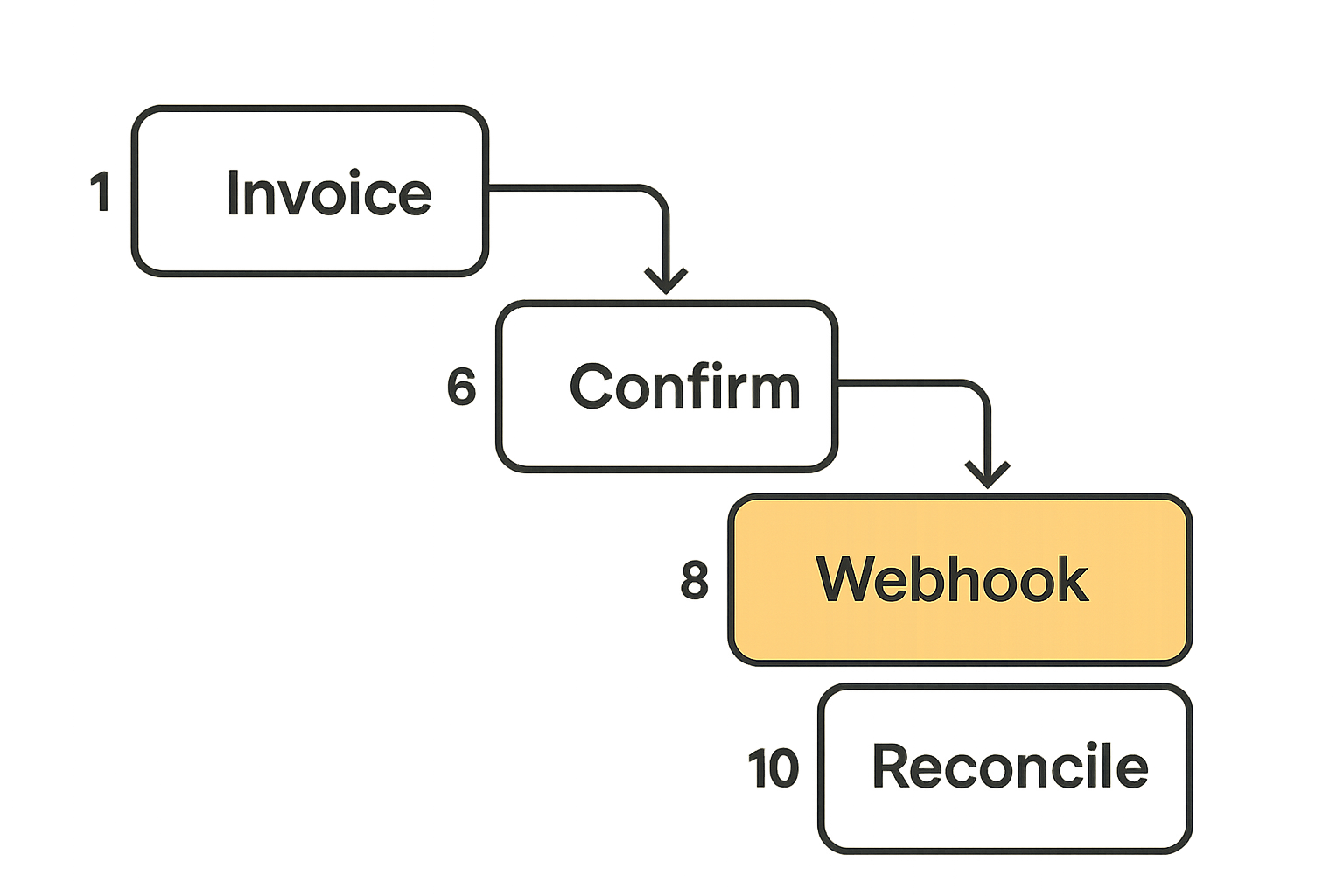
The core sequence
A reliable workflow is boring by design. It should be easy to trace from order creation to settlement.
- Customer selects crypto at checkout.
- Merchant backend creates a payment invoice through the payment service.
- Payment service locks the quote and returns payment instructions.
- Customer sends funds from a wallet or exchange.
- Chain watcher or payment processor detects the transaction.
- Confirmation policy evaluates the transaction.
- Payment service updates invoice state.
- Webhook notifies the merchant backend.
- Merchant backend updates order state idempotently.
- Finance reconciles the invoice, transaction, and settlement.
The UI can disappear after step four. The workflow cannot.
Idempotency is not optional
Every write path needs an idempotency key or equivalent deduplication strategy. Customers refresh pages. Wallets rebroadcast. Webhooks retry. Workers crash halfway through processing.
If the same event can create two orders, ship two products, or mark two balances, the system is not production ready.
A simple pattern:
idempotency_key = merchant_id + order_id + invoice_id + event_type + event_version
Store processed event keys. Make order updates conditional. Return success for already-processed events. This is not fancy. It is how you avoid paying for the same bug twice.
Webhooks are delivery, not truth
Webhooks are useful because they push state changes to the merchant. They are dangerous when teams treat them as the only source of truth.
A webhook can be delayed, duplicated, blocked by a firewall, or delivered while your order service is down. Your merchant backend should verify important payment state by fetching the invoice from the payment API when needed.
Practical rule: Use webhooks to wake up your system. Use API reads to confirm what your system believes.
Related reading from our network: the review gates and fallback queues in human in the loop AI publishing are a useful analogy for payment operations, because both systems fail when automation has no human-safe recovery path.
Custody, escrow, and settlement decisions
Non-custodial versus custodial tradeoffs
Custody is not a branding word. It is a control boundary. The comparison below is simplified, but it is the decision many teams need to make early.
| Model | What works | What fails | Best fit |
|---|---|---|---|
| Non-custodial direct settlement | Merchant controls funds, lower processor balance risk | Merchant must manage wallets, refunds, and treasury ops | Operators with wallet discipline |
| Processor custody | Easier merchant experience, simpler refunds | Processor risk, compliance burden, withdrawal dependency | Merchants prioritizing convenience |
| Escrow | Better buyer and seller trust, conditional release | More complex dispute and release logic | Marketplaces and high-trust transactions |
| Hybrid | Flexible routing by use case | More operational complexity | Platforms with multiple merchant profiles |
The right answer depends on your business model, not on which term sounds more decentralized.
When escrow changes the risk model
Escrow matters when the buyer and seller do not fully trust each other, fulfillment takes time, or disputes are expected. Marketplaces, service platforms, and high-value transactions often need a payment flow that separates payment acceptance from fund release.
That changes the conversation. The system no longer asks only whether funds arrived. It asks whether the release conditions have been met.
If escrow is part of your product, review the platform-level flow around crypto escrow payments before you design order states. Escrow should not be bolted onto a simple paid or unpaid checkout model after launch.
Settlement needs an owner
Settlement is where payment architecture becomes finance architecture. Someone has to decide how often funds move, where they move, how fees are recorded, and how crypto balances map to accounting entries.
Common settlement questions:
- Settle immediately or batch daily?
- Settle in crypto or convert to fiat elsewhere?
- Deduct network fees from merchant proceeds or customer amount?
- Record exchange-rate gain or loss at invoice time or settlement time?
- Who approves manual settlement exceptions?
If nobody owns settlement, finance will eventually build its own parallel system. That is how reconciliation drift starts.
Data model and API contracts
The invoice object should be boring
A boring invoice object is good. It means support can read it, finance can export it, and developers can reason about it.
Example shape:
{
  'invoice_id': 'inv_8k21',
  'merchant_id': 'merch_42',
  'order_id': 'ord_1009',
  'fiat_amount': '149.00',
  'fiat_currency': 'USD',
  'crypto_amount': '0.00231000',
  'asset': 'BTC',
  'network': 'bitcoin',
  'status': 'confirmed',
  'expires_at': '2026-06-01T18:20:00Z',
  'required_confirmations': 2,
  'transactions': ['tx_abc'],
  'settlement_status': 'pending'
}
The exact fields vary by rail, but the principle holds: never force downstream systems to infer payment meaning from raw chain data.
Use a status machine merchants can audit
A simple status machine is easier to operate than a clever one.
Useful invoice statuses often include:
createdpending_paymentdetectedunderpaidoverpaidconfirmingconfirmedexpiredrefundedfailed
The mistake teams make is collapsing detected, confirming, and confirmed into one paid state. That removes the ability to explain what is happening during the riskiest part of the workflow.
Design payloads for reconciliation
A webhook payload should help the receiver update state, but it should also help finance reconcile later.
Include stable identifiers:
- Invoice ID
- Merchant ID
- Order ID
- Event ID
- Event version
- Transaction hash or payment proof
- Amount expected
- Amount received
- Asset and network
- Current status
- Timestamp of status transition
Avoid payloads that only say payment succeeded. That might be enough for checkout, but it is not enough for accounting, support, or incident response.
What breaks in practice
Underpayments and overpayments
Underpayments happen for ordinary reasons. Wallet fees confuse users. Exchange withdrawals deduct fees. Customers edit amounts. Tokens have decimal precision issues.
Overpayments happen too. Customers resend. Wallets use stale quotes. A buyer pays an expired invoice.
Your system needs policy, not panic.
Decide before launch:
- What underpayment threshold is automatically accepted?
- When is a customer asked to top up?
- When is an overpayment refunded?
- Which fees are deducted from refunds?
- Who can approve a manual exception?
Practical rule: Every amount mismatch should land in a defined state, not in an undefined support queue.
Duplicate notifications and retries
Webhook retries are healthy. Duplicate notifications are normal. They only become incidents when receivers are not idempotent.
The receiver should:
- Verify the webhook signature.
- Check the event ID.
- Fetch the invoice when the state transition matters.
- Apply the update only if the transition is valid.
- Return success after processing or recognizing a duplicate.
Do not build webhook receivers that assume events arrive exactly once and in order. In production, that assumption will fail.
Chain reorganizations and delayed finality
Most merchant teams do not need to become consensus researchers, but they do need to respect finality. A payment seen in the mempool is not the same as a payment accepted for fulfillment. A confirmed transaction on one network may carry a different risk profile from a final transaction on another.
For higher-value orders, use confirmation policies that reflect network behavior. For lower-value digital goods, you may choose speed over certainty. The important part is making that a documented business decision.
What works for developers
Local testing must simulate ugly payments
Do not only test the happy path. Simulate the flows that create tickets.
Test cases should include:
- Exact payment before expiration
- Payment after expiration
- Partial payment
- Overpayment
- Duplicate webhook
- Webhook delivered before order service is ready
- Confirmation delayed beyond the support window
- Refund requested after settlement
Developers integrating CoinPay can start from the API references and integration examples in the CoinPay developer docs, then build their own fixture suite around merchant-specific order states.
Observability should follow money
Payment observability should connect application logs, invoice state, transaction references, and merchant actions.
At minimum, trace these identifiers across services:
invoice_idorder_idmerchant_idevent_idtransaction_hashsettlement_batch_id
When a customer asks where their payment is, your team should not need five dashboards and a block explorer tab to answer.
Retries need durable queues
A retry loop in memory is not enough. If the process dies, the retry disappears. If the dependency is down for an hour, your system should still recover.
Use durable queues for webhook delivery, settlement jobs, reconciliation jobs, and notification retries. Store attempts, response codes, next retry time, and final failure reason.
A practical retry policy:
webhook_delivery:
  max_attempts: 12
  backoff: exponential
  first_retry_seconds: 30
  max_retry_minutes: 60
  terminal_action: mark_delivery_failed_and_alert
The goal is not infinite retry. The goal is reliable recovery with clear ownership when automation stops.
What works for merchants
Pricing windows must be visible
Crypto prices move. Customers also take time to pay. The merchant experience is better when the quote window is explicit.
Show:
- Amount due
- Asset and network
- Expiration time
- What happens after expiration
- Whether underpayments can be topped up
Do not hide expiration in tiny text. If a quote expires, the customer should understand why a payment is no longer automatically accepted.
Refunds require a policy before launch
Refunds in crypto payments are not the same as card refunds. You may need a return address, a manual approval step, network fee handling, and exchange-rate policy.
Define:
- Refund asset
- Refund network
- Refund amount basis
- Fee deduction policy
- Approval threshold
- Customer identity requirements where applicable
The worst time to design refund policy is after an angry customer has already paid.
Support needs payment context
Support teams need more than paid or unpaid. They need the payment narrative.
A useful support view shows:
- Invoice status
- Expected amount
- Received amount
- Asset and network
- Transaction hash
- Confirmation count
- Expiration time
- Webhook delivery status
- Refund status
- Internal notes
Related reading from our network: trust-heavy systems often become coordination infrastructure, not just content or transaction surfaces, which is the central point in AI Publishing Community Building.
Metrics that keep crypto payments honest
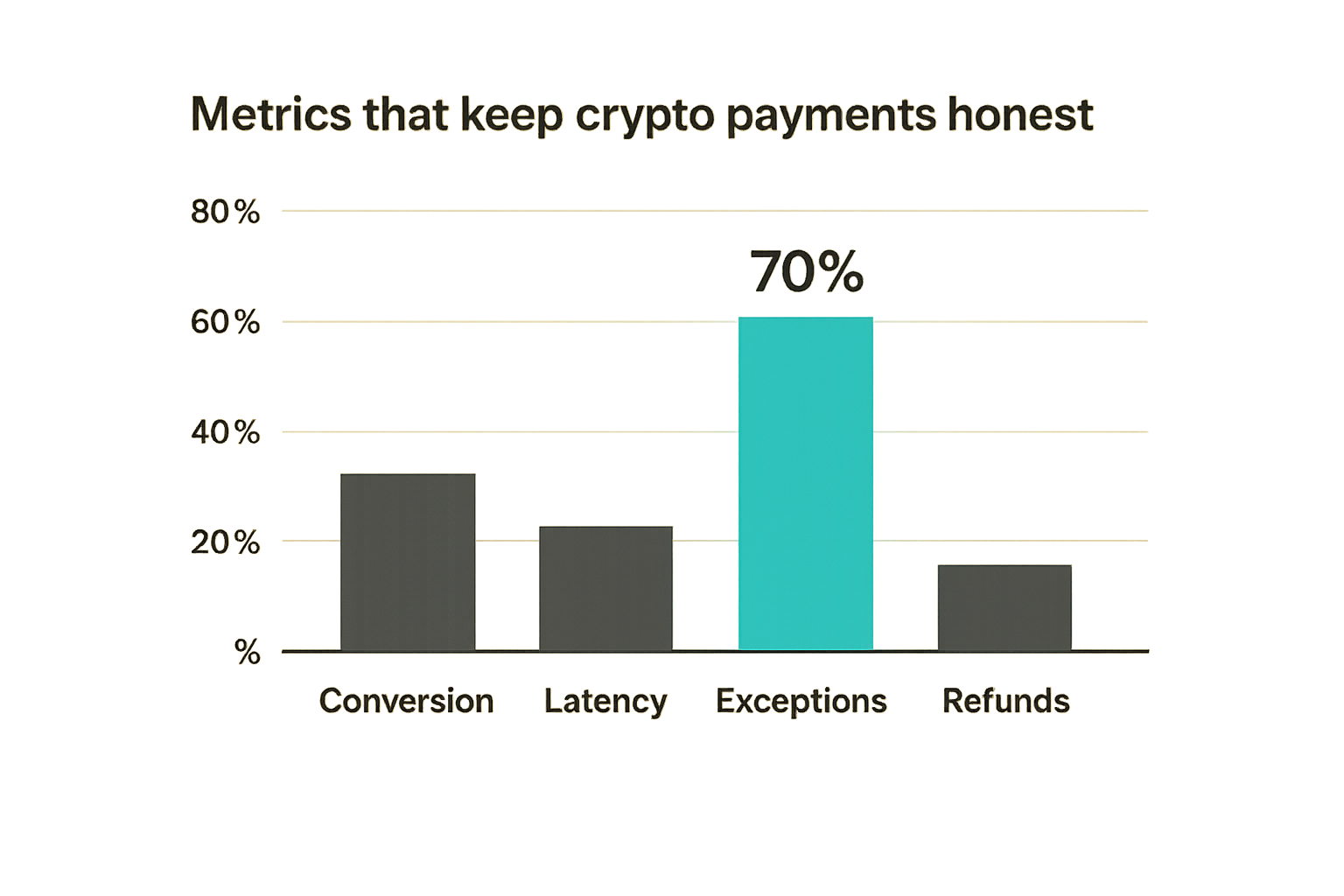
Conversion is not enough
Checkout conversion matters, but it does not tell the full story. A crypto checkout can convert well and still create an expensive operations burden.
Track conversion alongside:
- Invoice creation to payment detected
- Payment detected to confirmed
- Confirmed to order fulfilled
- Failed invoice reasons
- Support tickets per payment
- Manual review rate
If conversion improves while exceptions explode, the system is not actually improving.
Exception rate is the operating cost
The exception rate is one of the most honest metrics in crypto payments. It tells you how often automation fails to produce a clean outcome.
Common exception categories:
- Underpaid
- Overpaid
- Paid late
- Wrong asset
- Wrong network
- Confirmation timeout
- Webhook delivery failed
- Refund pending
The goal is not zero exceptions. The goal is to make exceptions visible, bounded, and cheap to resolve.
Settlement latency affects cash flow
Merchants care about when funds are usable. If settlement is slow, unclear, or manually reconciled, crypto becomes harder to run as a business payment method.
Measure:
- Time from confirmed payment to settlement created
- Time from settlement created to funds available
- Settlement failure rate
- Manual settlement adjustments
- Unreconciled balance age
Payment systems that ignore settlement latency eventually lose merchant trust, even if the checkout works.
Product fit: where CoinPay belongs
Use CoinPay when you want payment infrastructure, not custody theater
CoinPay is for developers and merchants building crypto payment infrastructure who need the operational pieces around checkout: payment creation, real-time processing, fee handling, non-custodial design choices, and merchant-facing workflows.
The product fit is strongest when your team wants to focus on commerce logic instead of rebuilding every payment primitive from scratch.
A good integration still requires architecture decisions. CoinPay can provide the payment layer, but your application should still own product-specific order rules, fulfillment policy, support process, and accounting exports.
Keep your system of record clean
The cleanest pattern is to let your commerce platform remain the order system of record and let the payment system remain the payment system of record.
That means:
- Orders reference invoices.
- Invoices reference transactions.
- Settlements reference invoices.
- Support sees all three without changing all three.
Do not copy raw chain data into every table. Do not let payment webhooks mutate unrelated business objects without validation. Keep boundaries clear and debugging becomes much easier.
Know when to build directly
Some teams should build more directly on-chain. If your product is a wallet, protocol, exchange, or complex smart-contract platform, you may need custom signing, custom risk engines, and chain-specific infrastructure.
But many merchants and fintech founders do not need to own that entire surface area. They need crypto payments that fit into checkout, reconciliation, settlement, and support without turning every order into a blockchain operations project.
Closing checklist for crypto payments in 2026
Launch checklist
Before you ship, make sure you can answer these questions without a war room:
- What is the invoice state machine?
- Which assets and networks are supported?
- What confirmation policy applies by order type?
- What happens when a customer underpays?
- What happens when a customer pays late?
- Are webhook receivers idempotent?
- Can the merchant fetch invoice state after webhook failure?
- Who owns refunds?
- Who owns settlement?
- Can support explain a payment in under a minute?
- Can finance reconcile invoices, transactions, fees, and settlements?
The practical question is not whether crypto payments can work. They can. The question is whether your implementation can survive real users, delayed networks, retries, refunds, support tickets, and month-end reconciliation.
Build the workflow first. Then polish the checkout.
Try coinpayportal.com
You are writing for developers and merchants building crypto payment infrastructure. Try coinpayportal.com to build crypto payments with production payment flows, merchant operations, and integration clarity in mind.
Try CoinPay
Crypto payments, escrow, and wallets — multi-chain, Lightning-ready, and fast to integrate.
Get started →