Crypto Payment Gateway Setup: A Developer and Merchant Architecture Guide for 2026

Most teams treat crypto payment gateway setup as a weekend integration task. Drop in an API key, render a wallet address, wait for a confirmation event, and ship. Then three months later a customer pays, the webhook fires twice, the order fulfills twice, and the support queue fills up.
The mistake teams make is treating the gateway as a payment terminal. It is not. It is a distributed state machine running across your backend, a third-party settlement layer, and a blockchain you do not control. Each of those three layers has its own failure modes, its own retry logic, and its own concept of "done."
Teams think the problem is connecting to the API. The real problem is deciding where trust lives, what constitutes a confirmed payment, and how your system recovers when any of those three layers disagrees with the others.
This guide is for developers building the integration and merchants who need to understand what they are actually commissioning. We will cover architecture decisions before any code, then walk through the full setup sequence, and close with the failure modes that kill production systems.
Table of Contents
- The Architecture Decision You Make Before Writing Any Code
- Custody Boundaries and Why They Define Everything Else
- The Full Setup Sequence
- Webhook Design and Payment State Management
- Reconciliation: The Work Nobody Talks About
- Common Failure Modes in Production
- Compliance, KYC, and Merchant Obligations
- Choosing a Gateway: What Actually Differentiates Them
The Architecture Decision You Make Before Writing Any Code

Before you look at a single API reference, you need to answer one question: who holds the funds between the customer paying and the merchant receiving?
That answer determines your compliance exposure, your settlement latency, your recovery options when something goes wrong, and how much trust you are placing in your gateway provider. Everything else — the SDK, the webhook format, the currency list — is implementation detail.
Hosted vs. Self-Hosted vs. Non-Custodial
A hosted gateway processes payments through the provider's infrastructure and often holds funds in custody before sweeping to your account. You get simplicity; you give up control and add counterparty risk.
A self-hosted gateway runs your own node software. You get control; you absorb the operational overhead of keeping nodes synced, handling chain forks, and managing private keys.
A non-custodial gateway generates payment addresses derived from your own keys. Funds move directly from customer to merchant wallet without the provider ever holding them. This is the architecture that eliminates a significant category of counterparty risk and is increasingly the default expectation for serious merchant integrations in 2026.
Practical rule: If your gateway provider can freeze, reverse, or redirect your funds without your private key signing a transaction, you are using a custodial system. Understand that before you go to production.
The Practical Question on Chains and Tokens
Do not start by asking which cryptocurrencies you want to accept. Start by asking which chains you can operationally support. Each additional chain means another confirmation threshold to set, another block explorer to query in disputes, and another reconciliation feed to maintain. Many teams accept twelve currencies on day one and spend six months debugging edge cases on six of them they barely use.
A useful way to think about it is: your first production integration should support two or three currencies with high on-chain volume, well-documented APIs, and predictable fee markets. Expand from there once the state machine is solid.
Custody Boundaries and Why They Define Everything Else
The custody boundary is the line between "the gateway provider knows about this payment" and "I own these funds." Crossing that line has tax, compliance, and operational implications.
For developers, the custody boundary determines which party is responsible for key management, address generation, and transaction signing. For merchants, it determines what happens if the gateway goes down during settlement.
Practical rule: Map the custody boundary explicitly in your system documentation before integration. Every engineer on the team should be able to draw it on a whiteboard.
Non-Custodial Address Generation
In a non-custodial setup, the gateway derives payment addresses from your extended public key (xpub or equivalent). You publish the derivation path; the gateway generates unique addresses per invoice. Your private key never leaves your infrastructure. The gateway cannot spend funds — it can only watch the chain.
This architecture means you need to maintain the wallet separately. CoinPay's wallet infrastructure is designed around this model, keeping key custody on the merchant side while the gateway handles address derivation, monitoring, and callback delivery.
What Changes With Custodial Gateways
With custodial gateways, settlement is a database entry until the provider sweeps funds to your external address. That sweep has its own schedule, threshold, and fee. In practice this means your "confirmed payment" is actually a promise from the provider. Most providers are reputable, but the architecture is different and your recovery path if something goes wrong is contractual, not cryptographic.
The Full Setup Sequence
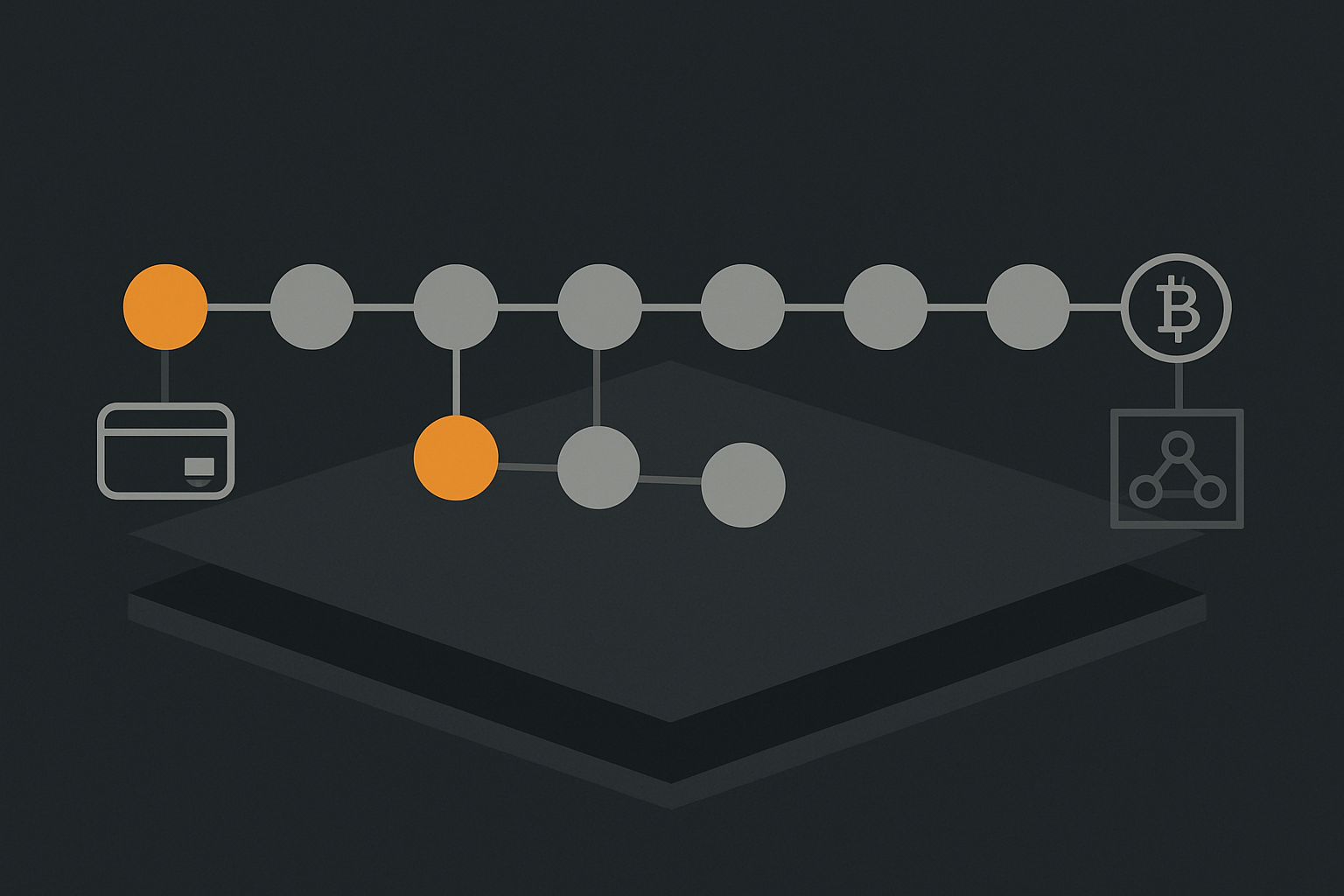
Here is the implementation sequence that works in production. Each step has a gate — do not move to the next until the current one is validated.
- Register and configure your account. Set your currency preferences, confirmation thresholds per currency, and IPN (Instant Payment Notification) endpoint URL. For most gateways this is a dashboard operation, not a code operation.
- Generate or connect your wallet. For non-custodial setups, export your xpub and configure it in the gateway. Test address derivation against your own node before going further.
- Configure your webhook endpoint. Your IPN endpoint must be publicly reachable, must return HTTP 200 on success, and must be idempotent — it will receive duplicate events. More on this in the next section.
- Create a test invoice via API. Verify the response includes a unique payment address, an amount in the requested currency, an expiry timestamp, and an invoice ID you control.
- Send a test transaction on testnet or with minimal value. Confirm your system receives the pending webhook, then the confirmed webhook, then updates order state correctly.
- Validate idempotency. Replay the confirmed webhook manually. Confirm your system does not double-fulfill the order.
- Test expiry handling. Let an invoice expire without payment. Confirm your system marks the order correctly and does not leave a zombie invoice open.
- Load test your webhook endpoint. High-volume merchants will receive bursts during peak traffic. Your endpoint needs to queue and process, not block.
- Document your confirmation thresholds. For Bitcoin, many teams use 2–3 confirmations for lower-value orders and 6 for high-value. For faster chains, set thresholds based on finality guarantees, not just time.
- Go live with a soft launch. Process a small number of real transactions before enabling for all customers. Monitor logs obsessively for the first 48 hours.
For a broader look at how this fits into a complete merchant workflow, the guide on how to accept crypto payments for your business covers the end-to-end merchant perspective including compliance and customer UX decisions.
Webhook Design and Payment State Management
Webhooks are where most integrations break. Not because the documentation is wrong, but because developers do not model the full state machine before writing the handler.
A payment has more than two states. At minimum your system needs to represent: created, pending (seen on mempool), partially paid, confirmed, overpaid, underpaid, expired, and refund-initiated. Most e-commerce frameworks have a boolean "paid" field. That is not enough.
Practical rule: Build your payment state machine before you write a single line of webhook handler code. Every possible gateway event should map to a valid state transition. If it does not, the event should be logged and queued for manual review — not silently dropped.
Idempotency Is Not Optional
Gateways retry webhook delivery. They do this because HTTP is unreliable and your endpoint will occasionally return a 500. A correct retry policy means you will receive the same confirmed event multiple times. Your handler must be idempotent: processing the same event twice should produce the same outcome as processing it once.
The implementation is straightforward: store the event ID when you first process it, check for it before processing, and return 200 if you have already handled it. The mistake teams make is adding idempotency as an afterthought after a production incident.
Signature Verification
Every reputable gateway signs its webhook payloads with a shared secret or asymmetric key. Verify the signature before you process any event. Do not trust the payload's claimed invoice ID without cryptographic verification — an attacker who knows your webhook URL can send fabricated confirmation events.
Reconciliation: The Work Nobody Talks About

Reconciliation is the process of confirming that what your database says happened matches what the blockchain says happened. Most teams skip it until they have a dispute they cannot resolve.
What breaks in practice is that your database and the blockchain drift. A webhook fails to deliver, you mark an order as unpaid, the customer has a confirmed transaction on-chain. Now you have a support ticket, a frustrated customer, and no automated path to resolution.
Building a Reconciliation Feed
A reconciliation feed polls the blockchain (or the gateway's transaction API) on a schedule — typically hourly for low-volume merchants, continuously for high-volume — and compares confirmed on-chain transactions against your internal order records. Any discrepancy triggers an alert and, where possible, an automated correction.
For each currency you accept, maintain:
- The derivation index range of addresses you have ever issued
- The last block height you have reconciled to
- A log of all IPN events received, including duplicates
The Overpayment and Underpayment Problem
Customers occasionally send the wrong amount. Your system needs a defined policy for both cases. Overpayments are operationally straightforward (credit the difference or issue a refund) but require a refund address workflow. Underpayments require a decision: hold the order, request top-up, or cancel and refund.
Define these policies before launch. Leaving them undefined means customer support makes ad-hoc decisions, creating inconsistency and potential compliance issues.
Common Failure Modes in Production
Here are the failure modes that appear most often in production crypto payment integrations, and what actually causes them.
| Failure Mode | Root Cause | Prevention |
|---|---|---|
| Double fulfillment | Non-idempotent webhook handler | Event ID deduplication before processing |
| Missed payment (webhook not delivered) | Endpoint downtime during event | Reconciliation feed as fallback |
| Expired invoice still monitored | State machine not updated on expiry | Explicit expiry handling in state transitions |
| Wrong confirmation count | Threshold not set per-currency | Per-currency config, not global default |
| Signature bypass | Signature verification skipped in dev | Enforce verification in all environments |
| Fee underpayment | Customer sends net-of-fee amount | Accept amount validation with tolerance |
| Address reuse | Caching address instead of generating per-invoice | Enforce one address per invoice at the API layer |
The pattern you will notice: almost every failure mode is a state management problem, not a crypto problem. The blockchain is doing its job. Your application is not correctly modeling the state it puts it in.
Compliance, KYC, and Merchant Obligations
Many developers treat compliance as someone else's problem. It is not. When you integrate a crypto payment gateway, you become a participant in a regulated activity in most jurisdictions.
The practical question is: what obligations does accepting crypto payments create for your business?
At minimum, most jurisdictions require:
- Transaction records for tax reporting purposes
- AML screening if you are processing above certain thresholds
- Disclosure to customers that you accept cryptocurrency as payment
Gateway providers handle some of this — particularly address screening against sanctions lists — but they do not handle your tax reporting. You need to export transaction records and account for realized gains or losses if you hold rather than immediately convert.
For merchants operating in multiple jurisdictions, the CoinPay blog covers ongoing regulatory updates relevant to merchant crypto operations.
Key-management compliance is also a real consideration: if you use a non-custodial setup, your xpub management and backup procedures become a compliance artifact, not just an operational one.
Choosing a Gateway: What Actually Differentiates Them
Most gateway comparison guides focus on fee percentages. That is not the most important variable for developers or serious merchants.
| Factor | Why It Matters |
|---|---|
| Custody model | Determines counterparty risk and key ownership |
| Webhook reliability and retry policy | Determines your recovery path when events are missed |
| API rate limits | Determines whether your integration can scale |
| Confirmation threshold configurability | Determines your fraud exposure per order value |
| Multi-currency address derivation | Determines whether you need separate wallets per currency |
| Reconciliation API / export format | Determines how much manual work you do monthly |
| Settlement speed and sweep thresholds | Determines your cash flow if you convert to fiat |
| Developer documentation quality | Determines your integration timeline and edge case coverage |
Fee percentage matters, but a gateway with a 0.5% fee and poor webhook reliability will cost you more than one with a 1% fee and a solid delivery guarantee. The CoinPay pricing page shows how transparent fee structures work in practice for a non-custodial gateway.
For merchants who also care about on-chain liquidity dynamics — relevant when you accept volatile assets and need to understand spread and slippage on conversion — the guide on market making in cryptocurrency gives useful context on why market depth affects the net amount you receive after conversion.
The Non-Custodial Advantage in 2026
The trend in production merchant integrations is firmly toward non-custodial architectures. Regulatory pressure on custodial intermediaries, high-profile gateway failures, and the availability of mature non-custodial infrastructure have changed the default calculus. If you are setting up a new integration today, the burden of proof should be on the custodial option, not the non-custodial one.
The CoinPay dashboard gives merchants real-time visibility into payment state, address derivation, and confirmation status without the gateway ever touching funds — which is what a well-designed non-custodial integration looks like operationally.
Crypto payment gateway setup is not a configuration task. It is an architectural decision that determines your custody exposure, your state management complexity, your compliance obligations, and your recovery options when things go wrong. Teams that treat it as an afternoon integration consistently run into production incidents that take weeks to debug.
The practical answer is to start with the custody boundary, build the state machine before writing handler code, invest in reconciliation from day one, and choose a gateway based on operational characteristics rather than headline fee percentage.
Try coinpayportal.com
CoinPayPortal is a non-custodial crypto payment gateway for developers, merchants, and fintech builders who need reliable crypto payment infrastructure without handing over custody of their funds. Register and start integrating — no custodial risk, transparent fees, and webhook delivery you can actually depend on.
Try CoinPay
Crypto payments, escrow, and wallets — multi-chain, Lightning-ready, and fast to integrate.
Get started →