Crypto Payment Processing in 2026: Architecture, APIs, Webhooks, and Merchant Operations

A customer pays in crypto. Your storefront says pending. The blockchain explorer says confirmed. Your finance team says the order is missing from the payout report. Support gets the ticket.
That is the real crypto payment processing problem.
Teams think the problem is accepting coins at checkout. The real problem is running a payment workflow where state, trust, settlement, inventory, refunds, and support all agree with each other.
In 2026, crypto payment processing is less about adding a shiny wallet option and more about designing a reliable transaction system. The checkout UI matters, but it is the thinnest part of the stack. The practical question is whether your API calls, webhook handlers, confirmation rules, reconciliation jobs, and merchant operations can survive production behavior.
Table of contents
- Crypto payment processing is a state machine, not a button
- Map the full payment lifecycle before picking tools
- Choose the right crypto payment processing model
- Design the API contract around idempotency and state
- Webhooks are where most crypto payment processing breaks
- Confirmations, risk, and finality are business decisions
- Reconciliation is the operating system of merchant trust
- Custody, escrow, and settlement boundaries matter
- What works and what fails in production
- Where coinpayportal.com fits in the architecture
Crypto payment processing is a state machine, not a button
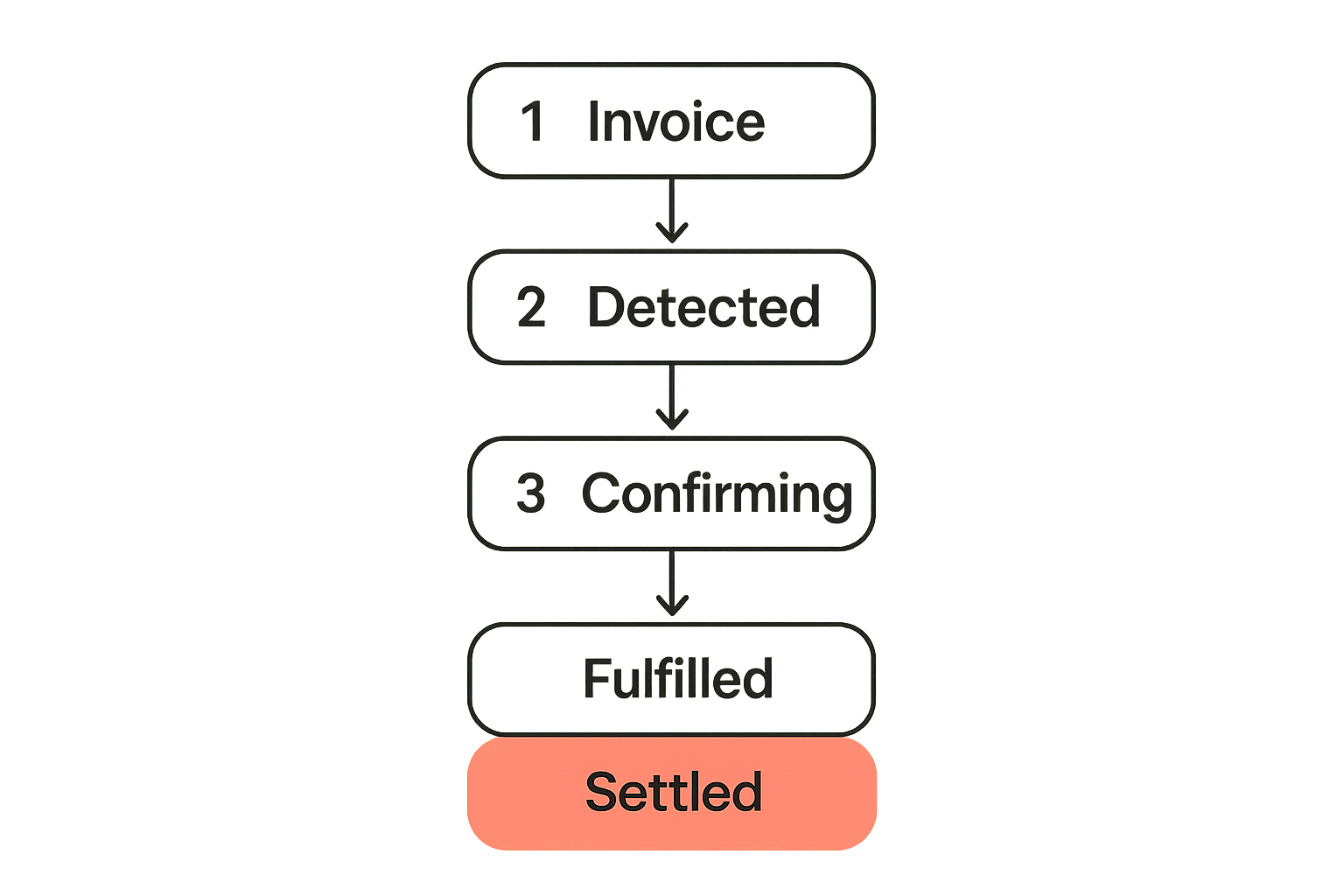
The mistake teams make is treating crypto payment processing like a payment method toggle. Add wallet address. Show QR code. Wait for funds. Mark order paid.
That works in a demo. It breaks when customers pay late, send the wrong amount, choose the wrong network, reload the checkout page, double-submit an order, or open a dispute after fulfillment.
A useful way to think about it is: every payment is a state machine. Your system creates intent, observes payment evidence, evaluates risk, updates the order, settles funds, and records the accounting trail.
The invoice is the source of commercial truth
The invoice should define what is being paid for, how much is due, which currencies or networks are accepted, when the quote expires, and what happens after payment.
Do not let a blockchain transaction alone define the purchase. A transfer only proves that value moved. It does not prove which cart, subscription, customer, tax rule, shipping address, or fulfillment action it belongs to.
Practical rule: Treat the invoice as the commercial record and the blockchain transaction as settlement evidence.
The chain is settlement evidence, not your order system
Blockchains are good at recording transfers. They are not good at understanding your merchant workflow. Your ecommerce platform needs order IDs, SKUs, customer records, support notes, refund policy, and tax handling.
When teams use the chain as the order system, they end up parsing explorers during support tickets and manually guessing customer intent. That changes the conversation from payments to incident response.
The payment processor coordinates both sides
A crypto payment processor should sit between commerce intent and chain evidence. It should create payment requests, monitor addresses or payment sessions, emit events, expose status, and give merchants a usable operational record.
If you are already evaluating gateway setup tradeoffs, the earlier CoinPay guide on crypto payment gateway setup covers the surrounding custody, webhook, and reconciliation decisions in more detail.
Map the full payment lifecycle before picking tools
Most bad crypto payment processing implementations start with vendor comparison before workflow mapping. The team asks which processor supports the most coins. A better first question is which system will own each state transition.
Checkout creation
At checkout, your application should create a payment session with a stable merchant order reference. The response should include accepted assets, payment address or URI, amount, expiration time, and a processor-side payment ID.
You need to decide whether prices are quoted in fiat, crypto, or both. Fiat-denominated pricing is common for merchants because inventory, taxes, and margins are usually tracked in local currency. Crypto-denominated pricing may fit digital-native products, but it still needs expiry rules because exchange rates move.
Payment detection and confirmation
Payment detection is not the same as payment confirmation. A processor may detect an incoming transaction quickly, but your business may require confirmations before fulfillment.
For low-risk digital goods, you may allow provisional access after detection and finalize after confirmation. For high-value goods, you may wait longer. For irreversible delivery, you need stricter rules.
Related reading from our network: teams building decentralized compute marketplaces face similar workflow boundaries around jobs, payments, and settlement in cloud computing services for decentralized compute builders.
Fulfillment, settlement, and support
Fulfillment should be triggered by a durable payment state, not by a browser callback. Settlement should be visible to finance, not buried in wallet history. Support should be able to answer: what was expected, what was received, when it was confirmed, and what action the system took.
What breaks in practice is usually not the happy path. It is the edge case nobody assigned to an owner.
Choose the right crypto payment processing model
There is no single correct model. There are tradeoffs around control, speed, custody, support load, and engineering capacity.
| Model | Best fit | Main advantage | Main risk |
|---|---|---|---|
| Hosted checkout | Merchants that want fast deployment | Less frontend and wallet complexity | Less control over UX |
| API-first gateway | SaaS, marketplaces, custom commerce flows | Strong control over state and integration | Requires disciplined backend work |
| Self-hosted direct-chain | Teams with blockchain operations maturity | Maximum control | Monitoring, security, and support burden |
| Escrow-enabled processing | Marketplaces and conditional delivery | Better buyer-seller trust workflow | More complex release and dispute logic |
Hosted checkout
Hosted checkout is the fastest path. The customer leaves your site or opens an embedded payment page, completes the crypto payment, and returns after status changes.
This model is useful when your team does not want to maintain wallet-specific UI, address display logic, network warnings, or mobile wallet deep links. It is less ideal when you need full control over checkout experience or complex marketplace behavior.
API-first gateway
An API-first gateway gives your backend control. You create payment sessions, store processor IDs, consume webhooks, and decide how payment status maps to order status.
This is usually the better fit for developers, fintech founders, and merchants with custom commerce flows. It also forces you to build the right internal model: payment state lives server-side, not in a customer browser tab.
For implementation details, gateway references, and endpoint behavior, developers should keep the CoinPay documentation close during integration planning rather than treating docs as a final QA step.
Self-hosted and direct-chain processing
Self-hosted processing can work, but it is rarely free. You need address generation, node or indexer reliability, mempool awareness, confirmation tracking, chain reorg handling, hot wallet security, treasury operations, and customer support tooling.
The practical question is not whether your engineering team can build it. It is whether the payment system should become a core operating burden.
Design the API contract around idempotency and state
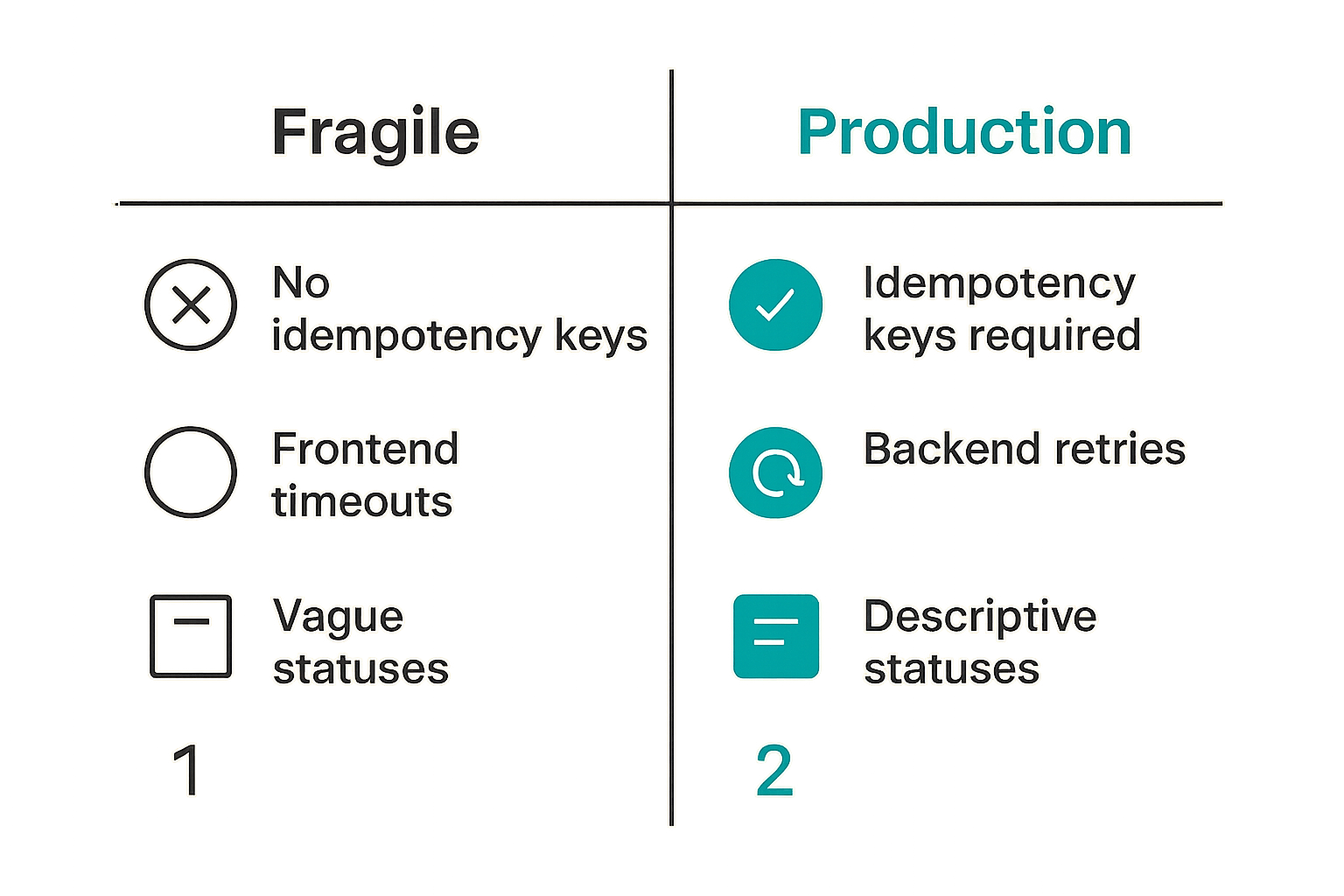
Payment APIs fail in boring ways: retries, timeouts, duplicate submissions, race conditions, stale frontend state, and missing metadata. Crypto adds irreversible settlement, so sloppy state handling gets expensive.
Idempotency keys are not optional
Every payment creation request should include an idempotency key or equivalent merchant order reference. If your server retries after a timeout, it should not create two invoices for the same cart.
Example request shape:
POST /payments
idempotency-key: order_9841_attempt_1

amount_fiat: 129.00
currency_fiat: USD
accepted_assets: BTC, USDT, ETH
merchant_order_id: order_9841
success_url: https://merchant.example/orders/9841
cancel_url: https://merchant.example/cart
The response should return a processor payment ID that your system stores permanently.
Practical rule: If a retry can create a second payable invoice, the integration is not production-ready.
Statuses should describe business reality
Avoid vague states like complete unless everyone agrees what complete means. Better payment states include created, awaiting_payment, detected, underpaid, overpaid, confirming, confirmed, expired, refunded, dispute_open, and settled.
Your commerce system can then map these to order states. For example, detected may show the customer that payment was seen, while confirmed triggers fulfillment.
Never let the frontend own payment truth
The frontend can display status. It should not decide status. Browser redirects, wallet callbacks, and client polling are all advisory.
Your backend should poll or receive webhooks from the processor, validate the event, update the payment record, and only then update the order. If the user closes the tab, payment processing should continue.
Webhooks are where most crypto payment processing breaks
Webhooks look simple until they are the only thing standing between a confirmed payment and a missing order. The typical mistake is writing webhook code as if it will run once, in order, with perfect payloads.
It will not.
Verify, persist, then act
Webhook handling should follow a strict sequence:
- Receive the event.
- Verify signature or authentication.
- Persist the raw event with timestamp and event ID.
- Check whether the event was already processed.
- Load the related payment and order.
- Apply a valid state transition.
- Emit internal commands for fulfillment, email, or ledger updates.
Do not perform fulfillment before storing the event. If fulfillment fails and the webhook is lost, you have created a support problem.
Handle duplicates and out-of-order events
Duplicate webhook delivery is normal. Out-of-order delivery is also possible. Your handler needs event IDs, payment IDs, state transition rules, and safe reprocessing.
A confirming event should not move a refunded payment backward. A detected event that arrives after confirmed should be stored but not downgrade status. An expired invoice should be able to move to paid_late if funds arrive after expiry.
Practical rule: Webhook consumers should be idempotent, replayable, and boring.
Separate payment events from fulfillment commands
Do not pack all business logic into the webhook controller. The webhook is an ingestion boundary. It should verify and persist external truth, then hand off to internal workflows.
This separation makes retries safer. It also lets support replay internal actions without asking the processor to resend an event.
Related reading from our network: if your payment pages depend on search or AI discovery, cloud computing answer engine optimization is adjacent reading on making technical pages easier for crawlers and answer systems to interpret.
Confirmations, risk, and finality are business decisions
A processor can expose confirmation count. It cannot decide your risk tolerance. That decision belongs to the merchant.
Different assets need different rules
Bitcoin, Ethereum, stablecoins on different chains, Lightning payments, and other networks do not behave identically. Confirmation time, fee behavior, reorg risk, and customer expectations differ.
A merchant selling a 20 dollar digital file can accept a different risk profile than a merchant shipping a 4,000 dollar hardware order.
Inventory risk changes confirmation policy
If you reserve scarce inventory before confirmation, late or failed payment creates opportunity cost. If you wait for confirmation before reservation, customer experience may suffer.
The right answer depends on inventory type. For digital goods, you may provision after payment detection with reversible access. For physical goods, you may reserve inventory for a limited time and release it if payment expires.
Refunds need their own control path
Crypto refunds are not card refunds. You usually need a destination address, network selection, fee policy, approval workflow, and fraud checks. Sending funds back to the originating address is not always safe or correct, especially with exchange wallets.
Refund workflow should be explicit: request, validate, approve, broadcast, confirm, record. Do not turn refund handling into a support Slack thread.
Reconciliation is the operating system of merchant trust
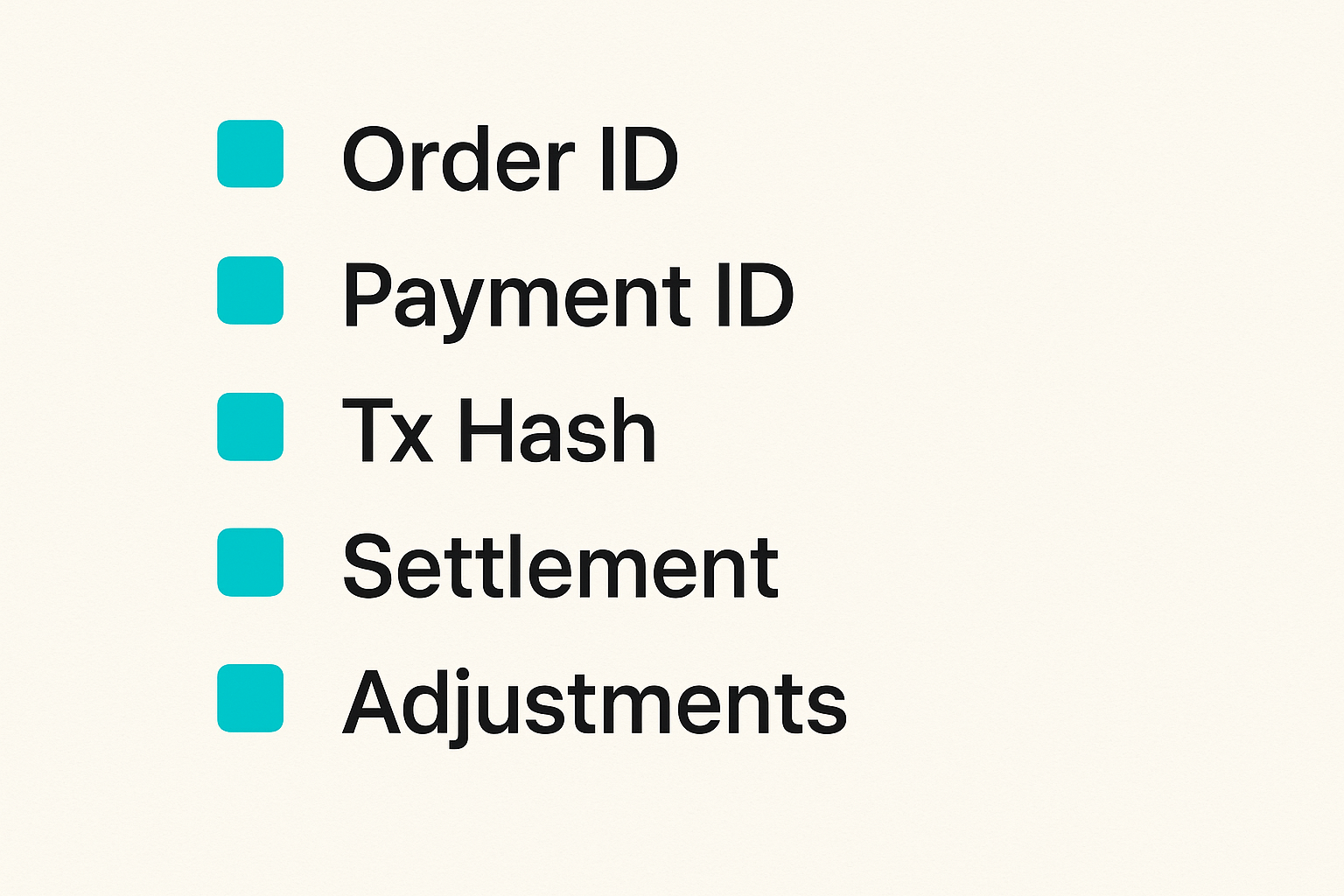
Reconciliation is where crypto payment processing becomes a real business system. If finance cannot match customer orders to received funds and settlements, the integration will lose trust even if checkout conversion looks fine.
Match invoices, transactions, and settlements
A usable reconciliation model links four records:
- Merchant order ID
- Processor payment ID
- On-chain transaction hash or payment proof
- Settlement or payout record
Each record answers a different question. The order says what was sold. The payment ID says what was requested. The transaction says what arrived. The settlement record says what the merchant can use or account for.
Make underpayments and overpayments visible
Underpayments and overpayments are common enough that they need first-class handling. A customer may send less because of wallet fees, select the wrong network, or reuse an old quote. A customer may overpay because they manually typed the amount.
Do not hide these cases in generic failed states. Support needs visible categories and recommended actions: request remainder, refund difference, accept tolerance, or escalate.
Give finance a usable ledger
Finance teams need exports that include timestamps, fiat value at quote, asset amount, network fees where relevant, transaction IDs, settlement status, and adjustments.
A dashboard is helpful, but exports and APIs matter more. Month-end close should not require copying transaction hashes into spreadsheets from a block explorer.
Custody, escrow, and settlement boundaries matter
Custody is not only a legal or compliance topic. It changes the architecture of your payment system.
Non-custodial does not mean no responsibility
A non-custodial gateway can reduce the need for the processor to hold merchant funds, but the merchant still has responsibilities: secure wallets, maintain payout addresses, manage treasury policy, and handle refunds.
The benefit is control. The tradeoff is operational maturity. If nobody owns wallet security and reconciliation, non-custodial architecture becomes a slogan instead of a system.
Escrow changes the trust model
Marketplaces, freelance platforms, and high-value transactions often need conditional release. In that case, the payment flow is not simply customer pays and merchant fulfills. It becomes customer funds, seller performs, buyer accepts or time expires, funds release.
If your workflow needs conditional release, evaluate crypto escrow flows as part of the payment architecture rather than bolting escrow on after disputes appear.
Settlement currency is an operational choice
Some merchants want to keep crypto. Others want stablecoins. Others want fiat conversion through a provider. The right settlement model depends on volatility tolerance, accounting process, jurisdiction, supplier costs, and treasury policy.
Do not let the checkout asset list decide treasury strategy. Asset acceptance and settlement currency are related, but they are not the same decision.
Related reading from our network: even coupon and promotion systems have checkout-state edge cases, and the workflow framing in Shutterfly promo codes checkout workflow is a useful reminder that checkout reliability is rarely just a UI problem.
What works and what fails in production
The difference between a demo and production crypto payment processing is not elegance. It is whether the system has answers for edge cases before customers discover them.
What works
Strong implementations usually share the same habits:
- Server-side payment creation with stable merchant references
- Idempotent APIs and webhook consumers
- Explicit status mapping between payment and order systems
- Confirmation policies by asset, network, and order risk
- Reconciliation reports that finance can actually use
- Support views that show expected amount, received amount, transaction proof, and next action
- Separate workflows for refunds, late payments, and disputes
Practical rule: Build the support and reconciliation view before launch, not after the first missing-payment ticket.
What fails
Weak implementations usually fail in predictable ways:
- The frontend marks orders paid after a redirect
- The backend creates duplicate invoices after retrying a timeout
- Webhooks update orders without signature verification
- Underpayments get treated as generic failures
- Expired payments are ignored even after funds arrive
- Finance cannot match payouts to orders
- Refunds are handled manually without audit trail
The mistake teams make is optimizing for checkout launch while ignoring the operating surface that starts after payment.
A practical implementation sequence
Use this sequence if you are integrating crypto payments into a serious commerce system:
- Define payment states and order-state mapping.
- Decide accepted assets, networks, pricing currency, and quote expiry.
- Choose hosted checkout, API-first gateway, self-hosted, or escrow-enabled flow.
- Implement payment creation with idempotency.
- Store processor payment IDs and merchant order references.
- Build webhook ingestion with signature verification, event persistence, and replay safety.
- Add confirmation policies by asset and order risk.
- Implement reconciliation exports and finance views.
- Create support actions for underpayment, overpayment, late payment, refund, and dispute.
- Test retries, duplicate webhooks, expired invoices, wrong amounts, and chain delays before launch.
This is not excessive process. It is the minimum architecture needed to keep payment state from becoming tribal knowledge.
Where coinpayportal.com fits in the architecture
Crypto payment processing should remove coordination work, not create a second operations department. The useful gateway is the one that helps developers connect checkout, payment state, merchant controls, and settlement visibility without hiding the hard parts.
Use the gateway to reduce coordination work
For developers and merchants, coinpayportal.com is positioned around the practical parts of crypto payment infrastructure: payment sessions, real-time processing, non-custodial workflows, and merchant-side control.
That does not eliminate the need for good application design. It gives your system a clearer boundary. Your app owns commerce state. The gateway owns payment coordination. Your finance and support workflows consume the resulting records.
Keep merchant control where it matters
Good crypto payment processing architecture should let merchants control what matters: accepted payment options, custody boundaries, order fulfillment rules, refunds, and customer communication.
At the same time, it should avoid forcing every merchant to build chain monitoring, fee handling, payment detection, and status workflows from scratch. That is the balance developers should look for.
For merchants still deciding whether crypto belongs in the checkout flow at all, CoinPay also has a practical guide on how to accept crypto payments that frames the business and integration choices before implementation.
Closing the loop on crypto payment processing
Crypto payment processing is not a wallet address generator. It is a transaction workflow across checkout, APIs, webhooks, confirmations, settlement, reconciliation, and support.
If those pieces are designed together, crypto can become a reliable payment rail. If they are designed separately, every edge case becomes a manual investigation.
The practical question is not whether you can accept crypto. It is whether your crypto payment processing system can explain every payment from customer intent to final settlement.
Try coinpayportal.com
You are writing for developers and merchants building crypto payment infrastructure. Start with Try coinpayportal.com.
Try CoinPay
Crypto payments, escrow, and wallets — multi-chain, Lightning-ready, and fast to integrate.
Get started →