Crypto Payment Gateway Architecture: A Practical 2026 Guide for Developers and Merchants
A crypto payment gateway looks simple until the first customer pays the right amount on the wrong network, the webhook times out, support asks whether the order is paid, and finance wants to know why yesterday’s settlement total does not match the storefront.
Teams think the problem is accepting coins. The real problem is building a payment workflow that can prove what happened, recover from partial failure, and keep checkout, fulfillment, support, and accounting in the same reality.
That changes the conversation. The practical question is not “which button can I add to my site?” It is “what system of record will decide payment state when blockchains, wallets, APIs, exchange rates, and merchant operations disagree?”
In 2026, a crypto payment gateway is an architecture decision. The UI matters, but the hard parts are state, trust, settlement, refunds, reconciliation, and operational ownership.
Table of contents
- A crypto payment gateway is a workflow, not a widget
- Crypto payment gateway architecture starts with the payment state machine
- Checkout design is really an intent-capture problem
- Webhooks, callbacks, and idempotency decide reliability
- Custody boundaries change your risk model
- Settlement and reconciliation are where the real work appears
- What works and what fails in production
- Implementation workflow for a production crypto payment gateway
- Operational controls merchants should require
- Where coinpayportal.com fits in the architecture
- Closing checklist for choosing a crypto payment gateway
A crypto payment gateway is a workflow, not a widget
A crypto payment gateway sits between a buyer, a merchant system, one or more blockchain networks, and the merchant’s post-payment operations. If you treat it like a hosted button, you will ship quickly and then spend months dealing with edge cases manually.
The mistake teams make is assuming crypto checkout ends when an address is displayed. In production, checkout ends when the order can be fulfilled, the payment can be reconciled, the merchant can defend the record, and support can answer customer questions without asking engineering to inspect a block explorer.
What the gateway actually owns
A useful way to think about it is that a gateway owns payment evidence. It does not necessarily own your product catalog, customer account, fulfillment policy, or accounting ledger. But it should help you answer these questions:
- What did the customer intend to pay?
- Which asset, network, amount, address, and expiry were assigned?
- Did funds arrive?
- Was the payment underpaid, overpaid, late, duplicated, or on the wrong network?
- How many confirmations are required before fulfillment?
- Which webhook events were sent and acknowledged?
- What settlement or withdrawal path applies?
If the gateway cannot provide durable answers to those questions, your merchant system becomes a forensic tool. That is a bad place to put your checkout team.
Where merchants usually underestimate complexity
Merchants usually underestimate three things: asynchronous settlement, customer wallet behavior, and operational ambiguity.
A card payment often gives the merchant a near-instant authorization object. A blockchain payment gives you a public transaction that may be seen, replaced, delayed, confirmed, reorged on some chains, or sent with the wrong memo or chain selection. Wallet UX is inconsistent. Some wallets let users edit amounts. Some exchanges batch withdrawals. Some customers pay from custodial platforms that do not behave like normal wallets.
Related reading from our network: teams working on media infrastructure face similar architecture problems around state, storage, and delivery guarantees in computer systems technology for streaming and home media.
Practical rule: Do not evaluate a crypto payment gateway by the checkout screen alone. Evaluate the evidence trail it leaves behind when something goes wrong.
Crypto payment gateway architecture starts with the payment state machine
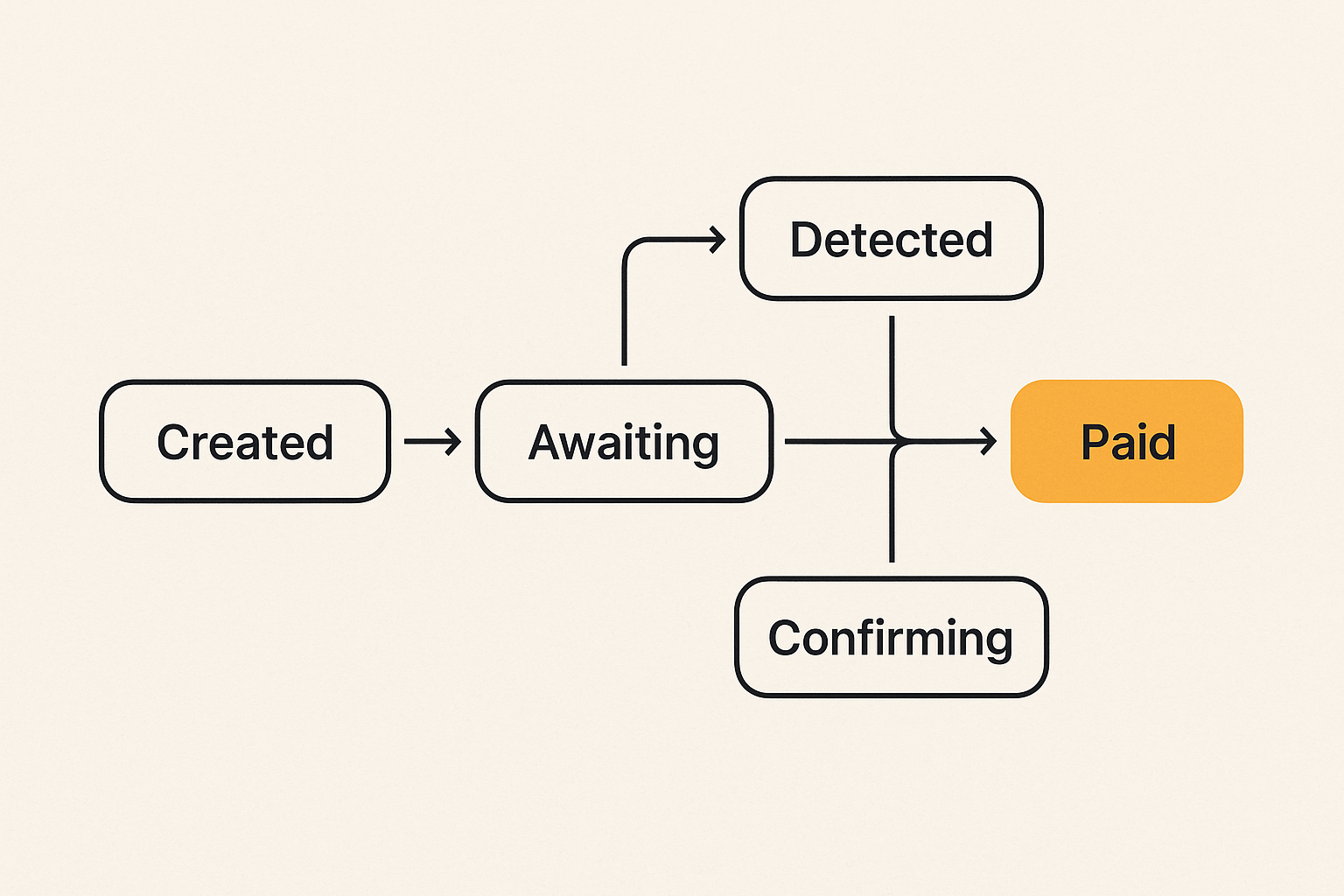
A production crypto payment gateway needs a state machine before it needs a beautiful payment modal. Without explicit states, every downstream system invents its own interpretation of “paid.” That is how teams end up with fulfilled unpaid orders, duplicate support tickets, and finance spreadsheets that never match.
A good state model should be boring. Boring is useful here because payment state must survive retries, delayed confirmations, duplicate events, and human review.
The minimum states you need
At minimum, design around these states:
| State | Meaning | Typical owner | Merchant action |
|---|---|---|---|
created | Payment intent exists but no address or quote is finalized | Merchant or gateway | Do not fulfill |
awaiting_payment | Address, asset, amount, and expiry are assigned | Gateway | Show checkout |
detected | Transaction seen but not final enough | Gateway | Hold fulfillment |
confirming | Required confirmations are in progress | Gateway | Prepare fulfillment only |
paid | Payment meets policy | Merchant system | Fulfill or unlock |
underpaid | Funds arrived below required threshold | Gateway plus support | Ask for top-up or review |
overpaid | Funds exceed requested amount | Gateway plus support | Fulfill, refund excess, or review |
expired | Payment window closed before valid funds arrived | Gateway | Create new intent if needed |
failed | Gateway cannot accept this payment as valid | Gateway | Stop fulfillment |
refunded | Merchant sent funds back or issued remedy | Merchant or gateway | Close support loop |
The exact names do not matter as much as the transitions. What breaks in practice is allowing random services to move an order from awaiting_payment to paid without a signed, replay-safe, auditable event.
Why pending is not a failure state
Pending is where most crypto payments live temporarily. Treating pending as an error creates bad customer experience and bad operations. Treating pending as paid creates fraud and fulfillment risk.
The right behavior depends on the business:
- Digital goods may wait for fewer confirmations on low-risk assets.
- High-value orders may require deeper confirmation policy.
- Time-sensitive checkout may expire quotes quickly but still detect late funds.
- B2B invoices may tolerate long settlement windows.
For a deeper setup walkthrough, the prior CoinPay guide on crypto payment gateway setup is useful if you are mapping provider APIs into an existing merchant stack.
Practical rule: “Pending” is not a bug. It is a first-class payment state that needs UI copy, webhook behavior, support handling, and reconciliation logic.
Checkout design is really an intent-capture problem
A checkout page should not simply ask a wallet to send money. It should capture an intent that both the merchant and gateway can defend later.
The intent is the contract between systems: customer, order, asset, amount, network, quote time, expiry, destination, metadata, and policy. If that contract is vague, everything after checkout becomes guesswork.
Create payment intent before showing an address
A basic payment intent should include:
{
  "merchant_order_id": "ord_98117",
  "customer_id": "cus_442",
  "asset": "USDC",
  "network": "polygon",
  "amount": "49.00",
  "currency": "USD",
  "quote_expires_at": "2026-06-04T15:20:00Z",
  "success_url": "https://merchant.example/orders/ord_98117/success",
  "cancel_url": "https://merchant.example/checkout",
  "metadata": {
    "plan": "pro_monthly",
    "cart_hash": "9b1f..."
  }
}
The gateway can then return the payment address, requested crypto amount, network, expiration time, and an ID that your system stores. Store that gateway payment ID on your order record immediately.
Do not wait until a webhook arrives to associate the order. By then, you are already debugging from incomplete context.
Do not let the frontend be the source of truth
The frontend can display state, but it should not decide state. Browser sessions close. Mobile wallets redirect inconsistently. Customers refresh pages. Ad blockers and privacy tools interfere with scripts. A checkout tab is not a ledger.
The backend should own these actions:
- Creating the payment intent.
- Persisting gateway IDs.
- Verifying webhook signatures.
- Applying idempotent state transitions.
- Triggering fulfillment only after valid payment state.
- Recording reconciliation data.
The frontend should poll or subscribe to the backend’s order state, not directly trust a client-side callback.
Related reading from our network: the same “frontend visibility is not operational truth” issue appears in search and AEO systems, where teams need server-side evidence for how content is parsed by AI content LLM crawlers.
Webhooks, callbacks, and idempotency decide reliability
Webhooks are where crypto payment gateway integrations either become reliable or become a support queue. A webhook is not a magic notification. It is an unreliable message over a network about an important event that may be delivered more than once, out of order, or after your service had a temporary failure.
That sounds harsh, but it is the correct mental model.
Treat every webhook as unreliable but important
Your handler should assume:
- The same event may be delivered multiple times.
- Events may arrive after the customer leaves checkout.
- Your endpoint may return a timeout even though your database write succeeded.
- The gateway may retry delivery.
- Your queue worker may process messages later.
- A later state may arrive before an earlier state.
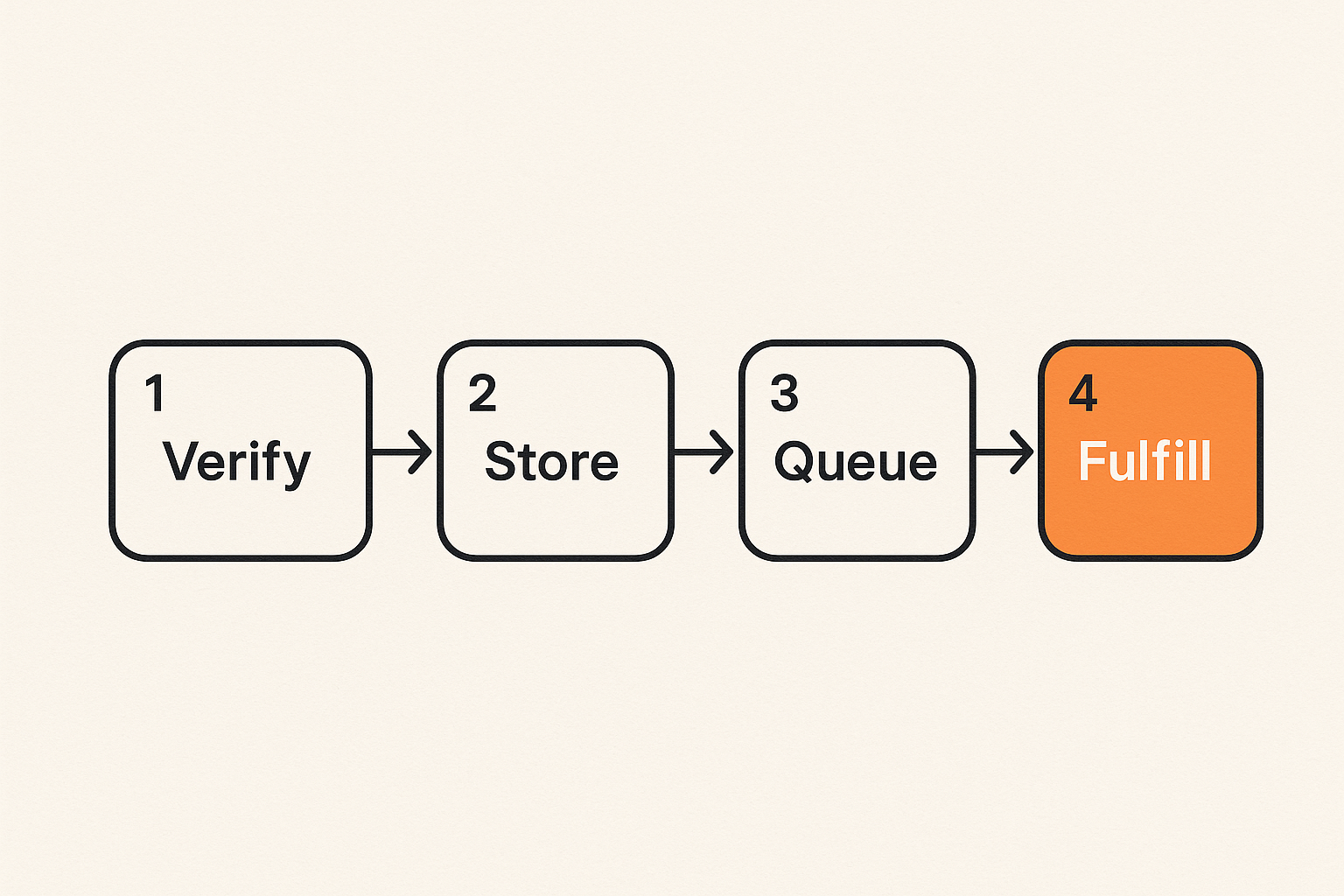
A good webhook endpoint does as little as possible synchronously. It verifies the signature, records the raw event, acknowledges quickly, and moves processing into a queue or transactional worker.
Do not run fulfillment directly inside the HTTP request handler unless you enjoy debugging duplicate shipments.
Use idempotency keys for every write
Idempotency means the same event can be processed more than once without changing the outcome incorrectly. For crypto payments, idempotency should exist at several layers:
- Gateway event ID.
- Payment intent ID.
- Blockchain transaction hash plus output details.
- Merchant order ID.
- Fulfillment action ID.
A simplified database pattern:
CREATE TABLE payment_events (
  id BIGSERIAL PRIMARY KEY,
  gateway_event_id TEXT UNIQUE NOT NULL,
  payment_id TEXT NOT NULL,
  event_type TEXT NOT NULL,
  payload JSONB NOT NULL,
  received_at TIMESTAMPTZ NOT NULL DEFAULT now(),
  processed_at TIMESTAMPTZ
);

CREATE TABLE payment_state_transitions (
  id BIGSERIAL PRIMARY KEY,
  payment_id TEXT NOT NULL,
  from_state TEXT NOT NULL,
  to_state TEXT NOT NULL,
  gateway_event_id TEXT NOT NULL UNIQUE,
  created_at TIMESTAMPTZ NOT NULL DEFAULT now()
);
Then your worker can reject duplicate gateway events while still preserving the raw payload for audit.
Practical rule: A webhook handler should be replay-safe before it is feature-complete. If replaying yesterday’s events breaks your orders, the integration is not production-ready.
Custody boundaries change your risk model
A crypto payment gateway can be custodial, non-custodial, hybrid, or escrow-oriented. Those words are often used casually, but they change your operational and legal risk profile.
The practical question is: who can move funds, when, under what conditions, and with what audit trail?
Non-custodial does not mean no responsibility
A non-custodial crypto payment gateway may avoid holding merchant funds, but the merchant still needs operational control. You still need to know which addresses are assigned, which payments were detected, which assets you accept, and what happens when customers make mistakes.
Non-custodial architecture often appeals to developers and merchants because it keeps the gateway from becoming the ultimate holder of funds. But it does not remove the need for:
- Secure wallet operations.
- Address management.
- Refund policy.
- Private key separation.
- Access controls.
- Transaction monitoring.
- Reconciliation.
If your business wants to understand the tradeoffs around lower-friction onboarding, the CoinPay article on a crypto payment gateway without KYC covers the non-custodial and risk boundary conversation in more detail.
Escrow is a separate product decision
Escrow is not just “hold the money for a while.” Escrow changes the trust model between buyer, seller, and platform. It introduces release rules, dispute windows, evidence handling, and sometimes arbitration workflows.
For marketplaces, high-ticket services, or peer-to-peer commerce, escrow may be the correct architecture. For simple retail checkout, it may be unnecessary complexity.
If you need funds to be held until conditions are met, design escrow as an explicit workflow. CoinPay’s escrow page is relevant when the payment flow requires conditional release rather than immediate merchant settlement.
Settlement and reconciliation are where the real work appears
Settlement is the part merchants notice when the launch excitement fades. Reconciliation is the part finance notices when the numbers do not match.
A crypto payment gateway should make it possible to connect customer orders to on-chain transactions, settlement records, fees, refunds, and internal accounting entries. If it cannot, your team will eventually build a shadow ledger in spreadsheets.
Reconcile on-chain events against orders
At minimum, each paid order should be reconcilable across these records:
| Record | Example field | Why it matters |
|---|---|---|
| Merchant order | merchant_order_id | Business context and fulfillment |
| Gateway payment | payment_id | Gateway state and webhook history |
| Blockchain transaction | tx_hash, network | Public payment evidence |
| Amount requested | amount_due | Underpayment and overpayment checks |
| Amount received | amount_received | Actual funds detected |
| Fees | network_fee, service_fee | Accounting and margin |
| Settlement record | settlement_id | Payout or wallet movement |
| Refund record | refund_tx_hash | Customer remedy and audit |
The mistake teams make is reconciling only at the transaction level. Finance does not care that a wallet received ten transfers. Finance cares which orders those transfers paid, whether revenue should be recognized, and whether fees were handled correctly.
Handle exchange-rate and network mismatches
Crypto checkout often quotes in fiat and settles in crypto, or quotes in one token on a specific network. That creates several mismatch classes:
- Customer sends the correct token on the wrong network.
- Customer sends the right network but wrong token.
- Customer pays after the quote expires.
- Customer pays an exchange withdrawal amount after fees are deducted.
- Customer sends two partial payments.
- Customer overpays because the wallet prefilled an old amount.
Your policy should be explicit. For example:
| Scenario | Automated response | Human review? |
|---|---|---|
| Slight underpayment within tolerance | Mark paid if policy allows | Usually no |
| Material underpayment | Hold fulfillment and request top-up | Sometimes |
| Overpayment | Mark paid and flag excess handling | Often |
| Wrong network | Do not mark paid automatically | Yes |
| Late payment after expiry | Detect and review | Yes |
| Duplicate payment | Mark one payment valid, flag extra funds | Yes |
This is where “just accept crypto” becomes a real operations problem. Payment policy needs to be encoded, not remembered.
What works and what fails in production
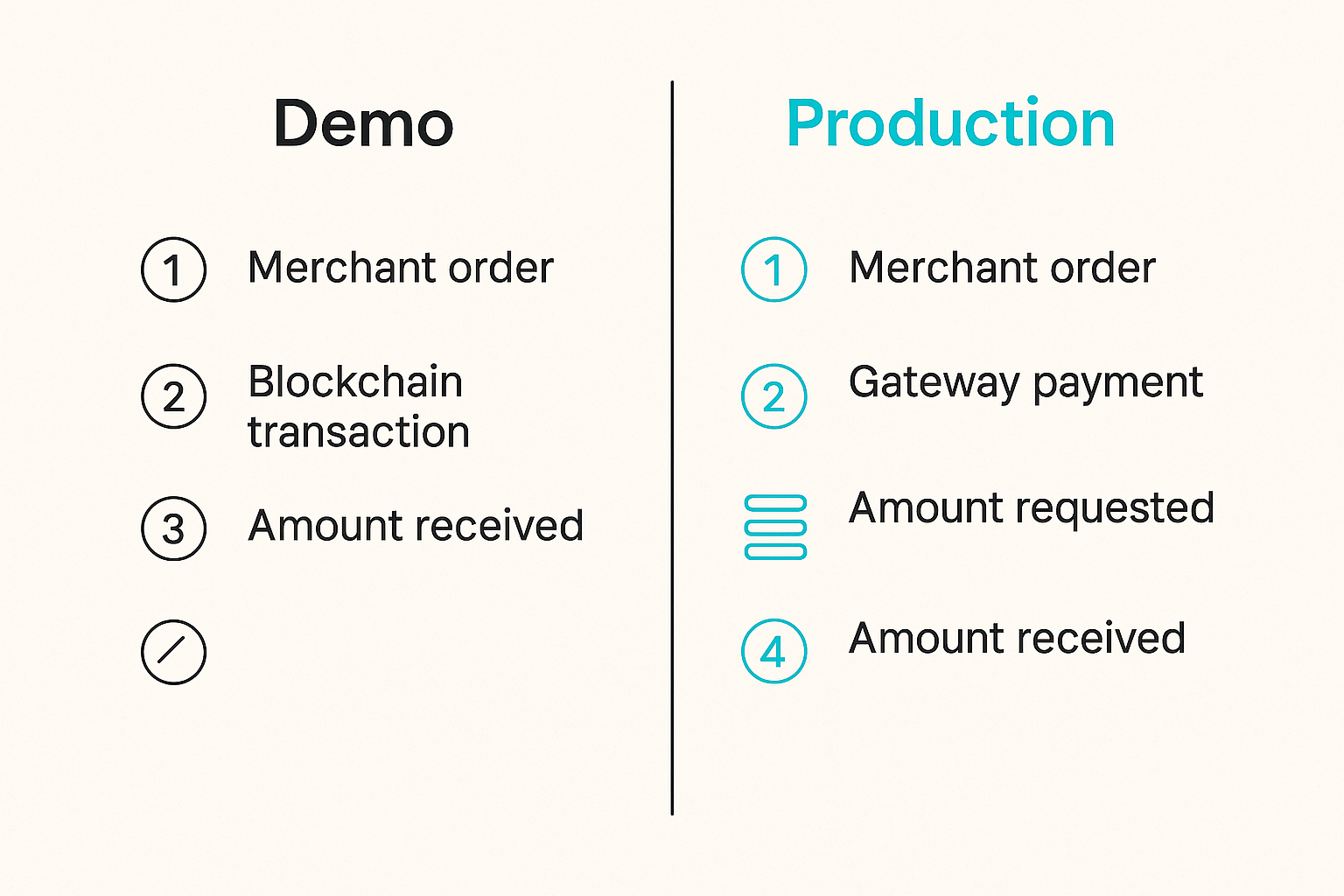
A crypto payment gateway integration becomes easier when teams stop optimizing for the demo and start optimizing for the incident. The demo path is one customer, one asset, one network, one successful transaction. Production is everything else.
What works
What works is a boring, layered architecture:
- Merchant backend creates payment intent.
- Gateway assigns address, amount, network, and expiry.
- Frontend displays only gateway-provided payment details.
- Gateway detects transactions and sends signed webhooks.
- Merchant backend stores raw events before processing.
- Worker applies idempotent state transitions.
- Fulfillment runs only from trusted backend state.
- Reconciliation jobs compare orders, events, transactions, and settlements.
- Support dashboard exposes enough context to resolve issues safely.
This architecture is not glamorous. It is maintainable.
A useful comparison:
| Area | Demo integration | Production integration |
|---|---|---|
| State | Browser callback says paid | Backend state machine decides |
| Webhooks | Directly triggers fulfillment | Stores, verifies, queues, processes |
| Errors | Customer retries manually | System supports recovery paths |
| Reconciliation | Manual block explorer checks | Order-to-transaction mapping |
| Support | Engineering investigates | Support sees payment history |
| Security | API key in server config | Scoped keys, signatures, audit logs |
What fails
What fails is usually not a blockchain issue. It is a systems issue.
Common failure modes include:
- Treating address generation as payment confirmation.
- Trusting frontend redirects as final proof.
- Ignoring duplicate webhooks.
- Not storing raw gateway events.
- Fulfilling on zero-confirmation without policy.
- Accepting too many assets before support is ready.
- Letting finance reconcile from wallet balances only.
- Having no answer for underpayments.
- Using one merchant wallet with no labeling discipline.
- Not testing expired, late, partial, and duplicate payments.
Related reading from our network: security teams face a similar signal-to-workflow problem in AI content threat detection for SOC workflows, where detection is only useful if triage, validation, and response are connected.
Implementation workflow for a production crypto payment gateway
The implementation should move from policy to code, not the other way around. If engineers start with API calls before the business has decided confirmation policy, refund handling, and custody boundaries, the code will encode assumptions nobody approved.
A practical build sequence
Use this sequence before going live:
- Define accepted assets, networks, minimum order values, and confirmation policy.
- Decide custody model: custodial, non-custodial, direct-to-wallet, escrow, or hybrid.
- Define payment states and allowed transitions.
- Create a payment intent endpoint in your merchant backend.
- Store gateway payment IDs against merchant orders.
- Build webhook verification and raw event storage.
- Process events asynchronously with idempotency controls.
- Trigger fulfillment only from backend state.
- Build reconciliation reports for orders, transactions, fees, and settlements.
- Add support tools for late, partial, duplicate, and overpaid transactions.
- Run sandbox tests plus manual edge-case tests.
- Launch with limited assets before expanding coverage.
The best integrations start narrow. One stable asset on one network with clear policy is better than ten assets with confused support handling.
A small webhook handler pattern
A practical webhook flow looks like this:
export async function handleGatewayWebhook(req, res) {
  const signature = req.headers['x-gateway-signature'];
  const rawBody = await readRawBody(req);

  if (!verifySignature(rawBody, signature, process.env.WEBHOOK_SECRET)) {
    return res.status(401).send('invalid signature');
  }

  const event = JSON.parse(rawBody.toString('utf8'));

  try {
    await db.paymentEvents.insert({
      gateway_event_id: event.id,
      payment_id: event.payment_id,
      event_type: event.type,
      payload: event
    });
  } catch (err) {
    if (isUniqueViolation(err)) {
      return res.status(200).send('duplicate ignored');
    }
    throw err;
  }

  await queue.enqueue('process-payment-event', { eventId: event.id });
  return res.status(200).send('ok');
}
Then the worker loads the event, checks current payment state, verifies the transition is allowed, writes the transition, and emits a fulfillment command if the new state is paid.
What breaks in practice is putting all of that inside one HTTP route with no durable event table. It works until the first retry, timeout, deploy, or database hiccup.
Operational controls merchants should require
The gateway integration is not done when engineering says the API works. It is done when support, finance, and operations can run the payment process without turning every exception into an engineering escalation.
Dashboards need operational truth, not vanity data
A merchant dashboard should answer operational questions:
- Which orders are awaiting payment?
- Which payments are detected but not confirmed?
- Which orders are paid but not fulfilled?
- Which transactions are late, partial, duplicate, or overpaid?
- Which webhook events failed delivery?
- Which settlements are pending?
- Which refunds require action?
“Total volume” is useful, but it does not resolve a customer ticket. Operational truth is specific, timestamped, and linked to the order.
Support needs safe manual actions
Support teams need tools, but not unlimited power. Safe manual actions include:
- Resend checkout link.
- Mark order for payment review.
- Request top-up payment.
- Approve overpayment handling.
- Trigger webhook replay.
- Attach transaction hash to a support case.
- Escalate wrong-network payment.
Dangerous actions, such as marking an order paid manually or issuing refunds, should require role-based permissions and audit logs.
Practical rule: If support cannot resolve common payment exceptions without engineering, the gateway integration is incomplete.
Where coinpayportal.com fits in the architecture
A good crypto payment gateway should remove payment workflow burden without taking over your entire commerce stack. Merchants still own their products, customers, fulfillment, pricing, and policies. The gateway should make crypto acceptance safer, more observable, and less fragile.
That is the useful place to evaluate coinpayportal.com: not as hype around “accept crypto,” but as infrastructure for developers and merchants building crypto payment flows.
Use the gateway to reduce payment-state ownership
Your team should not have to build every low-level payment concern from scratch. The gateway can help with real-time processing, automatic fee handling, payment tracking, and checkout integration so your application can focus on business rules.
For developer teams, the CoinPay docs are the right place to evaluate integration shape, API behavior, and how the gateway fits into your backend payment lifecycle.
The architectural fit is strongest when you want:
- A crypto checkout flow without building all gateway primitives yourself.
- A non-custodial payment model aligned with merchant control.
- Payment state that can connect to order fulfillment.
- Operational visibility for real merchant support cases.
- A practical path from sandbox testing to production payments.
Keep your business logic in your system
Do not outsource your entire business workflow to a payment provider. Keep these inside your own application:
- Customer identity and account state.
- Product entitlement rules.
- Fulfillment policy.
- Tax and invoice logic.
- Refund approval policy.
- Fraud review decisions.
- Accounting system integration.
The gateway should provide reliable payment signals. Your system decides what those signals mean for the customer relationship.
That separation keeps the architecture portable. It also makes incidents easier to debug because payment state and business state remain connected but not confused.
Closing checklist for choosing a crypto payment gateway
Choosing a crypto payment gateway in 2026 is less about the logo on the checkout page and more about how the system behaves when payments are asynchronous, messy, delayed, or disputed.
The practical question is whether the gateway helps your team operate the whole payment lifecycle.
Questions to ask before integration
Before committing, ask:
- Does the gateway expose a clear payment state model?
- Are webhooks signed, replayable, and documented?
- Can your backend create payment intents server-side?
- Can you reconcile orders to transaction hashes and settlement records?
- How are underpayments, overpayments, late payments, and wrong-network payments handled?
- What custody model applies, and who can move funds?
- Does the gateway support your required assets and networks without creating support overload?
- Can support safely review payment exceptions?
- Can finance export usable records?
- Does the system degrade safely when webhooks, wallets, or networks are slow?
The decision that matters
The decision that matters is not “can we accept crypto?” Many teams can add a crypto button. The harder question is whether your crypto payment gateway creates a reliable operating model for checkout, settlement, reconciliation, and support.
If the gateway gives you durable payment evidence, clean state transitions, idempotent webhook handling, custody clarity, and reconciliation support, it can become part of your payment infrastructure. If it only gives you a pretty checkout screen, you are still building the hard parts yourself.
A crypto payment gateway should make production simpler, not just demos faster.
Try coinpayportal.com
coinpayportal.com is for developers and merchants building crypto payment infrastructure. Start with the gateway, then wire it into the payment workflow your business actually needs: Try coinpayportal.com.
Try CoinPay
Crypto payments, escrow, and wallets — multi-chain, Lightning-ready, and fast to integrate.
Get started →