Blockchain Transactions: A Practical Payment Architecture Guide for Developers and Merchants

A customer pays, the checkout page says pending, the block explorer says something different, and your support team gets the ticket. That is when blockchain transactions stop being a crypto concept and become an operations problem.
Teams think the problem is getting a transaction hash. The real problem is building a reliable payment workflow around an eventually final, externally settled, sometimes reversible-looking system.
In 2026, merchants are not asking whether crypto payments can work. They are asking whether they can work without manual spreadsheet checks, abandoned orders, duplicate crediting, refund confusion, or a developer being paged every time a mempool slows down.
The practical question is not what is a blockchain transaction. The practical question is: how should your checkout, backend, ledger, webhook processor, and support workflow treat blockchain transactions so the business can trust the payment state?
Table of contents
- Blockchain transactions are a payment workflow, not a receipt
- What actually happens when a customer pays with crypto
- Design the payment state machine before the UI
- Confirmations, finality, and chain-specific risk
- Webhooks turn blockchain transactions into merchant events
- Reconciliation is where crypto payment systems prove themselves
- What breaks when teams implement blockchain transactions badly
- A production workflow for blockchain transactions
- Developer patterns for reliable transaction handling
- Where coinpayportal.com fits in the architecture
- Closing checklist for blockchain transactions
Blockchain transactions are a payment workflow, not a receipt

The mistake teams make is treating blockchain transactions like card authorization receipts. A card authorization usually arrives through a processor with a known lifecycle, dispute model, and settlement path. A blockchain payment arrives from a public network, through a wallet the merchant does not control, with timing and finality determined by chain behavior.
That changes the conversation. Your application should not ask, did we see a hash? It should ask: did we create the correct invoice, detect the correct transfer, apply the correct confirmation policy, update the order exactly once, and leave enough evidence for reconciliation and support?
A useful way to think about it is this: the transaction hash is an input to your payment system. It is not your payment system.
The transaction hash is only one event
A transaction hash proves that a transaction was broadcast or observed. It does not automatically prove that the transaction pays the correct invoice, has enough confirmations, cannot be replaced, was not sent to the wrong address, or should trigger fulfillment.
Your system needs more than a hash:
- invoice ID
- expected asset and network
- expected amount and tolerance
- destination address
- exchange-rate snapshot
- expiration time
- detected transaction hash
- confirmation count
- final internal payment state
- fulfillment decision
If you collapse those fields into a single paid flag, you will eventually credit the wrong order or fail to credit the right one.
Finality is a business rule
Finality is not only a chain property. It is also a merchant policy. A digital download, a high-value hardware order, a marketplace escrow release, and a SaaS subscription renewal should not all use the same threshold.
Practical rule: never let the frontend decide whether a blockchain transaction is final. The frontend can display status. The backend owns payment state.
For low-risk orders, you may accept fewer confirmations. For high-risk orders, you may wait longer or require manual review. The important part is that the rule is explicit, versioned, and visible to support.
What actually happens when a customer pays with crypto
A crypto checkout looks simple from the outside: show address, customer sends funds, order updates. In production, the system is more like a distributed workflow with unreliable timing.
Related reading from our network: teams building decentralized execution systems face similar queue, validation, and settlement tradeoffs in AI agents cloud computing, even though the workload is different.
From invoice to broadcast
A typical payment flow starts before any blockchain transaction exists:
- Customer chooses crypto at checkout.
- Backend creates an invoice with asset, network, amount, and expiry.
- System reserves or generates a destination address.
- Checkout UI displays payment instructions.
- Customer wallet broadcasts a transaction.
- Watcher or payment gateway detects the transaction.
What breaks in practice is the gap between invoice creation and transaction detection. Customers send after expiry. They choose the wrong chain. They copy an address but change the asset. They pay from an exchange that batches withdrawals. They send a slightly different amount because wallet fees or exchange withdrawal fees confuse the final number.
Your architecture needs to expect those cases instead of treating them as rare exceptions.
From confirmation to fulfillment
After detection, the system still has work to do:
- match the transaction to an invoice
- validate address, asset, and amount
- wait for confirmation policy
- mark the invoice as paid or exception
- emit a webhook or internal event
- fulfill the order
- record settlement and reconciliation data
If you use a gateway, this is where the gateway should reduce operational load. If you build directly, this is where your node, indexer, job queue, and database design matter.
Design the payment state machine before the UI
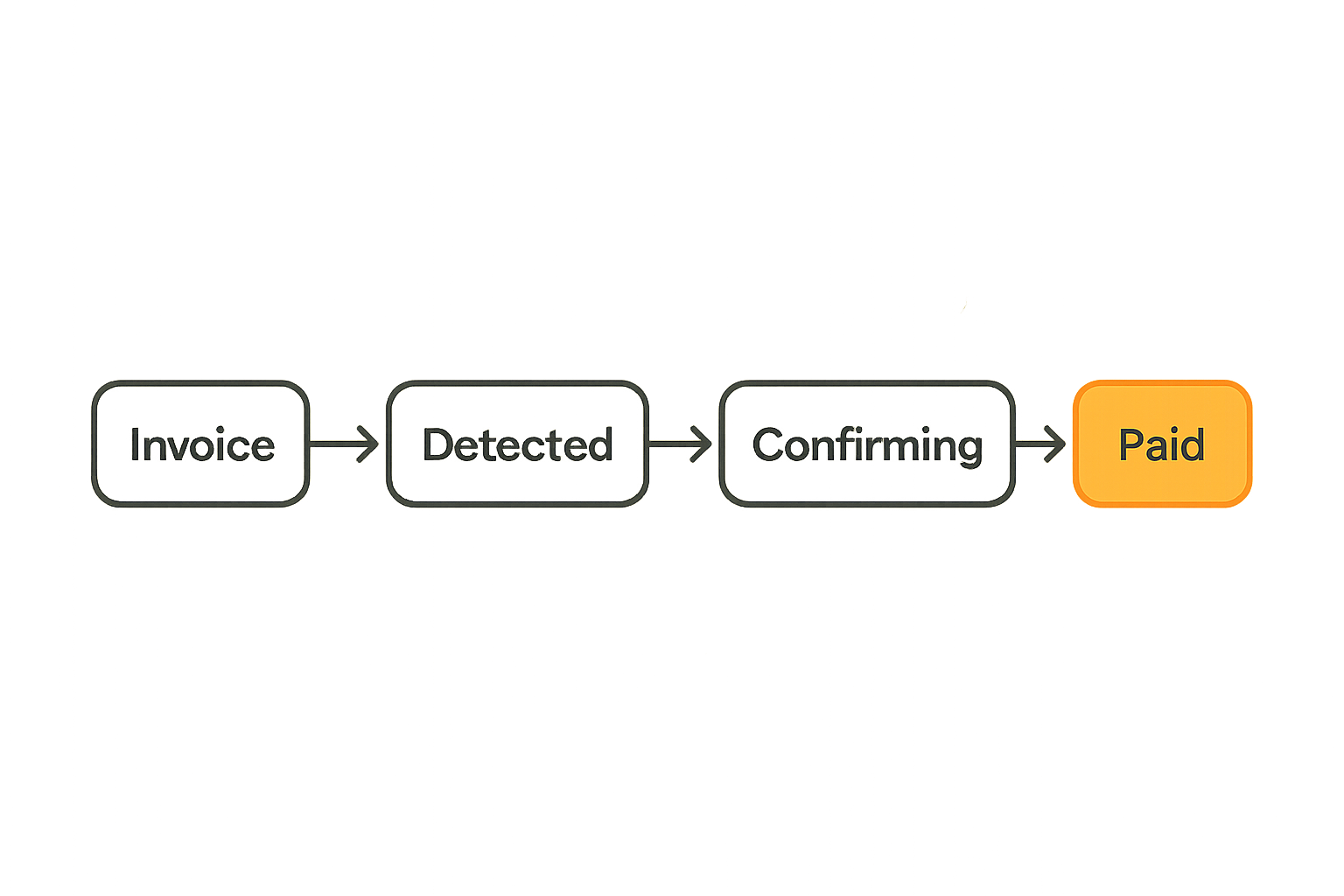
The UI is not the hard part. The hard part is state. A checkout page can show a QR code in an afternoon. A reliable merchant system needs a payment state machine that handles time, retries, partial payment, confirmations, and duplicate events.
If you are still choosing the broader integration model, our guide to crypto payment gateway setup covers custody boundaries, webhook state, and reconciliation decisions around the gateway layer.
States your backend should own
A practical state model might look like this:
| State | Meaning | Can fulfill? | Typical owner |
|---|---|---|---|
| created | Invoice exists, no payment seen | No | checkout service |
| awaiting_payment | Customer has payment instructions | No | checkout service |
| detected | Transaction observed on network | No | watcher or gateway |
| confirming | Enough match data, waiting for confirmations | No | payment service |
| paid | Confirmation policy satisfied | Yes | payment service |
| underpaid | Payment below tolerance | No or manual | operations |
| overpaid | Payment above expected amount | Maybe | operations |
| expired | No valid payment before expiry | No | checkout service |
| refunded | Refund completed or recorded | No new fulfillment | finance |
| disputed_internal | Needs review | No | support or risk |
Do not skip the exception states. They are where support time goes.
Events your backend should tolerate
A robust system accepts that events may arrive late, out of order, or more than once. Your webhook may say detected twice. A confirmation update may arrive before your internal job updates invoice state. A transaction may be seen after expiry.
Practical rule: model payment updates as events, then derive current state. Do not rely on a single mutable status column as your only source of truth.
This does not mean every merchant needs event-sourcing complexity. It means you should keep enough history to explain why an invoice moved from awaiting_payment to paid, underpaid, or expired.
Confirmations, finality, and chain-specific risk
Blockchain transactions are not uniform. Bitcoin, Ethereum, stablecoin transfers on different networks, and newer Layer 1 chains have different fee behavior, confirmation expectations, reorg risk, address formats, and user error patterns.
Low-value and high-value payments need different rules
Confirmation policies should be value-aware. A 10 dollar access pass and a 10,000 dollar B2B invoice should not be treated the same.
A simple policy matrix can help:
| Payment type | Example | Confirmation posture | Operational note |
|---|---|---|---|
| low-value digital | API credits, content access | faster acceptance | cap exposure per account |
| medium e-commerce | apparel, accessories | standard confirmations | delay shipment until paid |
| high-value physical | electronics, wholesale | stricter confirmations | manual review may apply |
| marketplace escrow | buyer-seller trade | strict release rules | release only after policy passes |
The point is not to pretend risk disappears. The point is to decide where the business accepts risk and where it waits.
Layer 1 differences matter operationally
When merchants compare networks, they often focus on fees and brand recognition. Those matter, but production systems also care about wallet support, explorer reliability, token standards, confirmation time, and support burden.
If your team is choosing which base networks to support, the practical comparison in Layer 1 cryptos for merchants and developers is useful because the chain decision flows directly into checkout reliability.
The mistake teams make is adding every chain customers request. More networks mean more edge cases: different address validation, token contracts, memo fields, minimum amounts, finality models, and refund flows.
Webhooks turn blockchain transactions into merchant events
A webhook is where raw blockchain activity becomes a business event. It is also where many integrations become fragile.
Your webhook endpoint should assume the sender will retry, the network will fail, your database may be locked, and the same event may arrive again later. That is normal infrastructure, not an emergency.
Idempotency is not optional
Idempotency means processing the same event multiple times produces the same final result. Without it, retries become duplicate fulfillment.
A minimal pattern:
create table payment_events (
  id bigserial primary key,
  event_id text unique not null,
  invoice_id text not null,
  tx_hash text,
  event_type text not null,
  received_at timestamptz not null default now(),
  payload_hash text not null
);
Then process by event_id, not by hope:
if event_id already exists:
  return 200
store event
lock invoice row
recompute invoice state
commit
emit fulfillment event only if state changed to paid
Practical rule: acknowledge duplicate webhooks safely. A retry should never create a second shipment, second account credit, or second subscription extension.
Signature verification and replay protection
Webhook security is not complicated, but it is often skipped during early testing. Verify signatures, check timestamps, and reject payloads outside your replay window.
A practical verification flow:
- Read the raw request body.
- Extract timestamp and signature headers.
- Reject old timestamps.
- Compute HMAC over timestamp plus body.
- Compare using constant-time comparison.
- Store the event ID before doing fulfillment work.
Related reading from our network: CI/CD teams face the same basic issue of trusting automated events only after permission and secret boundaries are designed well, as discussed in AI agents GitHub Actions security.
Reconciliation is where crypto payment systems prove themselves
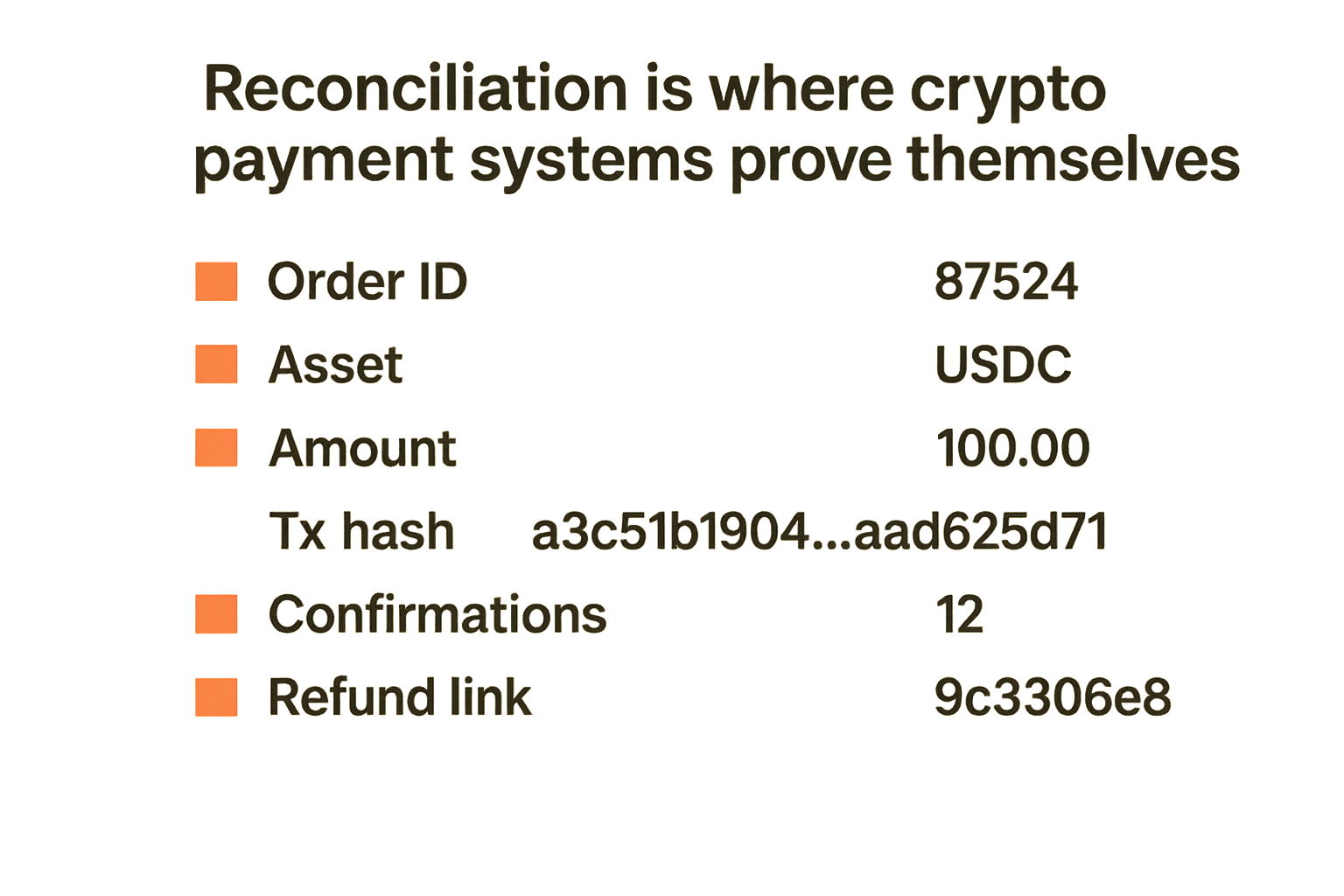
Checkout success is not the end. Finance still needs to know what happened. Support still needs to answer customers. Founders still need a clean view of revenue, fees, refunds, and unsettled exceptions.
If blockchain transactions are not reconciled, the system is not production-ready. It is just a checkout demo.
Separate checkout truth from ledger truth
Checkout truth answers: should the customer receive the product?
Ledger truth answers: what value moved, in what asset, on what network, at what time, and how should finance account for it?
Those overlap, but they are not identical. An invoice may be fulfilled after receiving an acceptable stablecoin payment. The ledger still needs the exact token amount, network fee assumptions, exchange-rate snapshot, and any later refund.
A useful ledger row includes:
- merchant account
- invoice ID
- asset and network
- expected amount
- received amount
- fiat quote at invoice creation
- fiat value at detection or settlement policy
- transaction hash
- confirmation timestamp
- fee handling model
- refund reference if applicable
Handle underpayments, overpayments, and late payments
Underpayments are common when customers pay from exchanges or misunderstand fees. Overpayments happen when wallet UI or exchange withdrawal minimums interfere. Late payments happen when someone sends after the invoice expires.
Decide the policy before support receives the ticket:
| Case | Common cause | Recommended handling |
|---|---|---|
| underpayment within tolerance | minor fee confusion | mark paid if policy allows |
| material underpayment | exchange fee deducted | request top-up or refund |
| overpayment | withdrawal minimum | fulfill and record credit or refund difference |
| late payment | expired checkout | manual match or automatic exception flow |
| wrong network | user selected unsupported chain | recovery depends on custody and address control |
This is where non-custodial design, address ownership, and support processes matter. A nice checkout UI cannot fix an undefined recovery policy.
What breaks when teams implement blockchain transactions badly
Bad implementations usually work during demos. They fail under retries, user mistakes, chain congestion, and month-end finance review.
Failure modes that show up in production
The common failures are predictable:
- A webhook retry triggers duplicate fulfillment.
- The system marks paid on zero confirmations for a high-value order.
- A customer pays after expiry and support cannot find the funds.
- The frontend says paid but the backend never committed the state change.
- The backend accepts the right amount on the wrong network.
- Finance cannot reconcile crypto revenue to order IDs.
- Refunds are handled manually with no link to the original invoice.
- A chain integration is added without address validation or minimum amount rules.
What breaks in practice is ownership. Engineering thinks finance will reconcile later. Finance thinks engineering stores the right fields. Support thinks the gateway dashboard is the source of truth. Nobody owns the full workflow.
What works and what fails
| Area | What fails | What works |
|---|---|---|
| checkout | static address with no invoice state | invoice-bound address or payment request |
| detection | frontend polling only | backend watcher or gateway event |
| confirmations | one global rule | risk-based policy by asset and value |
| webhooks | process immediately without lock | store event, lock invoice, derive state |
| fulfillment | triggered by tx hash | triggered by internal paid state |
| support | explorer link only | searchable invoice and event history |
| finance | export raw transactions | reconciled ledger with order mapping |
Related reading from our network: local agent networks have a similar operating problem around routing, trust, ownership, and follow-up; see AI agents asks and offers for an adjacent architecture lens.
A production workflow for blockchain transactions
A reliable system is not more complicated for the sake of complexity. It is explicit about the steps that already exist whether you model them or not.
Implementation sequence
Use this sequence when building or reviewing your crypto payment flow:
Define supported assets and networks. Decide what you support, minimum amounts, address rules, and confirmation policies.
Create invoice records before displaying payment instructions. Store amount, asset, network, expiry, merchant ID, and order ID.
Bind payment detection to invoice context. Match by address, payment request, memo, or gateway invoice reference.
Store every payment event idempotently. Never let duplicate webhook delivery duplicate business action.
Derive invoice state on the backend. Use detected, confirming, paid, expired, underpaid, and exception states.
Trigger fulfillment from internal paid state. Do not ship because an explorer shows a hash.
Write ledger entries for finance. Keep received amount, fiat quote, transaction hash, network, and refund references.
Build support search. Support should find an invoice by email, order ID, address, or transaction hash.
Test bad paths. Underpay, overpay, pay late, send duplicate webhook, and simulate confirmation delay.
Operational checks before launch
Before going live, ask boring questions. Boring questions prevent expensive tickets.
- Can we replay webhooks safely?
- Can we explain why an order was marked paid?
- Can we find all payments for a merchant for a date range?
- Can we handle a customer who paid from an exchange?
- Can we refund or credit overpayment differences?
- Can we disable a network quickly if it becomes unreliable?
- Can support see confirmation status without asking engineering?
Practical rule: if support cannot explain a payment state from your admin tools, the architecture is not finished.
Developer patterns for reliable transaction handling
Developers do not need a giant enterprise architecture to process blockchain transactions well. They need a few disciplined patterns and a refusal to put business state in the browser.
Use an append-only payment event table
Even if your invoice table stores the current state, keep the event history. It helps with replay, debugging, audits, and customer disputes.
A compact schema can be enough:
create table invoices (
  invoice_id text primary key,
  merchant_id text not null,
  order_id text not null,
  asset text not null,
  network text not null,
  expected_amount numeric not null,
  state text not null,
  expires_at timestamptz not null,
  paid_at timestamptz
);

create table invoice_transactions (
  id bigserial primary key,
  invoice_id text not null,
  tx_hash text not null,
  received_amount numeric not null,
  confirmations integer not null default 0,
  first_seen_at timestamptz not null,
  unique(invoice_id, tx_hash)
);
The exact schema will vary, but the principle holds: record what happened, then compute what it means.
Make fulfillment depend on internal state
Fulfillment should subscribe to an internal event such as invoice.paid, not to transaction.detected. This keeps your order system independent from chain-specific noise.
Bad pattern:
webhook says tx detected
ship order
Better pattern:
webhook says tx detected
payment service stores event
payment service evaluates invoice state
invoice becomes paid only after policy passes
order service receives invoice.paid
order service fulfills once
That separation is what lets you change confirmation rules without rewriting fulfillment.
Where coinpayportal.com fits in the architecture
Crypto payment infrastructure is useful when it reduces the number of custom systems a merchant has to build incorrectly. The goal is not to hide blockchain transactions. The goal is to turn them into merchant-safe events with clear state, confirmations, and operational context.
Use infrastructure for payment state, not hype
coinpayportal.com is for developers and merchants building crypto payment infrastructure. That means the important questions are architectural: how invoices are created, how payments are detected, how merchant systems receive updates, and how operations teams resolve exceptions.
For teams integrating directly, the CoinPay documentation is the natural place to start because docs should define the API and event behavior your backend relies on.
The right payment layer should help you:
- create invoice-bound payment requests
- receive webhook updates safely
- separate pending, confirming, paid, and exception states
- preserve transaction context for reconciliation
- keep merchant operations visible
Keep custody, checkout, and merchant operations explicit
The practical architecture question is where responsibility sits. Who controls destination addresses? Who decides confirmation policy? Who handles overpayments? Who can see the payment history? Who performs refunds?
Those answers should be visible before production. If they are vague, your integration risk is higher than it looks.
A non-custodial or merchant-controlled model can be attractive, but it does not remove the need for payment state, webhooks, support tooling, and reconciliation. It just changes the custody boundary.
Closing checklist for blockchain transactions
Blockchain transactions are reliable enough for commerce when the workflow around them is designed honestly. They are painful when teams pretend a transaction hash is the same thing as a completed order.
The merchant-ready test
Before you launch or expand crypto checkout, test the system against this checklist:
- invoice created before payment instructions are shown
- backend owns state transitions
- confirmation policy varies by risk where needed
- duplicate webhooks are safe
- underpayments and late payments have defined handling
- fulfillment depends on internal paid state
- ledger records support reconciliation
- support can search by order, address, and transaction hash
- refunds or credits link back to the original invoice
- unsupported networks are blocked clearly
The mistake teams make is optimizing for the first successful payment. Production requires optimizing for the thousandth payment, the delayed payment, the duplicate event, and the support ticket that arrives three weeks later.
If your architecture can explain those cases, blockchain transactions become a manageable part of your payment stack instead of a permanent exception queue.
Try coinpayportal.com
coinpayportal.com helps developers and merchants build crypto payment infrastructure with practical checkout, transaction, and merchant workflow concerns in mind. Try coinpayportal.com.
Try CoinPay
Non-custodial crypto payments — multi-chain, Lightning-ready, and fast to integrate.
Get started →