Blockchain Payments in 2026: A Practical Architecture Guide for Developers and Merchants

A customer can send the right asset to the right address and your payment system can still be wrong.
That is the uncomfortable part of blockchain payments in production. The chain may confirm, the wallet may show success, and the merchant dashboard may still be stuck in pending because the webhook was dropped, the exchange rate expired, or the order was never reconciled against the invoice.
Teams think the problem is adding crypto checkout. The real problem is building a payment workflow that can survive irreversible settlement, variable confirmation times, network fees, refunds, support tickets, and accounting.
That changes the conversation. Blockchain payments are not a button, a QR code, or a smart contract demo. They are an architecture decision across checkout, state, custody, settlement, and merchant operations.
Table of contents
- Why blockchain payments fail in production
- Model payment state before you pick a chain
- Choose payment rails with operations in mind
- Build the checkout API around idempotency and trust
- Webhooks and reconciliation are the real payment system
- Custody, escrow, refunds, and settlement boundaries
- What works and what fails in blockchain payments
- Implementation workflow for developers
- Product fit: where coinpayportal.com belongs
- Closing checklist for blockchain payments in 2026
Why blockchain payments fail in production
The UI is the smallest part
The mistake teams make is treating blockchain payments like a checkout skin. Add a wallet connect button, show a QR code, wait for funds, mark the order paid. That can work in a demo. It breaks when customers refresh pages, underpay invoices, send from exchanges, use the wrong network, or return two days later asking where their order is.
The UI matters, but it is not the system. The real system is the state machine behind the UI. It decides when an invoice is created, when the quoted price expires, how many confirmations are required, what happens on partial payment, and who owns the next action when something does not match.
A useful way to think about it is this: the checkout page is a projection of payment state, not the owner of payment state.
Practical rule: Do not let the browser decide whether a blockchain payment succeeded. Let your backend reconcile invoice state against verified payment events.
The chain is not your order system
A blockchain records transactions. It does not know your cart, your customer, your refund policy, your subscription period, or your inventory reservation. If you depend on raw on-chain events without an internal invoice model, you force your support team to reverse-engineer business context from transaction hashes.
That gets ugly quickly. A transaction can be valid on-chain and invalid for your order. Maybe it arrived after the payment window. Maybe it used the wrong token contract. Maybe it paid the old quote after price movement. Maybe it was sent to an address from a previously expired invoice.
Your order system needs its own payment facts: invoice id, amount due, amount received, asset, network, quote timestamp, expiry, confirmation threshold, customer reference, settlement status, and reconciliation result.
Merchant operations decide whether it works
The practical question is not whether crypto can move value. It can. The practical question is whether your business can operate around that value movement.
Can finance match deposits to orders? Can support explain pending confirmations? Can engineering replay missed webhooks? Can risk change confirmation thresholds during congestion? Can marketplace operators hold funds until both sides complete the workflow?
If the answer is no, you do not have blockchain payments. You have a transaction listener attached to a checkout page.
Related reading from our network: teams building decentralized compute marketplaces face similar state and settlement problems when jobs, workers, validation, and payments must line up across systems in this operational analytics guide.
Model payment state before you pick a chain
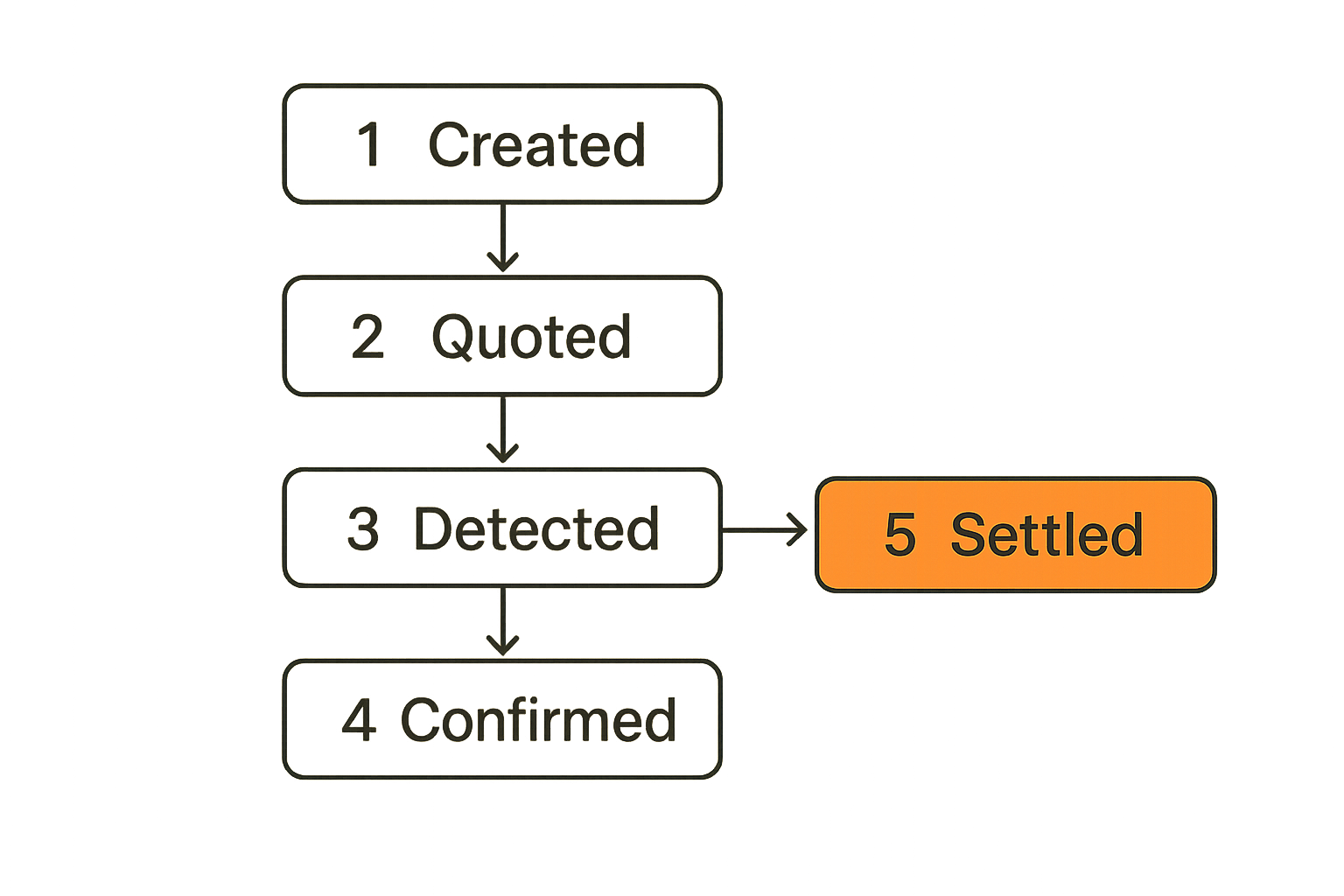
Invoice state is your source of truth
Before debating chains, wallets, or tokens, define the lifecycle. Most production systems need states like:
- created
- quoted
- awaiting_payment
- detected
- confirming
- paid
- overpaid
- underpaid
- expired
- refunded
- disputed
- settled
The exact labels matter less than the transitions. A clean state model prevents random flags from spreading across your codebase. Avoid booleans like paid, confirmed, sent, and expired living in separate places. They will disagree eventually.
A minimal invoice transition might look like this:
created -> quoted -> awaiting_payment -> detected -> confirming -> paid -> settled
                         |                  |             |
                         v                  v             v
                      expired          underpaid       refunded
Each transition should have a reason, timestamp, actor, and evidence. Evidence might be a transaction hash, a provider event id, a reconciliation job id, or an admin action.
Confirmations are a risk policy
Confirmation counts are not a universal truth. They are a risk setting. A small digital product order may tolerate faster acceptance. A high-value hardware order may require deeper settlement. Some networks finalize quickly. Others need more caution.
What breaks in practice is hardcoding one confirmation threshold everywhere. Then the business asks for different treatment by asset, amount, merchant, or region, and engineering has to patch logic into five handlers.
Treat confirmation policy as configuration:
| Dimension | Example policy input | Why it matters |
|---|---|---|
| Network | bitcoin, ethereum, polygon | Different finality and fee behavior |
| Asset | BTC, ETH, USDC | Volatility and token contract risk differ |
| Amount | 25 vs 25000 | Larger orders justify slower acceptance |
| Merchant | low-risk vs high-risk | Risk tolerance is business-specific |
| Product type | digital vs physical | Fulfillment reversibility differs |
Practical rule: Store the confirmation threshold used for each invoice. Do not only store the current global setting.
Timeouts are business rules
A payment timeout is not just a technical expiry. It controls pricing, inventory, and customer experience.
If you quote 100 USDC for an invoice, the customer needs a clear payment window. If they pay after the window, you need a deterministic rule: accept, reject, refund, or manual review. Without that rule, support becomes the policy engine.
Many teams set a 15-minute timer because they saw it elsewhere. That may be fine for volatile assets. It may be too short for customers paying from exchanges. It may be unnecessary for stablecoin checkout. The right window depends on your asset mix, order type, and tolerance for operational exceptions.
Choose payment rails with operations in mind
Asset support is not the same as asset readiness
Listing many assets looks good in a launch post. Running many assets is harder. Each chain and token adds operational surface area: address generation, fee estimation, confirmation logic, contract monitoring, stuck payments, refund path, accounting export, and support scripts.
The mistake teams make is optimizing for logo coverage instead of payment completion rate and support load. A merchant does not benefit from ten assets if three create most of the tickets.
A narrower set of well-operated rails often beats broad support with shallow tooling. If you are setting up a gateway from scratch, start with the assets customers actually use and the networks your team can support. For deeper setup tradeoffs, the earlier guide on crypto payment gateway setup walks through custody, webhooks, and reconciliation as gateway architecture choices.
Stablecoins reduce some risk and add others
Stablecoins reduce price volatility for merchants, but they do not remove payment risk. You still need to care about networks, token contracts, freezes, liquidity, settlement destinations, and accounting treatment.
Stablecoin payments also create a UX trap. Customers may see USDC and assume any USDC on any network is acceptable. Your system must be explicit about network and token contract. If you support USDC on Ethereum but the customer sends USDC on another network, that is not a normal successful payment unless your infrastructure supports that rail.
Good checkout copy is part of the architecture here. The customer should see asset, network, amount, address, expiry, and warnings in one place.
Lightning and fast rails change support expectations
Fast rails are useful because they shorten payment waiting time. They also change customer expectations. If payments usually settle in seconds, then a 90-second delay feels broken.
That means your observability must improve with speed. You need to distinguish user delay, invoice expiry, routing failure, provider delay, and internal webhook lag. A fast network with slow internal processing still feels slow.
Related reading from our network: privacy-sensitive teams face a similar issue where the visible portal is only a small part of the workflow; the real architecture is governance, encryption, and auditability, as discussed in this secure messaging architecture piece.
Build the checkout API around idempotency and trust
Create invoices, not loose addresses
A loose address says where money can arrive. An invoice says why money should arrive, how much is expected, which asset and network are valid, and what happens next.
Your create invoice endpoint should return a stable object, not a one-off payment instruction. At minimum:
POST /invoices
idempotency-key: order_9821_crypto_checkout

request:
  order_id: order_9821
  amount_fiat: 129.00
  currency: USD
  accepted_assets: [USDC, BTC]
  success_url: https://merchant.example/success
  cancel_url: https://merchant.example/cancel

response:
  invoice_id: inv_7m2
  status: awaiting_payment
  payment_options:
    - asset: USDC
      network: ethereum
      amount: 129.00
      expires_at: 2026-06-08T12:20:00Z
    - asset: BTC
      network: bitcoin
      amount: 0.00187
      expires_at: 2026-06-08T12:20:00Z
The backend owns the invoice. The checkout page renders it. If the page refreshes, the same invoice state returns. If the customer opens two tabs, your system does not create two conflicting payment requests for the same order.
Make every client action retry safe
Crypto checkout often sits behind flaky user behavior: mobile wallet handoff, exchange withdrawal screens, page refreshes, and browser back buttons. Your API should assume clients retry.
Use idempotency keys for invoice creation, order confirmation, refund requests, and settlement actions. Store request fingerprints. Return the original result when the same action repeats. Reject conflicting retries under the same key.
Practical rule: If a payment action moves money, changes fulfillment, or changes accounting state, make it idempotent before launch.
Keep pricing and payment windows explicit
Do not hide exchange rates inside logs. Store quote inputs and outputs on the invoice:
- fiat amount
- asset amount
- rate source
- quote timestamp
- quote expiry
- accepted slippage or exact-payment rule
- network fee assumptions if relevant
This is what lets finance and support answer basic questions later. Why did the customer owe this amount? Was the quote expired? Did they underpay by a network fee? Was the asset price refreshed after checkout?
For teams integrating directly, the CoinPay developer docs are the place to map these invoice and callback concepts into actual API behavior instead of scattering payment logic across checkout code.
Webhooks and reconciliation are the real payment system
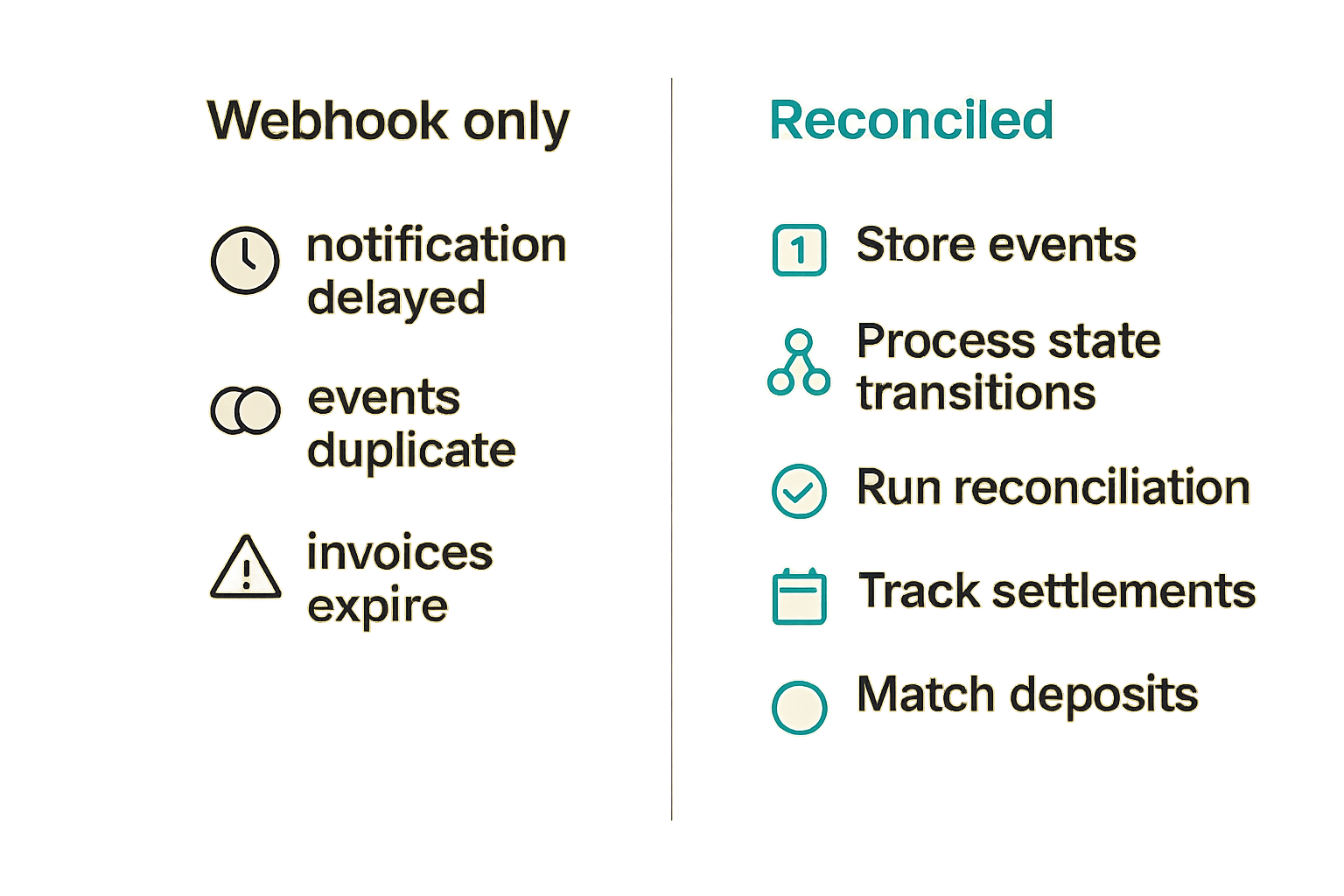
Webhooks notify, reconciliation proves
A webhook is a notification. It is not proof that your entire business process completed.
Your system should process webhooks quickly, verify signatures, persist the raw event, and enqueue state transitions. But it should also run reconciliation jobs that compare expected invoices against observed payment events and settlement records.
The difference matters. Webhooks can be delayed, duplicated, blocked by a firewall, or processed while a dependent service is down. Reconciliation is how you recover without manually scanning transaction hashes.
A basic reconciliation loop asks:
- Which invoices are awaiting payment but have detected transactions?
- Which detected transactions reached the required confirmation threshold?
- Which paid invoices have not triggered fulfillment?
- Which fulfilled orders have not reached settlement status?
- Which deposits cannot be matched to an invoice?
Design for duplicate and delayed events
Most webhook failures are not dramatic. They are boring. A provider retries the same event. Your handler times out after writing to the database but before returning success. A queue processes events out of order. A customer pays at minute 14, the event arrives at minute 16, and the invoice expiry job already ran.
If your handler assumes perfect ordering, you will ship race conditions.
Use event ids, transaction hashes, invoice ids, and monotonic state transitions. Persist every event before acting on it. Make transition logic reject impossible moves but allow late evidence to attach to the invoice.
| Bad handler | Production-safe handler |
|---|---|
| Updates order directly | Updates invoice state first |
| Assumes one event per payment | Deduplicates by event and transaction |
| Trusts event order | Evaluates current state before transition |
| Drops unknown payments | Queues unmatched deposits for review |
| Has no replay path | Supports event replay and reconciliation |
Give support a ledger view
Support does not need a block explorer link and a shrug. They need a payment ledger view that connects customer, order, invoice, transaction, status, and next action.
The ledger should show:
- customer order id
- invoice id
- asset and network
- expected amount
- received amount
- transaction hash
- confirmation count
- current invoice state
- webhook event history
- reconciliation result
- refund or settlement status
This reduces engineering interruptions. It also prevents support from inventing one-off policy decisions because the system hides the facts.
Related reading from our network: private deal-sharing systems run into a similar trust problem, where verification and safe sharing matter more than the visible code itself; see this encrypted coupon code workflow guide for an adjacent pattern.
Custody, escrow, refunds, and settlement boundaries
Custody is a product boundary
Custody is not only a legal or compliance question. It is a product boundary that affects user trust, operational risk, and engineering responsibility.
If your system takes custody, you own key management, withdrawal controls, hot wallet limits, monitoring, and incident response. If your system is non-custodial, you still need to define how payment instructions are generated, how settlement destinations are controlled, and how refunds happen.
Many merchants prefer infrastructure that keeps custody boundaries simple. That does not remove the need for state. It just changes who can move funds and under what conditions.
Escrow needs explicit release logic
Escrow is not pending with a nicer name. It requires defined release conditions.
For marketplaces, services, and high-trust transactions, escrow logic should answer:
- Who can fund the escrow?
- What evidence marks the work or delivery complete?
- Who can dispute?
- What is the dispute window?
- Who can release funds?
- What happens if one party disappears?
- How are fees calculated?
If you need buyer-seller protection, treat escrow as its own workflow. CoinPay has a dedicated crypto escrow flow for cases where funds should not move directly from buyer to merchant without release conditions.
Refunds are new payments
Card payment thinking causes mistakes here. A crypto refund is not simply undoing the original transaction. It is usually a new payment in the opposite direction.
That means you need refund addresses, refund approval, asset selection, fee handling, audit trails, and fraud checks. If the customer paid from an exchange, the sending address may not be a safe refund destination. If the asset moved in price, your refund policy must say whether you refund the fiat value, crypto amount, or merchant-defined amount.
Practical rule: Never assume the original sending address is the correct refund address. Ask, verify, and record refund intent.
What works and what fails in blockchain payments
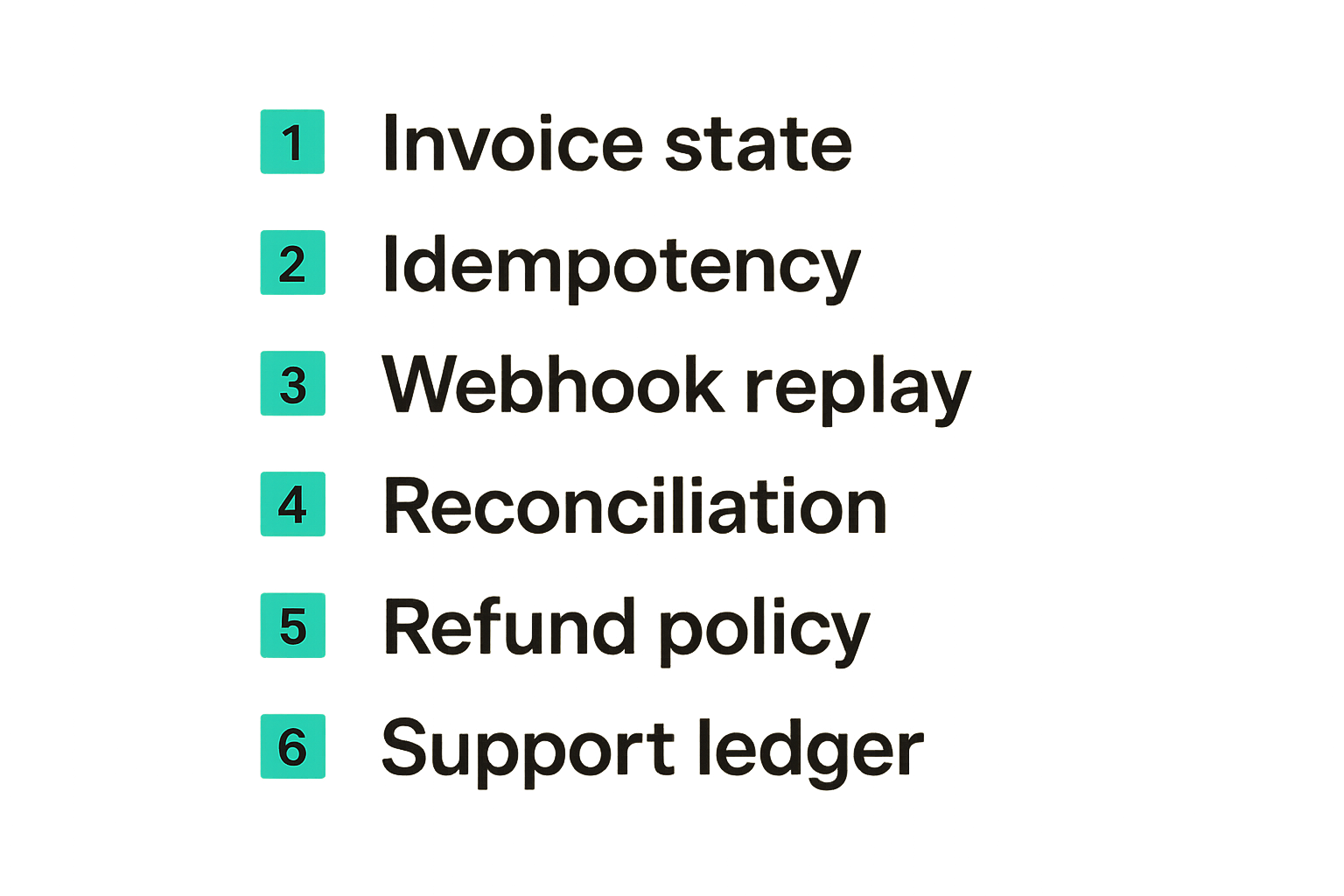
What works in production
Working blockchain payments systems tend to be boring in the right places. They have clear invoice state, explicit payment windows, durable webhook processing, reconciliation jobs, admin review queues, and support-visible ledgers.
They also avoid pretending that all payment exceptions are edge cases. Underpayments, late payments, duplicate events, wrong-network sends, and abandoned invoices are normal production events. Treat them as first-class states.
What works:
- one invoice per business payment intent
- deterministic state transitions
- idempotent API calls
- signed and replayable webhooks
- scheduled reconciliation
- configurable confirmation policy
- explicit refund workflow
- clear custody and settlement boundaries
- operational dashboards for support and finance
What fails once volume arrives
The systems that fail usually fail because they were built around the happy path. They mark orders paid from the frontend. They create a new address every refresh. They treat webhook delivery as guaranteed. They cannot explain why an invoice expired. They cannot match deposits to orders after the fact.
Common failure modes:
| Failure mode | What breaks | Better pattern |
|---|---|---|
| Frontend marks paid | Customers can see false success | Backend owns payment state |
| No idempotency | Duplicate invoices and refunds | Idempotency keys per action |
| No raw event storage | Webhooks cannot be replayed | Persist events before processing |
| No reconciliation | Missed payments become tickets | Scheduled invoice matching |
| No support ledger | Engineering handles every issue | Order-invoice-transaction view |
| Vague refund policy | Disputes become manual | Treat refunds as new payments |
The practical question is not whether you can prevent every exception. You cannot. The question is whether exceptions land in a controlled workflow or in a Slack channel.
Implementation workflow for developers
A practical build sequence
If you are building blockchain payments into a merchant product, do not start with wallet UI. Start with the backend model and work outward.
- Define payment intents and invoice states.
- Decide supported assets, networks, and confirmation policies.
- Build invoice creation with idempotency keys.
- Store quote data and expiry rules on each invoice.
- Render checkout from backend invoice state.
- Receive and verify webhooks.
- Persist raw events before processing transitions.
- Run reconciliation jobs on a schedule.
- Build support views for invoices, transactions, and exceptions.
- Add refund, settlement, and export workflows.
This sequence feels slower than embedding a widget. It is faster than debugging money movement without a state model.
Minimal data model
You do not need an overbuilt schema to start. You need enough structure to prevent ambiguity.
payments
  id
  merchant_id
  order_id
  status
  amount_fiat
  fiat_currency
  created_at
  updated_at

invoices
  id
  payment_id
  asset
  network
  amount_expected
  amount_received
  quote_rate
  quote_expires_at
  confirmation_required
  status

payment_events
  id
  invoice_id
  provider_event_id
  tx_hash
  event_type
  raw_payload
  received_at
  processed_at

refunds
  id
  payment_id
  asset
  network
  amount
  destination_address
  status
  reason
Keep raw payloads. Keep timestamps. Keep the policy values used at the time. Future you will need them when a merchant asks why an order moved from confirming to expired.
Operational checks before launch
Before accepting real customer funds, run through production-like failure tests:
- duplicate webhook delivery
- webhook delivery after invoice expiry
- underpayment by a small amount
- overpayment
- wrong asset or wrong network attempt
- customer refresh during checkout
- invoice creation retry
- refund to a newly provided address
- reconciliation after webhook outage
- support lookup by order id and transaction hash
If these tests require database surgery, your workflow is not ready.
Product fit: where coinpayportal.com belongs
Use infrastructure where the workflow is repetitive
Most merchants do not need to become blockchain infrastructure companies. They need reliable payment acceptance, clear settlement, and fewer support problems.
That is where a gateway can help. The useful product boundary is not just take crypto. It is invoice creation, payment tracking, real-time processing, fee handling, webhook delivery, and merchant-facing operational context.
For developers and merchants building crypto payment infrastructure, coinpayportal.com fits when you want to avoid rebuilding the repetitive parts of blockchain payments while keeping your product logic focused on orders, fulfillment, customer experience, and marketplace rules.
Keep ownership of your business rules
A gateway should not erase your business rules. You still decide which assets to accept, what confirmation policy fits your risk, how long quotes remain valid, when to fulfill, and how refunds are approved.
The better architecture is shared responsibility:
| Layer | Gateway responsibility | Merchant responsibility |
|---|---|---|
| Checkout | Payment instructions and status | Cart, order, customer UX |
| Events | Webhooks and payment updates | Fulfillment transitions |
| Settlement | Processing and fee handling | Accounting and payout policy |
| Exceptions | Payment evidence | Customer decision and support policy |
| Escrow | Hold and release workflow | Dispute evidence and release rules |
That separation keeps the payment rail from leaking into every corner of your application.
Closing checklist for blockchain payments in 2026
Questions to answer before you ship
Before you put blockchain payments in front of customers, answer these questions in writing:
- What is the source of truth for invoice state?
- Which assets and networks are actually supported?
- How long is a quote valid?
- What happens if the customer pays late?
- What happens if they underpay or overpay?
- How many confirmations are required and why?
- Can every webhook be replayed safely?
- How does reconciliation find missed payments?
- Who approves refunds?
- Is the refund a fiat-value refund or crypto-amount refund?
- Where does support see payment evidence?
- Where does finance export settlement data?
If the answers live only in engineering memory, the system is not operational yet.
The practical standard
Blockchain payments are useful when they reduce friction for customers and open new settlement options for merchants. They are painful when teams ship the visible checkout before the invisible workflow.
The practical standard for 2026 is simple: every payment should have an invoice, every invoice should have state, every state change should have evidence, and every exception should have an owner.
That is how blockchain payments move from a demo to a production system.
Try coinpayportal.com
You are writing for developers and merchants building crypto payment infrastructure. If you want blockchain payments without rebuilding checkout state, webhooks, escrow, fee handling, and merchant operations from scratch, Try coinpayportal.com.
Try CoinPay
Non-custodial crypto payments — multi-chain, Lightning-ready, and fast to integrate.
Get started →