Blockchain Payment Gateway Architecture: A Practical 2026 Guide for Developers and Merchants
A blockchain payment gateway looks simple until the first real customer pays from the wrong wallet, underpays by network fees, closes the browser, and asks support why the order is still pending.
Teams think the problem is accepting crypto at checkout. The real problem is operating a payment state machine across wallets, chains, confirmations, exchange rates, merchant ledgers, webhooks, refunds, and support workflows.
That changes the conversation. The button is not the system. The hosted checkout page is not the system. The practical question is whether your gateway can preserve truth when the user interface, the blockchain, and the merchant backend disagree.
In 2026, a blockchain payment gateway is less about adding a crypto logo to checkout and more about designing the boring infrastructure around state, trust, settlement, and reconciliation. If you get that layer wrong, every downstream team pays for it: engineering debugs edge cases, finance cannot close the books, and support becomes the payment processor.
Table of contents
- Why a blockchain payment gateway is an architecture decision
- Core components of a blockchain payment gateway
- Custody, settlement, and trust boundaries
- Payment state and webhook design
- Reconciliation and the merchant ledger
- API integration patterns for developers
- What works in production
- What fails when teams implement it badly
- Security and compliance boundaries
- Where coinpayportal.com fits
Why a blockchain payment gateway is an architecture decision
A useful way to think about a blockchain payment gateway is as payment infrastructure with an unreliable external settlement rail. The rail is not unreliable because blockchains are broken. It is unreliable because your application does not control when a user broadcasts a transaction, what wallet they use, what fee they attach, which chain they choose, or how long finality takes.
That is the central architecture problem. You are not just collecting payment. You are synchronizing business state with external network state.
The gateway is a state machine
A good gateway does not treat payment as a boolean. It treats payment as a sequence of states:
- invoice created
- awaiting payment
- transaction detected
- confirming
- confirmed
- settled
- expired
- underpaid
- overpaid
- refunded
- disputed or reviewed
Each transition should have a reason, timestamp, actor, and source. Some transitions come from the blockchain listener. Some come from merchant API calls. Some come from operator actions. If these all write directly to the order table with no event history, debugging becomes guesswork.
Practical rule: never let checkout success be the only proof of payment. Persist a payment event trail that can be replayed, audited, and reconciled.
The UI is only one client
The mistake teams make is treating the checkout page as the payment workflow. In production, the checkout page is just one client of the gateway. Other clients include the merchant backend, webhook consumers, admin dashboards, reconciliation jobs, refund tooling, risk review, and support search.
A customer may close the tab before confirmation. A webhook may fail. A block explorer may show a transaction before your indexer sees it. The merchant may fulfill an order from an internal admin screen. If your architecture assumes the user waits on a spinner until finality, it will break.
Ownership matters more than feature lists
Feature lists are easy to compare: coins supported, chains supported, checkout templates, plugins, conversion options. Ownership is harder and more important.
Ask who owns:
- transaction detection
- confirmation policy
- invoice expiry
- underpayment handling
- webhook retries
- merchant ledger entries
- refund initiation
- support visibility
- reconciliation exports
If nobody owns a boundary, the boundary becomes a production incident.
Core components of a blockchain payment gateway
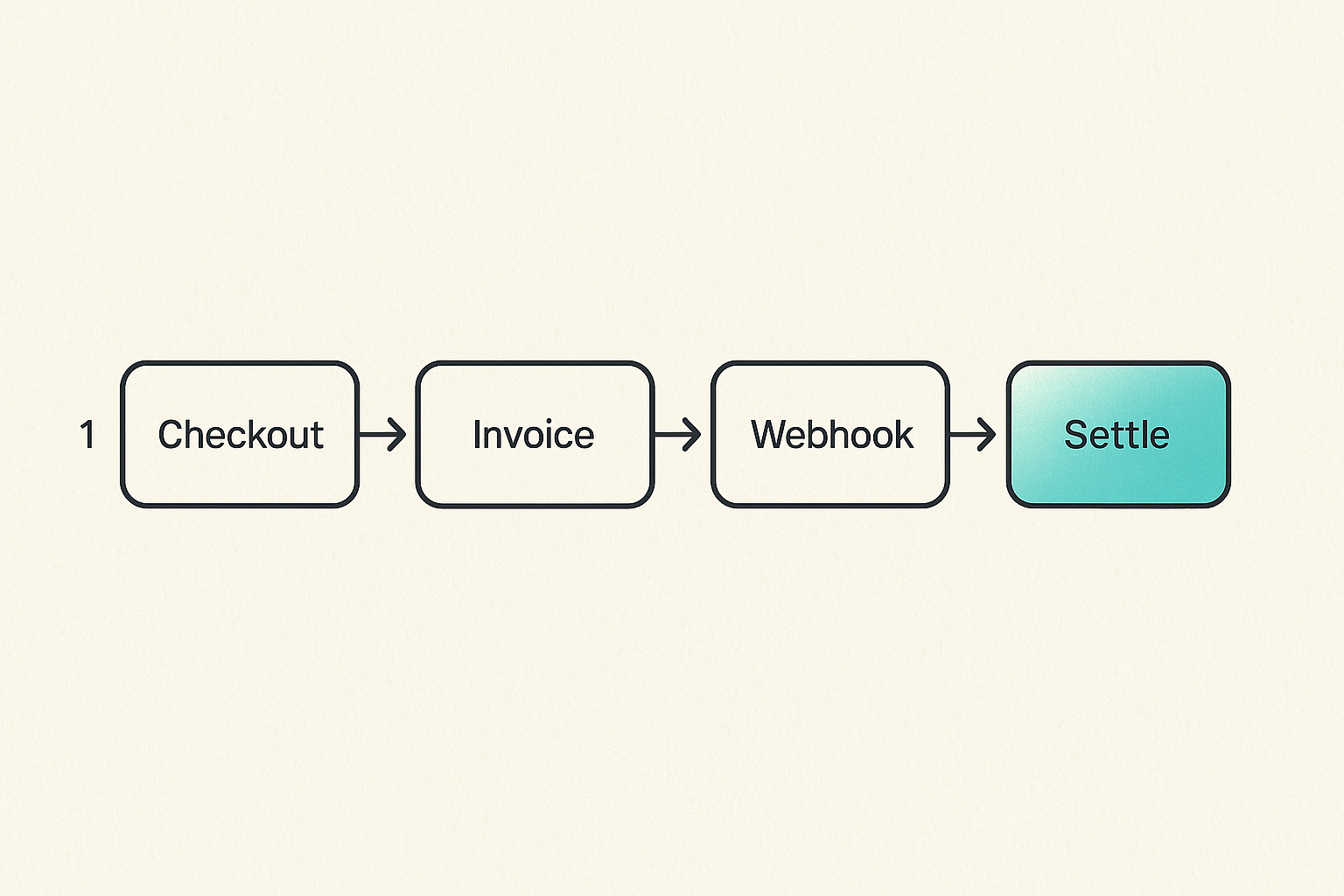
A blockchain payment gateway has a few core components. The names vary, but the workflow does not. You create an invoice, assign payment instructions, watch the chain, update state, notify the merchant, and reconcile the result.
Checkout sessions and invoices
A checkout session is the user-facing payment attempt. An invoice is the accounting object behind it. Keep them related but distinct.
The checkout session may expire, be retried, or be abandoned. The invoice should remain a durable record with amount, currency, asset, network, exchange rate snapshot, merchant reference, and payment policy.
Good invoice records usually include:
- merchant account ID
- order or cart reference
- fiat amount and display currency
- crypto amount and asset
- network or chain
- expiry timestamp
- destination address or payment request
- status
- metadata for reconciliation
If you are evaluating a provider or building your own integration, the first place to look is the invoice model. Coin and chain support matters, but the invoice model determines whether the system is operable.
For teams still mapping the setup path, our earlier guide on crypto payment gateway setup walks through the surrounding architecture decisions before the first production payment.
Address assignment and payment detection
Address assignment is where many designs quietly create future pain. You need to decide whether each invoice gets a unique address, a reusable merchant address, a payment URI, or a chain-specific account pattern. Unique addresses simplify attribution. Reused addresses reduce wallet management but complicate matching.
Payment detection should not be a single block explorer call. In production, you want a listener or provider abstraction that can tolerate provider outages, reorgs, delayed indexing, and duplicate notifications.
What breaks in practice is not usually the happy path. It is the customer who sends the right asset on the wrong network, sends from an exchange with batched withdrawals, or pays after invoice expiry.
Webhooks, ledgers, and merchant callbacks
Webhooks are the bridge from gateway state to merchant state. They should not be treated as best-effort notifications with no memory. A webhook delivery needs an event ID, signature, retry policy, delivery log, and a way for the merchant to fetch current state if delivery fails.
The merchant ledger is separate. It records what the merchant earned, what fees applied, what settled, and what remains pending. This ledger is what finance, reporting, and support will use when the payment volume becomes meaningful.
Custody, settlement, and trust boundaries
Custody is not a legal footnote you add after integration. It changes how the gateway is built, how refunds work, how settlement happens, and who can recover from mistakes.
Custodial and non-custodial tradeoffs
The practical question is not whether custodial or non-custodial is universally better. The question is which trust boundary matches your product, regulatory obligations, support capacity, and merchant expectations.
| Model | What it means | Works well when | What to watch |
|---|---|---|---|
| Custodial gateway | Provider receives and holds funds before merchant withdrawal | Merchants want simplified operations and conversion | Counterparty risk, withdrawal policy, compliance burden |
| Non-custodial gateway | Funds route directly or under merchant-controlled rules | Merchants care about control and transparent settlement | More responsibility for wallet operations and refunds |
| Escrow-based flow | Funds are held until release conditions are met | Marketplaces, services, high-trust transactions | Dispute process, release rules, evidence handling |
| Hybrid model | Different flows use different custody boundaries | Platforms with varied merchant risk profiles | Complexity and inconsistent support workflows |
That changes the conversation. A blockchain payment gateway is not only a checkout tool. It is a trust routing layer.
Escrow is a workflow, not a badge
Escrow is often marketed as a feature, but it only works if the workflow is explicit. Who can open a dispute? What evidence is required? Who can release funds? What happens if both parties disappear? How are fees handled on release or refund?
If your marketplace needs buyer-seller protection, the gateway must support the operational side of escrow, not just the phrase. CoinPayPortal's escrow flow is relevant when the payment state needs to include release conditions instead of immediate merchant settlement.
Related reading from our network: decentralized compute teams face similar routing and validation questions in IBM quantum computing in 2026, where the hard part is not access to a resource but proving that the workflow completed correctly.
Settlement policy should be explicit
Settlement policy answers simple questions that become expensive if ignored:
- settle immediately after N confirmations or after review?
- settle in crypto, stablecoin, or fiat equivalent?
- absorb network fees or pass them to the merchant?
- allow delayed payments after invoice expiry?
- batch settlement or settle per transaction?
Practical rule: write settlement policy as configuration, not tribal knowledge. Operators should know why a payment settled, not just that it did.
Payment state and webhook design
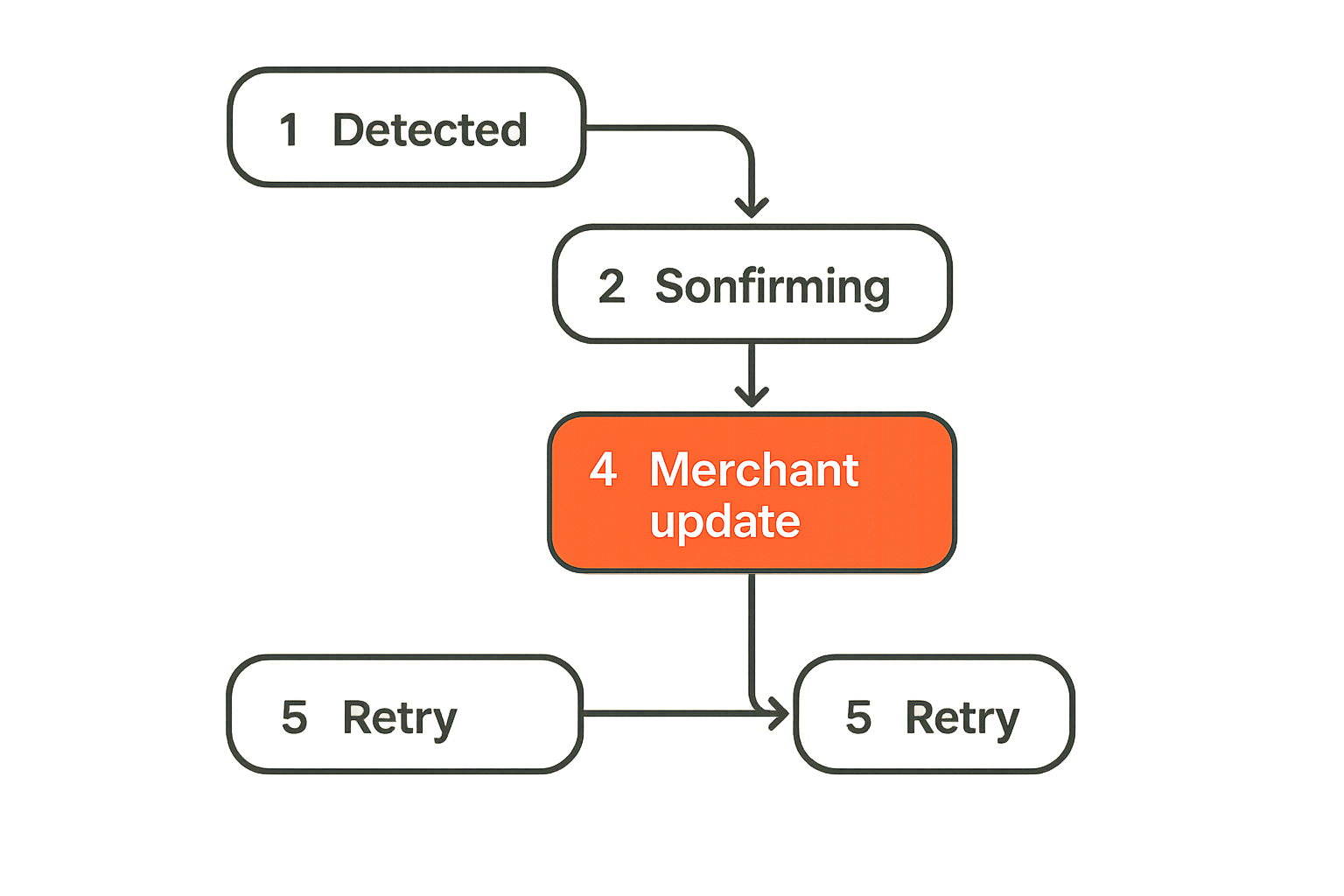
The webhook layer is where clean architecture either pays off or collapses. A blockchain payment gateway should assume duplicate events, out-of-order delivery, partial failures, and merchants that deploy bugs on Friday.
Use idempotent event handling
Every payment event should have a stable ID. Every webhook should be safe to process more than once. The merchant should store processed event IDs and treat repeated delivery as confirmation, not as a new order.
A typical webhook payload should include:
{
  "event_id": "evt_123",
  "type": "payment.confirmed",
  "payment_id": "pay_456",
  "merchant_reference": "order_789",
  "status": "confirmed",
  "amount": "125.00",
  "currency": "USD",
  "asset": "USDC",
  "network": "polygon",
  "confirmations": 24
}
If you build this yourself, do not use status alone as the idempotency key. The same payment can move through the same visible status more than once if a listener replays data or a provider redelivers events.
Model confirmations as transitions
Confirmations are not a background detail. They are part of the business contract. A digital goods merchant may accept lower confirmation depth for stablecoins on a fast network. A high-value physical shipment may wait longer.
The gateway should make this policy visible. A payment detected at zero confirmations should not be equivalent to a payment settled after the configured threshold.
Example state transitions:
payment.detectedwhen a transaction appears.payment.confirmingwhile confirmation depth increases.payment.confirmedwhen policy threshold is reached.payment.settledwhen merchant settlement rules complete.payment.review_requiredif risk or mismatch rules trigger.
Retries need a contract
Webhook retries should have predictable behavior. Merchants need to know how long retries continue, what response codes count as success, how signatures are verified, and whether they can replay missed events.
A useful pattern is:
- retry on non-2xx responses
- exponential backoff with a maximum window
- signed payloads with timestamp tolerance
- merchant endpoint health view
- manual replay from dashboard or API
Related reading from our network: AI-agent builders deal with similar event and credential boundaries in Mac tools for AI agent builders, especially when local tools, remote APIs, and test harnesses all need consistent event contracts.
Reconciliation and the merchant ledger
Reconciliation is where payment systems become real. You can ship a checkout button without it. You cannot operate a serious merchant business without it.
Separate blockchain truth from business truth
Blockchain truth says a transaction happened. Business truth says what that transaction means for an invoice, order, customer, merchant balance, fee, refund, or dispute.
Do not collapse these into one table. Keep raw transaction observations separate from interpreted payment records. This lets you reprocess chain data if your matching logic changes, without rewriting the original observation.
A practical ledger record should capture:
- payment ID
- merchant ID
- gross amount
- gateway fee
- network fee treatment
- net amount
- settlement status
- settlement destination
- timestamps for creation, confirmation, and settlement
Handle partial, overpaid, and late payments
Partial payments are common when users manually copy amounts, wallets subtract fees, or exchange withdrawals do not match the exact invoice amount. Overpayments happen for the same reasons. Late payments happen when customers keep an address or payment request open.
Decide policy before production:
- under what tolerance is an underpayment accepted?
- is overpayment credited, refunded, or held for manual review?
- does a late payment reopen an expired invoice?
- who pays fees on correction refunds?
- what does the customer see while the case is unresolved?
Practical rule: every payment mismatch needs a deterministic status. Pending forever is not a status; it is an operational debt bucket.
Refunds and fees need first-class records
Refunds are not negative payments. They have different authorization, fee, compliance, and support properties. A refund should reference the original payment, but it should be its own object with status, destination, amount, asset, network, reason, and operator trail.
Network fees also need explicit treatment. If the merchant expects to receive exactly the invoice amount but the system silently deducts fees, finance will discover the bug later. If customers pay fees but the UI never explains it, support will discover it immediately.
API integration patterns for developers
Most developer pain comes from unclear integration boundaries. The blockchain part gets attention, but the API contract determines whether the merchant backend stays clean.
Hosted checkout versus embedded API
Hosted checkout is usually faster to launch. Embedded API gives more control. The decision should be based on where you want to own complexity.
| Pattern | Developer effort | UX control | Operational burden | Best fit |
|---|---|---|---|---|
| Hosted checkout | Low | Medium | Lower | Merchants that want quick integration |
| Embedded API | Medium | High | Medium | SaaS, marketplaces, custom checkout flows |
| Direct wallet integration | High | High | High | Teams with blockchain engineering capacity |
| Full custom gateway | Very high | Maximum | Maximum | Payment companies and large platforms |
If you are going embedded, the API should expose invoice creation, payment status retrieval, webhook replay, refund creation, and ledger export. CoinPayPortal's developer docs are the right starting point when you want to inspect the API surface before committing to a checkout architecture.
Design around rate limits and timeouts
A merchant backend should not poll payment status every second for every open checkout. Polling can be useful as a fallback, but webhooks should carry the main state changes.
Design for:
- request timeouts on invoice creation
- idempotency keys for create calls
- safe retries from the merchant backend
- webhook-first updates
- polling only for recovery or customer refresh
- clear error codes for expired or invalid invoices
Rate limits are not just provider protection. They are a design signal. If your integration requires constant polling to stay correct, the workflow is wrong.
A minimal integration shape
A reasonable merchant integration looks like this:
async function createCryptoCheckout(order) {
  const invoice = await gateway.invoices.create({
    idempotencyKey: order.id,
    merchantReference: order.id,
    amount: order.total,
    currency: order.currency,
    successUrl: order.successUrl,
    cancelUrl: order.cancelUrl
  });

  await db.orders.update(order.id, {
    paymentId: invoice.id,
    paymentStatus: 'awaiting_payment'
  });

  return invoice.checkoutUrl;
}
Then the webhook handler updates internal order state only after verifying signature and event idempotency:
async function handleGatewayWebhook(event) {
  verifySignature(event);

  if (await db.events.exists(event.event_id)) return;
  await db.events.insert(event.event_id);

  if (event.type === 'payment.confirmed') {
    await db.orders.markPaid(event.merchant_reference, event.payment_id);
  }
}
The important part is not the syntax. The important part is that invoice creation and payment confirmation are separate operations.
What works in production
What works is not exotic. It is mostly disciplined state management, boring retries, and clear ownership.
A practical implementation sequence
Use this sequence whether you build, buy, or integrate a blockchain payment gateway:
- Define supported assets, networks, and settlement currencies.
- Decide custody boundaries for each payment flow.
- Model invoice, payment, transaction, refund, and ledger objects.
- Configure confirmation thresholds and expiry policy.
- Implement idempotent invoice creation.
- Verify webhook signatures and store event IDs.
- Build reconciliation reports before launch, not after.
- Create support views for payment search and mismatch handling.
- Test underpayment, overpayment, late payment, duplicate webhook, and provider outage cases.
- Run a low-volume pilot with real wallets before broad release.
This sequence prevents the common trap: shipping checkout first and discovering the operating model later.
Monitoring that catches payment drift
Payment drift is when the chain, gateway, merchant backend, and ledger slowly stop agreeing. You need monitoring that detects disagreement, not just service uptime.
Useful metrics include:
- invoices created versus payments detected
- payments detected versus payments confirmed
- webhook delivery success rate
- average confirmation time by network
- pending payments past expected confirmation window
- manual review count
- ledger settlement lag
- refund failure count
Related reading from our network: remote software teams face the same handoff problem in cloud based productivity and collaboration tools, where the workflow breaks when updates live in disconnected tools instead of a shared operating layer.
Support playbooks reduce engineering interrupts
Support needs to answer payment questions without waking engineering for every mismatch. That requires tooling, not heroics.
A support view should show:
- customer order reference
- invoice status
- transaction hash and network
- confirmation count
- expected amount and received amount
- expiry time
- webhook delivery history
- refund or review status
The mistake teams make is hiding gateway complexity from internal teams until something goes wrong. Operators do not need private keys or database access, but they do need enough context to explain what happened.
What fails when teams implement it badly
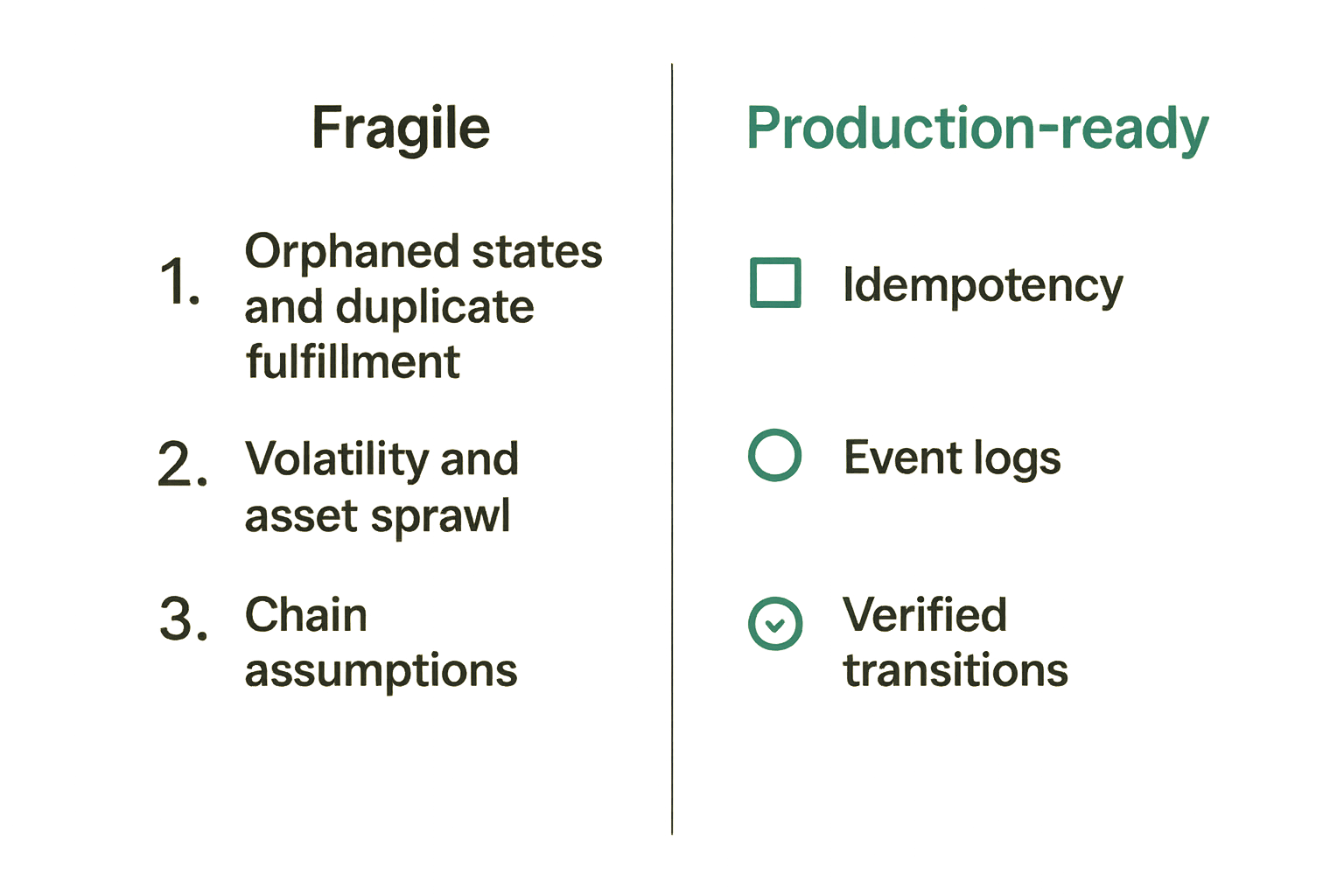
Bad implementations usually fail in predictable ways. They do not fail because crypto is mysterious. They fail because the system has no durable state model, no replay path, and no operator workflow.
Orphaned states and duplicate fulfillment
An orphaned state happens when one system thinks payment is complete and another does not. Maybe the gateway confirmed payment but the merchant webhook failed. Maybe the merchant marked the order paid based on a return URL before the transaction confirmed. Maybe an operator manually fixed one table and not another.
Duplicate fulfillment is the opposite failure. A webhook retry is treated as a new payment event, and the merchant ships twice or credits the user twice.
The fix is not more manual review. The fix is idempotency, event logs, and a single fulfillment rule: only a verified payment transition can trigger fulfillment.
Volatility, asset sprawl, and chain assumptions
Supporting every asset sounds good in sales conversations. In production, every asset adds pricing, network, confirmation, fee, refund, and support complexity.
Stablecoins reduce volatility but do not remove network risk. Native assets have different fee behavior. Layer 2 networks have different finality assumptions. Exchange withdrawals can batch and delay payment. Some wallets display confusing network names.
A useful way to think about it is that each supported asset-network pair is a product surface. If you cannot monitor, support, and reconcile it, you probably should not offer it yet.
Manual fixes become hidden product logic
Manual fixes are sometimes necessary. The danger is when they become the real system.
If operators regularly edit order status, resend funds from personal wallets, or ask engineering to run database scripts, your gateway logic is incomplete. Those actions should become product workflows with permissions, audit logs, and deterministic outcomes.
What breaks in practice is institutional memory. The person who knows the manual fix leaves, the next incident is handled differently, and finance cannot explain why ledger balances changed.
Security and compliance boundaries
Security in a blockchain payment gateway is not only smart contract review or wallet hardening. It is the full path from checkout creation to settlement, refund, and audit.
Key management is a product decision
If your system can move funds, key management is core product architecture. Decide where keys live, who can authorize transactions, how approvals work, how rotation happens, and what the recovery path is.
For non-custodial flows, the gateway may avoid holding merchant funds, but it still needs to protect API credentials, webhook signing secrets, admin permissions, and any automation that can influence settlement or refunds.
For custodial or hybrid flows, the controls need to be stronger: segregation of duties, withdrawal limits, multisig or policy controls, and operational review for unusual activity.
Risk controls belong in the workflow
Risk controls should not be an afterthought bolted onto support. They should be part of the state machine.
Examples:
- high-value payment requires additional confirmations
- mismatch amount triggers review
- suspicious destination refund requires approval
- merchant account changes pause settlement
- repeated failed webhook delivery pauses fulfillment automation
This does not mean every merchant needs heavy compliance tooling on day one. It means the architecture should have a place for risk decisions to live.
Audit logs protect operators
Audit logs are not only for regulators. They protect your team from ambiguity.
Log who changed settlement settings, who approved a refund, who replayed a webhook, who changed a wallet address, and which system generated each state transition. When a merchant asks why an order was not fulfilled, the audit trail should answer without a Slack archaeology project.
Practical rule: if an operator action can move money, change fulfillment, or alter settlement, it needs an audit log and permission boundary.
Where coinpayportal.com fits
A blockchain payment gateway should reduce merchant complexity without hiding the parts merchants still need to control. The goal is not to pretend blockchain payments behave like card payments. The goal is to provide a reliable operating layer around the differences.
Product fit for developers and merchants
coinpayportal.com is for developers and merchants building crypto payment infrastructure who need the gateway layer to handle real payment workflows: checkout creation, automatic fee handling, real-time processing, and operational visibility.
That fit matters when your team wants to avoid building chain listeners, webhook retry systems, mismatch handling, and support tooling from scratch. It also matters when you want a non-custodial posture but still need merchant-friendly payment flows.
The right gateway should let engineering integrate cleanly, let merchants understand payment status, and let operators resolve edge cases without turning every issue into a custom script.
When to build versus integrate
Build your own gateway if payments are the core product, you have blockchain infrastructure expertise, and you are ready to own 24/7 operational edge cases. Integrate if payments support the business but are not the business.
A simple test: if a failed webhook, delayed confirmation, or wrong-network payment would block your roadmap for a week, you probably want a gateway partner. If your differentiation is checkout UX, marketplace logic, or merchant experience, spend engineering time there instead of rebuilding commodity payment plumbing.
Closing the loop, the best blockchain payment gateway choice in 2026 is the one that makes state, settlement, custody, reconciliation, and support explicit. Not the one with the longest coin list.
Try coinpayportal.com
You are writing for developers and merchants building crypto payment infrastructure. Try coinpayportal.com to build crypto checkout and gateway workflows without turning payment operations into an internal platform project.
Try CoinPay
Non-custodial crypto payments — multi-chain, Lightning-ready, and fast to integrate.
Get started →