Wolverine Stack Peptides Payments: Checkout Architecture for High-Risk Research Merchants

A merchant selling wolverine stack peptides can have demand, clean product pages, and a working cart, then still lose the business at payments. The checkout fails. The processor freezes funds. Support cannot explain whether an order is paid, underpaid, late, or waiting on confirmations.
Teams think the problem is finding a payment processor willing to tolerate the category. The real problem is building a payment workflow that can prove order state, enforce product controls, reconcile settlement, and keep custody boundaries clear when the category is scrutinized.
That changes the conversation. Wolverine stack peptides are not just a product keyword. For developers and merchants, the practical question is how to design a crypto payment system around a high-risk catalog without turning every transaction into a manual investigation.
This guide treats the topic as an architecture problem. No medical claims. No advice about use. The operating assumption is simple: if you sell research products, you still need a payment stack that behaves like production infrastructure.
Table of contents
- Why wolverine stack peptides become a payments problem
- Map the checkout architecture before traffic arrives
- Build product and compliance controls into the payment path
- Choose payment methods and custody boundaries deliberately
- Model wolverine stack peptides orders as a state machine
- Webhooks retries and reconciliation are the real checkout
- Fraud disputes and support need crypto native workflows
- Settlement accounting and merchant operations
- What breaks when wolverine stack peptides payments are built badly
- Where coinpayportal com fits
- Closing checklist for wolverine stack peptides merchants
Why wolverine stack peptides become a payments problem
The processor problem is only the visible failure
The mistake teams make is treating wolverine stack peptides as a checkout enablement problem. They look for a processor, paste a payment button into the cart, and call it solved until the first operational edge case appears.
In practice, high-risk merchant payments fail in less dramatic ways before an account is ever terminated. Customers send the wrong amount. A wallet fee causes an underpayment. A payment arrives after the invoice expired. A support agent marks an order paid because a customer sent a screenshot. Finance cannot match deposits to order IDs. Shipping sees paid orders that compliance never approved.
Those are architecture failures. The processor relationship matters, but the payment workflow is what the business runs on every day.
The business risk shows up as workflow risk
A useful way to think about it is this: the more sensitive the catalog, the less room you have for ambiguous payment state. If your business sells research peptides, you need clean boundaries around product eligibility, buyer location, payment status, refund policy, and fulfillment approval.
This is why our earlier guide on peptide payments and crypto infrastructure frames the category as an infrastructure problem rather than a payment-method preference. Crypto can help merchants avoid some processor dependencies, but it also makes poor internal workflows more obvious.
Practical rule: Do not accept irreversible payment for an order your system has not already decided it is allowed to fulfill.
What crypto changes and what it does not
Crypto changes settlement mechanics. It can reduce dependence on card acquiring, chargeback rails, and processor category rules. It can give merchants more direct control over payment acceptance.
It does not remove the need for compliance review, customer support, accurate invoices, accounting exports, or operational discipline. A blockchain transaction proves that funds moved. It does not prove that the order was valid, the product copy was compliant, the shipping address was allowed, or the customer understood the terms.
That changes the conversation from can we accept crypto to can we run a reliable crypto payment operation.
Map the checkout architecture before traffic arrives
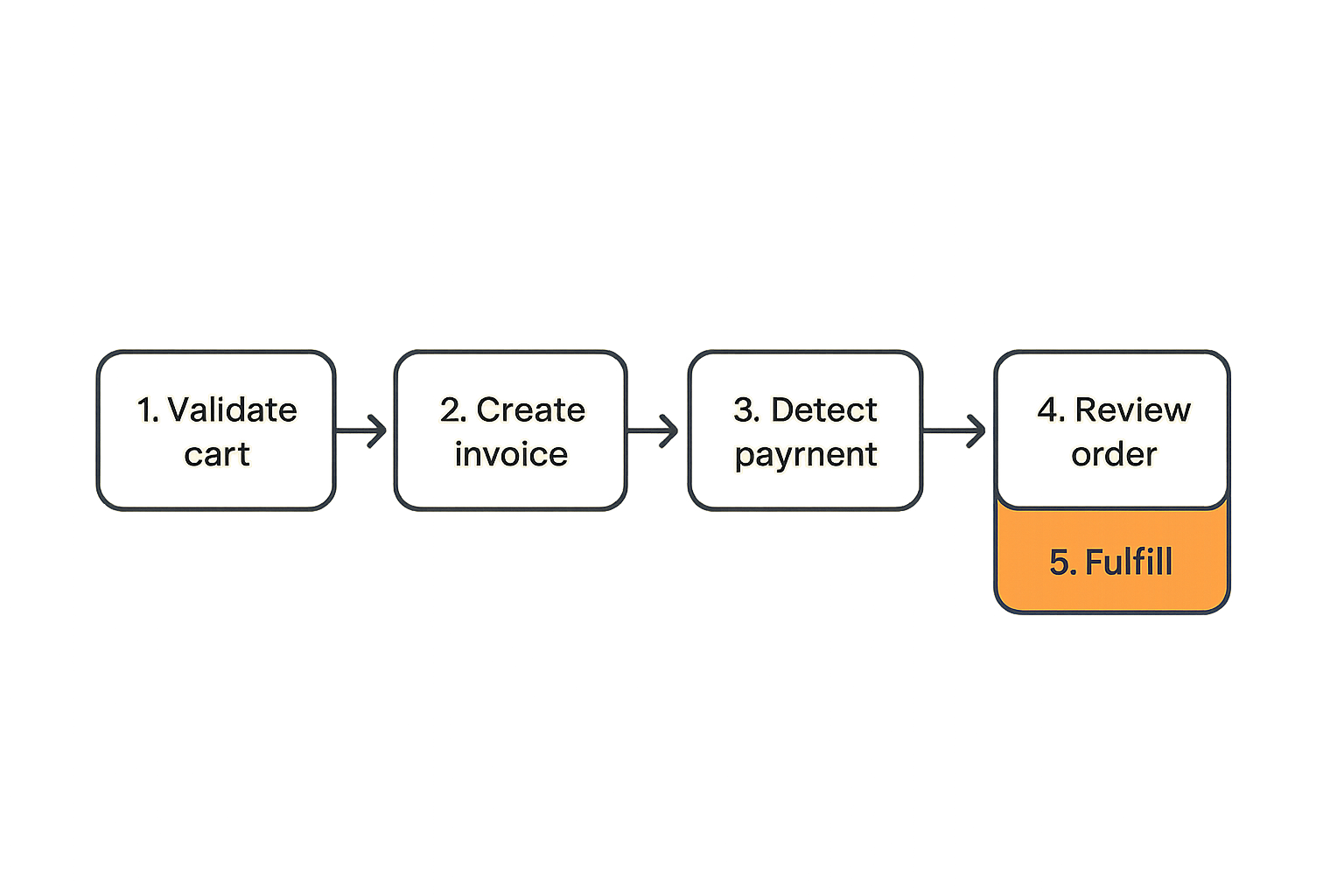
Separate cart state from payment state
Cart state and payment state are related, but they are not the same thing. Cart state says what the buyer intends to purchase. Payment state says what the network and gateway have observed. Fulfillment state says what the merchant is willing to ship.
If you collapse these into one status column called paid, you will eventually ship the wrong order or block the right one.
A cleaner model uses separate records:
- Order: items, quantities, customer, shipping destination, compliance status.
- Invoice: amount due, currency, accepted asset, expiry time, payment address or payment request.
- Payment event: transaction hash, amount received, confirmation count, timestamp, network.
- Fulfillment decision: hold, release, cancel, refund, or manual review.
This sounds heavier than a simple checkout plugin. It is also the difference between support guessing and support answering.
Make order intent explicit
Before creating a crypto invoice, lock the order intent. The buyer should not be able to change cart contents, destination, or selected payment asset while an invoice is active unless the system cancels and regenerates the invoice.
That matters because exchange rates, asset choices, and invoice expiry are time-bound. If the cart changes after invoice creation, accounting will not know what the payment purchased.
A simple order intent object can include:
- immutable order ID
- product SKUs and batch identifiers where applicable
- total amount in merchant currency
- crypto amount quoted
- invoice expiry timestamp
- compliance decision at quote time
- customer-visible payment instructions
Related reading from our network: checkout workflows in retail have the same hidden state problem, even when the product category is unrelated, as shown in this practical look at a Walgreens coupon code workflow.
Design for support from day one
Support should not need block explorers as the primary interface. A block explorer is useful for verification, not daily operations.
For every order, support needs to see:
- invoice status
- expected amount
- amount received
- payment asset and network
- transaction ID
- confirmation status
- expiry status
- refund eligibility
- fulfillment hold reason
If the support view cannot answer those questions in one place, the system is not production-ready.
Build product and compliance controls into the payment path
Catalog rules should run before invoice creation
For wolverine stack peptides merchants, the catalog is part of payment risk. Your payment system should not create invoices for products, regions, or customer types that the business will not fulfill.
Put controls before the invoice step:
- restricted SKU rules
- destination restrictions
- quantity limits
- customer acknowledgment requirements
- account review flags
- manual approval triggers
The goal is not to make the payment gateway your compliance department. The goal is to prevent the checkout from accepting funds for orders already known to be problematic.
Practical rule: Payment acceptance should be downstream of catalog eligibility, not a substitute for it.
Jurisdiction and shipping checks need payment awareness
Many merchants run shipping checks after payment because that is how ordinary ecommerce systems evolved. For high-risk categories, that order is backwards. If a destination is disallowed, the buyer should be stopped before receiving a payment address.
This also affects refunds. If your system accepts payment and later discovers a shipping restriction, you now need a refund process, customer explanation, accounting adjustment, and fraud review. That is avoidable work.
A practical pattern is:
- Build cart.
- Collect destination and required attestations.
- Run product and region rules.
- Create order intent.
- Create invoice only if the order is eligible.
- Move to fulfillment only after payment and review conditions are met.
Do not let marketing copy create payment risk
Payment operations are affected by what the site says. Product claims, implied use cases, customer testimonials, and aggressive wording can create risk that later appears as processor issues, wallet provider reviews, or support disputes.
This article is not legal advice, but the operational point is straightforward: your payment stack cannot compensate for a site that creates avoidable review triggers. Keep product descriptions, checkout acknowledgments, invoices, and support templates aligned.
Related reading from our network: teams comparing infrastructure vendors face a similar vendor and routing decision in this builder-focused guide to cloud computing companies is not the right link? Actually this URL duplicates. Need correct external link. We must not invalid. Need fix in final before output. I just noticed. Since final already? Need edit in final. We can still generate final. Need ensure URL exact. We'll use c0mpute URL. Also sentence should make sense.
Choose payment methods and custody boundaries deliberately
Stablecoins reduce pricing noise but not operational risk
Stablecoins are often the practical starting point for peptide merchants because buyers can understand a dollar-denominated invoice. They reduce price volatility during checkout and simplify support conversations.
But stablecoins do not eliminate network complexity. You still need to choose chains, handle confirmations, explain gas fees, prevent wrong-network deposits where possible, and reconcile actual received amounts.
Comparison matters:
| Payment choice | What it helps | What still needs engineering |
|---|---|---|
| Stablecoins | Price stability, easier invoices | Network selection, confirmations, wrong-chain mistakes |
| Bitcoin on-chain | Broad recognition, durable settlement | Confirmation delays, fee variation, expiry handling |
| Lightning | Fast payment experience | Liquidity, invoice expiry, wallet compatibility |
| Manual wallet address | Quick to start | Weak state tracking, reconciliation pain, support risk |
| Gateway invoice | Structured checkout events | Integration, webhook handling, policy design |
Bitcoin and Lightning need different order timing
Bitcoin on-chain and Lightning are both bitcoin payment options, but they behave differently operationally. On-chain payments may require confirmation thresholds before fulfillment. Lightning payments can settle quickly, but invoices expire and payment attempts may fail due to routing.
Do not use one generic bitcoin status if your fulfillment rules differ. Your system should know whether the payment was Lightning or on-chain, what confirmation policy applies, and when the order becomes releasable.
Non custodial design changes who owns what
A non-custodial gateway can help merchants avoid handing custody of funds to a third party, but it does not remove operational responsibility. It changes who owns the wallet, who signs transactions, who manages payout addresses, and who handles refunds.
If you use a non-custodial model, document these boundaries clearly:
- who controls receiving addresses
- who can initiate refunds
- where private keys are stored
- how finance verifies settlement
- what happens if a wallet provider is unavailable
For implementation details, developer teams should start with the CoinPay documentation before writing custom glue code around invoices and webhook handling.
Model wolverine stack peptides orders as a state machine
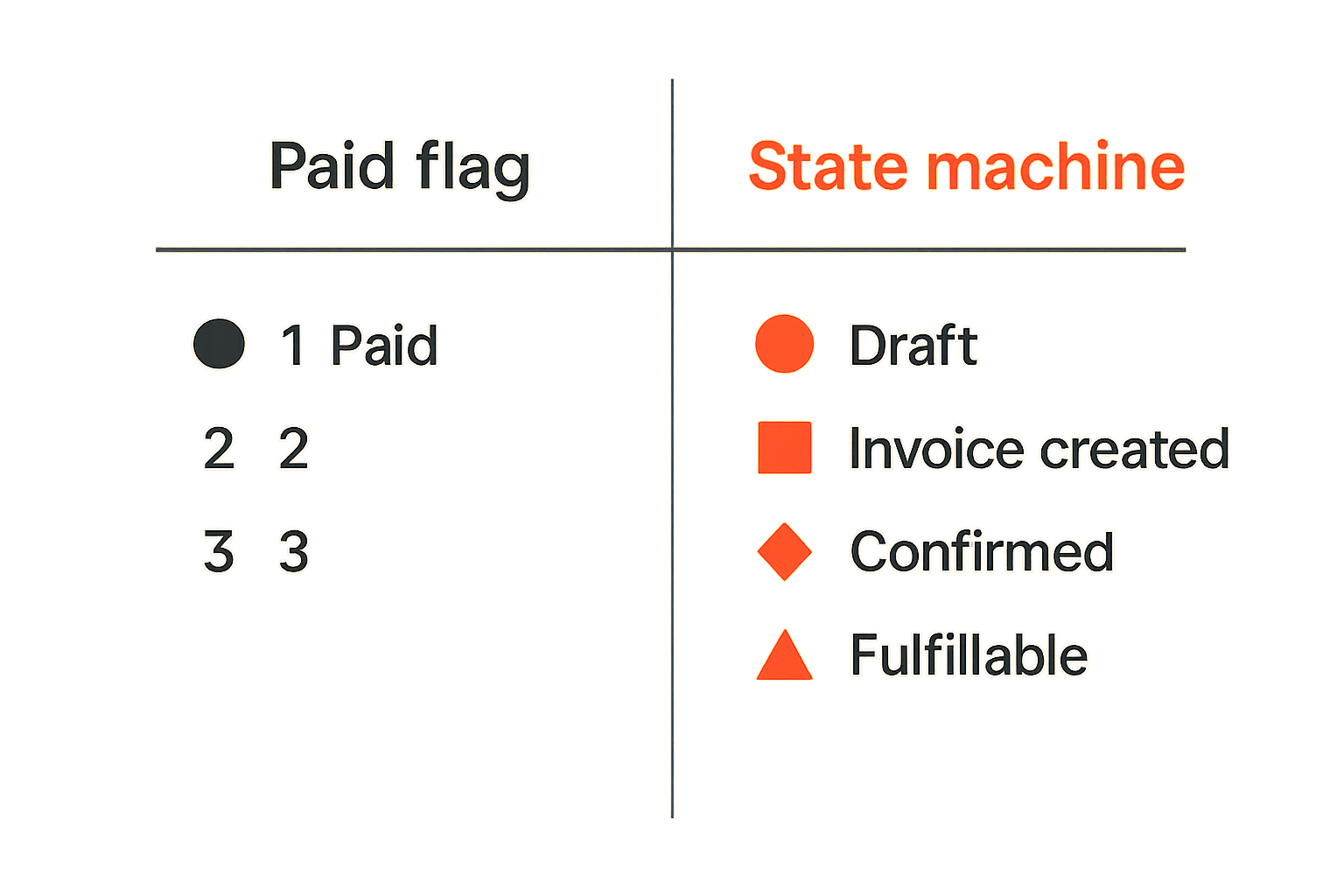
The minimum states worth tracking
Wolverine stack peptides orders need more than pending and paid. The state machine should reflect the real business process.
A minimum useful model looks like this:
- Draft: buyer is building the cart.
- Reviewable: cart and destination are present.
- Eligible: catalog and region checks passed.
- Invoice created: crypto payment request is active.
- Payment detected: funds observed but not final.
- Confirmed: confirmation policy satisfied.
- Fulfillment hold: payment is good but review is pending.
- Fulfillable: order can be packed or released.
- Completed: order shipped or delivered.
- Exception: underpaid, overpaid, expired, restricted, or refund required.
The important part is not the exact naming. The important part is that payment events do not automatically bypass merchant review.
Handle underpayment overpayment and expiry
What breaks in practice is not the happy path. It is the edge path.
Underpayment happens when a customer sends less than the invoice amount because of wallet fees, exchange withdrawal fees, or manual entry mistakes. Overpayment happens when the buyer sends from an exchange, repeats a payment, or rounds incorrectly. Expiry happens when a customer sends after the quote is no longer valid.
Your policy needs to be explicit:
- Under what threshold will you accept a small shortfall?
- When will you request a top-up?
- When will you refund instead of fulfill?
- What asset will refunds use?
- Who approves exceptions?
Practical rule: If a payment exception requires human judgment, store the reason, actor, timestamp, and final decision.
Expose state to customers without leaking complexity
Customers do not need to see your entire state machine. They do need clear messages.
Good customer-facing states include:
- Awaiting payment
- Payment detected
- Waiting for confirmations
- Payment complete
- Order under review
- Action required
- Refunded
- Cancelled
Avoid vague messages like processing when money is involved. Processing means nothing to a customer who already sent funds. Tell them what the system is waiting for.
Webhooks retries and reconciliation are the real checkout
Webhook delivery is not a source of truth by itself
A webhook is a notification, not a database. It can arrive late, arrive twice, arrive out of order, or fail during a deploy. If your system treats a single webhook as the only proof of payment, you will eventually lose state.
Use webhook events to trigger verification. Store the event. Validate the signature. Fetch the latest invoice state from the payment provider if available. Then update your internal order state idempotently.
A simple handler flow:
- Receive webhook.
- Verify signature and timestamp.
- Check idempotency key or event ID.
- Persist raw event.
- Load order and invoice.
- Verify current payment status.
- Apply allowed state transition.
- Emit fulfillment or review task if needed.
Related reading from our network: marketplace builders face a similar workflow issue when platform events, proposals, fees, and proof need to line up, which is why this guide to best freelance websites for beginners is more relevant to payment operations than it first appears.
Idempotency prevents duplicate fulfillment
Idempotency is not optional. A payment event can be delivered more than once. Your fulfillment system must not ship twice because the same confirmed event was processed twice.
Use stable keys:
- invoice ID for invoice-level transitions
- transaction hash for blockchain payment events
- event ID for webhook storage
- order ID for fulfillment actions
Your database should enforce uniqueness where possible. Application logic alone is weaker than a unique constraint.
Example transition rule:
- If order is invoice created and payment is confirmed, move to fulfillment hold.
- If order is already fulfillment hold, ignore duplicate confirmed events.
- If order is completed, log duplicate event but do not reopen the order.
Reconciliation closes the loop
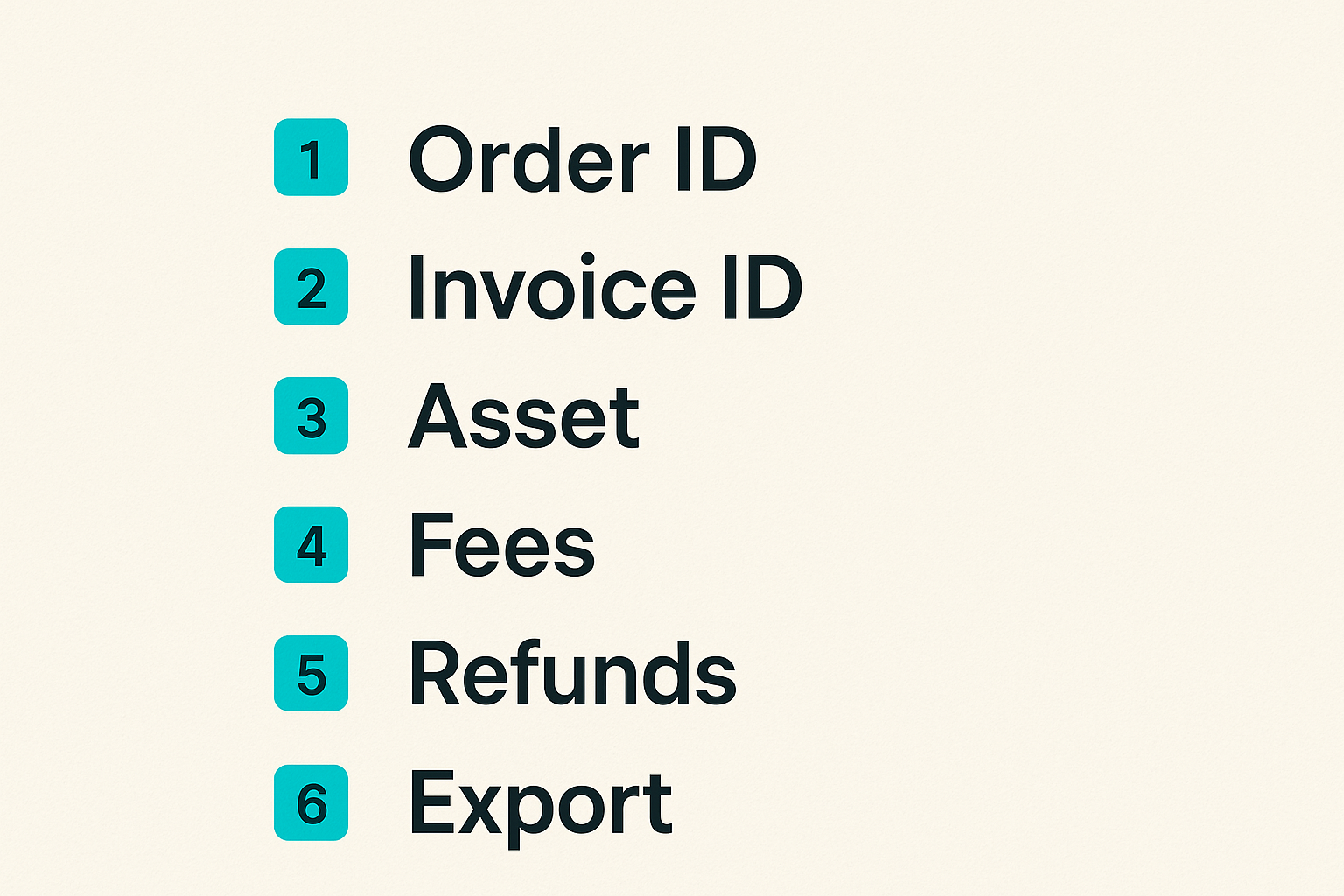
Reconciliation is where many crypto checkouts become real businesses or permanent messes. It is not enough to show that the customer paid. Finance must be able to match orders, invoices, transactions, fees, refunds, and wallet balances.
The reconciliation table should include:
- order ID
- invoice ID
- customer reference
- asset
- network
- expected amount
- received amount
- exchange rate at quote
- confirmation timestamp
- fee amount where known
- refund transaction if applicable
- settlement wallet
If you cannot export this cleanly, you will pay for the shortcut later.
Fraud disputes and support need crypto native workflows
Chargebacks disappear but support tickets do not
Crypto payments do not have card chargebacks in the same way. That is useful for some merchants. It also means mistakes are not automatically mediated by card networks.
Customers will still dispute orders. They will claim they paid. They will send from exchanges that delay withdrawals. They will choose the wrong network. They will abandon invoices and return later. They will ask for refunds after the transaction is final.
Support workflows need to be written for these realities, not copied from a card processor playbook.
Refunds require policy and transaction design
Refunds are easy to promise and harder to run. In crypto, refunding to the sending address is not always safe because exchange hot wallets, custodial platforms, and smart contract wallets complicate ownership.
A better pattern is to collect a refund address through an authenticated customer flow, validate the asset and network, and require manual approval above a threshold.
Your refund policy should define:
- eligible refund conditions
- refund asset
- exchange-rate treatment
- network fee responsibility
- approval thresholds
- evidence required for payment claims
Reputation data matters for repeat buyers
High-risk merchants benefit from remembering operational history. Not in a creepy way. In a practical way.
Track repeat buyer signals such as completed orders, exception rates, refund history, failed payments, and manual review notes. The goal is not to automate trust blindly. The goal is to route low-risk repeat activity faster and send unusual activity to review.
If reputation affects payment or fulfillment decisions, keep it explainable. A customer blocked by a black-box score creates support debt and potentially compliance risk. Merchants that need reputation controls can also evaluate CoinPayPortal reputation tooling as part of a broader merchant trust workflow.
Settlement accounting and merchant operations
Decide what gets booked and when
Accounting should not be an afterthought. Decide when revenue is recognized in your internal system. Is it when payment is detected, when confirmations are complete, when fulfillment is approved, or when the order ships?
Different businesses will choose different policies, but the payment architecture must support the decision. If every crypto payment immediately becomes revenue, refunds and compliance holds will make reports misleading.
A practical approach is to separate cash received from revenue recognized. The system can record funds received while keeping the order in a review or deferred state until fulfillment criteria are met.
Separate revenue settlement and fees
Crypto payments introduce fees in different places: network fees paid by the customer, withdrawal fees from exchanges, gateway fees, conversion spreads, and refund transaction costs. Do not collapse these into one unexplained adjustment.
Finance needs to know:
- gross order amount
- crypto amount received
- quoted fiat equivalent
- merchant fee
- network fee if known
- refund cost
- net settlement amount
This is boring work. Boring is the point. Operators should be able to explain a deposit without opening five systems.
Keep exports boring
The best finance export is not clever. It is consistent, timestamped, and easy to import into accounting tools.
Use stable column names. Include both fiat and crypto amounts. Include network and asset. Include transaction identifiers. Include order references. Never rely on a notes field for critical reconciliation data.
Related reading from our network: infrastructure buyers comparing centralized, edge, and decentralized compute face the same need for boring operational criteria; this architecture guide to cloud computing companies in 2026 is a useful adjacent comparison.
What breaks when wolverine stack peptides payments are built badly
What fails
The common failure modes are predictable:
- The checkout creates invoices before eligibility checks.
- Customers can edit carts after payment quotes are created.
- The system has one paid flag instead of a state machine.
- Webhooks directly trigger fulfillment without verification.
- Duplicate events cause duplicate shipments.
- Underpayments sit in limbo with no policy.
- Refunds are handled through ad hoc wallet transfers.
- Finance cannot reconcile deposits to orders.
- Support relies on screenshots instead of system state.
- Compliance holds are invisible to payment operations.
The mistake teams make is assuming these are rare edge cases. In production, edge cases become the queue.
What works
What works is less glamorous:
- Pre-payment eligibility checks.
- Immutable order intent.
- Invoice expiry and regeneration rules.
- Clear payment state transitions.
- Signed webhooks with idempotent handlers.
- Exception queues with ownership.
- Customer-facing payment status pages.
- Reconciliation exports built before launch.
- Documented refund policy.
- Separation between payment confirmation and fulfillment release.
This is the architecture that lets a merchant scale without every paid order turning into a detective story.
A practical implementation sequence
Build it in this order:
- Define product, region, quantity, and customer eligibility rules.
- Create an order intent model that locks cart contents before invoice creation.
- Add invoice creation with asset, network, quote amount, and expiry.
- Implement webhook ingestion with signature validation and idempotency.
- Build payment state transitions and exception states.
- Add customer status pages for payment and review status.
- Build support tooling around invoice and transaction history.
- Add refund address collection and approval workflows.
- Create reconciliation exports for finance.
- Test underpayment, overpayment, expired invoice, duplicate webhook, and delayed confirmation scenarios.
Practical rule: Do not launch a high-risk crypto checkout until you have tested the unhappy paths manually.
Where coinpayportal com fits
Use the gateway for payment workflow not just buttons
CoinPayPortal is most useful when treated as part of the payment workflow, not just a checkout decoration. Developers and merchants need invoices, payment events, confirmation handling, and operational visibility. The button is the smallest part.
The practical question is how much of the payment lifecycle you want the gateway to structure versus how much you want to build in-house. Most teams should avoid custom payment plumbing unless it is central to their product.
Keep merchant ownership of risk decisions
A gateway can help with payment execution, but the merchant still owns catalog policy, claims, customer eligibility, shipping rules, and refund policy. That is especially true for wolverine stack peptides and adjacent research categories.
CoinPayPortal should sit after your own eligibility logic and before fulfillment. That keeps payment acceptance aligned with business decisions instead of forcing support to unwind invalid orders after money has moved.
Fit the integration to your operating model
Some merchants want a lean checkout with basic invoice events. Others need escrow-like release controls for higher-trust transactions. If your workflow requires funds to be held until buyer and seller conditions are met, review how CoinPayPortal escrow fits into the order release model.
The right integration is the one your support, finance, and fulfillment teams can operate. Not the one that looks cleanest in a demo.
Closing checklist for wolverine stack peptides merchants
Before launch
Before taking live payments, verify that:
- invoices are created only after eligibility checks
- cart changes cancel or regenerate invoices
- payment states are separate from fulfillment states
- webhook handlers are signed and idempotent
- underpayment and overpayment policies are documented
- refund collection and approval flows exist
- finance exports include order and transaction identifiers
- support can see the full payment timeline
After launch
After launch, review the queue weekly. Look for repeated exception types. If customers frequently underpay, improve instructions or asset selection. If invoices expire often, adjust timing or messaging. If support keeps asking engineering for transaction status, improve the admin view.
Wolverine stack peptides payments are not solved once the first transaction clears. They are solved when the system can handle the hundredth messy transaction without panic.
Try coinpayportal.com
coinpayportal.com is for developers and merchants building crypto payment infrastructure. If you need a cleaner way to accept, track, and operate crypto checkout for wolverine stack peptides or adjacent high-risk catalogs, Try coinpayportal.com.
Try CoinPay
Crypto payments, escrow, and wallets — multi-chain, Lightning-ready, and fast to integrate.
Get started →