Wolverine Peptide Payments: Crypto Checkout Architecture for High-Risk Merchants

A wolverine peptide store can look operationally simple from the outside: product page, cart, checkout, confirmation email. Then the processor review arrives, the account gets frozen, paid orders sit in limbo, and support has no single source of truth.
Teams think the problem is finding a processor willing to tolerate the category. The real problem is building a payment workflow that can keep selling when conventional rails are unreliable, slow, or hostile to the merchant profile.
That changes the conversation. Wolverine peptide payments are not just about adding crypto logos to a checkout page. They are about state, trust, settlement, reconciliation, customer instructions, fulfillment holds, refunds, and auditability.
The practical question is not whether crypto can accept payment. It can. The practical question is whether your architecture can tell operations exactly what happened when a buyer sends the wrong amount, pays late, uses the wrong chain, or claims they paid when no confirmation exists.
Table of contents
- Wolverine peptide payments are an architecture problem
- Map the wolverine peptide payment lifecycle before choosing tools
- Design checkout around state, not screens
- Webhook reliability is the core production issue
- Reconciliation decides whether support can trust the system
- Risk controls for wolverine peptide merchants
- Implementation workflow for a production crypto checkout
- What breaks when wolverine peptide payments are implemented badly
- How coinpayportal.com fits the workflow
Wolverine peptide payments are an architecture problem
The mistake teams make is treating wolverine peptide payments like a plugin search. They look for a gateway, paste a widget into the checkout, and assume the hard part is done. In production, the hard part starts after the buyer clicks pay.
Why the checkout button is the easy part
A checkout button only captures intent. It does not prove funds arrived, determine whether the customer paid the exact amount, decide whether the order should be released, or preserve evidence for a support dispute.
With card payments, many of those concerns are hidden behind the acquirer, processor, and network rules. That abstraction is convenient until the category is considered high-risk, the merchant account is reviewed, or payout terms change without warning.
With crypto payments, the abstraction shifts. You gain direct settlement options and fewer category gatekeepers, but you must own more of the workflow. That includes invoice state, chain monitoring, confirmation depth, exchange rate windows, refunds, and customer education.
Practical rule: Do not evaluate a crypto payment gateway by the checkout screen. Evaluate it by the states it exposes when something goes wrong.
Where high-risk merchant operations actually fail
Many peptide and research-adjacent merchants fail operationally in boring places. An order is marked paid before funds are confirmed. A buyer sends USDT on the wrong network. A fulfillment team ships against a pending transaction. A refund is promised in fiat terms but paid in crypto terms without a clear rate policy.
None of those are blockchain problems in the abstract. They are workflow problems. If the system has no durable payment object, no event log, and no operator dashboard, every edge case becomes a manual investigation.
For a deeper adjacent breakdown, the prior CoinPay guide on peptide payments and crypto infrastructure covers why this category needs payment design instead of processor optimism.
The boundary between commerce and claims
Wolverine peptide is often discussed in communities that mix commerce, research language, and health-related expectations. Payment infrastructure should not make product claims, medical claims, or compliance assumptions. It should enforce clear commerce rules: what was ordered, what amount was requested, what payment was detected, what state the order entered, and who approved any exception.
That boundary matters. The payment system should not decide whether a product description is compliant. It should give the business enough control to pause categories, review orders, block jurisdictions, and preserve records.
Related reading from our network: teams designing private communication systems face a similar boundary problem between interface and trust model in secure messaging apps in 2026.
Map the wolverine peptide payment lifecycle before choosing tools
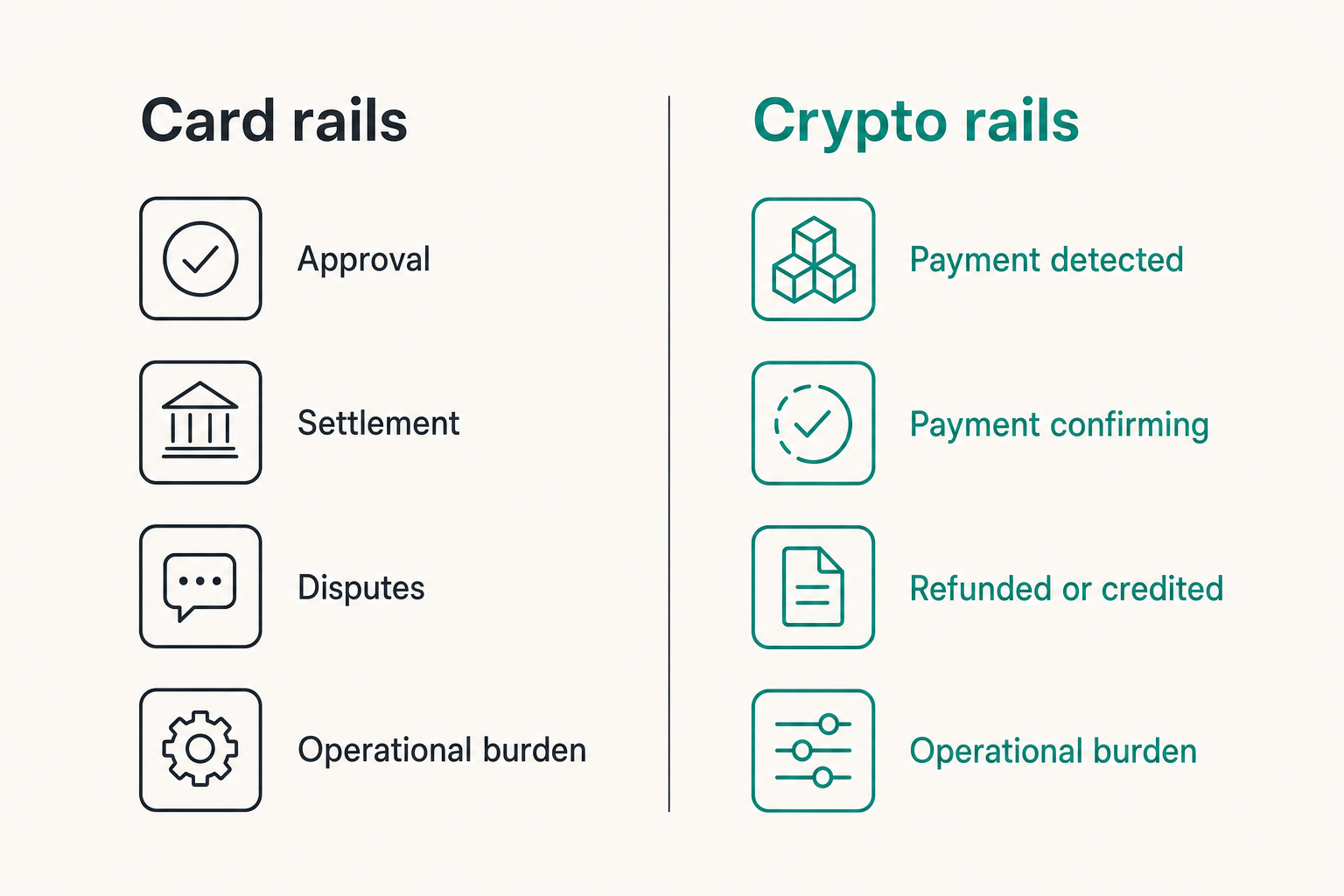
A useful way to think about it is this: every payment method is a state machine. If you cannot describe the state machine, you are not ready to choose the gateway.
The minimum lifecycle states
A practical lifecycle for a wolverine peptide merchant usually needs at least these states:
- Cart created
- Invoice created
- Payment address assigned
- Payment detected
- Payment confirming
- Payment confirmed
- Underpaid
- Overpaid
- Expired
- Order released
- Fulfillment held
- Refunded or credited
The names can vary. The important part is that payment state and order state are not the same thing. Payment can be confirmed while the order remains held for review. An order can be canceled while an on-chain payment arrives late.
Practical rule: Keep payment state, order state, and fulfillment state separate. Collapsing them into paid or unpaid is how support chaos starts.
What changes when payment is on-chain
On-chain payments are externally observable, but they are not automatically business-final. You still need to decide how many confirmations are enough, how long an invoice remains valid, what exchange rate is locked, and what happens when the buyer sends a token you do not support.
The practical question is whether the merchant system can answer these questions without a developer opening a block explorer:
- Which invoice did this transaction belong to?
- Was the amount sufficient at the locked rate?
- Did it arrive before expiration?
- Is the transaction confirmed enough to release the order?
- Has this transaction already been applied somewhere else?
If the answer is no, the system is not production-ready. It is a demo.
A comparison of card rails and crypto rails
| Decision area | Card processor model | Crypto payment model |
|---|---|---|
| Category approval | Processor controls merchant acceptance | Merchant has more direct acceptance options |
| Settlement timing | Processor payout schedule | Network and wallet settlement design |
| Chargebacks | Formal dispute rails | No native chargeback, refund workflow required |
| Evidence | Processor portal and receipts | Event log, transaction hash, invoice records |
| Failure mode | Account holds, rolling reserves, disputes | Wrong network, underpayment, late payment |
| Operational burden | Hidden until processor risk action | Visible and must be designed upfront |
The point is not that one model is magically better. The point is that crypto moves control and responsibility closer to the merchant. That is useful only if the workflow is built for it.
Design checkout around state, not screens
A clean checkout page does not compensate for a weak payment state model. What breaks in practice is the gap between what the buyer sees and what the backend knows.
Invoice creation and amount locking
Every crypto checkout should create a durable invoice record before showing payment instructions. That invoice should include:
- Internal invoice ID
- Order ID
- Requested fiat amount
- Quoted crypto amount
- Currency and chain
- Rate source and timestamp
- Expiration time
- Assigned payment address or payment URI
- Current payment state
For a merchant selling wolverine peptide products, amount locking matters because support conversations usually happen in fiat terms. The customer says they paid for a 120 dollar order. Your system needs to know what that meant in USDT, BTC, ETH, or another supported asset at the time of checkout.
Address assignment and chain selection
Do not let chain selection be vague. USDT on Ethereum is not the same operational object as USDT on Tron or another network. If the buyer sees only send USDT, you will eventually receive funds on a network your system does not monitor.
A better checkout flow forces explicit selection:
- Asset: USDT
- Network: Ethereum, Tron, or another supported chain
- Amount: exact token amount
- Address: assigned address
- Expiration: visible countdown
- Warning: wrong network may require manual recovery or may be unrecoverable
The warning is not legal theater. It reduces tickets.
Expiration, underpayment, and overpayment
Invoices need expiration because exchange rates move and buyers abandon carts. But expiration creates edge cases. A buyer may pay two minutes late. Another may send less because of wallet fees. Another may send more because they rounded up.
Define the policy before launch:
- Accept small underpayments under a fixed tolerance or hold for review
- Auto-credit overpayments above a minimum threshold
- Expire unpaid invoices but keep watching for late payments
- Never reuse an expired invoice address without understanding the accounting impact
The prior CoinPay article on peptide transactions and payment state management goes deeper on why these edge cases are not rare once real customers start paying.
Webhook reliability is the core production issue
Payment teams often over-focus on the first API call and under-focus on event delivery. Webhooks are where crypto checkout becomes operational. They connect blockchain observation to order decisions.
Use idempotency everywhere
A webhook can be delivered twice. A provider can retry after a timeout. Your own worker can crash after writing one table but before updating another. If the same payment event creates two order updates, you have a reconciliation bug.
Use idempotency keys at multiple layers:
- Provider event ID for webhook ingestion
- Transaction hash plus output or log index for on-chain events
- Invoice ID for payment application
- Order ID for fulfillment transition
A minimal event table might look like this:
payment_events(id, provider_event_id, invoice_id, tx_hash, event_type, raw_payload, received_at, processed_at, status)
Then your worker can safely say: if provider_event_id has already been processed, acknowledge and stop. If tx_hash has already been applied to an invoice, do not apply it again.
Practical rule: Webhook handlers should record first and decide second. If you cannot replay events, you cannot trust the integration.
Separate payment events from order decisions
A payment detected event should not automatically ship a product. It should update payment state. A separate decision layer should decide whether order state changes.
That decision can include:
- Required confirmations reached
- Amount is within tolerance
- Invoice was not canceled before payment
- Product or jurisdiction review passed
- Fraud or abuse checks passed
- Manual hold not active
This separation prevents payment infrastructure from becoming an uncontrolled fulfillment trigger.
Store raw provider payloads
Store the raw webhook payload, headers, signature verification result, and processing result. This sounds excessive until a customer sends a screenshot from a wallet and support needs to know what your system received at 02:13 UTC.
Do not rely only on derived fields. Derived fields are for application logic. Raw payloads are for audit, debugging, and provider escalation.
For adjacent architecture thinking, Related reading from our network: computing in the 1970s is a useful reminder that queues, terminals, scheduling, and settlement-like coordination problems are older than crypto.
Reconciliation decides whether support can trust the system
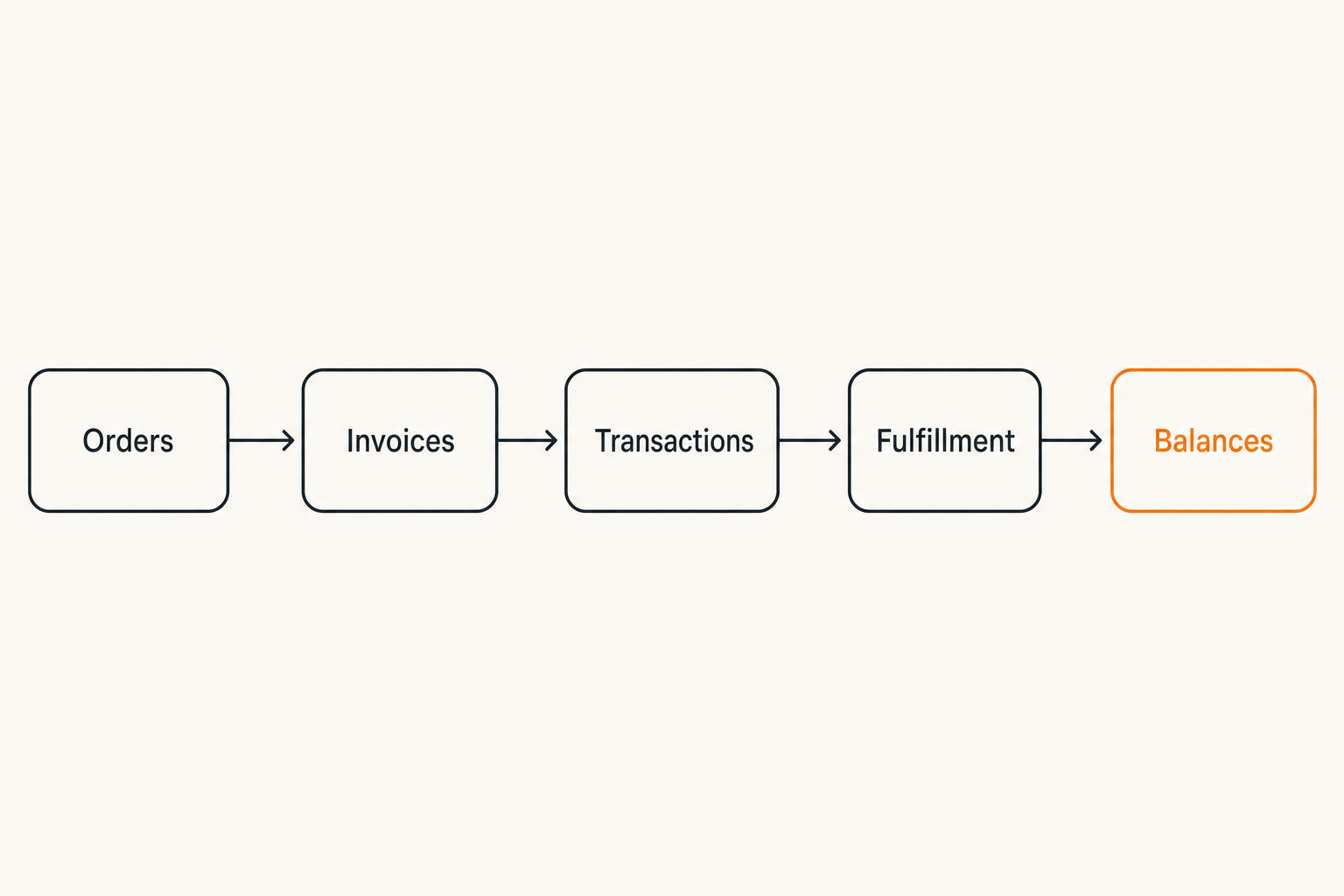
Reconciliation is not accounting busywork. It is the difference between a support team that can answer customers in minutes and a founder manually searching wallet history at midnight.
Daily matching is not optional
At minimum, reconcile these objects daily:
- Orders created in the commerce platform
- Invoices created in the payment system
- On-chain transactions detected
- Confirmed payments applied
- Fulfillment releases
- Refunds or credits issued
- Wallet balances or settlement records
The goal is to find mismatches before customers do. If an order says unpaid but the wallet received funds, support needs a queue. If an order says paid but no confirmed transaction exists, fulfillment needs a hold.
Handle token, chain, and rate mismatches
Crypto reconciliation is not just amount equals amount. You need to include asset, chain, decimals, confirmation status, and rate metadata.
Common mismatch classes include:
- Correct asset, wrong chain
- Correct chain, wrong amount
- Correct amount, late arrival
- Duplicate payment for one invoice
- One transaction attempting to cover multiple orders
- Token transfer detected but below minimum confirmation policy
Each mismatch should have an operator action: accept, hold, refund, credit, escalate, or ignore as dust.
Build the operator view first
Developers tend to build buyer-facing checkout first. That is understandable, but the operator view is what determines whether the system survives production.
An operator should see:
- Order and invoice side by side
- Payment state timeline
- Transaction hash and chain
- Amount requested versus amount received
- Confirmation count
- Customer email or account ID
- Applied policy decision
- Manual action history
If support cannot see the timeline, they will create their own spreadsheet. Once that happens, your payment system is no longer the source of truth.
Risk controls for wolverine peptide merchants
Risk control is not the same as blocking every risky order. It means the system can slow down, route, or hold decisions when the context is ambiguous.
Keep product policy separate from payment logic
Do not hardcode product policy inside webhook handlers. Payment code should not contain rules like if product category equals X then reject. That creates brittle systems and painful redeploys.
Instead, maintain a separate policy layer that can evaluate:
- Product category
- Destination country or region
- Customer account history
- Order value
- Payment method
- Manual review flags
The payment layer should expose facts. The policy layer should make business decisions. That separation makes audits, updates, and operational changes much easier.
Use holds for ambiguous orders
A hold is a legitimate state, not a failure. High-risk merchants need holds because not every order is clean enough for automatic release.
Use holds when:
- Payment is late but detected
- Payment is under the tolerance threshold
- Customer used a suspicious account pattern
- Shipping region requires review
- Product policy needs manual approval
- Refund destination is unclear
Holds should be visible to support and, when appropriate, communicated to the customer. Silent holds create tickets.
Escrow and reputation where trust is weak
Some peptide-adjacent transactions involve higher trust friction: first-time buyers, wholesale orders, marketplace-style relationships, or staged fulfillment. In those cases, escrow or reputation workflows may reduce disputes because they make release conditions explicit.
This does not mean every wolverine peptide checkout needs escrow. It means merchants should recognize when simple pay-and-ship is not enough. If the commercial relationship depends on proof, milestones, or buyer confidence, payment architecture should reflect that.
Implementation workflow for a production crypto checkout
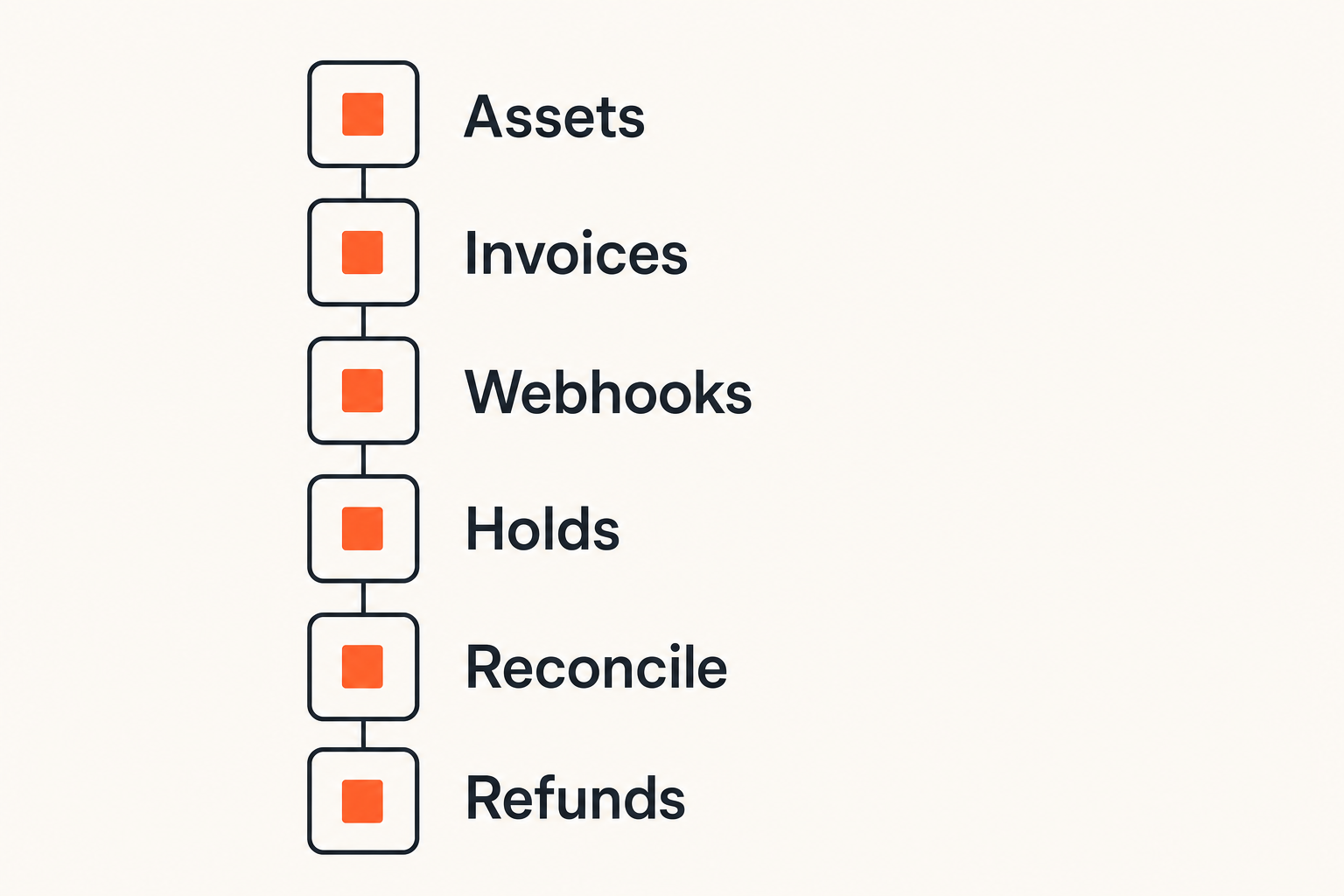
The mistake teams make is trying to implement everything at once. A safer path is to implement a narrow, observable payment contract and then add automation only after the edge cases are visible.
Step 1 define the payment contract
Start by writing the contract between checkout, payment, and order systems. This is not a legal contract. It is an engineering contract.
Define:
- Which assets and chains are supported at launch.
- How exchange rates are selected and how long quotes remain valid.
- How many confirmations are required per asset and chain.
- What underpayment tolerance applies.
- What happens to late payments.
- Who can manually release a held order.
- How refunds are calculated and approved.
Keep the initial scope small. One stablecoin on one or two networks is often easier to operate than ten assets with inconsistent customer instructions.
Step 2 implement event ingestion
A basic production sequence looks like this:
- Customer places an order and selects crypto checkout.
- Backend creates an invoice with amount, asset, chain, and expiration.
- Gateway returns payment instructions and an invoice identifier.
- Customer sends funds.
- Gateway or watcher emits payment detected and confirmation events.
- Webhook handler verifies signature and stores the raw event.
- Worker applies the event idempotently to the invoice.
- Order decision service releases, holds, or escalates the order.
- Reconciliation job checks invoice, order, and wallet records.
This sequence is not glamorous. It is what keeps the business from depending on screenshots.
If you are implementing against CoinPay, the developer documentation is the place to start mapping invoice creation, callbacks, and merchant-side integration details into your existing stack.
Step 3 test unhappy paths
Happy-path tests are not enough. Before launch, simulate:
- Duplicate webhook delivery
- Webhook delivery out of order
- Payment after invoice expiration
- Payment below required amount
- Payment above required amount
- Wrong chain selection
- Provider timeout after invoice creation
- Order canceled before payment arrives
- Refund requested after partial fulfillment
The point is not to eliminate every manual case. The point is to ensure every manual case has a visible state and a safe operator action.
What breaks when wolverine peptide payments are implemented badly
Bad crypto payment implementations usually do not fail all at once. They degrade through small operational leaks until nobody trusts the dashboard.
What fails
The most common failures are predictable:
- Checkout displays ambiguous payment instructions
- Invoices expire but late payments are not monitored
- Webhooks update orders directly without idempotency
- Support relies on wallet screenshots instead of event logs
- Refund policies are invented case by case
- Fulfillment ships before confirmation policy is satisfied
- Accounting cannot match wallet inflows to orders
- Developers become the escalation path for routine tickets
Once these failures accumulate, the business starts treating crypto as unreliable. Often the rail is not the problem. The implementation is.
What works
What works is less exciting and more durable:
- Narrow supported assets and chains
- Durable invoice records
- Explicit payment states
- Idempotent webhook ingestion
- Separate order decision logic
- Operator dashboards with timelines
- Daily reconciliation
- Written exception policies
This is also where budgeting and workflow discipline matter. Related reading from our network: finance teams buying tools face the same ownership and rollout problem in budgeting software in 2026.
Operational metrics to watch
Do not invent vanity metrics. Track metrics that show whether the workflow is healthy:
| Metric | Why it matters | Bad signal |
|---|---|---|
| Invoice completion rate | Shows checkout clarity and payment confidence | Many created invoices never receive funds |
| Late payment count | Reveals expiration and instruction issues | Customers frequently pay after timeout |
| Manual hold rate | Shows policy and payment ambiguity | Support queue grows faster than orders |
| Underpayment rate | Reveals wallet fee and instruction problems | Many orders arrive just below required amount |
| Reconciliation mismatch count | Measures system trust | Accounting finds unexplained wallet inflows |
| Refund cycle time | Shows operational maturity | Refunds require founder or developer action |
A metric is useful only if someone owns it. If nobody reviews underpayments weekly, underpayment rate is just dashboard decoration.
How coinpayportal.com fits the workflow
The product-fit question is not whether a gateway can technically receive crypto. The question is whether it helps merchants build a payment boundary that is clear enough for developers, support, and operations to trust.
Non-custodial infrastructure as a boundary decision
For wolverine peptide merchants, custody is not just a wallet preference. It affects risk, settlement, access, and operational control. A non-custodial payment gateway can help keep the merchant closer to settlement while still providing checkout, payment tracking, and integration workflows.
That does not remove the need for policy, reconciliation, or support process. It makes the boundary clearer: the merchant controls funds, while the gateway helps coordinate payment creation, detection, and merchant notifications.
Developer integration without hiding merchant operations
A good integration should expose enough structure for developers without pretending the UI is the whole system. You want APIs and webhooks, but you also want operational clarity around invoices, statuses, callbacks, and exceptions.
For developers and merchants building crypto payment infrastructure, coinpayportal.com is best understood as part of the checkout and payment workflow, not a magic risk shield. Use it to make invoice creation, real-time processing, and merchant-side handling more predictable. Then connect that to your order management, support, and reconciliation process.
If your store sells wolverine peptide products, the closing decision is straightforward: do not bolt crypto onto a fragile checkout. Design the workflow first, then choose infrastructure that preserves state and gives operators a reliable source of truth for every wolverine peptide payment.
Try coinpayportal.com
You are writing for developers and merchants building crypto payment infrastructure. Try coinpayportal.com to start designing checkout, payment tracking, and merchant operations around real crypto settlement workflows.
Try CoinPay
Crypto payments, escrow, and wallets — multi-chain, Lightning-ready, and fast to integrate.
Get started →