SS-31 Peptide Payments: Crypto Checkout Architecture for High-Risk Peptide Merchants

Selling SS-31 peptide online creates a payment problem before it creates a branding problem. A merchant can have clean product pages, careful disclaimers, and legitimate research-oriented demand, then still lose the transaction when the processor decides the category is too exposed.
Teams think the problem is SS-31 peptide checkout acceptance. The real problem is building a payment workflow that can survive processor risk reviews, wallet mistakes, late confirmations, refund questions, and customer support pressure without turning every order into a manual investigation.
That changes the conversation. The practical question is not which button accepts crypto. It is how the order, invoice, blockchain transaction, fulfillment hold, settlement record, and support trail move together.
This guide treats SS-31 peptide payments as an architecture problem for developers, merchants, fintech founders, and blockchain engineers. It is not medical guidance, product advice, or a shortcut around compliance. It is a production workflow guide for merchants operating in a category where payment rails are fragile and operational discipline matters.
Table of contents
- Why SS-31 peptide is a payments workflow problem
- Map the SS-31 peptide buyer journey before choosing payment rails
- Crypto payment architecture for SS-31 peptide merchants
- State management: the part that breaks
- Webhooks, retries, and idempotency
- Compliance, product claims, and operational boundaries
- Reconciliation and accounting for SS-31 peptide orders
- What works and what fails in production
- Implementation sequence for developers
- Metrics and failure modes to monitor
- Where coinpayportal.com fits
Why SS-31 peptide is a payments workflow problem
The checkout is the visible part
The mistake teams make is treating payment acceptance as a front-end feature. They add a crypto option, show a QR code, and assume the hard part is done. For low-risk digital goods, that may be enough for a prototype. For SS-31 peptide merchants, the visible checkout is only one surface of a larger workflow.
The customer sees a product page, cart, invoice, and payment address. Your operations team sees risk review, shipping restrictions, customer identity signals, refund policies, inventory holds, support tickets, and audit trails. Your developer sees callbacks, duplicate events, confirmations, stale invoices, address reuse risk, and reconciliation jobs.
A useful way to think about it is this: the checkout collects intent, but the payment system proves state.
The real risk sits in state transitions
What breaks in practice is not always the transaction itself. It is the moment between states. A customer sends funds after an invoice expires. A chain confirms slowly. A webhook arrives twice. A support agent marks an order paid based on a screenshot. Finance exports deposits without knowing which invoice they belong to.
In SS-31 peptide commerce, those mistakes matter because the category already receives more scrutiny than a standard retail SKU. Payment ambiguity creates operational risk. If the system cannot explain what happened, the team starts making judgment calls in Slack.
Practical rule: Never let a screenshot, chat message, or customer claim become the source of truth for payment state.
Why this matters in 2026
By 2026, more merchants understand that crypto can be useful for high-risk categories. That does not mean every crypto integration is production-ready. Many teams still underestimate the merchant-side work: tax exports, refund workflows, chain fee assumptions, fulfillment holds, and customer education.
If you want adjacent context on peptide category payment issues, our previous guide on peptide payments and crypto infrastructure covers why merchants in this niche often need more resilient rails than a standard card processor can provide.
Map the SS-31 peptide buyer journey before choosing payment rails
Separate browsing from payment intent
Do not start with wallets. Start with the journey.
A buyer may browse SS-31 peptide product pages, read disclaimers, add items to a cart, abandon the session, return from a different device, and only then create payment intent. Each of those steps has different risk and data requirements.
Browsing should not create invoices. Cart updates should not reserve blockchain addresses indefinitely. Payment intent should be created only when the customer has accepted required terms, selected shipping details, and is ready to pay within a defined window.
This keeps the payment layer clean. It also prevents invoice sprawl, where your database fills with abandoned crypto addresses and half-created orders.
Capture eligibility and shipping constraints early
For peptide merchants, payment should not be the first serious checkpoint. If the product cannot be shipped to the destination, or if the merchant requires specific acknowledgments, capture that before invoice creation.
This reduces refund load. It also prevents the worst customer experience: a buyer successfully sends crypto, then support discovers the order cannot be fulfilled.
The practical question is simple: what must be true before you ask a customer to send irreversible funds?
Typical pre-payment checks include:
- Destination country, state, or region eligibility
- Customer acceptance of research-use terms where applicable
- Inventory availability
- Shipping method compatibility
- Order value limits
- Fraud or abuse flags
Decide where crypto belongs
Crypto does not have to replace every payment rail. Some merchants use it as a fallback when cards fail. Others present it as the primary option for the entire category. Others restrict it to wholesale, international, or repeat customers.
The right answer depends on your support capacity and risk tolerance. Crypto can reduce dependency on fragile processors, but it shifts responsibility toward your own workflow design.
Practical rule: Offer crypto where your team can support the full lifecycle: invoice, confirmation, fulfillment hold, refund policy, settlement, and reconciliation.
Crypto payment architecture for SS-31 peptide merchants
Hosted checkout versus embedded checkout
Hosted checkout is usually faster to launch. The customer leaves your storefront, pays on a payment page, and returns after completion. This reduces front-end complexity and makes it easier to isolate payment logic from product content.
Embedded checkout gives you more control over the user experience. It can reduce drop-off, but it also means your application must handle more states directly: invoice expiry, chain selection, address display, partial payments, and wallet instructions.
For SS-31 peptide merchants, hosted checkout is often the safer first deployment if the gateway exposes strong webhooks and a clean API. Embedded checkout makes sense once your team has already proven support and reconciliation workflows.
Related reading from our network: teams comparing infrastructure vendors face a similar routing problem in cloud environments, where the wrong abstraction leaks into operations; this architecture guide to cloud computing companies in 2026 is a useful parallel.
Wallet address generation and invoice expiry
Each invoice should have a unique payment address or a reliable unique payment identifier. Address reuse makes reconciliation harder and increases privacy leakage. It also creates support confusion when two customers send funds to the same destination.
Invoice expiry must be explicit. If the customer sees an amount denominated in crypto, that quote is only valid for a time window. If they pay after expiry, your system needs a defined outcome: accept at current value, hold for manual review, or refund according to policy.
A basic invoice object should include:
invoice_id: inv_8f31
order_id: ord_1042
asset: USDT
network: TRON
amount_due: 125.00
expires_at: 2026-07-15T18:45:00Z
status: pending
payment_address: unique-address-per-invoice
confirmations_required: 1
Chain selection and settlement assumptions
Chain selection is an operations decision, not a logo list. Bitcoin, Ethereum, stablecoins, Tron, Solana, and Lightning all behave differently under fee pressure, confirmation time, wallet compatibility, and customer familiarity.
For many merchants, stablecoins are easier for pricing because the order total maps more closely to accounting records. But stablecoin networks introduce their own issues: wrong-network deposits, token contract confusion, and varying confirmation assumptions.
Do not list a network unless you can support mistakes on that network. If customers can send USDT on the wrong chain, support needs a policy before launch, not after the first angry ticket.
State management: the part that breaks
Use an invoice state machine
A payment workflow needs strict states. Without them, every exception becomes a custom decision.
A reasonable invoice state machine looks like this:
created— invoice exists but has not been displayed or activated.pending— customer has payment instructions and the invoice is waiting for funds.detected— transaction is seen but not sufficiently confirmed.confirmed— payment meets confirmation rules.settled— funds are available according to the gateway or wallet policy.expired— payment window closed without valid payment.exception— underpayment, overpayment, wrong asset, late payment, or manual review.refunded— refund completed or recorded.
Your order state can then react to invoice state without pretending they are the same thing.
Make confirmations and expirations explicit
Blockchain payment UX often fails because the application uses vague language. A customer sees paid, while the merchant sees unconfirmed. Support sees pending. Finance sees no settlement. Everyone is technically correct, which is the problem.
Use precise labels:
- Awaiting payment
- Payment detected
- Awaiting confirmations
- Payment confirmed
- Fulfillment review
- Expired
- Payment exception
The customer should understand that sending funds is not always the same as the order being released for fulfillment.
Keep order state separate from payment state
An order can be payment-confirmed and still not ready to ship. Inventory may fail. Eligibility review may fail. A compliance hold may apply. A customer may need to confirm shipping details.
Likewise, an order can be canceled while an invoice later receives funds. If your system collapses order and payment into one status field, late payments become chaos.
Practical rule: Store payment state, order state, fulfillment state, and settlement state separately, then define which transitions are allowed between them.
Webhooks, retries, and idempotency
Design webhooks as signals not truth
Webhooks are delivery mechanisms. They are not the database of record. Your application should receive the webhook, verify it, store the event, and then fetch or compute the current invoice state before changing the order.
This matters because webhooks can arrive late, out of order, or more than once. If your handler blindly updates records, duplicate callbacks can ship the same order twice or reopen a closed exception.
A safer handler flow:
- Verify signature.
- Store raw event with event ID.
- Check if the event ID was already processed.
- Load invoice by invoice ID.
- Compare incoming state to allowed transitions.
- Apply transition in a database transaction.
- Trigger downstream actions asynchronously.
Use idempotency keys everywhere
Idempotency is not only for card payments. It is critical for crypto invoice creation and webhook handling.
If a customer double-clicks pay, your server should not create two active invoices for one order. If your job worker retries a fulfillment event, it should not mark the same package twice. If the gateway retries a webhook, your handler should return success after recognizing it.
Use idempotency keys for:
- Invoice creation per order
- Webhook event processing
- Refund requests
- Settlement import jobs
- Manual support actions
For developers building this integration directly, keep the gateway contract close to your code. The CoinPay documentation is the right place to anchor implementation details such as API behavior, callback handling, and supported payment flows.
Build a replay path for support
Support teams need a safe way to replay payment events. Not edit the database by hand. Not ask engineering to run a one-off script. A controlled replay tool lets an authorized user reprocess stored events after a bug fix or outage.
The replay path should show:
- Original event payload
- Signature verification result
- Invoice state before replay
- Proposed transition
- Result after replay
- Operator who initiated the replay
This turns support from guesswork into operations.
Compliance, product claims, and operational boundaries
Keep medical content out of payment events
Payment infrastructure should not carry unnecessary product claims. Your payment event does not need clinical language, dosage discussion, or marketing copy. It needs order ID, invoice ID, amount, asset, network, customer reference, and status.
This is both cleaner technically and safer operationally. Keep product catalog content in the commerce system. Keep payment records minimal and structured.
Related reading from our network: privacy teams face a similar separation problem when metadata leaks more than message content; this guide to secure messaging apps in 2026 is adjacent but useful for thinking about data minimization.
Document merchant review criteria
If you operate a marketplace or platform that supports peptide merchants, define review criteria before onboarding. You do not want gateway operations deciding policy ad hoc after volume arrives.
Review criteria may include business identity, product category, website language, prohibited claims, refund policy, shipping regions, customer support availability, and evidence of lawful operations. The details depend on your business and legal advice, but the workflow should be explicit.
The mistake teams make is outsourcing all risk thinking to a payment provider. Providers can approve or deny processing, but your own system still needs a defensible merchant record.
Treat disputes as evidence workflows
Crypto payments do not have card chargebacks in the same way, but disputes still exist. Customers claim they paid. Customers send the wrong asset. Customers say the order did not arrive. Customers ask for refunds.
A dispute workflow should gather evidence:
- Invoice and order IDs
- Transaction hash
- Address and network
- Confirmation history
- Customer communications
- Shipping and fulfillment records
- Refund decision and operator notes
This is where high-risk merchants either look organized or look improvised.
Reconciliation and accounting for SS-31 peptide orders
Match invoices to orders and settlements
Reconciliation starts when the invoice is created, not at month end. Every invoice should be tied to one order. Every detected transaction should be tied to one invoice or placed in an exception queue. Every settlement record should map back to the invoice and order.
If you cannot answer which order produced a wallet deposit, you do not have payment infrastructure. You have a wallet with activity.
For SS-31 peptide merchants, reconciliation also helps support policy. When a customer asks about payment, the team should search by order ID, invoice ID, email, or transaction hash and see the same truth.
Handle underpayment overpayment and late payment
Underpayments happen when customers send the wrong amount, ignore network fees, or use a wallet that subtracts fees from the transfer. Overpayments happen when customers round up or send from a template. Late payments happen when customers copy an address and pay after expiry.
Define thresholds. For example, a tiny underpayment may be accepted automatically if it falls within a configured tolerance. A larger underpayment should move to exception. Overpayments may require store credit, refund, or manual review depending on policy.
Do not hide these decisions in code comments. Put them in configuration and expose them to operations.
Export clean records for finance
Finance does not want blockchain folklore. Finance wants clean records:
- Order total in store currency
- Crypto asset and network
- Amount due and amount received
- Exchange rate source and timestamp if applicable
- Fees
- Settlement destination
- Refunds or adjustments
- Final recognized amount
Even if your company is small, build exports early. Retrofitting accounting records after hundreds of peptide orders is painful.
What works and what fails in production
What works
What works is boring and explicit.
A strong SS-31 peptide payment workflow uses unique invoices, clear expiry, verified webhooks, idempotent handlers, separate states, exception queues, and searchable records. It avoids pretending that crypto removes operations. It simply moves the work from card disputes and processor holds into transaction monitoring and merchant-side controls.
Good teams also write support macros before launch. They know how to answer common questions: how long confirmations take, what happens after expiry, why an order is on hold, and how refunds are handled.
What fails
What fails is the quick button integration with no operational model.
The storefront shows one status. The gateway shows another. Support cannot find the invoice. Finance sees a wallet deposit but not the order. Developers patch the database. Customers learn that sending crypto does not mean the merchant knows what happened.
This is not a crypto problem. It is a workflow design problem.
A comparison table for operators
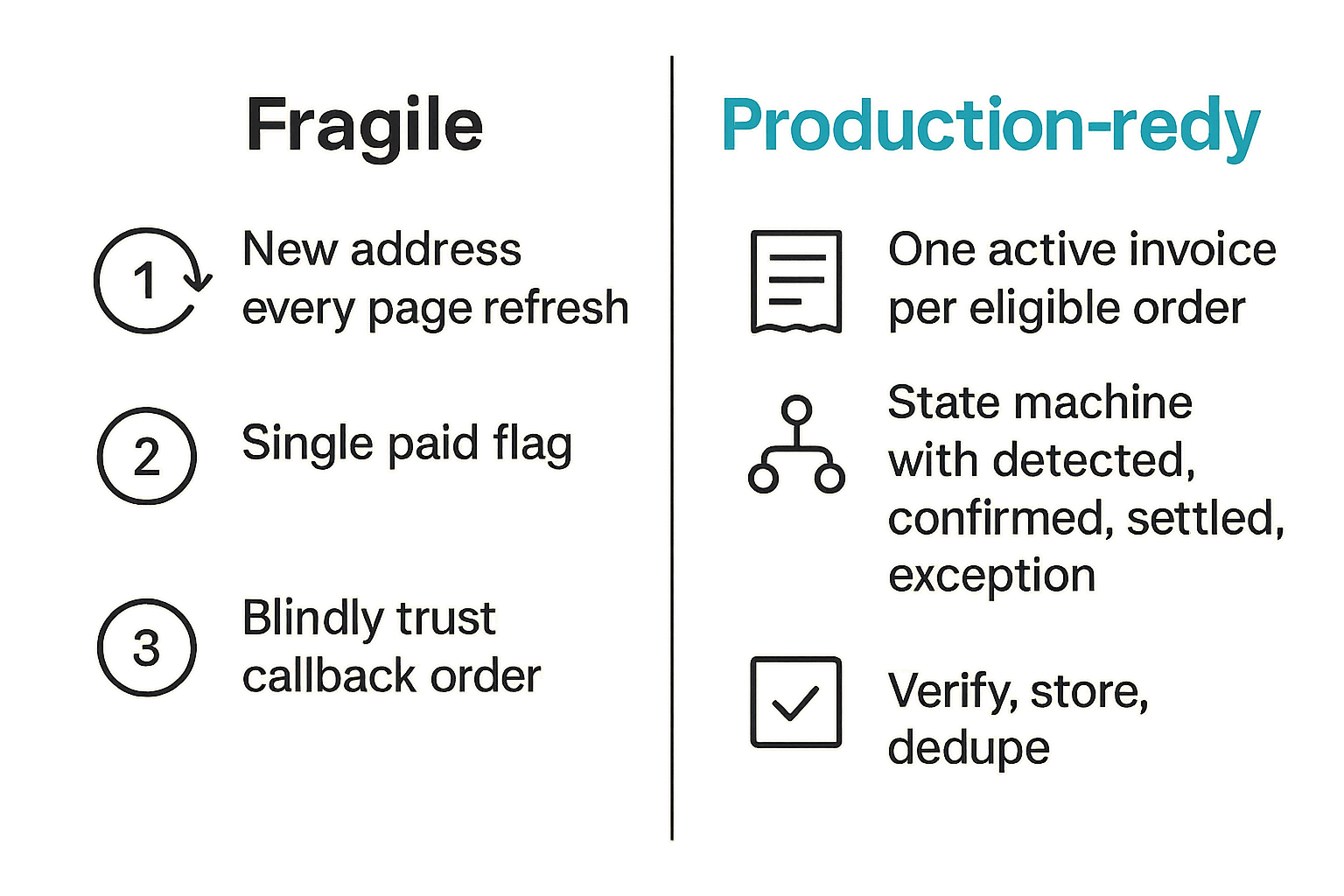
| Decision area | Fragile implementation | Production implementation |
|---|---|---|
| Invoice creation | New address every page refresh | One active invoice per eligible order |
| Payment status | Single paid flag | State machine with detected, confirmed, settled, exception |
| Webhooks | Blindly trust callback order | Verify, store, dedupe, and apply allowed transitions |
| Expiry | Hidden timer or no timer | Clear expiry with late-payment policy |
| Support | Screenshots and manual edits | Searchable invoice, transaction, and event history |
| Reconciliation | Wallet export only | Order-to-invoice-to-settlement mapping |
| Refunds | Case-by-case improvisation | Documented policy with recorded approvals |
Implementation sequence for developers
Step 1 define allowed flows
Start with a short written model. Do not open your editor yet.
Define which products can be paid with crypto, which regions are allowed, whether customer accounts are required, which assets and networks are supported, what invoice expiry means, and which order states block fulfillment.
A concise flow definition might say:
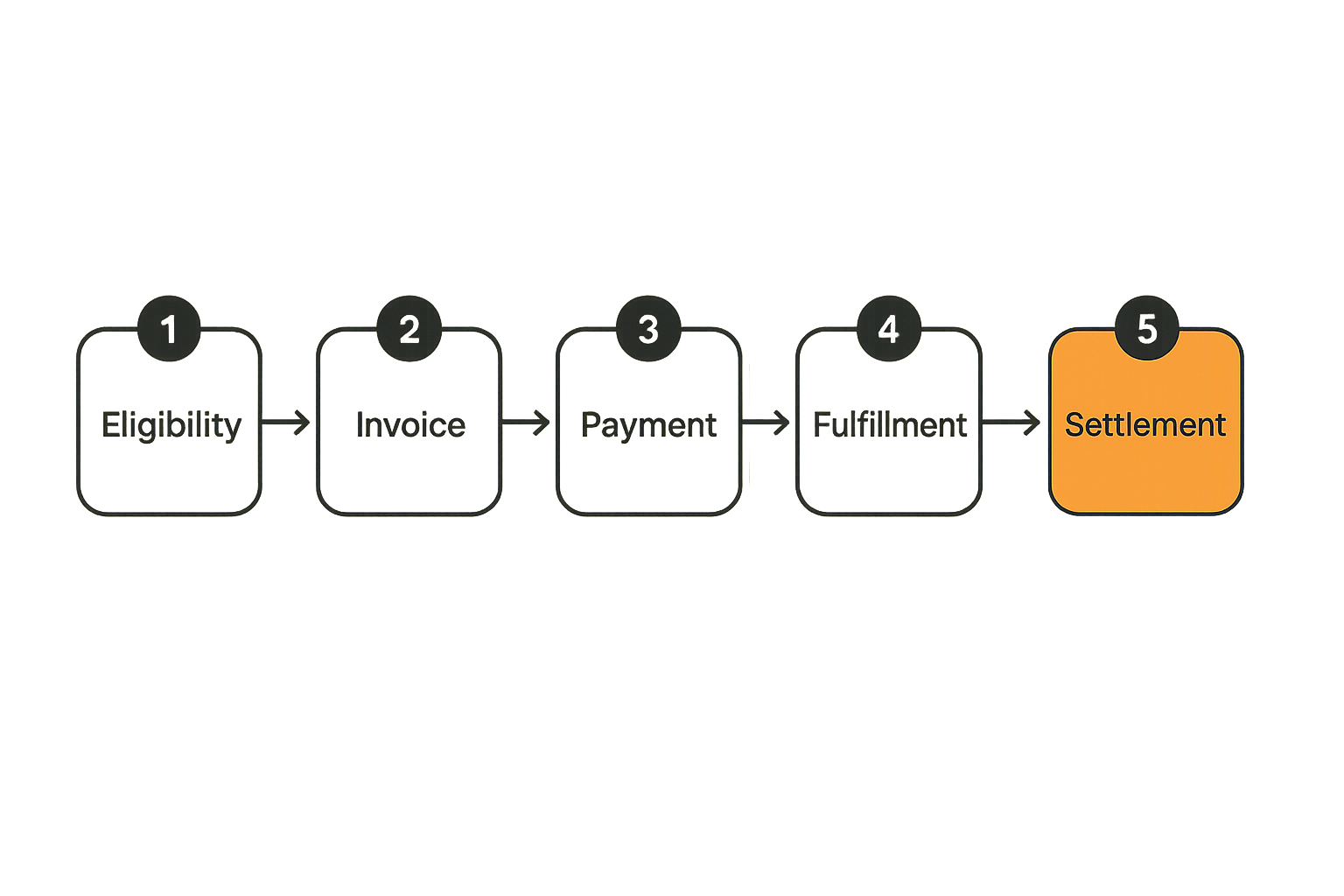
- Customer completes cart and eligibility checks.
- Server creates one crypto invoice for the order.
- Customer pays within 20 minutes.
- Transaction is detected and waits for confirmation.
- Confirmed payment moves order to fulfillment review.
- Exceptions move to support queue.
- Settlement job maps received funds to invoice and finance export.
Step 2 implement invoice creation
Invoice creation should happen server-side. The client requests payment, but the server decides whether an invoice is allowed.
Check for an existing active invoice before creating a new one. Use an idempotency key based on order ID and payment attempt. Store the gateway invoice ID immediately. Return only the fields the front end needs: amount, asset, network, address, expiry, and status endpoint.
Pseudo-flow:
POST /orders/{order_id}/crypto-invoice
- authenticate customer or session
- load order
- verify order is eligible and not already paid
- find active invoice for order
- if found, return it
- create invoice with gateway
- store invoice and expiry
- return payment instructions
Step 3 connect webhooks and order updates
Webhook handling should be boring. Boring is good.
Store every event. Dedupe by event ID. Validate transition rules. Use database transactions. Push fulfillment updates to a queue instead of doing everything inside the webhook request.
If a webhook says payment confirmed, do not immediately ship. Move the order into the next allowed state, such as payment confirmed or fulfillment review. That gives operations room to enforce inventory, shipping, and compliance checks.
For more detailed state handling in this category, our guide on peptide transactions in crypto payments goes deeper on transaction state, production edge cases, and what breaks when order state and payment state are collapsed.
Step 4 test edge cases before launch
Test the bad paths before the first real customer finds them.
Minimum test cases:
- Customer opens checkout twice
- Customer pays exact amount
- Customer underpays
- Customer overpays
- Customer pays after expiry
- Webhook arrives twice
- Webhook arrives before redirect return
- Transaction confirms after order cancellation
- Refund request is submitted
- Settlement export runs after a partial exception
Practical rule: If support cannot explain an edge case from the admin panel, the integration is not ready for production.
Metrics and failure modes to monitor
Measure payment completion and stuck states
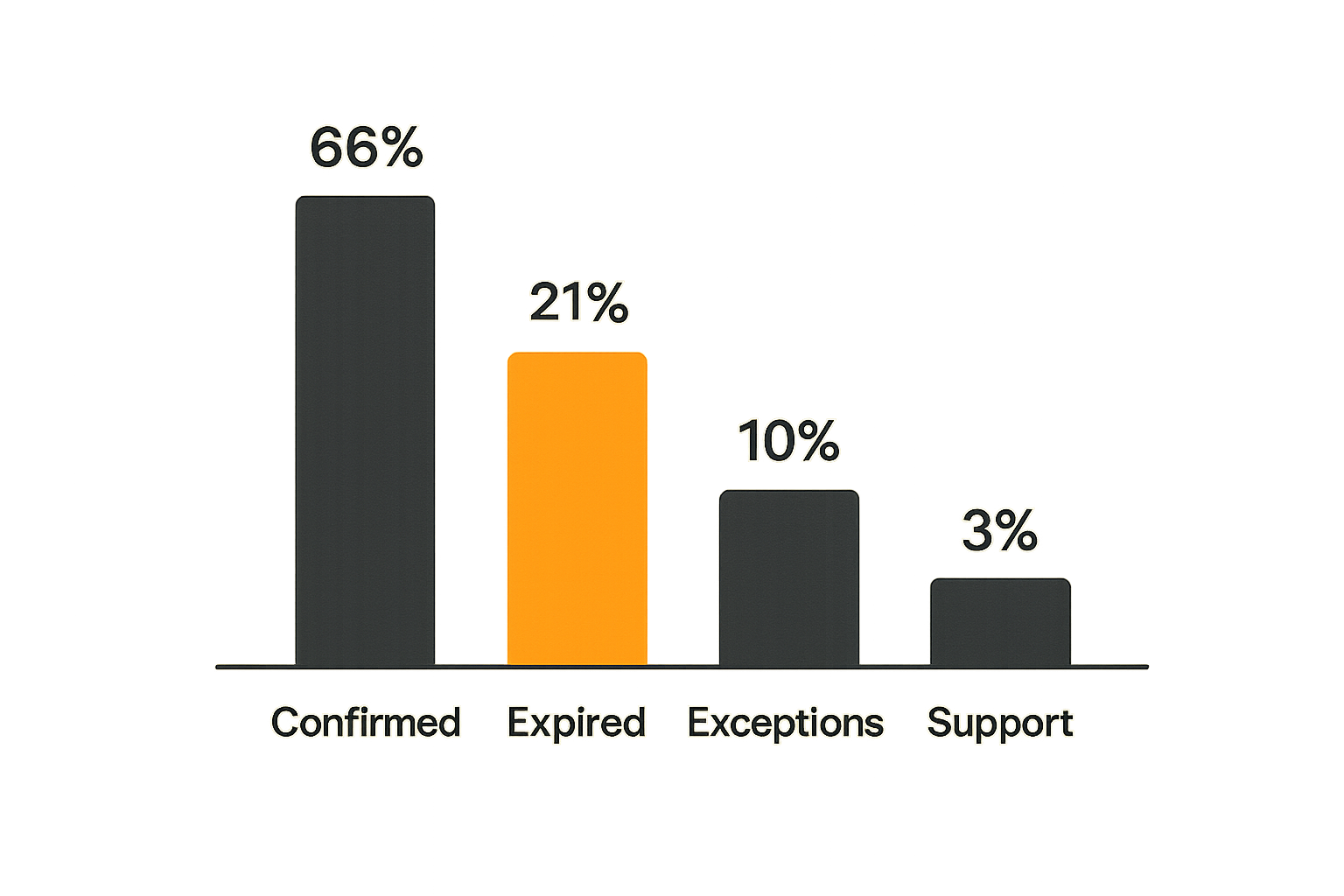
Track the funnel from payment intent to confirmed payment. Do not only track revenue. For SS-31 peptide merchants, stuck states are often more informative than completed volume.
Useful metrics include:
- Invoice creation rate
- Invoice payment rate
- Expired invoice rate
- Detected but unconfirmed count
- Exception queue count
- Average confirmation time
- Support tickets per paid order
- Manual intervention rate
If expired invoices climb, your checkout instructions may be unclear or your payment window may be too short. If exceptions climb, your asset or network choices may be confusing customers.
Watch support drivers
Support tickets reveal architecture gaps. If many customers ask whether payment was received, the status page is not clear enough. If customers frequently send the wrong network, the checkout UI is not explicit enough. If agents ask engineering to inspect transactions, the admin tooling is underbuilt.
Related reading from our network: incident response teams use similar ownership and escalation thinking; this piece on CHP traffic incident thinking for SOC response architecture is a useful analogy for triage queues, handoffs, and clear operational ownership.
Alert on settlement exceptions
Alerts should focus on conditions that require action, not every blockchain event.
Alert on:
- Payment confirmed but order not advanced
- Order shipped without confirmed payment
- Settlement missing for confirmed invoice
- Exception queue above threshold
- Webhook verification failures
- Repeated duplicate invoice creation attempts
- Refund pending beyond policy window
The goal is not noise. The goal is to catch broken assumptions before customers and finance discover them.
Where coinpayportal.com fits
Non-custodial payment acceptance
coinpayportal.com is built for developers and merchants building crypto payment infrastructure, especially where the UI is not the whole system. For an SS-31 peptide merchant, the important question is not whether a payment page can show an address. It is whether the gateway supports the operational shape around that address.
That means APIs, real-time payment processing, automatic fee handling, order-aware callbacks, and merchant-side control. A non-custodial model can be useful when merchants want payment acceptance without handing over unnecessary custody assumptions, but it still needs strong state and support workflows.
Escrow and reputation workflows
Some peptide commerce flows involve trust gaps: new buyer, new merchant, wholesale order, delayed fulfillment, or a marketplace-style relationship. In those cases, payment acceptance alone may not solve the operational risk.
Escrow and reputation features can help when the workflow requires staged release, trust signaling, or stronger transaction history. If your use case involves conditional fulfillment or buyer-seller trust, the CoinPay escrow flow is relevant to evaluate as part of the architecture rather than as an afterthought.
The closing point is simple: SS-31 peptide payments need more than a crypto logo at checkout. They need reliable state, clear ownership, reconciliation, and support tools that make each transaction explainable.
Try coinpayportal.com
coinpayportal.com helps developers and merchants build crypto payment infrastructure for real checkout, webhook, settlement, and merchant operations. Try coinpayportal.com.
Try CoinPay
Crypto payments, escrow, and wallets — multi-chain, Lightning-ready, and fast to integrate.
Get started →