Solution Peptides Payments: Architecture for Merchants Selling Regulated Research Products

Solution peptides merchants usually do not fail because the checkout button is ugly. They fail because payment state, order review, customer communication, and settlement are stitched together after the store is already taking orders.
Teams think the problem is finding a processor that will approve solution peptides. The real problem is building a payment workflow that can survive processor volatility, chain delays, refund disputes, inventory holds, and support tickets without turning every order into a manual investigation.
That changes the conversation. The practical question is not, “Can we accept crypto?” It is, “Can our checkout, webhook, reconciliation, and fulfillment systems agree on what happened when a buyer sends value on-chain?”
For developers, merchants, fintech founders, and blockchain engineers, solution peptides payments are an architecture problem before they are a sales problem.
Table of contents
- Solution peptides are a workflow problem, not just a product category
- Solution peptides payment architecture in 2026
- Map the checkout state machine before writing code
- Reference architecture for solution peptides checkout
- Webhooks, idempotency, and reconciliation
- Risk controls for merchants selling solution peptides
- Custody, escrow, refunds, and settlement boundaries
- Failure modes that show up in production
- Metrics operators should monitor
- Where CoinPayPortal fits
Solution peptides are a workflow problem, not just a product category
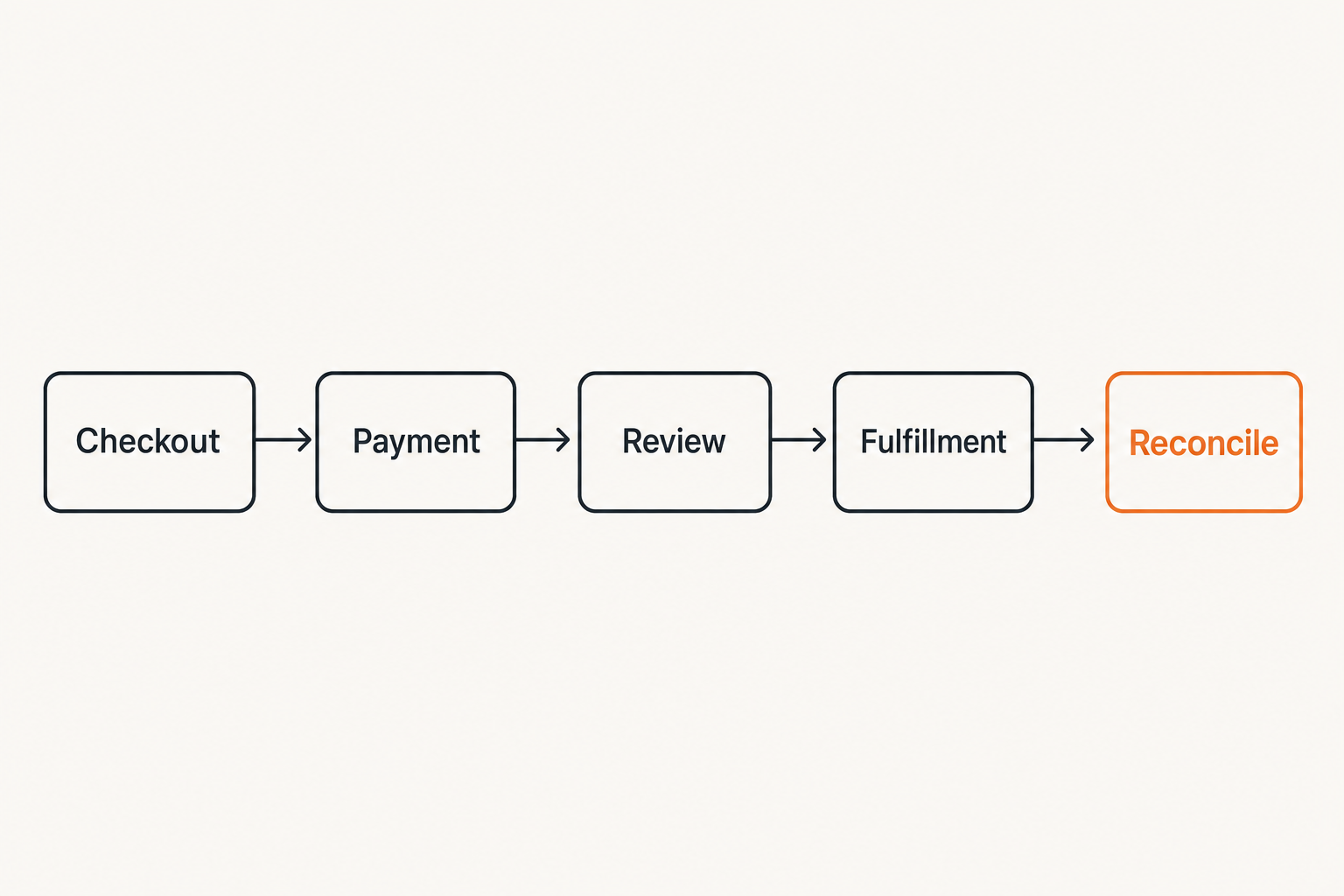
The mistake teams make is treating solution peptides as a catalog label and payments as a processor selection exercise. That is too shallow. In production, the product category affects onboarding, review, chargeback exposure, customer expectations, fulfillment timing, and payment support.
For a peptide merchant, the checkout UI is only the front edge of the system. The real system includes price locking, invoice expiration, network confirmation rules, address generation, fraud review, order holds, fulfillment release, refund handling, and a human support path when the buyer sends the wrong amount.
Why ordinary payment assumptions break
Card-native commerce assumes a mostly synchronous authorization flow: buyer enters card, gateway returns approved or declined, order moves forward. Crypto-native commerce is different. A buyer may open the invoice, wait ten minutes, send a partial amount, send from an exchange, overpay because of wallet behavior, or pay after the quoted rate expires.
For low-risk retail goods, these edge cases are annoying. For solution peptides, they become operational risk because many merchants already operate under stricter platform, processor, and compliance pressure.
Practical rule: Do not model crypto checkout as a card authorization clone. Model it as an invoice state machine with delayed, observable settlement.
A useful way to think about it is this: the payment is not complete when the buyer clicks “pay.” It is complete when the merchant ledger, blockchain observation layer, order management system, and fulfillment policy all agree on the next allowed action.
The real unit of work is the order lifecycle
The order lifecycle starts before payment and ends after settlement. If your system only records “paid” or “unpaid,” you do not have enough state to operate responsibly.
A practical lifecycle includes:
- Product eligibility and order validation before invoice creation.
- Rate quote and crypto invoice creation.
- Payment detection and confirmation tracking.
- Internal risk review for flagged orders.
- Fulfillment release only after policy gates pass.
- Refund or exception workflow when payment and order state diverge.
- Ledger reconciliation against wallet and accounting records.
This is why prior planning matters. If you already handle peptide-specific merchant constraints, the architecture should build on that model rather than bolt crypto on afterward; we covered the broader category in peptide payments crypto infrastructure, and the same lifecycle thinking applies here.
Solution peptides payment architecture in 2026
Solution peptides payment architecture in 2026 is about reducing dependency on brittle intermediaries while increasing operational discipline. Crypto can help merchants accept value without the same card-network exposure, but it does not remove the need for policies, logs, customer messaging, and reconciliation.
The practical question is where you draw boundaries. If every part of the stack can mutate order state, refunds, and fulfillment, you have not built a payment system. You have built a distributed argument.
Separate checkout, custody, and fulfillment
Keep three concerns separate:
| Layer | Owns | Should not own |
|---|---|---|
| Checkout | Invoice creation, price quote, buyer payment instructions | Product approval, shipping release |
| Custody or wallet layer | Address control, fund movement, settlement visibility | Customer support decisions |
| Fulfillment | Inventory reservation, shipment release, exception handling | Blockchain interpretation |
This separation prevents common damage. A webhook should not ship an order by itself. A support agent should not manually mark funds as received without a ledger entry. A fulfillment service should not decide whether a transaction has enough confirmations.
Related reading from our network: teams evaluating decentralized infrastructure face similar ownership questions around scheduling, validation, and payments in Akash Network alternatives.
Design for review without blocking settlement
Some orders should be reviewed. That does not mean the payment system should freeze or lose track of settlement. Payment state and fulfillment state should be related but not identical.
Example:
- Payment status:
confirmed - Risk status:
manual_review - Fulfillment status:
hold - Customer message: “Payment received. Your order is under standard review before fulfillment.”
That message is materially different from “payment pending.” It reduces duplicate payments and support tickets because the buyer knows the funds arrived. What breaks in practice is when merchants hide internal review behind vague payment labels.
Practical rule: Let payment finality and fulfillment permission be two separate decisions. Joining them too early creates bad support data and bad customer behavior.
Map the checkout state machine before writing code
A crypto payment integration for solution peptides should start with a state diagram. Not a payment provider selection spreadsheet. Not a theme mockup. A state diagram.
The mistake teams make is coding the happy path first and discovering the state machine later through angry tickets. That is expensive because every edge case becomes a one-off database patch.
The minimum states you need
At minimum, model these invoice states:
| State | Meaning | Merchant action |
|---|---|---|
created | Invoice exists, no payment seen | Show payment instructions |
pending | Transaction detected, confirmations incomplete | Wait and update buyer |
underpaid | Amount received is below required threshold | Ask for top-up or review |
overpaid | Amount exceeds invoice amount | Apply policy, possibly refund difference |
confirmed | Required payment finality reached | Move to review or fulfillment gate |
expired | Quote window closed with no valid payment | Create new invoice if needed |
refunded | Funds returned per policy | Close order exception |
failed | Invoice cannot be resolved automatically | Route to operations queue |
You may add more, but you should not have less. The important point is that state names should describe observable facts, not vague feelings.
Why pending is not a failure state
Pending is normal in crypto payments. A transaction can be seen before it is final enough for fulfillment. The number of confirmations depends on the chain, amount, risk tolerance, and merchant policy.
Bad systems treat pending as an error and push the buyer back into checkout. That creates duplicate payments. Good systems explain what is happening and keep watching.
For merchants working through more complex peptide transactions, it is worth reviewing how state boundaries behave under real on-chain conditions; we wrote about that in peptide transactions in crypto payments.
Reference architecture for solution peptides checkout
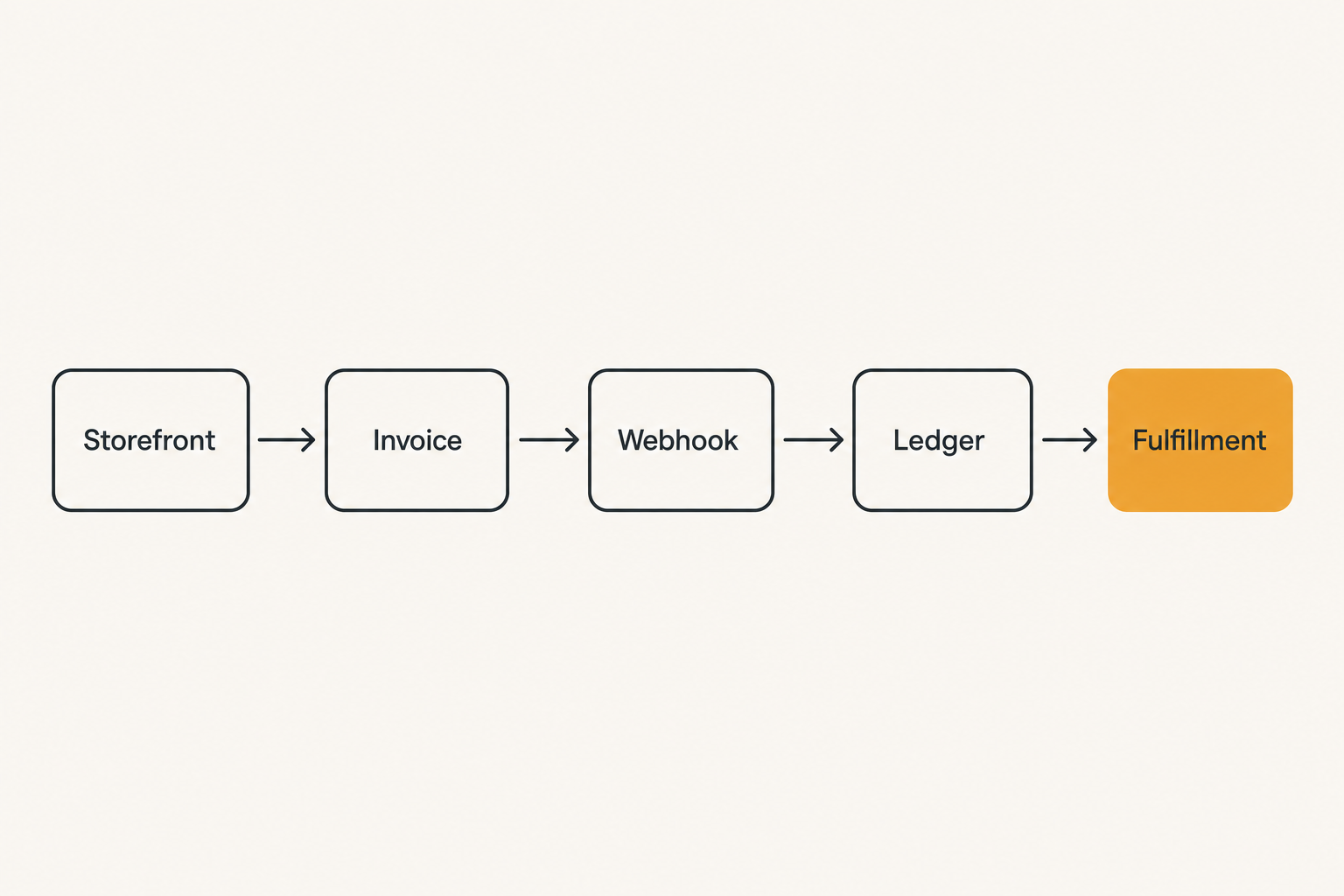
A workable architecture does not need to be exotic. It needs to be explicit. You want small services with clear ownership, durable event storage, and predictable retries.
Core services and responsibilities
A practical stack looks like this:
- Storefront: Collects cart, buyer, shipping, and compliance-required fields.
- Order service: Creates the order, validates inventory, assigns internal order ID.
- Payment service: Creates crypto invoice, stores quote, address, amount, expiry, and chain.
- Blockchain observer or gateway: Detects transactions and emits payment events.
- Webhook handler: Verifies events, applies idempotency, writes state transitions.
- Risk review service: Flags orders for manual review based on policy.
- Fulfillment service: Releases shipment only after payment and review gates pass.
- Ledger service: Reconciles expected invoices against observed settlement.
- Support console: Shows one timeline, not five disconnected dashboards.
The support console matters more than teams expect. If agents cannot see invoice state, transaction hash, confirmations, review status, and fulfillment decision in one place, they will build their own shadow system in spreadsheets.
Implementation sequence
Build in this order:
- Define the order and invoice state machines.
- Create database tables for orders, invoices, payment events, ledger entries, and support notes.
- Implement invoice creation with quote expiry and idempotency keys.
- Add webhook verification and durable event logging.
- Apply state transitions from stored events, not directly from HTTP request handlers.
- Add fulfillment gates that read payment and review status.
- Build exception queues for underpayment, overpayment, expiry, and duplicate payment.
- Reconcile daily against wallet balances and gateway reports.
- Only then optimize checkout copy and front-end conversion.
Practical rule: Store every payment event before acting on it. If your webhook handler performs business actions before durable logging, retries will eventually hurt you.
A small event table can do a lot:
CREATE TABLE payment_events (
  id BIGSERIAL PRIMARY KEY,
  provider_event_id TEXT NOT NULL UNIQUE,
  invoice_id TEXT NOT NULL,
  event_type TEXT NOT NULL,
  tx_hash TEXT,
  amount_atomic NUMERIC NOT NULL,
  chain TEXT NOT NULL,
  confirmations INTEGER DEFAULT 0,
  received_at TIMESTAMPTZ NOT NULL DEFAULT now(),
  payload JSONB NOT NULL
);
The table is not glamorous. It is what lets you replay history when an exchange withdrawal arrives late or a webhook retries after a timeout.
Webhooks, idempotency, and reconciliation
Webhooks are where many crypto payment systems become unreliable. Not because webhooks are bad, but because teams treat them as commands instead of signals.
A webhook says something happened. Your system decides what that event means.
Webhook events should change state, not ship orders
A webhook handler should usually do four things:
- Verify signature or authentication.
- Check idempotency against provider event ID and transaction hash.
- Store the event payload.
- Enqueue a state transition job.
It should not directly ship an order, email a refund promise, or mutate inventory in multiple systems inside the request cycle.
Example pseudo-code:
app.post('/webhooks/payment', async (req, res) => {
  verifySignature(req);

  const event = normalizePaymentEvent(req.body);

  await db.transaction(async tx => {
    await tx.paymentEvents.insertIfNotExists({
      provider_event_id: event.id,
      invoice_id: event.invoiceId,
      event_type: event.type,
      tx_hash: event.txHash,
      amount_atomic: event.amountAtomic,
      chain: event.chain,
      confirmations: event.confirmations,
      payload: req.body
    });

    await tx.jobs.enqueue('apply_payment_state', { invoiceId: event.invoiceId });
  });

  res.status(200).send('ok');
});
This design makes retries safe. If the provider sends the same event three times, the unique key prevents duplicate side effects.
Reconciliation is a ledger job
Reconciliation is not optional for solution peptides merchants. If an order system says paid but the wallet ledger disagrees, operations needs to know before fulfillment scales the mistake.
Your ledger should answer:
- Which invoices were created?
- Which payments were detected?
- Which payments were confirmed?
- Which funds settled to the expected wallet?
- Which orders were fulfilled?
- Which refunds or exceptions were created?
A simple daily reconciliation report can compare invoice totals, observed chain totals, gateway totals, and internal ledger totals. If those numbers drift, the system should produce a queue, not a mystery.
Related reading from our network: private records and attachment discipline show up in unrelated workflows too; tax teams face similar audit-trail problems in IRS secure messaging.
Risk controls for merchants selling solution peptides
Risk controls are not a moral judgment on the buyer. They are how the merchant keeps payment, fulfillment, and support aligned under pressure.
For solution peptides, risk controls should be boring, documented, and visible to operators.
What works
What works in practice:
- Clear product eligibility rules before checkout.
- Invoice expiry windows that are visible to the buyer.
- Confirmation thresholds based on chain and order value.
- Manual review queues with reasons, not generic flags.
- Address reuse prevention where possible.
- Customer messages that distinguish payment status from order review.
- Refund policy displayed before payment.
- Internal audit logs for all manual overrides.
A useful manual review record includes who reviewed the order, what triggered the review, what evidence was checked, and which action was taken.
What fails
What fails is pretending crypto removes merchant operations. It does not.
Common bad patterns:
- Accepting payment before validating whether the order can be fulfilled.
- Using one wallet address for many open invoices without strong attribution.
- Manually editing order status without corresponding ledger entries.
- Treating “transaction detected” as “safe to ship.”
- Hiding review holds from buyers.
- Letting support agents promise refunds without confirming address ownership.
Practical rule: Every manual override should create an audit event. If an operator can change payment or fulfillment state without a reason code, your system will not survive scale.
The comparison is straightforward:
| Approach | Short-term result | Production result |
|---|---|---|
| One-click crypto button with weak state | Fast launch | Duplicate payments, unclear refunds, support backlog |
| Explicit invoice state machine | Slower launch | Cleaner operations and safer fulfillment |
| Manual spreadsheet reconciliation | Flexible at first | Breaks when order volume grows |
| Ledger-backed reconciliation | More setup | Exceptions become visible and assignable |
Custody, escrow, refunds, and settlement boundaries
Solution peptides merchants should know exactly where funds sit, who controls keys, what triggers settlement, and how refunds are authorized. These are business controls, not only technical details.
Non-custodial does not mean no operational responsibility
Non-custodial payment architecture can reduce some counterparty exposure, but it does not remove merchant responsibility for order state, customer communication, and refund policy.
If funds go directly to merchant-controlled wallets, you still need:
- Address generation and labeling.
- Wallet monitoring.
- Confirmation policy.
- Refund authorization workflow.
- Accounting export.
- Separation between payment receipt and shipment release.
If escrow is part of the workflow, define the release and dispute rules before launch. CoinPayPortal’s escrow flow is relevant when merchants need a more explicit trust boundary between buyer payment and merchant settlement.
Refunds need policy and address hygiene
Refunds are where sloppy systems create losses. A buyer may request a refund to a different address than the sending address. An exchange may have sent the original transaction from a pooled wallet. A chain fee may affect the returned amount. A volatile asset may move between payment and refund.
Your refund policy should state:
- Whether refunds are denominated in crypto amount or fiat value.
- Which address verification steps are required.
- Who approves exceptions.
- How network fees are handled.
- How partial refunds are recorded.
Do not let refund decisions live only in email. The refund record should reference the original invoice, transaction hash, approval trail, destination address, amount, chain, and reason code.
Failure modes that show up in production
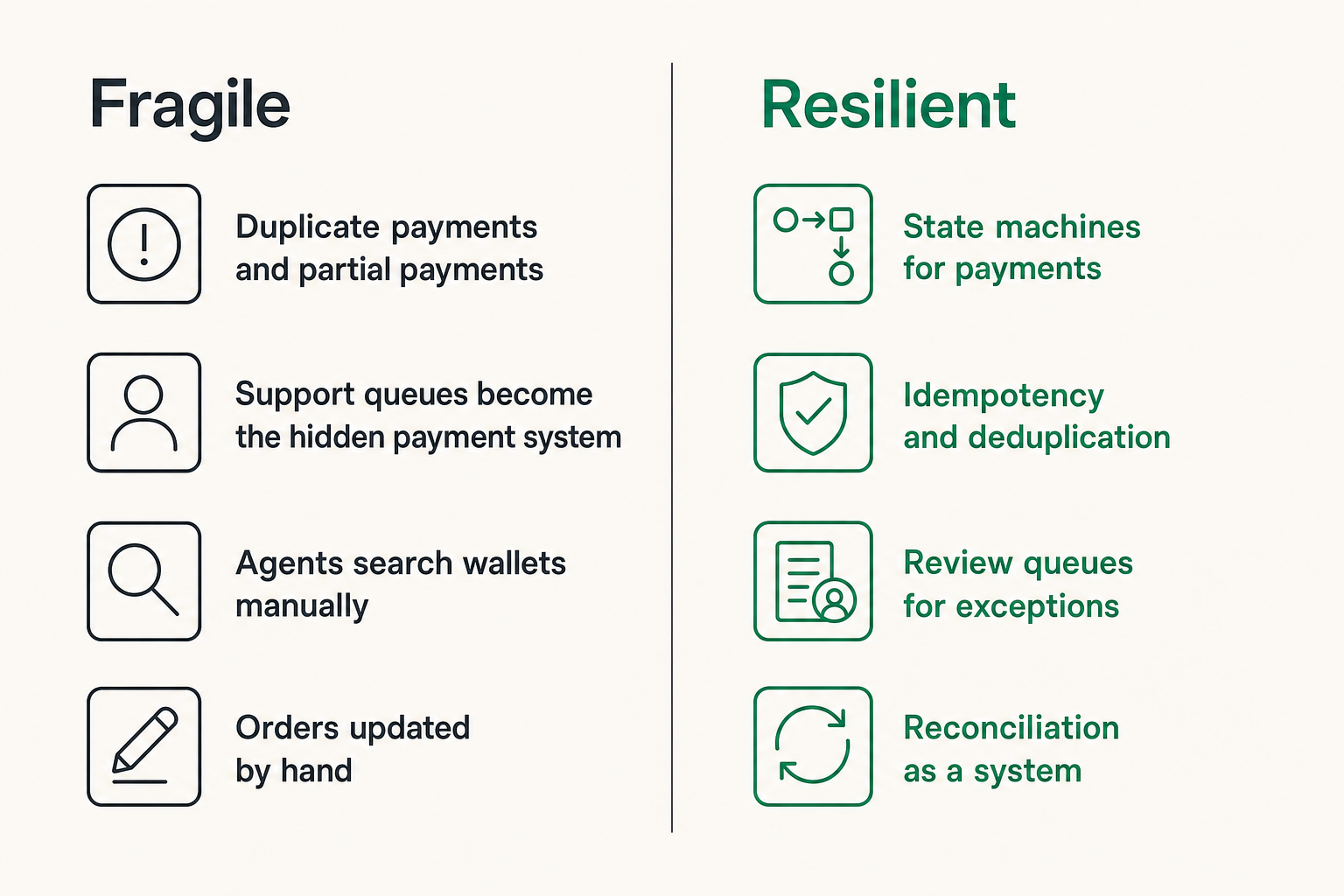
What breaks in practice is rarely one dramatic exploit. It is usually a chain of small assumptions: the buyer pays late, the webhook retries, support marks the order paid, fulfillment ships, and reconciliation finds the mismatch two days later.
Duplicate payments and partial payments
Duplicate payments happen when buyers do not understand invoice state. If your checkout expires but the wallet transaction still broadcasts, or your UI says “failed” while the network says “pending,” some buyers will pay again.
Partial payments happen when buyers send from exchanges, misread network fees, or manually enter amounts. Your system needs policies:
- Accept small underpayments within a defined tolerance?
- Request top-up payment?
- Refund automatically?
- Route to manual review?
There is no universal answer. The important part is making the policy explicit and automatable.
Support queues become the hidden payment system
When the back office lacks visibility, support becomes the real payment engine. Agents ask for screenshots, search wallets manually, paste transaction hashes into explorers, and update orders by hand.
That process does not scale. It also creates inconsistent customer outcomes.
A better support view shows:
- Order ID and invoice ID.
- Quoted amount and asset.
- Address shown to buyer.
- Transaction hash and confirmations.
- State transition timeline.
- Review status and reason.
- Refund eligibility and prior actions.
Related reading from our network: even local coordination systems run into similar routing and follow-up issues; the operating model in how to run a local community network is a useful adjacent lens for queues, ownership, and follow-through.
Metrics operators should monitor
Metrics are not vanity dashboards. They tell you where the workflow is leaking money, time, or trust.
The mistake teams make is tracking gross crypto volume but ignoring exception rate. Volume without exception context hides operational debt.
Checkout metrics
Track these weekly:
| Metric | Why it matters |
|---|---|
| Invoice creation count | Measures checkout demand |
| Payment completion rate | Shows buyer ability to complete crypto checkout |
| Expired invoice rate | Indicates quote window or UX issues |
| Underpayment rate | Exposes wallet, exchange, or fee confusion |
| Overpayment rate | Exposes amount-entry and wallet behavior |
| Average confirmation time | Helps set customer expectations |
| Duplicate payment rate | Signals bad state messaging |
These metrics should be segmented by asset, chain, wallet type where known, and order value band.
Back-office metrics
Back-office metrics are where merchant reality appears:
- Manual review rate.
- Average review time.
- Fulfillment hold time after payment confirmation.
- Refund request rate.
- Refund completion time.
- Reconciliation variance.
- Support tickets per 100 paid invoices.
- Orders manually overridden.
If support tickets rise faster than paid invoices, the payment workflow is not healthy. If reconciliation variance is nonzero for multiple days, fulfillment should slow down until the cause is understood.
A useful operating cadence is simple: review exceptions daily, metrics weekly, and policies monthly. Do not wait for a processor incident or wallet discrepancy to discover that no one owns the payment ledger.
Where CoinPayPortal fits
CoinPayPortal is for developers and merchants building crypto payment infrastructure. For solution peptides merchants, the fit is not “add crypto because crypto is trendy.” The fit is giving operators a clearer payment workflow when conventional processor access is fragile or expensive.
Integration surface
A good payment platform should give developers enough control to model their own lifecycle. That means clean documentation, predictable invoice creation, webhook events, and operational visibility.
When evaluating a gateway, look for:
- API-first invoice creation.
- Webhook signing and replay-safe event IDs.
- Clear payment status semantics.
- Support for merchant-controlled operational flows.
- Documentation that explains failure modes, not just happy paths.
CoinPayPortal’s developer docs are the right place to start when you are mapping invoice creation and event handling into your existing order system.
Custody boundaries
The custody boundary should be understandable to the founder, engineer, and support lead. If only one person knows where funds go or how settlement works, the system is too fragile.
For many solution peptides merchants, the best architecture is not the most complex one. It is the one where:
- Buyers receive clear payment instructions.
- Invoices have explicit state.
- Funds are observable.
- Fulfillment waits for defined gates.
- Refunds follow policy.
- Operators can investigate without guessing.
That changes the conversation from “Which processor will tolerate us?” to “Which payment architecture gives us control without creating a support mess?”
Try coinpayportal.com
coinpayportal.com is for developers and merchants building crypto payment infrastructure. If you are designing solution peptides checkout, start with the workflow: state, trust, settlement, and support. Try coinpayportal.com.
Try CoinPay
Crypto payments, escrow, and wallets — multi-chain, Lightning-ready, and fast to integrate.
Get started →