Screen Sharing Peptide: A Practical Remote Support Workflow for Crypto Payment Teams
A merchant says the crypto checkout is broken. Their customer sees a pending payment, your dashboard shows nothing final, the wallet extension is open, and three people are now in a call trying to describe what they see.
That is where screen sharing peptide becomes a real operational problem, even if the phrase sounds strange at first. In practice, teams use screen sharing as a small but critical connector between merchant support, developer debugging, and payment operations.
Teams think the problem is screen sharing software. The real problem is building a safe workflow for viewing, controlling, and debugging payment states without crossing custody, privacy, or support boundaries.
That changes the conversation. For crypto payment teams in 2026, the practical question is not whether support can see a screen. It is how support can guide a merchant through checkout configuration, wallet behavior, webhook delivery, reconciliation, and settlement without leaking secrets or creating a second incident.
Table of contents
- Why screen sharing peptide matters in crypto payment operations
- The real architecture problem behind screen sharing peptide
- Map the payment support surface before you share a screen
- A screen sharing peptide workflow for merchant incidents
- Security boundaries for remote control and shared screens
- Debugging crypto checkout issues over screen share
- Webhooks, reconciliation, and settlement during live support
- What works, what fails, and how to measure it
- Implementation checklist for engineering and support
- Where CoinPayPortal fits in the workflow
Why screen sharing peptide matters in crypto payment operations
The phrase is odd, the workflow is not
Screen sharing peptide is not a standard payments term. Most teams will not find it in a gateway spec, wallet SDK, or blockchain node manual. But as a search phrase, it points at a familiar operational pattern: small fragments of remote collaboration that move a blocked payment issue from confusion to resolution.
A useful way to think about it is this: the screen share is the peptide, not the protein. It is a small component inside a larger operating system. On its own, it does not solve payment reliability. Connected to a good workflow, it can shorten a painful support loop.
In crypto payments, that loop often includes a merchant admin panel, a checkout session, a wallet, a block explorer, webhook logs, API keys, settlement settings, and accounting exports. If support treats the screen share as an open-ended tour, the session becomes slow and risky. If support treats it as a controlled diagnostic step, it becomes useful.
Where crypto payments make remote support harder
Card payment support is already complex. Crypto adds a few sharp edges:
- The payer may be using a self-custody wallet that the merchant does not control.
- Network choice matters. USDT on Tron is not the same operational event as USDT on Ethereum.
- Transactions may be visible on-chain before the merchant system marks them paid.
- Finality, confirmations, underpayments, overpayments, and expired invoices all create ambiguous states.
- Support must never ask for seed phrases, private keys, signing permissions, or wallet recovery data.
The mistake teams make is assuming the call is about seeing the merchant's browser. It is really about proving state across several systems without crossing trust boundaries.
Practical rule: A screen share should confirm observable state. It should not become a workaround for missing logs, unclear payment states, or unsafe admin access.
The real architecture problem behind screen sharing peptide

The checkout UI is only the visible layer
The merchant sees a checkout screen. Engineering sees an API request, a payment intent, a chain transaction, a webhook delivery attempt, and a settlement record. Finance sees reconciliation. Support sees a ticket.
Those are not separate problems. They are different views of the same payment lifecycle.
When a merchant shares their screen, support often gets a narrow view: an error message, a pending spinner, or a wallet prompt. That view is useful, but only if the support agent can connect it to backend truth. If the agent has no access to event logs, correlation IDs, or payment status history, the screen share becomes a guessing exercise.
For a payment gateway, the better architecture is to make screen sharing the last mile of context, not the primary source of truth.
Support needs context, not unlimited access
Support teams need enough information to guide the merchant. They do not need root access to merchant systems. They do not need to control wallets. They do not need to see API secrets in plaintext.
A practical support console should expose:
- Payment intent ID
- Merchant ID
- Checkout session status
- Expected asset and network
- Quoted amount and expiry
- Detected on-chain transaction hash, if any
- Webhook delivery status
- Last error class
- Safe metadata fields
It should hide or mask:
- API secret keys
- Wallet seed phrases and private keys
- Customer personal data not needed for troubleshooting
- Internal credentials
- Full bearer tokens
- Signing prompts and sensitive wallet actions
That changes the conversation in a support call. Instead of saying, please click around until we find something, the agent can say, open the checkout session with ID pay_123, confirm the network is Polygon, and show me the wallet error without exposing your recovery phrase.
Map the payment support surface before you share a screen
What support may inspect
Before a team standardizes screen sharing peptide as a workflow, it should map what can safely be inspected during a session. This is not bureaucracy. It prevents support from improvising under pressure.
Safe inspection usually includes:
- Public checkout configuration
- Non-secret merchant settings
- Payment status labels
- Public transaction hashes
- Network selection
- Browser console errors after secrets are hidden
- Webhook endpoint URL hostname, not full credentials
- Test mode activity
- Documentation pages
For live production payments, support should use read-only views wherever possible. The operator may ask the merchant to perform an action, but the operator should not take control unless the task is low risk and explicitly approved.
The team at pairux.com works with remote teams on practical screen sharing and remote control patterns, and the same discipline applies here: clarify who controls the session, what is visible, and when the session stops.
What support must never touch
Crypto payment support fails badly when teams blur the line between guidance and custody. A support person controlling a merchant's wallet is not just helping. They may be taking operational responsibility for a signing decision.
Never allow support to:
- Ask for seed phrases or private keys
- Type or paste wallet recovery data
- Approve wallet signatures on behalf of a user
- Create withdrawal addresses without a documented approval path
- Change settlement wallets during an ad hoc session
- Copy API secrets into chat
- Download merchant exports to a personal machine
- Disable fraud, risk, or confirmation rules to force success
Practical rule: If an action can move funds, change custody, or weaken authentication, it should not be performed through casual remote control.
A good support workflow makes this easy. The agent should have language ready: I can walk you through where to click, but I cannot approve that transaction or view your recovery phrase. That protects the merchant and the provider.
A screen sharing peptide workflow for merchant incidents
The minimum viable session flow
The practical question is: what should happen every time a merchant requests live help?
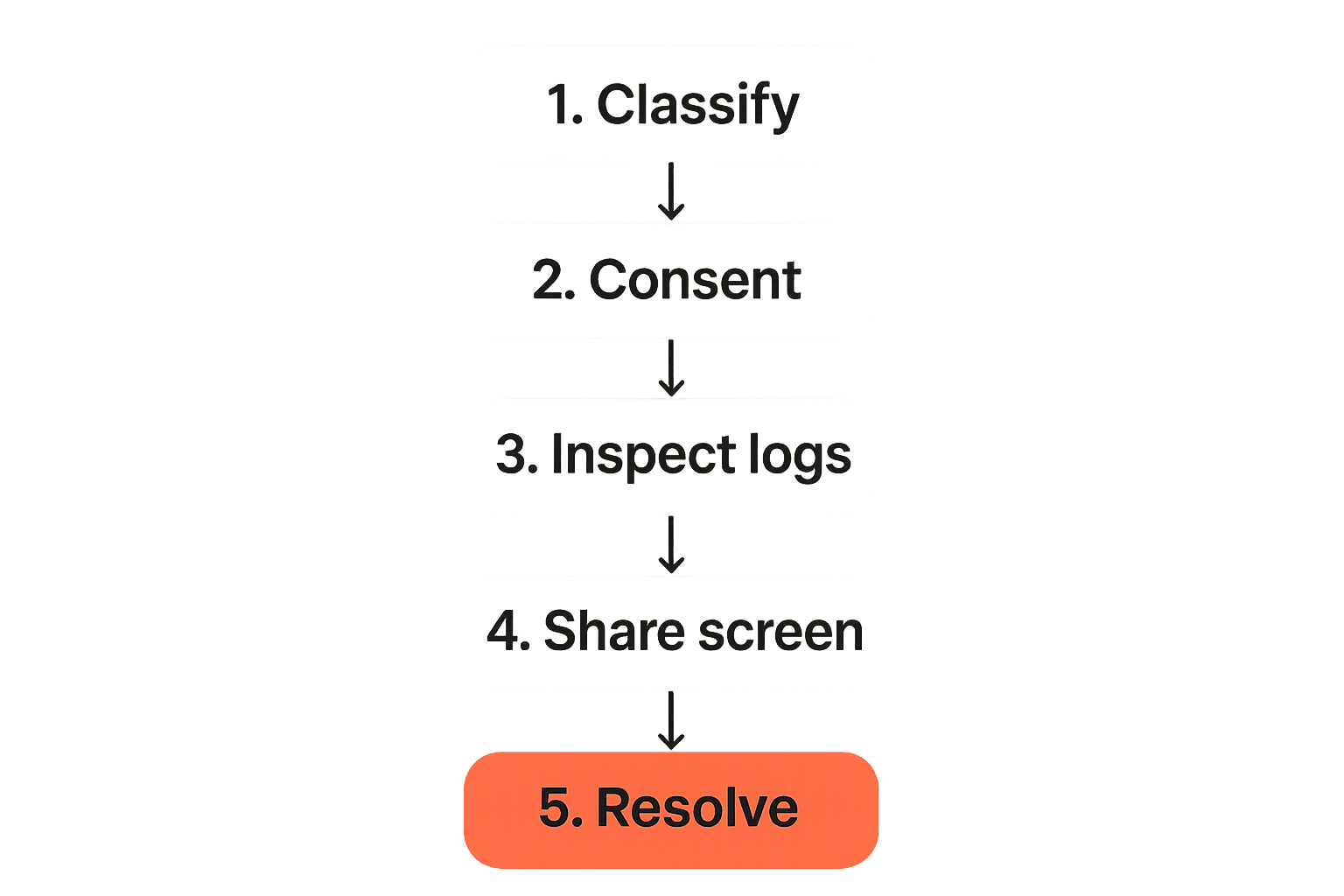
A lightweight sequence works better than a loose call:
- Classify the incident. Identify whether the issue is checkout configuration, wallet behavior, webhook delivery, settlement, reconciliation, or merchant dashboard access.
- Create or attach a ticket. Generate a ticket ID before the session begins. Do not debug production payments with no written record.
- Confirm scope and consent. State what the agent may view, whether remote control is allowed, and what must be hidden.
- Collect safe identifiers. Ask for payment intent ID, invoice ID, transaction hash, merchant ID, or test checkout ID.
- Inspect provider-side state first. Check logs and status before asking the merchant to expose their screen.
- Use screen sharing for the missing context. Confirm UI state, wallet messages, browser behavior, or dashboard configuration.
- Record the outcome. Mark root cause, workaround, owner, and whether a product fix is needed.
This sequence keeps the session focused. It also gives engineering enough information when the issue needs escalation.
When to escalate from support to engineering
Not every incident needs an engineer in the call. In fact, adding engineers too early often slows the merchant down because the call turns into live forensics.
Escalate when:
- The payment state in the provider system conflicts with on-chain evidence.
- Webhook delivery is failing despite a healthy merchant endpoint.
- The checkout is generating incorrect amounts or addresses.
- A wallet integration regression affects multiple merchants.
- A settlement job is delayed or duplicating records.
- The agent cannot explain the error using the runbook.
Do not escalate just because the merchant is frustrated. Escalate because the state model is unclear, the system behavior is unsafe, or the issue may affect more than one merchant.
Security boundaries for remote control and shared screens
Custody boundaries come first
Crypto payment infrastructure has a simple rule that becomes complicated under pressure: do not become the custodian by accident.
If your company is not supposed to control merchant funds, your support workflow must not create de facto control. A screen share can accidentally cross that line when an agent takes control of a browser, opens a wallet, changes addresses, or guides a user through signing something they do not understand.
The safer model is assisted navigation:
- The merchant keeps keyboard and mouse control for sensitive actions.
- The agent uses annotations or verbal guidance.
- The agent pauses before any wallet prompt.
- The merchant reads and confirms the action independently.
- The session stops if secrets appear.
For enterprise merchants, add role checks. The person on the call may not be authorized to change settlement wallets or rotate API keys. Screen sharing does not replace merchant-side approval workflows.
Redaction, consent, and audit logs
Screen sharing tools should support basic operational hygiene:
- Explicit consent before viewing or controlling the screen
- Session start and stop timestamps
- Participant identity
- Recording policy, if recordings are allowed
- Redaction guidance before opening dashboards
- A way to pause sharing instantly
- Notes linked to the support ticket
Recording can be useful for training and audit, but it can also capture secrets. If recordings are enabled, teams need a retention policy and a deletion path. Many teams should avoid recording wallet sessions entirely unless they have mature redaction and access controls.
Practical rule: Treat a screen share recording like a sensitive production log. If you would not store a secret in logs, do not store it in a video.
Debugging crypto checkout issues over screen share
The checkout state machine
Most checkout failures are easier to solve when everyone uses the same state machine. A merchant saying the payment is stuck can mean several different things.
A practical crypto checkout model might look like this:
| State | What it means | What support should check |
|---|---|---|
| Created | Checkout session exists | Asset, network, amount, expiry |
| Viewed | Customer opened checkout | Browser, device, merchant redirect |
| Wallet opened | Wallet interaction started | Wallet type, network, prompt text |
| Broadcast | Transaction sent to chain | Transaction hash, mempool visibility |
| Detected | Provider saw transaction | Address, amount, confirmations |
| Confirmed | Payment accepted | Confirmation policy, status update |
| Webhook sent | Merchant notified | Endpoint response, retries |
| Reconciled | Merchant records updated | Order ID, settlement report |
| Expired or failed | Payment not accepted | Expiry, underpayment, wrong network |
The screen share is most useful in the Viewed and Wallet opened states. Provider logs are usually stronger in Detected, Confirmed, and Webhook sent states. Reconciliation often belongs in reports and exports, not live browser inspection.
Wallet, network, and amount mismatches
The highest-friction calls usually come from mismatches that are obvious only after the merchant and provider compare views:
- The checkout expects USDC on Base, but the payer wallet is on Ethereum.
- The invoice expired before the customer broadcast the transaction.
- The payer sent the right asset to the wrong network address format.
- The wallet rounded or displayed an amount differently than the checkout.
- The merchant test mode key is being used in production.
- A browser extension blocks the checkout script.
What breaks in practice is the assumption that the merchant can describe wallet behavior precisely. They often cannot. A short, controlled screen share can show the exact wallet prompt, network badge, and error message.
But the agent still needs discipline. If a seed phrase modal appears, stop. If a signing prompt appears, explain it and let the user decide. If the amount is wrong, do not ask the user to send anyway. Fix the payment session or create a new one.
Webhooks, reconciliation, and settlement during live support
Use correlation IDs instead of screenshots
Screenshots are useful for human context, but they are weak operational evidence. They go stale, crop out important details, and often expose more than needed. For payment infrastructure, correlation IDs are better.
Every checkout session should expose safe identifiers that support can ask for without exposing secrets:
- Payment ID
- Invoice ID
- Merchant order ID
- Transaction hash
- Webhook event ID
- Settlement batch ID
A support agent should be able to paste one ID into an internal console and see the lifecycle. If your team cannot trace from checkout to webhook to settlement, screen sharing will become a crutch.
A simple internal trace view might show:
payment_id: pay_8k21
merchant_order_id: ord_1044
asset: USDC
network: base
status: confirmed
transaction_hash: 0xabc...
webhook_event: evt_991 delivered 200
settlement_batch: batch_2026_06_04 pending
The point is not to expose every internal detail. The point is to give support enough truth to avoid asking the merchant to prove what the platform already knows.
Separate payment truth from merchant perception
A merchant may believe a payment failed because their order page still says unpaid. The provider may have confirmed the payment and delivered the webhook. Both experiences can be true.
That is why support needs to separate layers:
| Layer | Source of truth | Common failure |
|---|---|---|
| Checkout | Payment provider | Expired session or wrong network |
| Chain | Node or indexer | Delayed detection or reorg handling |
| Webhook | Provider delivery log | Merchant endpoint returns 500 |
| Merchant order | Merchant backend | Idempotency bug or missed update |
| Settlement | Provider or merchant ledger | Batch delay or export mismatch |
This table prevents a common argument: the merchant says unpaid, the provider says paid, and nobody names the layer. During a screen share, the agent should keep asking: which system currently disagrees?
What works, what fails, and how to measure it
What works in production
The best teams do not use screen sharing peptide as a heroic support tactic. They use it as a controlled exception inside a documented workflow.
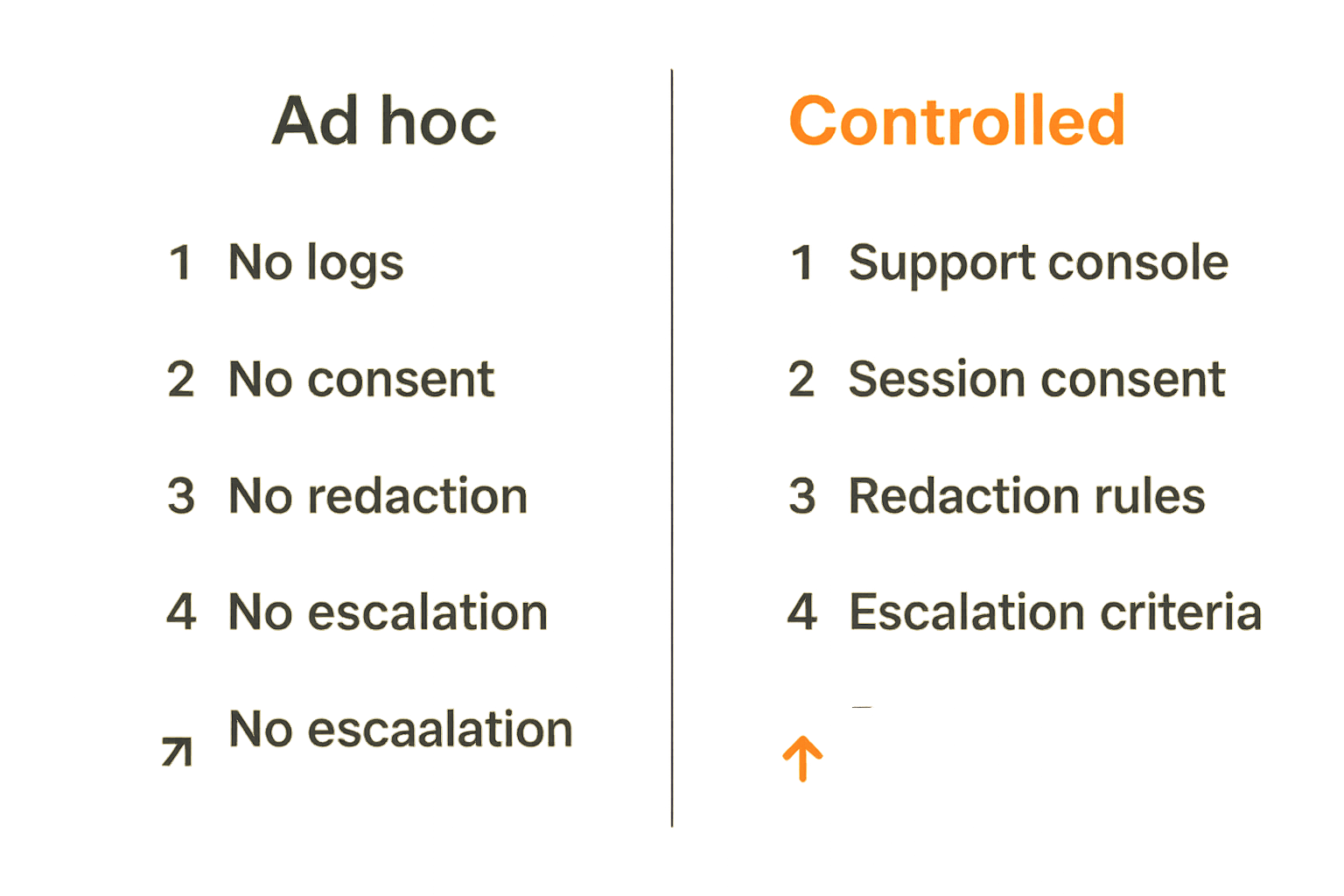
What works:
- Read-only support consoles with traceable payment lifecycle events
- Clear redaction rules before the screen is shared
- Session consent and ticket linkage
- Safe identifiers visible in merchant dashboards
- Runbooks for common wallet and network errors
- Escalation criteria based on system state, not emotion
- Post-session tagging so product can see repeated failure patterns
A useful metric is not simply average handle time. Faster is not better if the session creates security risk or hides a product defect. Track categories instead: wrong network, expired invoice, webhook failure, settlement confusion, dashboard permission issue, wallet prompt confusion.
Then ask which categories should disappear from support calls. If merchants repeatedly need a screen share to understand an expired invoice, the product should explain expiry better. If support repeatedly asks engineering to inspect webhook logs, the support console is incomplete.
What fails repeatedly
The failure modes are predictable:
| Bad pattern | Why it fails | Better pattern |
|---|---|---|
| Support asks for a screenshot of everything | Leaks secrets and misses backend truth | Ask for safe IDs and inspect logs |
| Agent takes wallet control | Crosses custody and consent boundaries | Use guided navigation only |
| Engineering joins every call | Creates dependency and slows triage | Escalate only on defined state conflicts |
| No ticket before session | Outcome disappears after the call | Link every session to an incident record |
| Webhook debugging by screen share | Browser view cannot prove delivery | Use event logs and retry history |
| Same issue repeats weekly | Product defect becomes support ritual | Tag sessions and fix the flow |
The mistake teams make is celebrating how quickly support solved the call while ignoring why the call was needed. A screen share is expensive. It requires human attention, interrupts merchants, and can expose sensitive data. Use it when it adds context that logs cannot provide.
Implementation checklist for engineering and support
Build the runbook before the incident
A good runbook does not need to be huge. It needs to be specific enough that support does not improvise around funds, credentials, or production state.
Include:
- Incident categories and first questions
- Safe and unsafe information examples
- Approved remote control rules
- Wallet prompt handling language
- Payment state definitions
- Escalation thresholds
- Internal console links or search paths
- Post-session tagging requirements
A simple checklist for the start of a session:
- Confirm ticket ID.
- Confirm merchant identity and role.
- Confirm issue category.
- Ask for safe payment identifier.
- Inspect provider-side state.
- Explain screen sharing scope.
- Ask the merchant to hide secrets.
- Start screen share.
- Stop if custody or secrets appear.
- Record root cause and next owner.
This is not heavy process. It is how teams avoid making different decisions on every call.
Turn repeated sessions into product fixes
Screen sharing data should feed product decisions. If ten merchants need live help to configure webhook retries, the problem is not merchant education. The workflow is unclear or the observability is insufficient.
Look for patterns:
- Repeated confusion around test mode versus live mode
- Merchants using the wrong asset or network
- Customers abandoning wallet prompts
- Webhook endpoints failing without clear merchant alerts
- Settlement reports that finance teams cannot reconcile
- Dashboard roles that block the person responsible for support
Each pattern should become one of three things: better documentation, better product UX, or better internal tooling. If it becomes only a support macro, the same failure will return.
Practical rule: Every repeated screen share should either improve the product, improve the runbook, or improve the support console. Otherwise it is just manual toil.
Where CoinPayPortal fits in the workflow
Payment infrastructure should reduce screen sharing
CoinPayPortal is built for developers and merchants who need crypto payment infrastructure that behaves like an operational system, not just a checkout button. That matters because the best screen sharing peptide workflow is the one you need less often.
Clear payment states, reliable APIs, webhook handling, and merchant-facing visibility reduce the need for live calls. When a merchant can see the payment ID, network, status, transaction hash, and webhook result, support starts from facts instead of guesses.
The UI is not the whole system. For crypto payments, state, trust, settlement, and support are the real work. A good gateway gives each team the right view: developers get APIs and logs, merchants get understandable payment status, support gets traceability, and finance gets reconciliation context.
Use screen sharing peptide as a temporary bridge
Screen sharing peptide should be a bridge between current uncertainty and better infrastructure. Use it to unblock a merchant today, but do not let it become the permanent interface for payment operations.
The practical target is simple:
- Merchants should not need screen sharing to understand normal payment states.
- Support should not need screen sharing to inspect provider-side truth.
- Engineering should not need screen sharing to diagnose routine webhook failures.
- Finance should not need screen sharing to reconcile settlement batches.
Use live collaboration for edge cases: unusual wallet behavior, browser-specific checkout failures, merchant onboarding, and high-context configuration problems. For everything else, build the state model and tooling.
In closing, screen sharing peptide is useful only when it is treated as a controlled workflow inside crypto payment operations. The teams that make it work do not rely on screen sharing as magic. They use it to fill a narrow context gap, protect custody boundaries, and turn repeated support pain into better payment infrastructure.
Try coinpayportal.com
CoinPayPortal helps developers and merchants build crypto payment flows with practical checkout, API, and merchant operations in mind. Try coinpayportal.com.
Try CoinPay
Crypto payments, escrow, and wallets — multi-chain, Lightning-ready, and fast to integrate.
Get started →