SaaS Cryptocurrency Payments: The Architecture Merchants Actually Need

Most teams adding SaaS cryptocurrency payments start in the wrong place. They look for a wallet connect button, a checkout widget, or a fast API call that returns an address. That feels like progress until the first customer pays late, sends the wrong amount, chooses the wrong chain, or opens a support ticket with a transaction hash nobody can map to an invoice.
Teams think the problem is accepting crypto. The real problem is running a payment system where state, trust, settlement, and support all keep working after the checkout screen closes.
That changes the conversation. A SaaS cryptocurrency integration is not a marketing feature. It is a workflow decision that touches billing, customer success, finance, fraud review, reconciliation, refunds, and developer operations.
The practical question is not whether your product can display a crypto payment option. The practical question is whether your stack can reliably answer: who paid, for what, on which network, at what rate, with how many confirmations, and what should happen next?
Table of contents
- SaaS cryptocurrency is not a payment button
- The SaaS cryptocurrency checkout architecture
- Design the payment state machine before the UI
- Webhooks are the operational contract
- Custody, settlement, and treasury boundaries
- Developer workflow for adding SaaS cryptocurrency payments
- What breaks when teams implement it badly
- What works in production
- SaaS cryptocurrency pricing, risk, and merchant operations
- Where CoinPayPortal fits in a SaaS cryptocurrency stack
SaaS cryptocurrency is not a payment button
The mistake teams make is treating SaaS cryptocurrency as a front-end feature. Add a logo, show a QR code, listen for a transaction, and call it done. That is fine for a demo. It is not enough for a merchant business where failed billing creates support load and revenue leakage.
A useful way to think about it is this: crypto is the rail, but the product is the payment workflow. Your SaaS needs to know when to create a charge, when to expire it, when to grant access, when to revoke access, when to reconcile, and when to escalate a human review.
As guest contributors, the team at saasrow.com looks at SaaS payment decisions as operating-system decisions for the business, not isolated integration tasks.
The UI is the smallest part
A payment button is visible, so it gets the attention. But most failures happen after the customer clicks it.
The customer may leave the checkout page. The transaction may sit in mempool longer than expected. The amount may be slightly short because the wallet applied a fee differently. A webhook may arrive twice. Finance may need to match the payment to an invoice weeks later.
If the UI is the only thing designed, the rest of the company becomes the fallback system.
Practical rule: do not launch a crypto checkout flow until you can explain the back-office workflow for a late, partial, duplicate, and refunded payment.
State is the product
In card payments, many teams outsource state to the processor. With cryptocurrency payments, the state model is more visible. You have blockchain state, gateway state, invoice state, subscription state, and internal entitlement state.
Those states are related, but they are not the same thing.
A transaction being seen on-chain does not always mean the invoice should be marked paid. An invoice being paid does not always mean the subscription should renew immediately. A payment being settled does not mean the revenue has been reconciled.
The system has to preserve those distinctions.
Why this matters in 2026
By 2026, many merchants are not asking whether crypto payments are possible. They are asking whether they can support stablecoins, global buyers, developer-led checkout flows, lower cross-border friction, and faster settlement without creating a finance mess.
That is a more mature question. It pushes teams away from hype and toward architecture.
For SaaS companies, the value is not only accepting BTC, ETH, USDT, USDC, or another asset. The value is letting a customer pay in the method they prefer while your internal systems still behave like a real billing platform.
The SaaS cryptocurrency checkout architecture
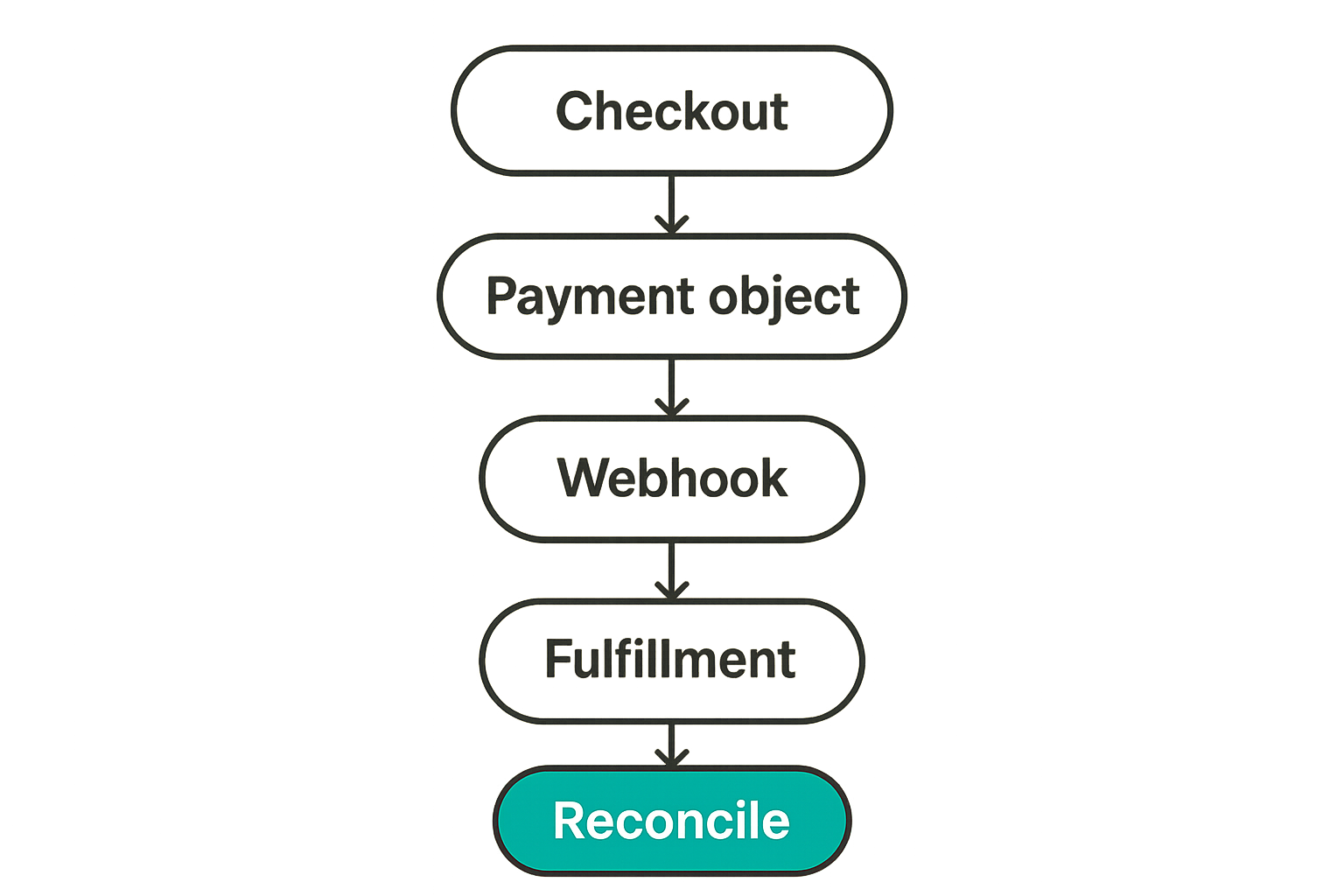
A proper SaaS cryptocurrency checkout architecture separates customer experience from payment truth. The checkout page helps the customer pay. The payment object records what the system expects. Webhooks and reconciliation decide what the business can trust.
Hosted checkout vs embedded API
There are two common patterns.
Hosted checkout is faster to ship. You redirect the customer to a gateway-hosted page, receive status updates, and keep less payment UX inside your app. This works well when speed, simplicity, and consistent payment instructions matter more than deep UI control.
Embedded API checkout gives your product more control. You create payment intents, display addresses or QR codes, poll status, and build the complete flow in your application. This can be better for marketplaces, complex subscriptions, white-label products, and platforms with custom onboarding.
Neither is automatically better. The decision is about ownership.
| Approach | What works | What fails | Best fit |
|---|---|---|---|
| Hosted checkout | Fast launch, fewer UX edge cases, gateway handles instructions | Less UI control, redirect dependency | Merchants, SaaS apps, simple invoices |
| Embedded API | Full product control, custom flows, deeper billing integration | More engineering ownership, more support paths | Platforms, marketplaces, advanced SaaS billing |
| Direct wallet only | Simple prototype, no gateway dependency | Weak state, poor reconciliation, high support load | Internal tools or very small volume |
Practical rule: choose hosted checkout when you want operational safety first. Choose embedded APIs when you are ready to own the payment experience and its failure modes.
The payment object is your source of truth
The core object in your system should not be a wallet address. It should be a payment object tied to an invoice, customer, amount, asset, network, expiration time, and status.
A reasonable internal payment record includes:
payment_idmerchant_idcustomer_idinvoice_idexpected_amountexpected_assetnetworkaddress_or_payment_uriexpires_atstatustx_hashesconfirmations_requiredmetadata
This gives your team a stable handle. The blockchain transaction becomes evidence for the payment, not the payment record itself.
Network and asset choices are product decisions
Supporting every chain and token sounds flexible. In practice, it creates documentation, support, liquidity, reconciliation, and risk work.
A SaaS merchant should decide which assets and networks to support based on customer demand and operational complexity. Stablecoins may simplify pricing. Faster networks may improve checkout completion. More established assets may have better tooling and buyer familiarity.
What breaks in practice is offering too many options without support readiness. Customers choose the wrong network, send unsupported tokens, or ask why a transaction that looks successful in their wallet did not unlock the product.
Design the payment state machine before the UI
A crypto payment flow needs a state machine before it needs polish. If your team cannot define the allowed transitions, your UI will make promises your backend cannot keep.
The minimum states you need
A practical SaaS cryptocurrency payment can start with these states:
created: payment object exists, customer has not paid yetpending: transaction detected but not final enough for fulfillmentconfirmed: payment has enough confirmation confidencepaid: business rules allow fulfillmentexpired: payment window closed before valid paymentunderpaid: payment received but below required thresholdoverpaid: payment received above required amountfailed: payment cannot be completed automaticallyrefunded: refund workflow completed
Do not collapse these too early. confirmed and paid may sound similar, but one is network confidence and the other is business action.
Idempotency prevents duplicate access
Webhooks repeat. Customers refresh pages. Workers retry jobs. Billing systems call APIs twice. If your payment endpoint is not idempotent, duplicate events can grant duplicate credits, extend subscriptions twice, or create multiple invoices for one checkout session.
Use idempotency keys at the boundary where your system creates payment objects. Use unique constraints for external event IDs and transaction hashes. Make fulfillment actions safe to run more than once.
Example fulfillment guard:
if entitlement.exists(invoice_id):
  return already_fulfilled

if payment.status == paid:
  create_entitlement(invoice_id, customer_id)
  mark_invoice_fulfilled(invoice_id)
The important part is not the syntax. The important part is that fulfillment checks the business record, not just the latest event.
Expirations, underpayments, and overpayments
Expiration is not only a UX timer. It protects pricing. If you quote a customer for a volatile asset or a time-bound exchange rate, you need a payment window.
Underpayments need a policy. Do you accept small dust differences? Do you ask the customer to top up? Do you cancel automatically? Overpayments also need a policy. Do you credit the account, refund the difference, or send the case to support?
The policy should be visible to the customer and encoded in the backend. If it lives only in support scripts, it will drift.
Practical rule: every non-happy path needs a system state, not just a support note.
Webhooks are the operational contract
Webhooks are where a crypto payment gateway becomes part of your business system. They are not notifications for the UI. They are the contract that moves invoices, subscriptions, access, and finance records forward.
Verify before you trust
Never trust a webhook only because it reaches your endpoint. Verify signatures, timestamps, event IDs, and expected merchant context. Reject events that do not match your payment records.
A minimal webhook handler should do this:
raw_body = request.body
signature = request.header('x-signature')

if not verify_signature(raw_body, signature, webhook_secret):
  return 401

event = parse(raw_body)

if event.id already processed:
  return 200

payment = find_payment(event.payment_id)
if payment is null:
  store_unmatched_event(event)
  return 202

apply_event_with_lock(payment.id, event)
return 200
The lock matters. Two events for the same payment can arrive close together. Without a lock or equivalent transaction boundary, your state transitions can race.
Retries are normal, not exceptional
Webhook delivery is not guaranteed to be clean. Your endpoint will be down. Deploys will happen. A queue will lag. A gateway will retry. This is normal.
Design for at-least-once delivery. Store events before processing when possible. Make handlers idempotent. Return success only when your system has safely accepted the event, not necessarily when every downstream job has completed.
What fails is doing too much inside the webhook request. If the handler updates five systems synchronously and one is slow, you turn a payment event into a timeout problem.
Reconciliation closes the loop
Webhooks are fast, but reconciliation is what makes the books trustworthy. You should periodically compare gateway payment records, blockchain transaction data where relevant, invoices, internal ledger entries, and settlements.
Reconciliation catches missed webhooks, duplicated events, manual adjustments, and settlement differences. It also gives finance a way to close periods without asking engineering to query production tables by hand.
Custody, settlement, and treasury boundaries
The checkout is only one boundary. Custody and settlement decide who holds funds, who can move them, who manages keys, and how finance recognizes revenue.
Non-custodial vs custodial tradeoffs
Non-custodial setups reduce reliance on a third party holding funds, but they push more responsibility to your team. You may need wallet operations, key management, sweeping, gas management, monitoring, and recovery procedures.
Custodial or gateway-managed settlement can simplify merchant operations. The tradeoff is dependency on the provider's settlement process, supported assets, and account controls.
A merchant should choose based on operating capability, not ideology.
| Boundary | More control | More operational work | Common risk |
|---|---|---|---|
| Direct custody | High | High | Key loss, wallet ops errors |
| Gateway-managed settlement | Medium | Low to medium | Provider dependency |
| Hybrid treasury | High | Medium to high | Complex reconciliation |
Settlement currency drives finance work
If you price in USD but receive volatile assets, finance needs a rate source, timestamp policy, gain or loss handling, and settlement records. Stablecoin settlement may reduce volatility, but it does not remove reconciliation work.
Settlement decisions should be made with finance early. Engineering can integrate the rail, but finance has to live with the records.
Refunds are a separate workflow
Crypto refunds are not card reversals. They are new outbound transactions, usually to an address the customer provides or confirms. That creates security and support questions.
You need to decide:
- Who can approve a refund?
- How is the refund address collected?
- Is the address verified?
- Which asset and network are used?
- How are network fees handled?
- How is the refund mapped to the original invoice?
Treat refunds as a workflow with approvals, audit logs, and status. Do not hide it inside a manual wallet transfer.
Developer workflow for adding SaaS cryptocurrency payments
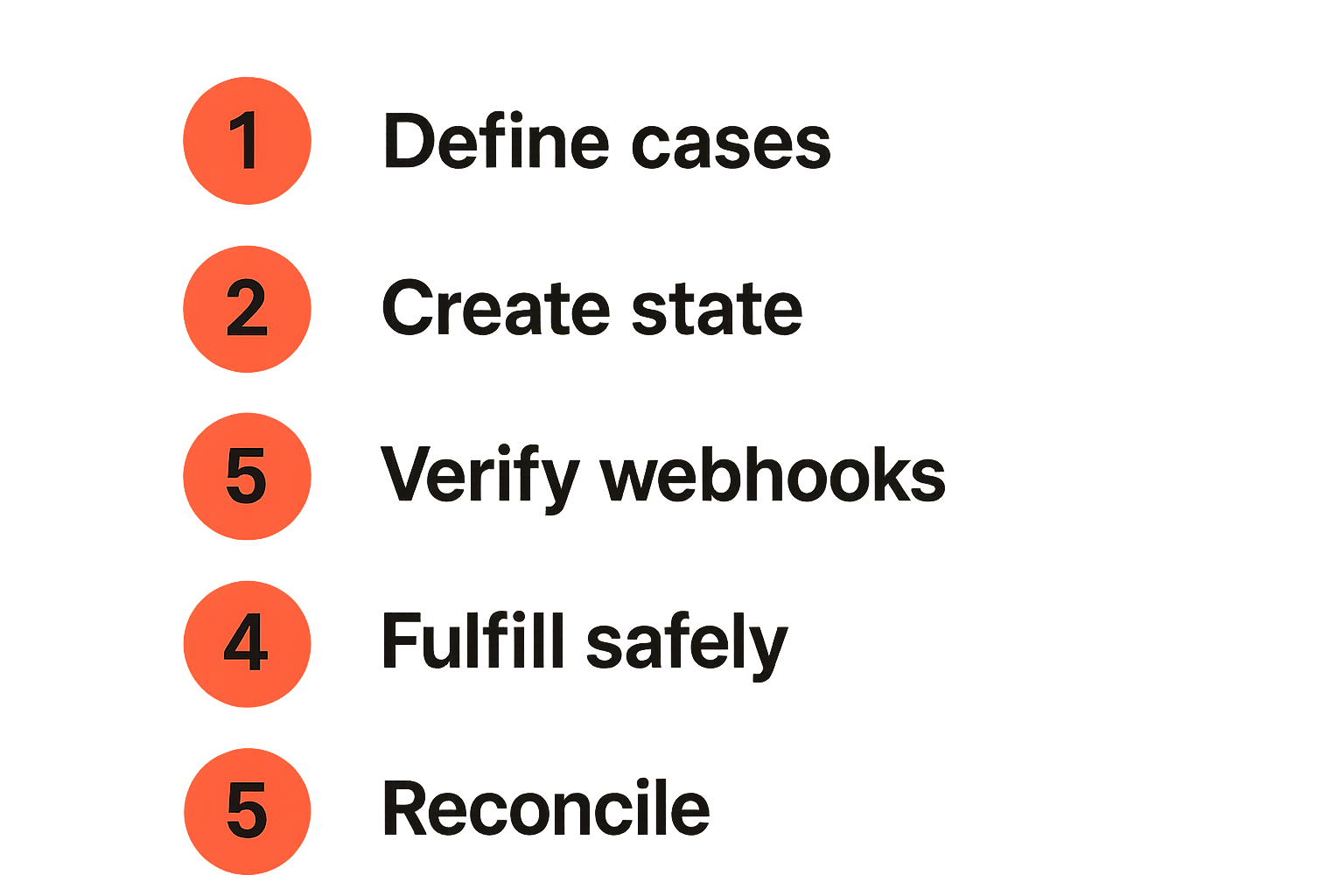
The safest implementation path is boring. Start with a narrow payment flow, prove state and reconciliation, then expand assets, networks, and billing cases.
Implementation sequence
- Define the business cases: one-time invoice, subscription renewal, usage top-up, marketplace escrow, or account credit.
- Choose hosted checkout or embedded API based on how much payment UX you want to own.
- Create an internal payment object and state machine before writing checkout UI.
- Add idempotent payment creation with metadata for customer, invoice, and merchant context.
- Implement webhook verification, event storage, and locked state transitions.
- Build fulfillment as a separate idempotent job triggered by payment state.
- Add reconciliation jobs that compare gateway status to internal records.
- Write support views that show invoice, payment, asset, network, transaction hash, and current state.
- Test late, partial, duplicate, expired, and refunded payments.
- Launch with limited assets and expand only when support and finance are ready.
That sequence feels slower than adding a button. It is faster than rebuilding the system after customers have paid into ambiguous states.
Minimal API model
A small SaaS product can start with three internal endpoints:
POST /billing/crypto-payments
  input: invoice_id, customer_id, asset, network
  output: payment_id, checkout_url, expires_at

POST /webhooks/crypto-gateway
  input: signed gateway event
  output: accepted

GET /billing/crypto-payments/{payment_id}
  output: status, amount, asset, network, expires_at, tx_hashes
Keep customer-facing status reads separate from webhook writes. Do not let the browser decide that a payment is complete. The browser can display status, but the backend decides entitlement.
Sandbox behavior to test
A sandbox that only tests happy-path payment is not enough. Before launch, test the ugly cases.
- Webhook arrives before the checkout page updates.
- Webhook arrives twice.
- Webhook arrives after the invoice expired.
- Customer sends less than required.
- Customer sends more than required.
- Customer uses the wrong network.
- Fulfillment job fails after payment is marked paid.
- Reconciliation finds a paid gateway record missing internally.
The practical question is not whether the integration works on a good day. It is whether it fails into a recoverable state.
What breaks when teams implement it badly
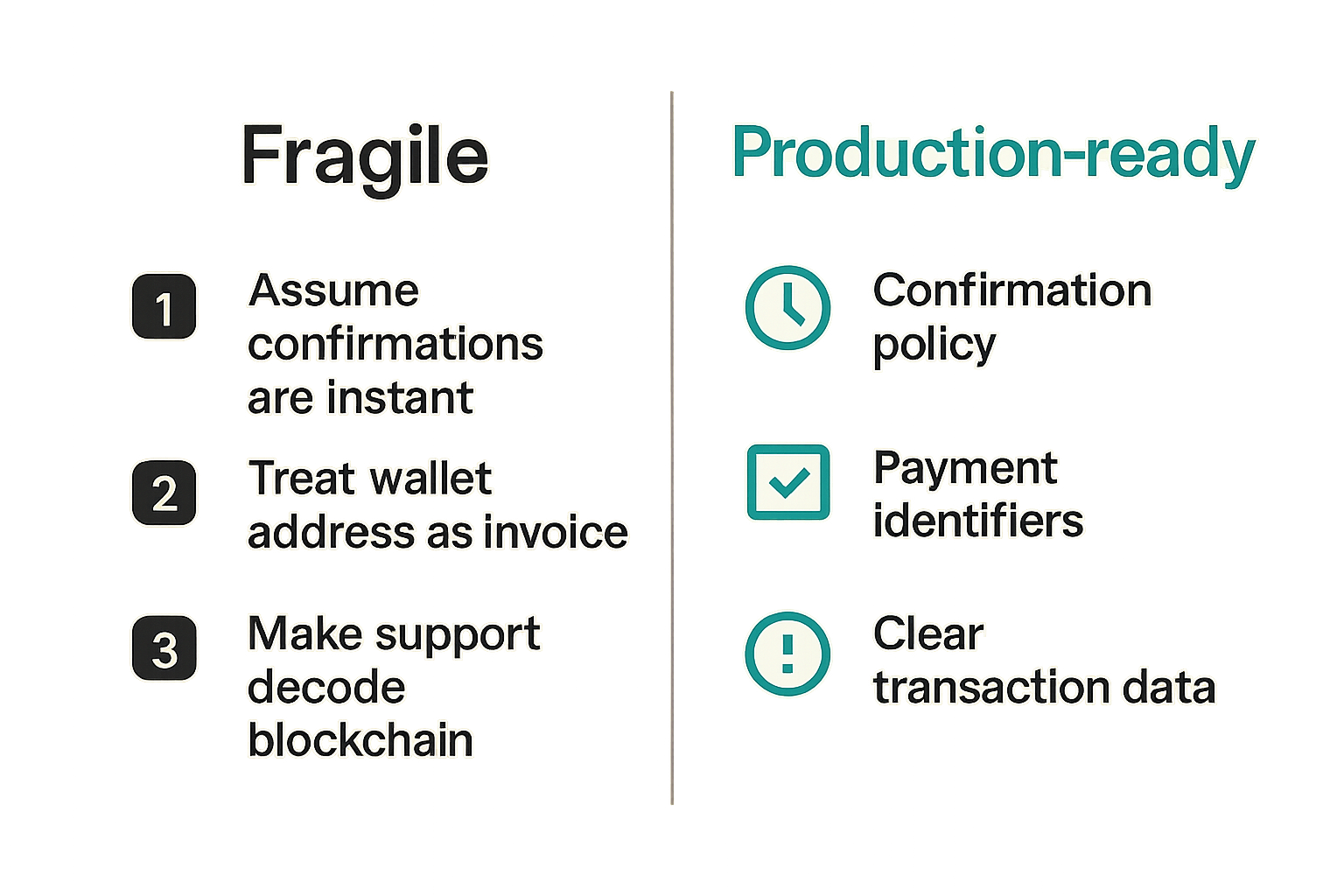
Bad crypto payment integrations do not usually fail all at once. They create a slow leak: support tickets, mismatched invoices, manual spreadsheet fixes, and engineers pulled into payment investigations.
Assuming confirmations are instant
Some teams treat detected as paid. That may be acceptable for tiny, low-risk transactions, but it should be an explicit risk decision. For most SaaS billing, you want a confirmation policy by network and asset.
The policy does not have to be complicated. It does have to exist.
If the network is fast and the value is low, you may grant provisional access. If the value is high, you may wait longer. If the transaction is suspicious or inconsistent, you may hold for review.
Treating a wallet address as an invoice
A wallet address is not enough context. If multiple customers pay to the same address, or if one customer reuses an old address, your system needs a way to map transactions correctly.
Payment-specific addresses, payment URIs, memo fields where appropriate, or gateway-managed payment identifiers can reduce ambiguity. The goal is to avoid asking support to infer intent from a transaction hash.
What breaks in practice is address reuse without a strong internal payment object. The chain shows money moved. Your billing system does not know why.
Making support decode the blockchain
Support teams should not need to be blockchain analysts. They need a merchant view that answers simple questions:
- Which invoice is this payment for?
- What did the customer send?
- Which network did they use?
- How many confirmations are required?
- What state is blocking fulfillment?
- What action is allowed next?
If support needs engineering for every payment issue, the integration is not production-ready.
What works in production
Production systems make the boring parts observable. They do not rely on a perfect checkout session. They assume payment events can be late, duplicated, partial, and confusing.
Build a merchant ledger
A merchant ledger is an internal record of money movement and business meaning. It is not necessarily a blockchain ledger. It is your source for invoices, credits, debits, settlements, refunds, fees, and adjustments.
For SaaS cryptocurrency payments, a ledger helps separate payment detection from accounting meaning. A transaction can be confirmed while settlement is pending. A refund can be approved while the outbound transfer is not yet complete.
Ledger entries should be append-only where possible. Corrections should be new entries, not silent edits.
Make reconciliation first class
Reconciliation should run on a schedule and on demand. It should compare your internal view against the gateway view and flag differences.
Useful reconciliation outcomes include:
- matched: internal and external records agree
- missing_internal: gateway shows payment but your system does not
- missing_external: internal record references unknown external payment
- amount_mismatch: amount differs beyond tolerance
- status_mismatch: gateway and internal states disagree
- settlement_pending: payment accepted but not settled
This is how finance gets confidence and engineering avoids emergency database spelunking.
Track the metrics operators actually use
Do not stop at total crypto volume. Operators need metrics that reveal workflow health.
| Metric | Why it matters | Owner |
|---|---|---|
| Checkout completion rate | Shows UX and asset fit | Product |
| Payment confirmation time | Shows network and policy impact | Engineering |
| Underpayment rate | Reveals wallet or instruction issues | Support/Product |
| Webhook failure rate | Shows integration reliability | Engineering |
| Reconciliation exceptions | Shows finance workload | Finance/Ops |
| Refund cycle time | Shows support and treasury friction | Ops |
These metrics change decisions. If underpayments cluster on one asset, update instructions or remove it. If webhook failures spike after deploys, move processing behind a queue. If reconciliation exceptions are high, fix your state model before adding more chains.
SaaS cryptocurrency pricing, risk, and merchant operations
A crypto payment option changes more than checkout. It changes pricing policy, operating cost, support scripts, and internal controls.
Fees are not only network fees
Teams often compare crypto payments to cards by looking only at network fees. That is too narrow.
Your real cost includes gateway fees, conversion spreads, withdrawal fees, treasury operations, support time, failed payment handling, engineering maintenance, and reconciliation work. A cheaper transaction can still be expensive if it creates manual operations.
This does not mean crypto is too costly. It means the business case should include the full workflow.
Rate limits and retries need ownership
Every external API has limits. Your integration should know what happens when payment creation, status polling, or webhook processing hits a limit.
Use queues for bursty work. Back off on retries. Store enough local state to avoid polling aggressively. Make retry exhaustion visible in an operator dashboard.
The mistake teams make is treating payment APIs as if they are internal function calls. They are not. They are networked dependencies with latency, rate limits, and maintenance windows.
Compliance starts with records
This article is not legal advice, but the operational point is simple: compliance work becomes much harder when records are incomplete.
Keep customer identifiers, invoice references, transaction hashes, asset, network, exchange rate source if used, settlement records, refund approvals, and admin actions. Even if your current needs are simple, clean records give you options later.
For B2B SaaS, this matters during audits, enterprise procurement, tax preparation, and dispute resolution. The payment system should produce evidence without engineers writing custom SQL every time.
Where CoinPayPortal fits in a SaaS cryptocurrency stack
CoinPayPortal fits the part of the stack where merchants and developers need crypto payment acceptance without turning every payment edge case into a custom internal platform.
Product fit
If you are building a SaaS cryptocurrency checkout flow, the useful product surface is not just the checkout page. It is the set of primitives around payment creation, status updates, webhook-driven automation, and merchant operations.
A gateway should help you:
- create payment requests tied to business metadata
- present clear payment instructions to customers
- receive reliable payment status updates
- reduce custom wallet-monitoring code
- support reconciliation and operational review
- keep checkout, webhooks, and settlement aligned
That is the difference between accepting a transaction and operating a payment method.
Migration path
If you already accept crypto through a direct wallet flow, migrate in layers. Do not rip everything out in one release.
Start by creating internal payment objects for new invoices. Then route a small segment of customers through the gateway-backed flow. Compare support volume, confirmation timing, reconciliation exceptions, and refund handling. Once the workflow is stable, expand assets, networks, and billing cases.
If you are starting from zero, resist the urge to support every requested asset on day one. Launch with the smallest set that your customers will actually use and your team can actually support.
The closing point is simple: SaaS cryptocurrency payments work when they are treated as payment infrastructure, not a checkout decoration.
Try coinpayportal.com
CoinPayPortal helps developers and merchants build crypto payment flows with practical checkout and payment infrastructure. Try coinpayportal.com.
Try CoinPay
Crypto payments, escrow, and wallets — multi-chain, Lightning-ready, and fast to integrate.
Get started →