Pure Peptide Labs Payments: Crypto Checkout Architecture for High-Risk Merchants

Pure peptide labs merchants do not usually fail because the checkout button is ugly. They fail because payment state, fulfillment state, and processor risk are wired together like one fragile object.
Teams think the problem is finding a processor willing to approve a peptide or research chemical storefront. The real problem is building a payment workflow that keeps working when a processor changes policy, a bank asks questions, a customer pays late, or support has to prove what happened.
That changes the conversation. Pure peptide labs is not just a search term or a merchant category. For developers, merchants, fintech founders, and blockchain engineers, it is an architecture problem: how do you accept payment, preserve trust, reconcile orders, and avoid custody mistakes in a category where traditional payment rails are inconsistent?
The practical question is not whether crypto payments can replace every processor. The practical question is how to design a stack where checkout, webhooks, settlement, refunds, and support are explicit systems instead of tribal knowledge in a shared inbox.
Table of contents
- Why Pure Peptide Labs Is a Payments Architecture Problem
- What Breaks When Pure Peptide Labs Merchants Use Generic Checkout
- Architecture Goals for a Peptide Payment Stack
- Crypto Payment Flow for Peptide Labs
- Stablecoins, Bitcoin, and Network Selection
- Webhooks, Idempotency, and Order State
- Merchant Operations: Reconciliation, Support, and Refunds
- What Works and What Fails
- Risk, Trust, and Escrow for Pure Peptide Labs
- Where CoinPayPortal Fits in the Stack
Why Pure Peptide Labs Is a Payments Architecture Problem
The search term is not the strategy
Many merchants use terms like pure peptide labs because they are trying to find a buyer segment, a supplier category, or a checkout workaround. That is understandable, but it is not enough to run a resilient payment operation.
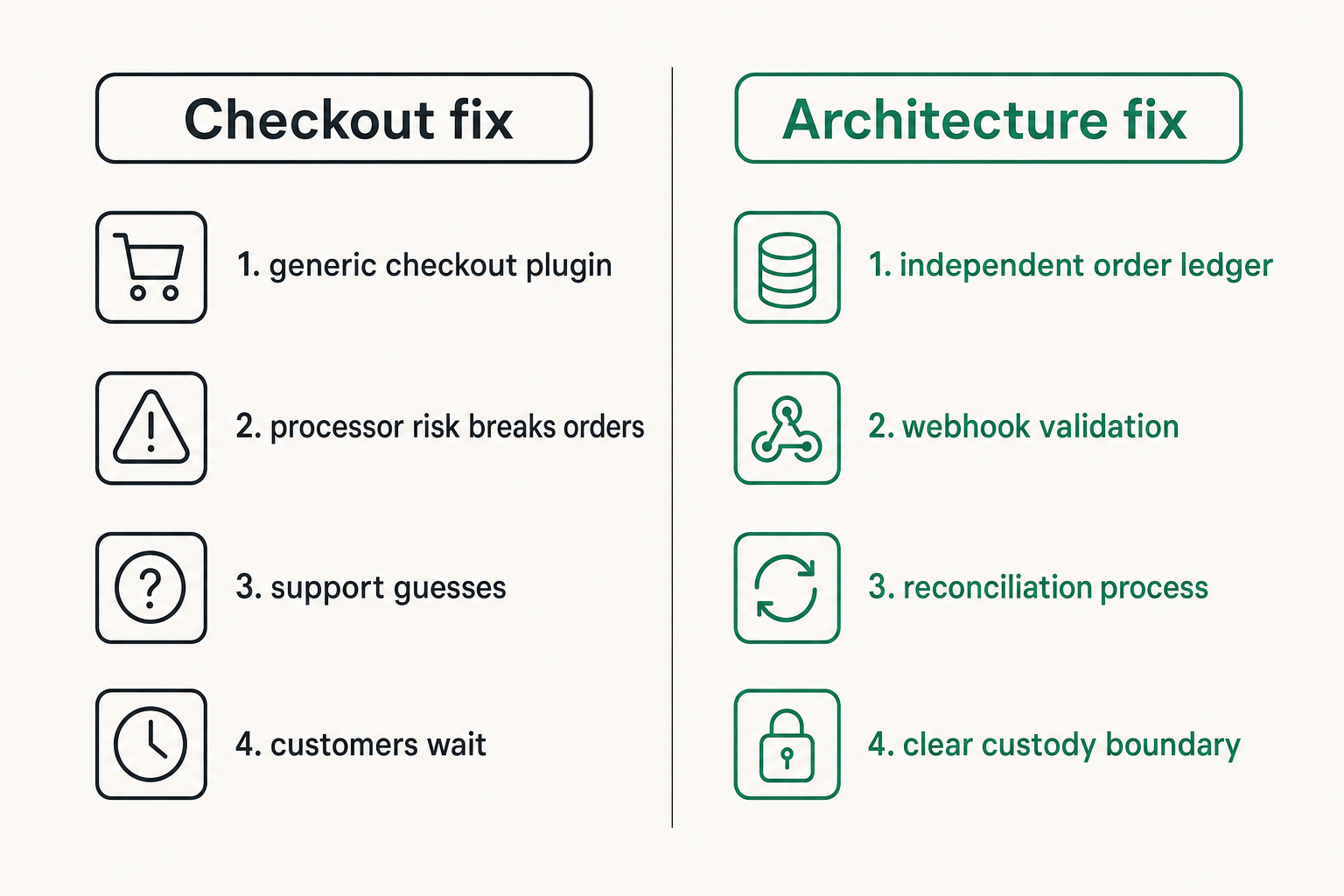
The mistake teams make is treating the keyword as the business model. They build a storefront, add product pages, attach a generic checkout plugin, and assume payment acceptance is solved. It works until it does not. A processor review, reserve requirement, frozen payout, policy update, or delayed dispute can break the entire order pipeline.
A useful way to think about it is this: the product category creates operational risk, but the payment architecture determines whether that risk is survivable.
If the merchant has no independent order ledger, no webhook validation, no reconciliation process, and no clear custody boundary, then every payment issue becomes a company-wide incident. Developers investigate manually. Support guesses. Founders negotiate with processors. Customers wait.
The processor risk is operational
Peptide and research chemical merchants often sit in a gray zone for traditional finance. This article is not legal, medical, or compliance advice. It is an infrastructure discussion. But the operational reality is simple: categories that banks consider high-risk need more explicit systems.
Processor dependency is not just a pricing issue. It affects cash flow, order fulfillment, customer trust, and your ability to keep selling while risk reviews happen. If every successful order depends on one card processor staying comfortable, your checkout is a single point of failure.
Related reading from our network: teams building decentralized infrastructure face similar architecture tradeoffs around queues, ownership, and system boundaries in computing lessons for decentralized builders.
The business decision hidden in checkout
Checkout is where business policy becomes software. Do you ship after one confirmation or six? Do you accept underpayments? Do you refund to the original address only? Do you hold funds until tracking is uploaded? Do you display network fees? Do you expire invoices after 15 minutes or 60?
Those are not UI decisions. They are trust, settlement, and support decisions.
Practical rule: if a payment rule can affect fulfillment, cash flow, or customer support, model it explicitly in your system instead of burying it inside a checkout plugin.
For pure peptide labs merchants, the checkout button is the visible part. The real system is everything that happens after the customer clicks pay.
What Breaks When Pure Peptide Labs Merchants Use Generic Checkout
Processor dependency becomes a single point of failure
Generic checkout systems are designed for low-friction categories with predictable processor behavior. They assume the merchant account remains available, the card network rules are stable enough, and chargebacks follow a familiar path.
What breaks in practice is the dependency chain. Storefront order creation depends on processor approval. Fulfillment depends on payout confidence. Support depends on dashboard access. Finance depends on settlement files. If one vendor changes its posture, the merchant loses operational visibility.
For adjacent depth on this exact category, we have covered the broader merchant-side problem in peptide payments crypto infrastructure, including why processor fragility is usually a systems problem before it is a checkout problem.
Refunds and disputes turn into support debt
Crypto payments change the dispute model. That is useful for some merchants, but it also removes familiar card-network workflows. If your team does not design refund handling, address collection, customer messaging, and exception review up front, support becomes the dispute engine.
A typical failure looks like this:
- customer submits an order and receives a crypto invoice
- customer pays from an exchange account
- exchange batches withdrawal and underpays by a small amount
- invoice expires before full amount confirms
- storefront still shows pending
- customer opens a ticket with a transaction hash
- support cannot map the transaction to an order quickly
None of that is exotic. It is normal production behavior. The question is whether your system expects it.
Compliance context gets separated from payment state
Peptide merchants may need stricter product descriptions, buyer acknowledgments, jurisdiction controls, shipping constraints, or manual review workflows. If those controls live only in the storefront and payment state lives only in a gateway dashboard, the merchant loses context at the exact moment it matters.
A comparison table makes the architecture problem clearer:
| Area | Generic checkout habit | Production-grade payment workflow |
|---|---|---|
| Order state | Stored mainly in storefront | Stored in an internal ledger with payment events |
| Payment proof | Screenshot or dashboard lookup | Transaction hash, invoice ID, confirmations, webhook log |
| Refunds | Manual support decision | Policy-driven workflow with address validation |
| Risk review | Processor owns the context | Merchant keeps product, customer, and payment context together |
| Reconciliation | CSV export after the fact | Daily matching of orders, invoices, wallet events, and settlements |
Practical rule: do not let a third-party dashboard become your system of record. Dashboards are for visibility. Your order ledger is for truth.
Architecture Goals for a Peptide Payment Stack
Separate storefront, payment state, and settlement
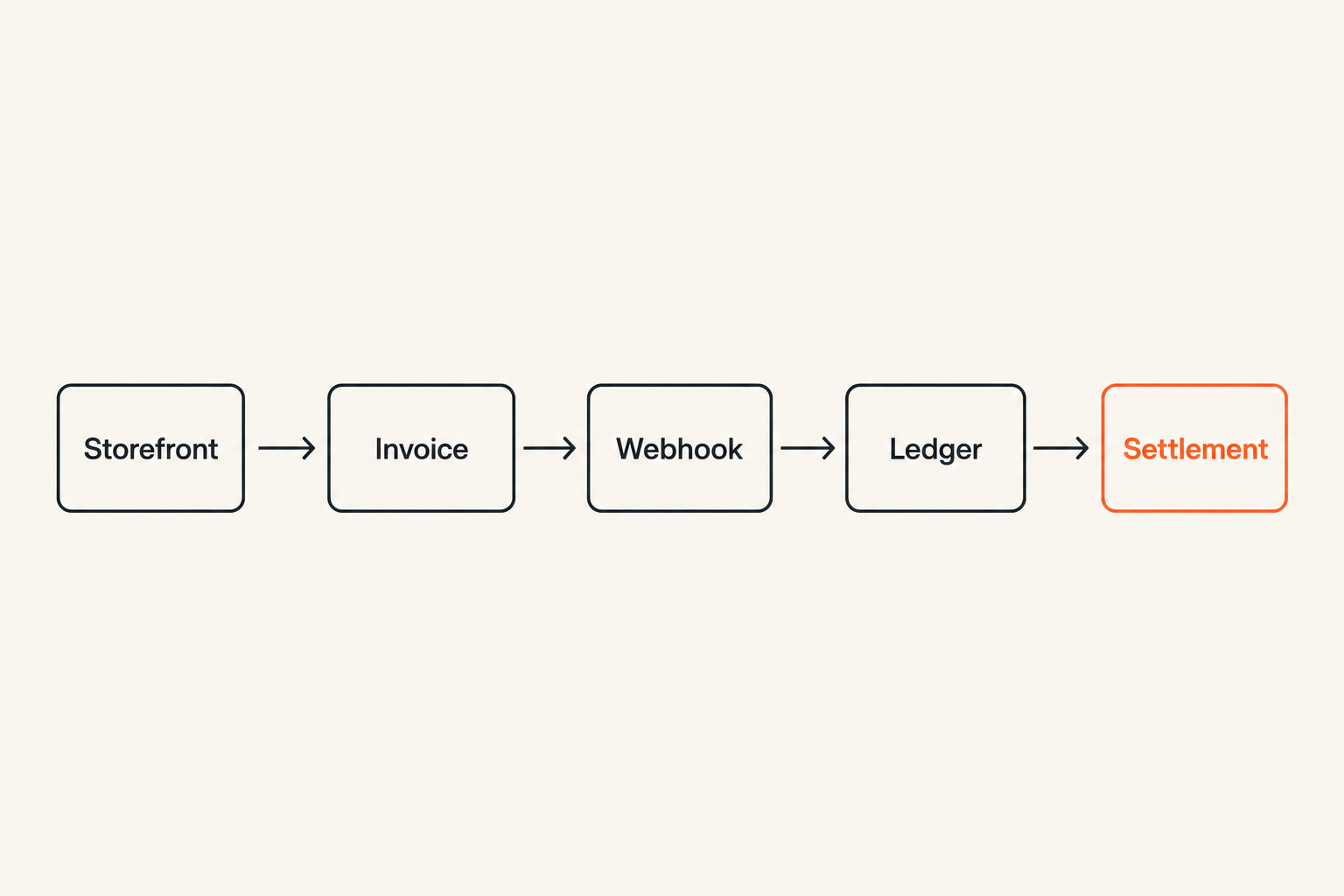
The first goal is separation. Your storefront should create orders. Your payment system should manage invoices and network events. Your settlement process should move funds according to custody and treasury rules. Those systems can integrate tightly, but they should not be the same thing.
When everything is coupled, small failures become large failures. A webhook delay blocks fulfillment. A pricing mismatch creates manual edits. A wallet issue breaks customer checkout. A storefront plugin update changes payment behavior without finance knowing.
A cleaner architecture has these components:
- storefront order service
- payment invoice service
- webhook receiver
- internal payment ledger
- wallet or non-custodial settlement destination
- reconciliation job
- support view with order and payment history
This is not overengineering. It is the minimum structure that lets a high-risk merchant reason about payment state.
Design for idempotency and retries
Payment systems repeat themselves. Customers refresh pages. Browsers retry requests. Webhooks arrive twice. Blockchain confirmations update over time. Networks delay. APIs timeout even when the operation succeeded.
The practical question is whether the system can receive the same event twice without creating two shipments, two refunds, or two accounting entries.
Idempotency is how you make retries safe. Every order creation request should carry a stable key. Every webhook event should have a unique event ID. Every transition should check current state before mutating the order.
Example checkout request shape:
merchant_order_id: order_78214
idempotency_key: checkout_order_78214_v1
amount: 248.00
currency: USD
accepted_assets:
  - USDC
  - BTC
expires_in_minutes: 30
metadata:
  customer_id: cust_913
  fulfillment_hold: manual_review
Make reconciliation observable
Reconciliation is where many crypto payment projects become messy. The customer paid. The order says pending. The wallet shows funds. The support ticket has a hash. Finance has a settlement total. Which system is right?
The answer should not require a founder to inspect a block explorer at midnight. Build an observable reconciliation layer:
- invoice ID maps to merchant order ID
- transaction hash maps to invoice ID
- wallet event maps to settlement batch
- settlement batch maps to accounting entry
- support view shows all of the above
Related reading from our network: streaming companies hit a similar issue where the play button hides ingest, delivery, entitlement, and reconciliation complexity; the same principle applies in streaming SaaS architecture.
Crypto Payment Flow for Peptide Labs
Quote the order and lock the payment window
A crypto checkout should begin by quoting the order. The merchant knows the fiat price. The payment system converts that into accepted assets and networks for a defined window.
The quote should include:
- invoice ID
- fiat amount
- crypto amount
- asset and network
- destination address or payment request
- expiration time
- confirmation policy
- underpayment and overpayment rules
Pure peptide labs merchants should avoid open-ended payment windows. Volatility, delayed exchange withdrawals, and support ambiguity all get worse when invoices remain valid forever.
Practical rule: every crypto invoice needs an expiration time, a confirmation policy, and a deterministic rule for underpayment. Without those three, support becomes the payment processor.
Confirm funds without trusting the browser
Do not mark an order paid because the browser returned to a success page. The browser is not a settlement system. It is a user interface running on a customer-controlled device.
A proper flow waits for server-side payment confirmation. That can come from a gateway webhook, your own node infrastructure, or an indexer you operate. The key is that order mutation happens on the server after verification.
The checkout page can show progress states:
- awaiting payment
- transaction detected
- awaiting confirmations
- paid
- expired
- exception review
But the storefront should not ship based on the page state alone.
Settle according to custody boundaries
Custody is where crypto payment architecture becomes a business decision. Some merchants want non-custodial flows where funds move directly to merchant-controlled wallets. Others use service providers for routing, conversion, or operational convenience.
Do not blur this boundary. If funds pass through a third party, document the role. If funds go directly to merchant wallets, document who controls keys, how treasury moves are approved, and how refunds are funded.
The custody boundary affects security, accounting, refund timing, and customer communication. It also affects who can solve a support issue when a transaction lands but the order remains pending.
Stablecoins, Bitcoin, and Network Selection
Stablecoins reduce pricing friction
Stablecoins are often the easiest fit for peptide merchants because the store prices in fiat and customers understand the amount. USDC or USDT payments can reduce volatility during the invoice window, especially when orders have meaningful average value.
The tradeoff is network choice. A stablecoin on one chain is not the same operational product as the same ticker on another chain. Fees, confirmation time, wallet support, exchange withdrawal behavior, and customer familiarity all matter.
A merchant accepting stablecoins should decide:
- which networks are supported
- whether wrong-network payments are recoverable
- who pays network fees
- how long invoices remain valid
- whether partial payments are accepted
Bitcoin works when confirmation policy is explicit
Bitcoin remains useful for merchants that want broad crypto acceptance and a mature settlement asset. But the policy needs to be explicit. Do you treat zero-confirmation payments as detected but not paid? How many confirmations are required before fulfillment? Do larger orders require more confirmations?
A simple policy is usually better than a clever one:
| Order value | Status after broadcast | Fulfillment trigger |
|---|---|---|
| Low | detected | 1 confirmation |
| Medium | detected | 2 confirmations |
| High | manual review | 3 or more confirmations |
This is illustrative, not universal. The right thresholds depend on your products, fraud tolerance, shipping speed, and customer expectations.
Network choice is a support decision
Developers often evaluate networks by fees and confirmation time. Merchants should also evaluate them by support burden.
A network that looks cheap can be expensive if customers constantly choose the wrong chain, cannot withdraw from their exchange, or send from wallets that hide transaction details. A network that is technically elegant can still be a poor checkout choice if the customer base does not understand it.
Related reading from our network: freelancers and small operators face a similar channel problem, where the cheapest platform is not always the lowest operational cost; see freelance websites and channel stack tradeoffs.
Webhooks, Idempotency, and Order State
Use a small state machine
Do not model payment state as a boolean paid field. That field will lie to you.
Use a small state machine instead:
created
awaiting_payment
payment_detected
confirming
paid
expired
underpaid
overpaid
refunded
manual_review
Each state should have allowed transitions. For example, expired can move to manual_review if a late payment arrives. confirming can move to paid after the required confirmations. underpaid can move to paid only if the customer sends the remaining amount or an operator approves the exception.
Verify webhooks before mutating orders
Webhook handlers should be boring and strict. Verify the signature. Check the timestamp. Confirm the event ID has not already been processed. Load the invoice. Validate the amount, asset, network, and order ID. Then transition state.
A minimal handler pattern:
receive webhook
verify signature
reject stale timestamp
check event_id uniqueness
load invoice by invoice_id
compare amount and asset
apply valid state transition
write immutable event log
return 200 only after durable write
If you return 200 before saving the event, you can lose payment updates. If you mutate state before verification, you can mark fake payments as real.
For implementation details and API behavior, developers should keep the payment integration close to the platform documentation; the CoinPay developer docs are the right place to start when wiring checkout, callbacks, and merchant-side flows.
Handle duplicates as normal traffic
Duplicates are not edge cases. They are normal traffic in distributed systems. A webhook provider retries because your server timed out. A customer opens two checkout tabs. A queue redelivers a message. A chain indexer emits an update after each confirmation.
Design for that from day one. The event log should be append-only. State transitions should be idempotent. Fulfillment should check whether shipment has already been released. Refunds should require unique refund IDs and operator approval.
Practical rule: if receiving the same event twice can create financial or fulfillment damage, the system is not production-ready.
Merchant Operations: Reconciliation, Support, and Refunds
Reconcile orders against wallet events
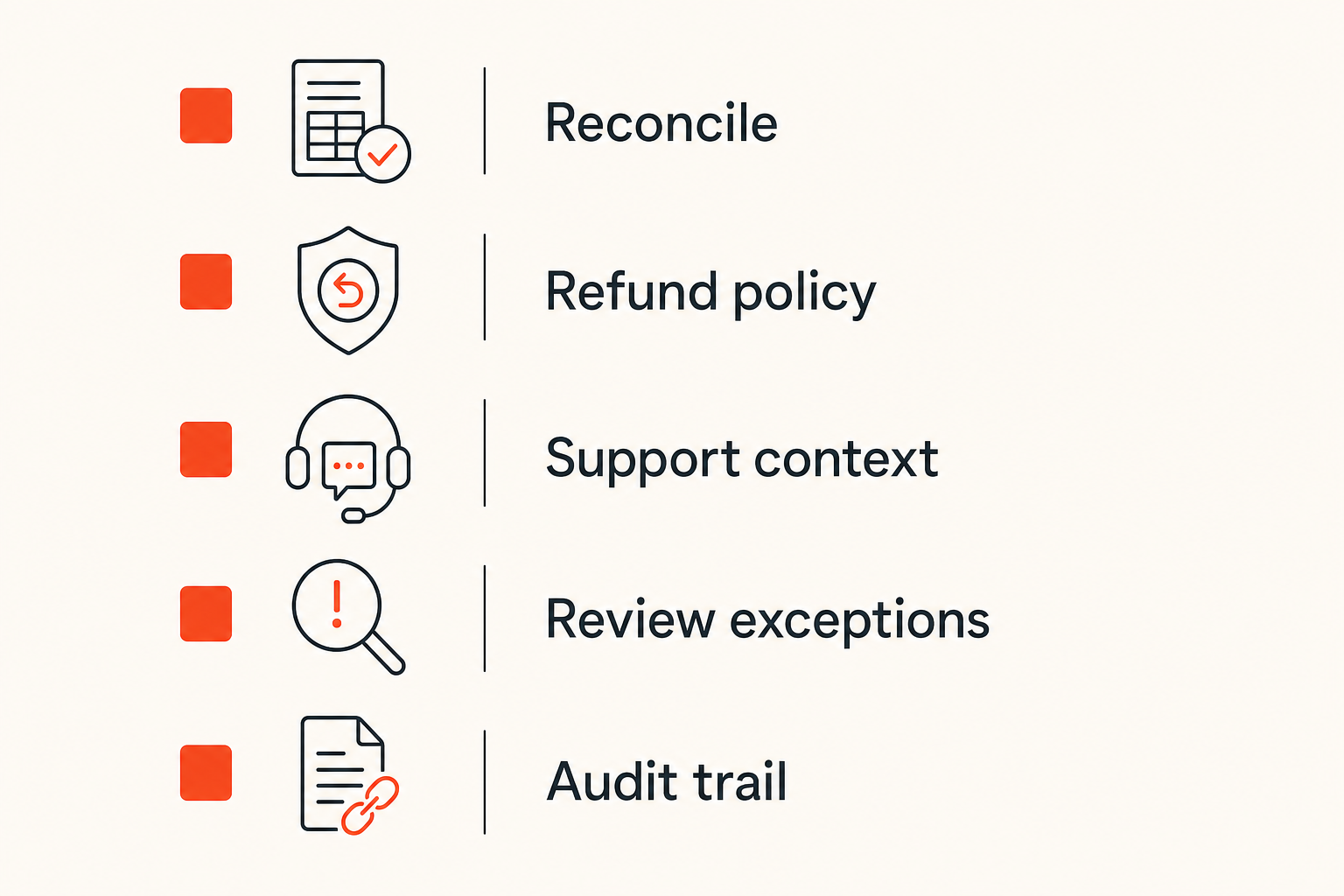
Reconciliation is not a finance chore you do later. It is how you know whether the payment system is telling the truth.
A daily reconciliation job should compare:
- storefront orders created
- invoices issued
- payments detected
- confirmations completed
- expired invoices with late payments
- wallet deposits
- settlement transfers
- refunds issued
The job should produce exceptions, not just totals. Operators need to know which orders need review. A difference of 500 dollars is less useful than a list of five invoice IDs with mismatched states.
Build a refund policy before the first dispute
Crypto refunds require discipline because sending funds back is usually a new transaction. That means address collection, network selection, approval, and audit trail all matter.
Define the policy before launch:
- refund to original address when possible
- require customer confirmation for exchange-originated payments
- avoid refunding to a different asset unless approved
- record refund transaction hash
- attach refund to original invoice and order
- require manual approval above a threshold
Refunds are not only customer service. They are treasury operations.
Give support teams operational context
Support should not need wallet access or engineering help for every payment question. They need a safe operational view:
- order ID
- invoice ID
- quoted amount
- received amount
- asset and network
- transaction hash
- confirmation count
- current state
- expiration time
- exception reason
- refund status
This view reduces noise for engineers and shortens customer resolution time. It also prevents support from making promises the system cannot enforce.
What Works and What Fails
What works in production
What works is usually not glamorous. It is explicit state, boring logs, predictable retries, and clear ownership.
For pure peptide labs merchants, a durable crypto payment stack usually has these traits:
- checkout creates an invoice, not just a QR code
- order state changes only after verified server-side events
- payment events are logged immutably
- fulfillment reads payment state from the ledger
- finance reconciles wallet activity against orders
- support sees transaction context without touching keys
- refund workflows require approval and audit trails
- network and asset choices are documented for customers
The team also needs operational runbooks. What happens when a customer pays after expiration? What happens when they underpay by 2 dollars? What happens when they send USDT on the wrong network? If the answer is ask the founder, the system is not mature.
What fails under load
The failure modes are predictable:
- treating checkout success as payment success
- using one wallet address for every order without strong matching logic
- accepting assets the support team does not understand
- skipping webhook signature verification
- fulfilling on unconfirmed transactions without policy
- storing payment truth only in a plugin table
- manually reconciling from screenshots
- making refunds without linking them to original invoices
The mistake teams make is assuming low volume means simple architecture is safe. Low volume often means fewer automated checks, more manual exceptions, and more dependence on the person who remembers how everything works.
The practical implementation sequence
A practical build sequence looks like this:
- Define accepted assets, networks, invoice expiration, and confirmation rules.
- Add a payment invoice object that maps one-to-one with a merchant order.
- Implement idempotent checkout creation with a stable merchant order ID.
- Build a webhook receiver with signature verification and event deduplication.
- Store an append-only payment event log.
- Use a state machine to transition orders from awaiting_payment to paid or exception states.
- Connect fulfillment release to paid state, not browser redirects.
- Create a reconciliation job that compares invoices, wallet events, and settlement records.
- Build a support view for payment status and exception reasons.
- Test late payments, underpayments, duplicate webhooks, wrong-network payments, and refund flows before launch.
This sequence keeps the system small while still respecting the hard parts.
Risk, Trust, and Escrow for Pure Peptide Labs
Do not confuse non-custodial with unmanaged
Non-custodial payments are attractive because the merchant can avoid unnecessary custody intermediaries. But non-custodial does not mean unmanaged.
Someone still owns the wallet policy. Someone controls keys. Someone approves treasury movements. Someone defines refund funding. Someone monitors failed webhooks and settlement exceptions.
A non-custodial crypto payment gateway can reduce dependency on processor payouts, but it does not remove the need for operational controls. It moves responsibility closer to the merchant.
Escrow is useful when delivery risk is asymmetric
Some peptide transactions involve higher trust requirements: larger orders, wholesale buyers, first-time counterparties, or fulfillment milestones. In those cases, escrow can be useful because it separates payment commitment from immediate release.
Escrow should not be used as a vague trust badge. It should map to a concrete workflow: buyer funds, merchant fulfills, delivery condition is met, funds release, exceptions go to review. If your transaction model needs staged trust, explore whether crypto escrow fits the order flow instead of forcing every payment into immediate settlement.
Reputation data reduces repeated due diligence
High-risk commerce has repeated trust checks. Is this buyer legitimate? Has this merchant fulfilled previous orders? Are there unresolved disputes? Does this address appear in previous exceptions?
Reputation is not a replacement for compliance, but it can reduce repeated manual review. It can also help merchants avoid treating every order as a brand-new relationship. For recurring customers and B2B buyers, a reputation layer can inform review thresholds, fulfillment holds, and support escalation.
Where CoinPayPortal Fits in the Stack
Product fit for developers and merchants
CoinPayPortal is built for developers and merchants building crypto payment infrastructure. The fit is not that a gateway magically solves every high-risk commerce problem. The fit is that payment infrastructure should expose the right primitives: invoices, callbacks, non-custodial flows, operational visibility, and merchant-controlled settlement decisions.
For pure peptide labs merchants, that means the payment layer can be designed around checkout state, webhook verification, reconciliation, and support workflows instead of processor optimism.
A good integration should let developers keep business logic in their own system while using payment infrastructure for the pieces that should not be improvised: invoice generation, payment detection, callback delivery, and settlement routing.
A lightweight migration path
You do not need to rebuild the entire storefront to start. A sensible migration path is:
- keep the existing product catalog and order creation flow
- add crypto as a payment method for selected customers or regions
- route checkout through invoice creation
- listen for verified payment callbacks
- release fulfillment only after paid state
- reconcile daily before expanding volume
- document support policies for late, partial, and wrong-network payments
If the crypto workflow performs well, expand asset support or customer segments. If it creates too many exceptions, fix the operational policy before adding more networks.
Closing checklist for pure peptide labs
Before a pure peptide labs merchant treats crypto checkout as production-ready, the team should be able to answer these questions:
- What is the source of truth for payment state?
- Which assets and networks are accepted, and why?
- What happens when payment arrives late?
- What happens when payment is underpaid or overpaid?
- How are duplicate webhooks handled?
- Who controls settlement wallets?
- How are refunds approved and recorded?
- Can support map a transaction hash to an order without engineering help?
- Does finance reconcile wallet activity against invoices?
- Is fulfillment gated by verified server-side payment state?
Pure peptide labs is not primarily a checkout design problem. It is a payment operations problem. Once you model it that way, crypto becomes less about hype and more about control: explicit state, clear custody, safer settlement, and fewer surprises when traditional rails get unstable.
Try coinpayportal.com
You are writing for developers and merchants building crypto payment infrastructure. Try coinpayportal.com.
Try CoinPay
Crypto payments, escrow, and wallets — multi-chain, Lightning-ready, and fast to integrate.
Get started →