PT-141 Peptide Payments: Architecture, Checkout State, and Crypto Rails for High-Risk Merchants

Selling a PT-141 peptide product online creates a payment problem before it creates a growth problem. The merchant may have traffic, a catalog, a warehouse process, and customers ready to pay. Then the processor freezes payouts, rejects the merchant category, or asks for documentation the team never collected.
Teams think the problem is finding a payment button that accepts the order. The real problem is building a payment workflow that can survive high-risk review, irreversible settlement, customer support, and compliance evidence.
That changes the conversation. The practical question is not “which gateway supports PT-141 peptide?” It is “what payment architecture lets a peptide merchant keep orders, settlement, refunds, and risk controls consistent when the business sits in a category many providers treat cautiously?”
This article is written for developers, merchants, fintech founders, and blockchain engineers who need to build that system without pretending the UI is the hard part.
Table of contents
- Why PT-141 peptide payments are an architecture problem
- The risk model for PT-141 peptide merchants
- Design the checkout around state, not screens
- Build a compliance layer before the payment layer
- Crypto payment rails for peptide commerce
- Webhooks and reconciliation for PT-141 peptide orders
- Escrow, refunds, and dispute handling
- What breaks in production
- Implementation blueprint
- Product fit for coinpayportal.com
Why PT-141 peptide payments are an architecture problem
Most teams approach PT-141 peptide payments from the wrong layer. They start with processor acceptance, checkout UX, card decline rates, or whether crypto can bypass a legacy processor. Those matter, but they are downstream symptoms.
The mistake teams make is treating payment acceptance as a vendor procurement problem. In high-risk categories, it is a workflow design problem.
Not a checkout button problem
A checkout button only captures intent. It does not answer the operational questions that matter after the customer clicks:
- Was the product eligible for sale to that destination?
- Was the customer shown the correct terms before payment?
- Did the order receive the exact amount expected?
- What happens if the crypto transaction arrives late, underpaid, or overpaid?
- Who owns refunds when the asset price moved?
- What evidence exists if a provider, bank, or support team asks why the order was fulfilled?
For peptide merchants, these questions are not edge cases. They are the normal operating environment.
If you already understand the peptide merchant risk profile and need a broader category overview, our earlier guide on peptide payments and crypto infrastructure covers the processor and merchant-side context. This article goes deeper into the PT-141 peptide workflow itself.
Practical rule: Do not integrate payments until you can describe the order lifecycle without naming a payment provider.
Why payment processors treat peptide merchants differently
PT-141 peptide is commonly discussed in wellness, research, and performance-adjacent markets. That creates ambiguity. Ambiguity is what risk teams dislike.
Processors do not only evaluate the payment rail. They evaluate the merchant’s claims, fulfillment model, refund exposure, customer complaints, regulatory surface area, and documentation quality. A clean API integration does not offset a sloppy catalog or unclear terms.
For crypto payment systems, the risk changes shape rather than disappearing. You may reduce card chargeback exposure, but you inherit settlement finality, wallet support, network fees, irreversible sends, and reconciliation burden.
A useful way to think about it is this: card payments externalize parts of risk to the processor and card network. Crypto payments push more state ownership back to the merchant.
The risk model for PT-141 peptide merchants
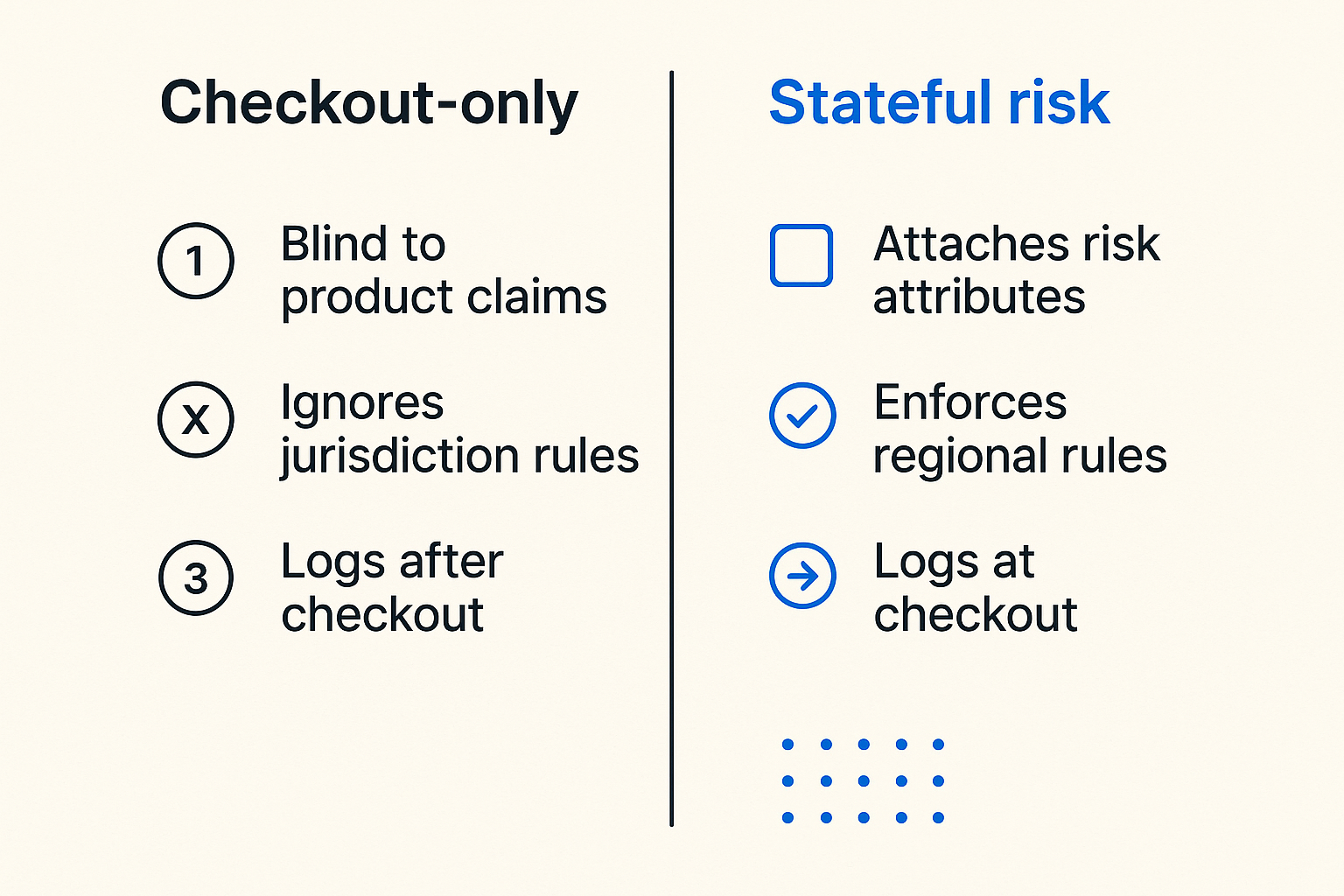
A PT-141 peptide merchant needs a risk model that is visible in software. Not a PDF saved by legal. Not a Slack thread. Not an owner saying “we reviewed this.” The payment system should enforce the commercial rules the business claims to follow.
Product claims drive payment risk
Payment risk is often triggered by what the merchant says, not only what the merchant sells. Product pages, email flows, ads, support scripts, and post-purchase instructions can all affect how a provider interprets the business.
Common risk triggers include:
- Medical or therapeutic claims that exceed the merchant’s intended classification
- Inconsistent language between product pages and checkout terms
- Missing research-use or jurisdiction-specific disclosures where applicable
- Aggressive refund promises that operations cannot honor
- Affiliate pages making claims the merchant site does not control
This is not medical or legal advice. It is a payment architecture point: your checkout should not be blind to catalog metadata.
A simple control is to attach risk attributes to each SKU:
| Attribute | Example value | Payment use |
|---|---|---|
| Product category | peptide | Route to approved payment methods |
| Jurisdiction rule | restrict certain regions | Block or review order before invoice |
| Claim review status | approved copy v12 | Store evidence at checkout time |
| Refund policy | unopened only | Show terms and drive support workflow |
| Fulfillment condition | temperature-sensitive | Add support and delivery checks |
When the checkout reads these attributes, payment becomes part of governance instead of a disconnected transaction.
Related reading from our network: teams building privacy-sensitive systems face similar state and trust tradeoffs in end-to-end encrypted messaging workflow design, where the hard part is not the screen but identity, devices, metadata, and recovery.
Jurisdiction and documentation matter
The practical question is not whether every PT-141 peptide merchant has the same risk. They do not. The question is whether your system can prove which rules applied to a specific order at a specific time.
At minimum, store snapshots of:
- Product title and description shown at checkout
- Customer country, region, and shipping destination
- Terms accepted and version number
- Payment method presented
- Invoice amount, currency, and expiration time
- Fulfillment status and tracking reference
- Support actions, refund decisions, and dispute notes
Many teams keep this information scattered across Shopify, a payment dashboard, a warehouse tool, and a support inbox. What breaks in practice is the investigation path. Nobody can reconstruct the order without manual digging.
Practical rule: If support cannot reconstruct an order from one internal order ID, your payment architecture is not production-ready.
Design the checkout around state, not screens
A good PT-141 peptide checkout is a state machine with a user interface attached. The UI matters, but the state model is what keeps money and orders from drifting apart.
Payment states your system must own
For crypto payments, your system needs states that reflect blockchain reality and merchant operations. A typical flow looks like this:
order_createdrisk_checkedinvoice_createdpayment_detectedpayment_confirmingpayment_confirmedunderpaid,overpaid, orexpiredfulfillment_releasedrefund_requestedrefund_completedorrefund_rejected
Do not collapse these into “paid” and “unpaid.” That is how teams ship orders after a mempool sighting, miss underpayments, or refund the wrong amount.
State should be append-only where possible. Every transition should have a timestamp, actor, source, and reason. Webhook events, admin actions, blockchain confirmations, and support overrides should all become events in the order ledger.
Idempotency and retries are not optional
Crypto payment systems receive repeated signals. Webhooks retry. Users refresh checkout pages. Block explorers lag. Nodes disagree temporarily. Admins click twice.
Idempotency is the guardrail that prevents these normal events from becoming accounting errors.
For example, invoice creation should accept an idempotency key based on your internal order ID:
POST /api/payment-invoices
Idempotency-Key: order_94821_pt141
Content-Type: application/json

{
  "order_id": "order_94821",
  "amount": "129.00",
  "currency": "USD",
  "asset": "USDC",
  "network": "polygon",
  "expires_at": "2026-07-06T15:30:00Z"
}
Webhook handlers should also be idempotent:
async function handlePaymentWebhook(event) {
  const exists = await db.webhookEvents.findUnique({
    where: { providerEventId: event.id }
  });

  if (exists) return { ok: true, duplicate: true };

  await db.transaction(async (tx) => {
    await tx.webhookEvents.create({ data: normalize(event) });
    await applyPaymentTransition(tx, event.invoiceId, event);
  });

  return { ok: true };
}
The point is not the code style. The point is that duplicate events should be boring.
Example state model
A minimal database model might separate orders, invoices, payments, and events:
| Table | Purpose | Key fields |
|---|---|---|
orders | Merchant order intent | order_id, customer_id, risk_status, fulfillment_status |
payment_invoices | Amount requested | invoice_id, order_id, asset, network, expires_at |
payment_attempts | On-chain payment evidence | tx_hash, invoice_id, amount_received, confirmations |
order_events | Audit trail | event_id, order_id, source, type, payload |
refunds | Refund lifecycle | refund_id, order_id, asset, amount, status |
This structure prevents the most common mistake: using the blockchain transaction as the order record. A transaction is evidence. It is not the whole business event.
Build a compliance layer before the payment layer
Payment architecture for PT-141 peptide merchants should include compliance controls before invoice creation. If an order is not eligible, you should not create a payable invoice and then clean up later.
Catalog controls
Catalog controls are operational rules expressed as data. They help developers avoid hardcoding policy decisions across templates, plugins, and support tools.
Useful SKU-level fields include:
allowed_countriesblocked_regionsrequires_age_gaterequires_terms_versionclaim_review_statusrequires_manual_revieweligible_payment_methods
At checkout, the system evaluates the cart against the customer context. If a product is blocked for the destination, the checkout stops before payment. If the product requires a specific disclosure, the terms acceptance is logged before invoice creation.
Practical rule: Never let payment success become the first time your system evaluates whether the order should exist.
Evidence capture and audit trails
Evidence capture sounds bureaucratic until the first payout review, customer dispute, or support escalation. Then it becomes the only thing that matters.
Capture the versioned state of the order:
- Product copy snapshot
- Terms snapshot
- Pricing snapshot
- Risk decision result
- Customer acknowledgement
- Payment invoice
- Blockchain transaction details
- Fulfillment release decision
The mistake teams make is relying on live product pages as evidence. Product pages change. Terms change. Checkout copy changes. If you need to explain what the customer saw in March, the July page is not evidence.
Related reading from our network: decentralized compute builders also deal with validation, routing, and proof of work across independent systems; the architecture tradeoffs are discussed in this practical guide to decentralized compute workflows.
Crypto payment rails for peptide commerce
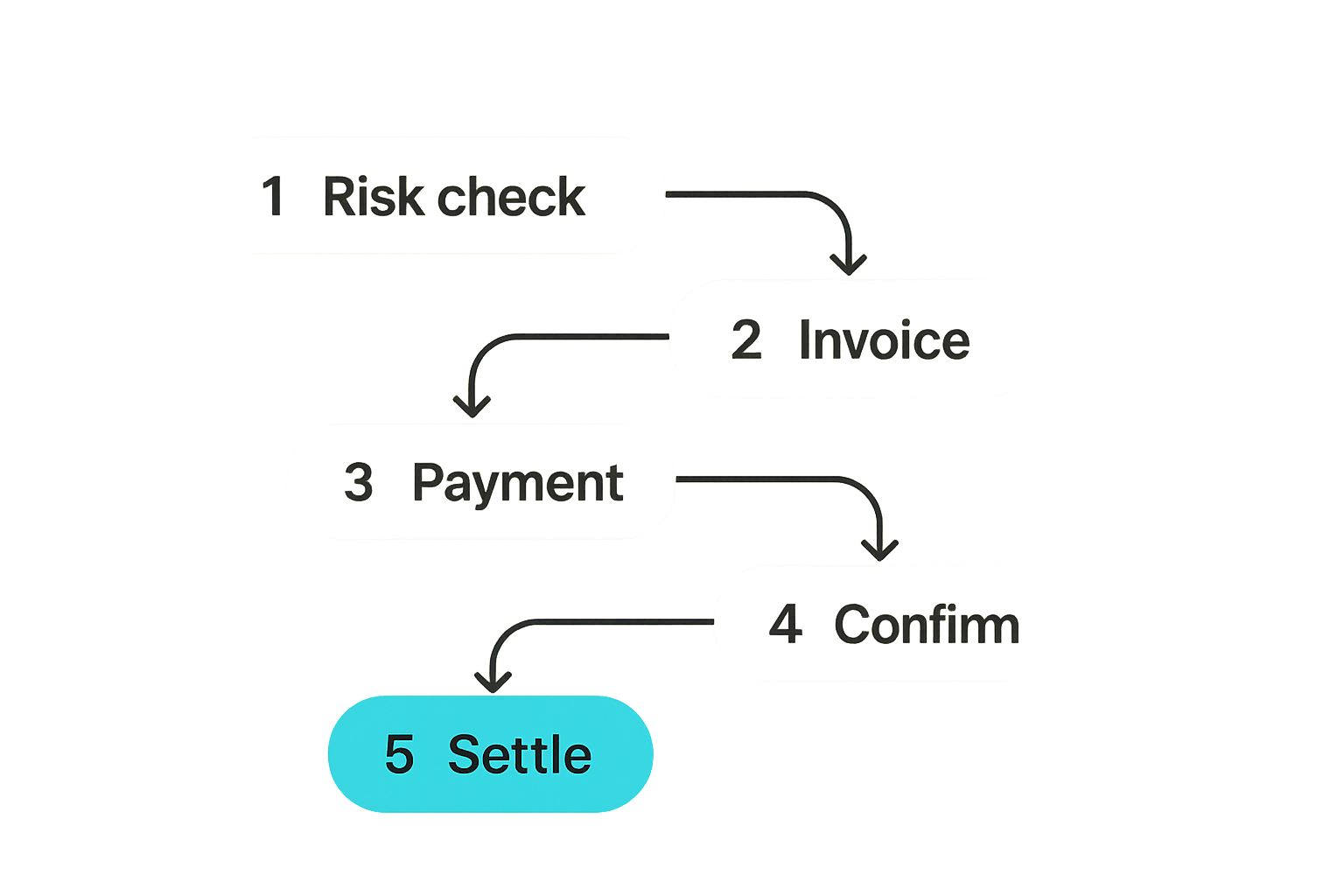
Crypto payments can fit peptide commerce because they give merchants more control over settlement. But control is not the same as simplicity. You still need routing, confirmations, treasury policy, refunds, and support tooling.
Wallet settlement versus hosted gateway
There are two broad models.
| Approach | What you control | What gets harder | Best fit |
|---|---|---|---|
| Direct wallet settlement | Addresses, custody, treasury | Monitoring, invoicing, reconciliation, support | Technical teams with strong ops |
| Hosted crypto gateway | Checkout, invoice tracking, webhook events | Vendor dependency, integration limits | Merchants wanting faster production path |
| Hybrid model | Own treasury, outsource checkout logic | Boundary design | Teams scaling from manual to automated |
Direct wallet settlement looks attractive because it avoids gateway fees and gives full control. But it pushes more work into your engineering team. You need address generation, chain monitoring, exchange-rate locking, webhook-equivalent signals, and refund operations.
A hosted gateway can remove a lot of plumbing. The important thing is to understand the boundary. Your commerce system still owns order state, compliance decisions, customer communication, and fulfillment release.
Stablecoins, Bitcoin, and network selection
For PT-141 peptide merchants, asset selection is an operations decision.
Stablecoins reduce pricing volatility and simplify customer support because the invoice amount maps more cleanly to fiat accounting. Bitcoin has broad recognition but introduces confirmation time and volatility considerations. Faster, lower-fee networks can improve checkout completion, but they require clearer customer instructions.
The practical question is: which assets can your team support when something goes wrong?
Before enabling a network, answer:
- Can support identify the transaction from customer-provided data?
- Can finance reconcile the received asset to the order amount?
- Can treasury safely hold, convert, or refund the asset?
- Can your checkout explain network selection without creating mis-sends?
- Can your webhook or chain monitoring detect partial payments?
If the answer is no, do not enable the asset just because customers ask for it.
Custody boundaries
Custody is where fintech founders and merchants need to be precise. Who controls funds at each point? Who can move them? What happens if an admin account is compromised? What happens if the provider is unavailable?
Non-custodial or merchant-controlled settlement can reduce dependency on a processor holding balances. But it also means key management, access control, and operational security matter.
A practical custody policy defines:
- Hot wallet limits
- Multisig requirements
- Conversion rules
- Refund authorization levels
- Admin roles
- Withdrawal review process
- Incident response steps
This is not optional backend work. It is the payment system.
Webhooks and reconciliation for PT-141 peptide orders
A PT-141 peptide order should not move to fulfillment because a browser returned to a success page. It should move because your backend received, verified, and reconciled payment evidence.
Treat webhooks as signals
Webhooks are not commands. They are signals from another system. Your backend should authenticate them, store them, deduplicate them, and decide what state transition is allowed.
A safe webhook handler does four things:
- Verifies signature and timestamp.
- Stores the raw event before mutation.
- Applies an idempotent transition.
- Emits internal events for fulfillment, email, and support systems.
If a webhook says payment_confirmed, your system should check whether the invoice exists, whether the amount matches, whether the asset and network match, and whether the order is still eligible for fulfillment.
Match on invoices, not memos
Do not rely on customer notes, transaction memos, email screenshots, or support messages as the primary matching mechanism. Use invoice IDs, unique addresses, payment intents, or provider references.
Crypto support queues get messy quickly:
- Customer sends from an exchange and cannot identify the sending wallet.
- Customer uses the wrong network.
- Customer underpays after fees.
- Customer pays after the invoice expired.
- Customer sends two transactions instead of one.
Your system should expect these cases. They are not rare enough to handle manually forever.
Reconciliation workflow
Reconciliation is the bridge between payment truth and business truth. It should run on a schedule and after material events.
A practical reconciliation job checks:
- Invoices created but not paid
- Payments detected but not confirmed
- Confirmed payments without fulfilled orders
- Fulfilled orders without confirmed payments
- Overpayments requiring support action
- Underpayments awaiting customer completion
- Refunds approved but not sent
- Wallet receipts not linked to invoices
For crypto payment teams, the best reconciliation process is boring, repeatable, and visible to operations. It should generate exceptions, not require humans to inspect every order.
Escrow, refunds, and dispute handling
Peptide commerce often has more support nuance than a simple digital download. Shipping windows, temperature sensitivity, customer misunderstanding, delivery exceptions, and policy restrictions all affect dispute handling.
Where escrow helps
Escrow is useful when the merchant wants to separate payment receipt from release conditions. It can create a controlled workflow for marketplace-like transactions, high-value orders, or cases where buyer and seller need more trust before final settlement.
For merchants evaluating this pattern, CoinPay’s crypto escrow workflow is relevant when the business needs conditional release rather than immediate merchant settlement.
Escrow does not remove the need for policy. It makes policy executable. You still need to define:
- Release conditions
- Cancellation windows
- Evidence required for disputes
- Admin override rules
- Timeout behavior
- Refund destination handling
The mistake teams make is presenting escrow as a trust shortcut. It is not. It is a state machine with money attached.
Refunds are a treasury workflow
Refunds in crypto are not the same as card refunds. You may not be able to push funds back through the same rail automatically. Asset prices may move. Network fees may apply. The customer may request a different refund address. Fraud risk may increase if support accepts address changes casually.
A refund workflow should require:
- Order eligibility check
- Refund amount calculation
- Asset and network selection
- Refund address confirmation
- Sanctions or risk screening where required by policy
- Approval threshold based on amount
- Transaction hash capture
- Customer notification
Related reading from our network: local network operators deal with similar intake, routing, follow-up, and accountability problems; the operating model in community-first coordination workflows is adjacent to merchant support design.
What breaks in production
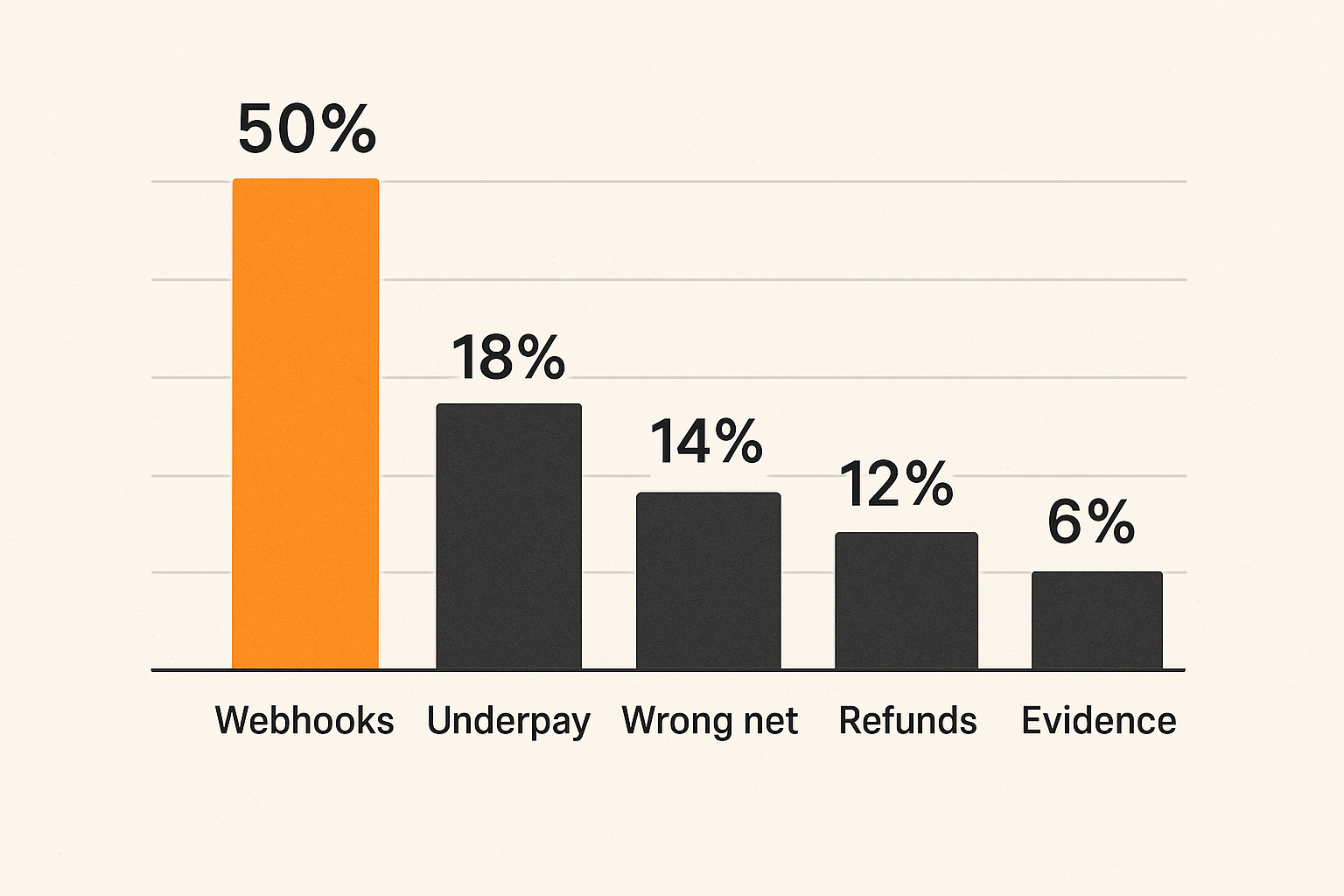
What breaks in practice is rarely the happy path. It is the seam between systems: checkout, wallet, gateway, fulfillment, support, finance, and compliance.
The common failure modes
The most common production failures are predictable:
| Failure mode | What caused it | Operational impact |
|---|---|---|
| Paid order not fulfilled | Webhook missed or not retried | Support tickets and manual shipment release |
| Unpaid order fulfilled | Success page trusted | Revenue loss and inventory leakage |
| Underpayment accepted | Amount comparison too loose | Accounting mismatch |
| Duplicate fulfillment | Webhook processed twice | Inventory and customer support issue |
| Wrong-network payment | Checkout instructions unclear | Manual recovery or loss |
| Refund sent to wrong address | Weak address confirmation | Irreversible support failure |
| Processor review failed | No evidence trail | Frozen payouts or account closure |
These are architecture failures, not bad luck.
What works
What works is boring engineering:
- Explicit order states
- Provider-independent order IDs
- Signed webhooks
- Idempotent handlers
- Versioned terms and product snapshots
- Scheduled reconciliation
- Manual review queues for exceptions
- Clear refund authorization
- Treasury controls
- Support tooling that shows payment and fulfillment state together
The strongest systems do not assume every payment will be clean. They assume exceptions will happen and make them cheap to resolve.
What fails
What fails is treating crypto as a magic replacement for merchant operations.
Crypto does not eliminate customer confusion. It does not remove compliance exposure. It does not automatically solve refunds. It does not make fulfillment evidence irrelevant. It does not make a prohibited claim acceptable.
The teams that get into trouble usually do one of three things:
- They bolt a wallet address onto checkout and call it done.
- They depend entirely on screenshots and manual support review.
- They let payment success override risk, catalog, or fulfillment rules.
Practical rule: Crypto reduces some payment dependencies, but it increases your responsibility for state, support, and settlement accuracy.
Implementation blueprint
The implementation path should be incremental. Do not rewrite the whole commerce stack before you understand the failure points. Start by making state visible, then automate the transitions.
A numbered rollout sequence
- Map the order lifecycle. Write down every state from cart creation through refund closure. Include manual review and exception states.
- Add SKU risk metadata. Attach jurisdiction, disclosure, and payment eligibility rules to PT-141 peptide products.
- Create a payment invoice service. Keep invoice creation separate from the storefront so retries and idempotency are controlled.
- Implement signed webhook ingestion. Store raw events, deduplicate by provider event ID, and apply allowed state transitions only.
- Build reconciliation jobs. Compare invoices, on-chain payments, order status, and fulfillment status.
- Connect support tooling. Give support one order view with payment, shipment, customer, and refund state.
- Define treasury controls. Decide who can move funds, approve refunds, and change settlement addresses.
- Run exception drills. Test underpayment, overpayment, expired invoice payment, duplicate webhook, and wrong-network payment.
- Document provider boundaries. Know which system owns checkout, custody, conversion, notifications, and dispute evidence.
- Review monthly. Update rules when catalog, jurisdictions, assets, or fulfillment processes change.
This sequence keeps the team focused on the real bottleneck: operational correctness.
Data model and API sketch
A practical integration can start with a small set of endpoints:
POST /orders/{order_id}/risk-check
POST /orders/{order_id}/payment-invoice
POST /webhooks/payments/{provider}
POST /orders/{order_id}/refunds
GET  /orders/{order_id}/payment-status
The risk check should run before invoice creation:
{
  "order_id": "order_94821",
  "risk_status": "approved",
  "rules": [
    "terms_v7_accepted",
    "destination_allowed",
    "sku_claim_review_approved"
  ],
  "payment_methods": ["usdc_polygon", "btc"]
}
The invoice response should be specific enough for reconciliation:
{
  "invoice_id": "inv_71f1",
  "order_id": "order_94821",
  "amount_due": "129.00",
  "pricing_currency": "USD",
  "asset_due": "USDC",
  "network": "polygon",
  "address": "0x...",
  "expires_at": "2026-07-06T15:30:00Z",
  "status": "invoice_created"
}
If you are integrating a payment gateway rather than building the whole stack, start with the provider’s API surface and map it back to your internal state machine. CoinPay’s developer documentation is the right place to evaluate checkout, webhook, and integration boundaries before wiring production orders.
Product fit for coinpayportal.com
CoinPay is useful for this topic when the merchant wants crypto payment infrastructure without pretending that payment acceptance is only a front-end widget.
Where CoinPay fits
For PT-141 peptide merchants, the product fit is architectural:
- Create crypto payment flows that map to merchant order IDs
- Reduce the amount of custom checkout plumbing required
- Support merchant-side settlement workflows
- Keep payment events available for backend automation
- Give developers a clearer integration point for invoices and status updates
- Help merchants avoid building every payment primitive from scratch
CoinPay does not remove the merchant’s responsibility for product policy, compliant claims, customer support, or fulfillment controls. No payment gateway can do that honestly. The value is in giving the payment layer a cleaner interface so the rest of the business can operate with less manual glue.
A PT-141 peptide payment stack should still have catalog controls, evidence snapshots, reconciliation, refund procedures, and treasury governance. The gateway is one component in that system, not the whole system.
That changes the conversation from “can I accept crypto?” to “can my commerce operation reliably move an eligible order from checkout to settlement to fulfillment to support closure?”
Try coinpayportal.com
You are writing for developers and merchants building crypto payment infrastructure. If you are designing PT-141 peptide payments with real checkout state, settlement, and merchant operations in mind, Try coinpayportal.com.
Try CoinPay
Crypto payments, escrow, and wallets — multi-chain, Lightning-ready, and fast to integrate.
Get started →