Peptide Merchant Account Architecture: Crypto Payment Infrastructure for High-Risk Merchants in 2026

Peptide merchants do not usually lose payment processing politely. One day checkout works. The next day reserves increase, payouts freeze, or the account is closed after a review nobody can clearly explain.
That is why the phrase peptide merchant account gets searched in panic. The merchant is not looking for a theory. They need orders to keep moving, support tickets to stop piling up, and a payment path that does not collapse every time a bank, processor, sponsor bank, or risk team changes its appetite.
Teams think the problem is finding a more tolerant merchant account provider. The real problem is building a payment workflow that can survive processor churn, high-risk review, chargeback exposure, refund disputes, and settlement delays.
That changes the conversation. A peptide merchant account is not just an application form. It is an architecture decision involving checkout state, customer communication, payment confirmation, reconciliation, custody boundaries, compliance records, and support operations.
Table of contents
- A peptide merchant account is a workflow, not a form
- The peptide merchant account architecture that survives processor churn
- Crypto payments are not a shortcut around operations
- Checkout design for peptide products
- Webhooks, confirmations, and idempotency
- Reconciliation and settlement for peptide merchants
- Refunds, escrow, and dispute handling
- Compliance and risk records without pretending to be a bank
- Implementation workflow for developers
- What breaks when teams implement this badly
- How coinpayportal.com fits a peptide merchant account stack
A peptide merchant account is a workflow, not a form

The mistake teams make is treating a peptide merchant account as a single vendor relationship. They compare approval odds, fees, rolling reserves, and payout timing. Those things matter, but they are not the operating system of the business.
The operating system is what happens when a customer places an order, payment is attempted, funds are confirmed, inventory is released, shipping is triggered, and support can explain the status without guessing.
Why peptide merchants get treated as high risk
Peptide sellers often sit in a difficult category. Products may be labeled for research use, customer intent may be ambiguous, and banks may not want the downstream reputational or regulatory complexity. Even when the merchant is legitimate, risk teams often view the category through the lens of disputes, product claims, fulfillment issues, and card network exposure.
The practical question is not whether that treatment is fair. The practical question is how to run checkout when your category can be reclassified without notice.
Where traditional approval breaks down
Traditional merchant account approval is built around underwriting at a point in time. You provide business details, websites, policies, fulfillment information, and sometimes supplier documentation. Then the processor says yes, no, or yes with constraints.
What breaks in practice is that approval does not guarantee durability. A later review can still trigger reserves, volume caps, document requests, or termination. If your checkout, reporting, and customer communication all depend on that one account, the business has no graceful degradation path.
The business impact of processor dependency
Processor dependency creates more than payment downtime. It creates inventory planning risk, cash-flow uncertainty, support pressure, and reputation damage. Customers do not care that a sponsor bank changed policy. They see failed checkout and unanswered payment questions.
Practical rule: Do not design peptide payments around the assumption that one provider will remain available forever. Design around replaceable payment rails and persistent internal order state.
Related reading from our network: teams building trust-heavy peptide funnels face similar launch constraints, and the operational angle is covered in peptide startup growth systems.
The peptide merchant account architecture that survives processor churn
A durable peptide merchant account strategy starts by separating business state from payment provider state. The payment provider can create invoices, detect funds, and send events. Your system should still own the order lifecycle.
Separate checkout from settlement
Checkout is the customer-facing act of paying. Settlement is the operational act of knowing funds are available, attributed, and ready for fulfillment or payout. In card processing, these often feel bundled. In crypto payment infrastructure, separating them is natural and useful.
A useful way to think about it is this:
| Layer | Owner | Failure if ignored |
|---|---|---|
| Product order | Merchant platform | Orders lose context when payments fail |
| Payment invoice | Gateway or payment service | Customers send funds with no trackable intent |
| Blockchain transaction | Network | Payment appears late or underpaid |
| Settlement record | Merchant finance system | Accounting cannot match funds to orders |
| Support timeline | Merchant operations | Staff cannot explain status to customers |
The architecture should let you replace the payment invoice layer without rewriting inventory, fulfillment, and reporting.
Keep payment state inside your system
Your platform should store local payment state: created, awaiting payment, detected, confirming, paid, underpaid, overpaid, expired, refunded, or manually reviewed. Do not rely on a hosted checkout page alone.
For peptide merchants, this matters because customer support often needs to answer questions like: Did the customer send the right asset? Was the payment late? Did the order expire? Did fees reduce the received amount? Was the transaction confirmed enough to ship?
Design for provider replacement
Provider replacement is not just a migration project. It is an architecture requirement. Keep a normalized payment interface in your codebase so your checkout can call one internal service even if the gateway changes behind it.
Example internal interface:
{
  "order_id": "ord_9021",
  "payment_method": "crypto",
  "asset": "USDC",
  "network": "polygon",
  "amount_due": "129.00",
  "status": "awaiting_payment",
  "expires_at": "2026-05-27T18:30:00Z"
}
The specific provider response can vary. Your internal object should not.
Crypto payments are not a shortcut around operations
Crypto can reduce dependency on card processors, but it does not remove the need for operational discipline. If anything, it makes state management more important because blockchain payments are irreversible and customer mistakes are common.
What crypto solves for peptide merchants
Crypto payments can help peptide merchants accept funds without the same card network dependency. They can reduce chargeback exposure, enable global payment acceptance, and provide transparent transaction proof. Stablecoins can also reduce volatility compared with accepting only volatile assets.
For a deeper category-specific treatment, our earlier guide on peptide payments and crypto infrastructure covers why the issue is usually infrastructure continuity, not just finding another high-risk processor.
What crypto does not solve
Crypto does not solve poor product positioning, unclear refund policies, weak fulfillment, bad customer communication, or risky claims. It also does not eliminate legal obligations. A payment rail is not a compliance strategy.
Practical rule: Crypto payments reduce card-rail dependency. They do not make the merchant immune to product, advertising, fulfillment, tax, or consumer protection risk.
The mistake teams make is thinking that accepting wallet payments means they can skip the boring parts. The boring parts are where the system survives.
The custody boundary matters
Developers and founders need to decide whether funds are held by the merchant, by a gateway, by smart-contract escrow, or by another party. This affects refunds, settlement timing, operational risk, and customer trust.
A non-custodial architecture can be attractive because it reduces reliance on a platform holding funds. But it also means the merchant must understand wallet operations, key management, and treasury controls. Custody is not a feature checkbox. It is a risk boundary.
Checkout design for peptide products
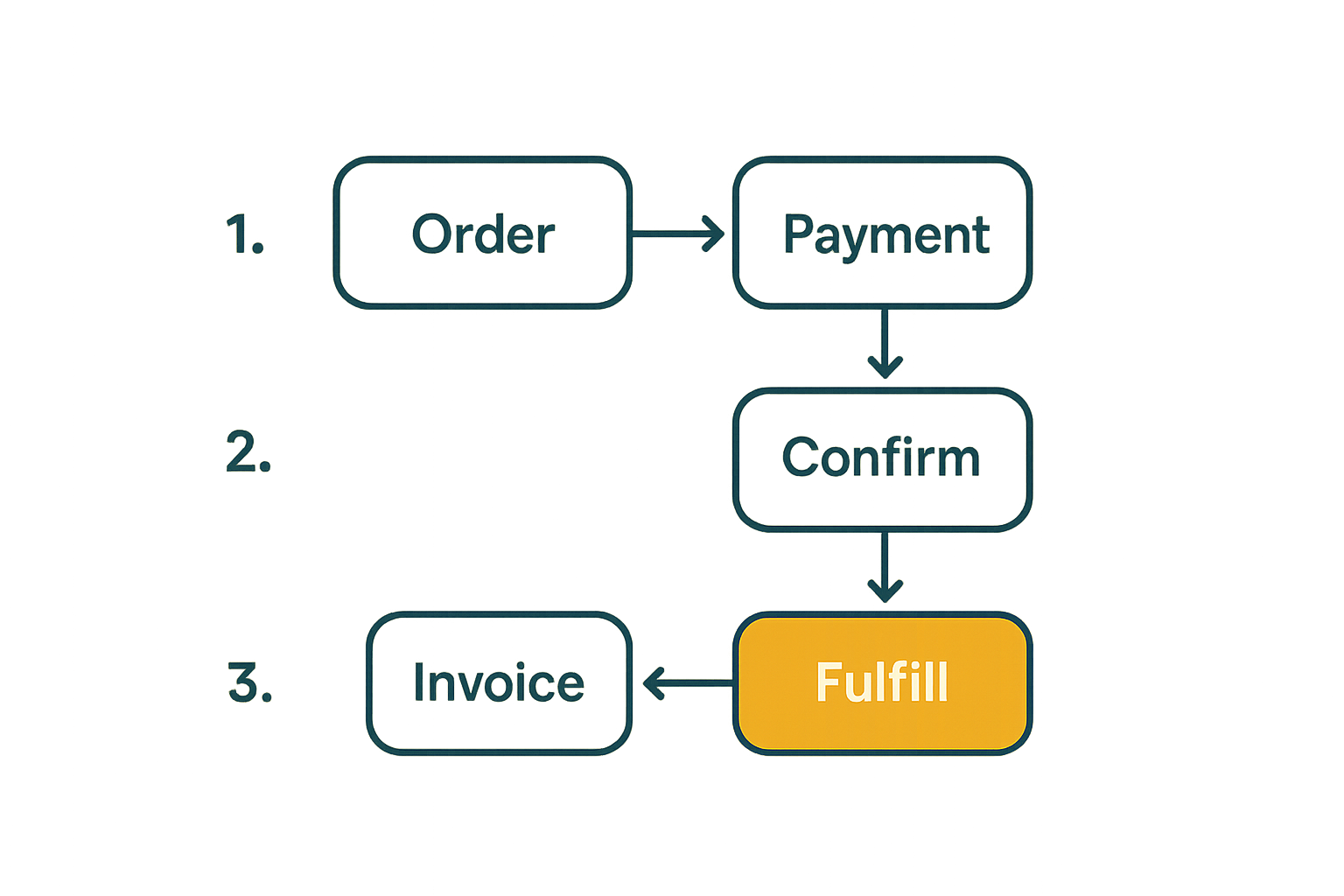
Checkout is where payment architecture becomes customer experience. For peptide merchants, the checkout page must reduce ambiguity because ambiguity turns into support tickets, abandoned orders, and payment mismatches.
Invoice-first beats address-only checkout
Do not simply show a wallet address and hope the customer sends the right amount. Use invoice-first checkout. Each order should create a unique payment request with amount, asset, network, expiration, and status tracking.
A good crypto checkout object should include:
- Order ID
- Payment ID
- Asset and network
- Amount due
- Exchange-rate timestamp if pricing in fiat
- Expiration time
- Destination address or payment URI
- Required confirmation policy
- Status callback URL
Address-only checkout fails when multiple customers send similar amounts, payments arrive late, or support needs to know which transaction belongs to which order.
Network and token selection
Peptide merchants should usually optimize for customer familiarity, stable value, and settlement reliability. Bitcoin may be useful for some customers. Stablecoins on lower-fee networks may be more practical for repeat e-commerce checkout.
The tradeoff is support complexity. Every added network increases the number of ways customers can send the wrong asset to the wrong chain. If you support USDT on multiple networks, your UI needs to make that difference painfully clear.
Customer instructions reduce support load
The checkout page should tell customers exactly what to do and what not to do. Include the network, asset, amount, expiration window, and confirmation expectations. Show warnings for wrong-network transfers. Provide a payment status page customers can refresh without opening a ticket.
Practical rule: If support has to explain the same crypto payment instruction more than twice, the checkout UI is under-specified.
Webhooks, confirmations, and idempotency
Payment integrations fail less often because an API call breaks and more often because teams mishandle asynchronous state. Crypto payments are asynchronous by default. Webhooks are not optional plumbing. They are the nervous system of the payment workflow.
Use payment events as the source of truth
Your backend should listen for events such as invoice created, payment detected, confirmations updated, paid, expired, underpaid, overpaid, and refund initiated. The frontend can poll, but the backend should update order state from signed server-to-server events.
A typical event flow:
- Customer creates an order.
- Backend creates a payment invoice.
- Customer sends funds.
- Gateway detects transaction.
- Confirmation threshold is reached.
- Order moves to paid.
- Fulfillment or manual review begins.
Developers can map this flow against the gateway API using the CoinPay documentation before wiring it into production order management.
Handle duplicate and late events
Webhooks can be delivered more than once. Blockchain transactions can arrive after invoice expiration. Customers can underpay, overpay, or send from an exchange that batches withdrawals. Your webhook handler must be idempotent.
Example pattern:
async function handlePaymentEvent(event) {
  const existing = await db.events.findUnique({ id: event.id });
  if (existing) return { ok: true, duplicate: true };

  await db.transaction(async (tx) => {
    await tx.events.create({ data: { id: event.id, type: event.type } });
    await applyPaymentStateTransition(tx, event.payment_id, event.type, event.payload);
  });

  return { ok: true };
}
The key is not the language. The key is recording the event before applying irreversible business actions.
Confirmations are a risk control
Confirmation policy should match order value, asset, and network risk. A low-value order may need fewer confirmations than a high-value wholesale order. Stablecoin payments on fast networks may feel instant, but your system still needs a clear rule for when inventory is released.
Do not hide this rule inside support folklore. Put it in configuration.
Reconciliation and settlement for peptide merchants
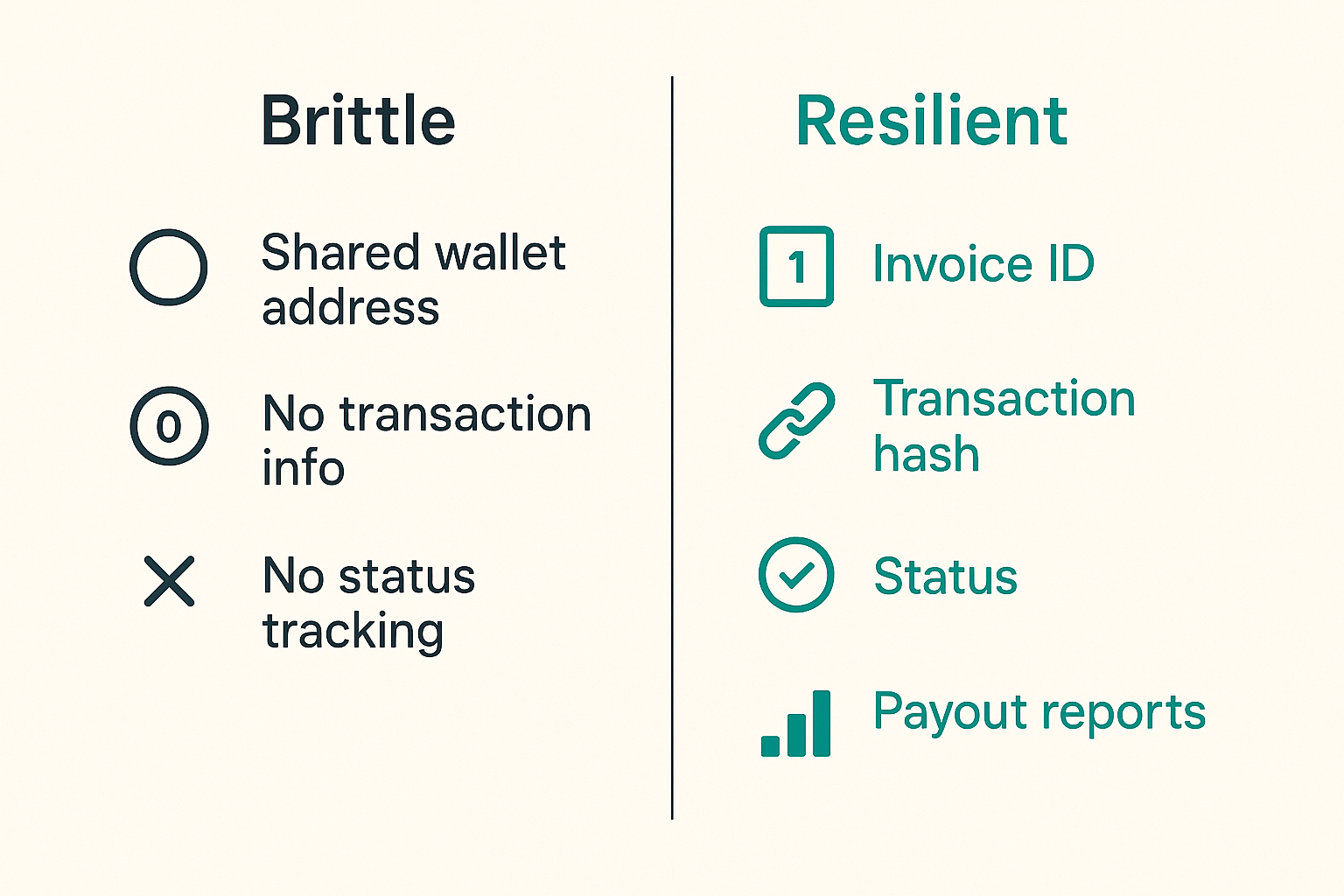
Reconciliation is where many crypto checkout projects become finance problems. The checkout worked. The customer paid. But at month end nobody can explain the wallet balance, fee drag, expired invoices, partial payments, or which orders are safe to recognize as revenue.
Map every order to a payment object
Every order should map to exactly one or more payment objects, and every payment object should map back to the order. If split payments are allowed, model them explicitly. If they are not allowed, enforce that in the UI and support workflow.
Minimal reconciliation fields:
| Field | Why it matters |
|---|---|
| order_id | Connects payment to commerce system |
| payment_id | Connects order to gateway record |
| tx_hash | Provides blockchain proof |
| asset | Explains treasury exposure |
| network | Prevents wrong-chain confusion |
| amount_due | Shows expected value |
| amount_received | Shows actual value |
| fee_amount | Supports accounting and pricing review |
| status | Drives fulfillment and support |
Track fees, slippage, and partial payments
If product prices are denominated in dollars but paid in crypto, rate timing matters. Stablecoins reduce volatility but do not remove network fees or customer-side withdrawal fees. Customers using exchanges may send slightly less than expected because the exchange subtracts fees.
Decide in advance how you handle small underpayments. Automatically accepting a tiny variance may improve customer experience. Automatically accepting large underpayments will create margin leakage.
Build payout reporting before volume grows
Do not wait until volume grows to build payout reporting. Finance needs to know what was paid, what was refunded, what is pending, and what is held for review. Operators need daily visibility, not a forensic project at the end of the month.
A simple daily report should include created invoices, paid invoices, expired invoices, underpaid invoices, total received by asset, refund requests, and unresolved support cases.
Related reading from our network: peptide operators also need security workflows around inventory, labs, and business systems; the SOC-style view in peptide security operations architecture is adjacent to the same operational discipline.
Refunds, escrow, and dispute handling
Refunds are where the difference between card habits and crypto reality becomes obvious. There is no chargeback button that reverses a blockchain transaction. That can be good for merchants, but it also means refund handling must be deliberate.
Refunds need policy and tooling
Your refund policy should answer basic questions before the first order ships:
- Are refunds sent in the original asset or fiat-equivalent value?
- Which network is used for refunds?
- Who pays refund network fees?
- What happens if the customer provides the wrong refund address?
- Are partial refunds supported?
- Is approval required for high-value refunds?
Put these rules in tooling. Support agents should not improvise treasury policy in a ticket thread.
Escrow can reduce trust friction
For some peptide transactions, especially higher-value or B2B orders, escrow can reduce trust friction between buyer and seller. Escrow is not necessary for every retail checkout, but it can be useful when fulfillment milestones, inspection, or release conditions matter.
If escrow is part of your workflow, make it explicit in the order state. CoinPay supports merchant workflows where escrow can be evaluated as part of the payment design; see the crypto escrow page when the transaction needs a release step instead of immediate merchant settlement.
Support needs payment context
Support should see the payment timeline without logging into five systems. A useful support view includes invoice creation time, expiration time, payment detection time, confirmations, transaction hash, amount received, refund status, and internal notes.
What breaks in practice is support operating from screenshots. Screenshots are not payment records. They are clues.
Practical rule: A support agent should be able to answer payment status from the order record, not from a wallet explorer tab and guesswork.
Compliance and risk records without pretending to be a bank
A crypto checkout does not turn a peptide merchant into a bank, but it does create records that need to be accurate, retrievable, and consistent. The goal is not theater. The goal is operational evidence.
Collect evidence at checkout
Capture the terms accepted, product labels shown, customer acknowledgments, IP metadata where appropriate, shipping details, and payment record. If the merchant sells research-use products, the checkout should not contradict that positioning with careless language.
This matters when a customer later claims confusion, when a platform reviews the account, or when internal staff need to reconstruct an order.
Product claims create payment risk
Payment risk is not isolated from marketing. If product pages make aggressive claims, payment providers and banks may view the account differently. Even crypto-native rails do not protect the merchant from platform, marketplace, hosting, shipping, or regulatory risk.
Related reading from our network: local coordination systems face similar trust and verification design issues, even outside payments, as discussed in peptide asks and offers network coordination.
Keep audit trails boring
Boring audit trails are good. Every state change should have a timestamp, actor, source, and reason. Automated webhook updates should be distinguishable from manual overrides. Refund approvals should be logged. Configuration changes should be visible.
The point is not to build a compliance museum. The point is to avoid mystery when money moves.
Implementation workflow for developers
The practical question is how to ship this without turning checkout into a six-month platform rewrite. Start with a narrow payment path, model state cleanly, and add operational controls before adding more assets or networks.
A practical build sequence
- Define the order states and payment states separately.
- Create an internal payment object that is provider-neutral.
- Add invoice creation from the backend, not only the browser.
- Store amount, asset, network, expiration, and payment ID.
- Build a signed webhook endpoint.
- Implement idempotent event processing.
- Add a customer payment status page.
- Add support and finance views.
- Test underpayment, overpayment, late payment, duplicate webhook, and refund cases.
- Only then add more assets, networks, or escrow paths.
This sequence keeps the system understandable. It also keeps provider replacement realistic.
Minimal payment data model
A minimal model can be simple:
create table payments (
  id text primary key,
  order_id text not null,
  provider text not null,
  provider_payment_id text not null,
  asset text not null,
  network text not null,
  amount_due numeric not null,
  amount_received numeric default 0,
  status text not null,
  tx_hash text,
  expires_at timestamptz,
  created_at timestamptz not null default now(),
  updated_at timestamptz not null default now()
);
You may need more fields in production, but this captures the essential relationship. Add event tables and audit logs before you need them.
Testing before production
Test the ugly paths. A happy-path payment proves very little. You need to know what happens when the customer sends the wrong amount, pays after expiration, refreshes checkout repeatedly, sends from an exchange, or contacts support before confirmations complete.
The mistake teams make is launching crypto checkout as if it were a static QR code. It is not. It is an asynchronous payment system.
What breaks when teams implement this badly
Bad crypto payment implementation usually fails at the seams: checkout to order management, webhook to fulfillment, wallet to accounting, support to transaction history. The UI can look fine while operations are already cracking.
What fails
Common failure modes include:
- Shared wallet addresses with no invoice-level attribution
- No idempotency in webhook handling
- Fulfillment triggered before confirmation policy is met
- Support relying on customer screenshots
- No handling for underpaid or late payments
- Refunds handled manually with no approval record
- Finance exporting wallet transactions with no order mapping
- Too many networks enabled before support is ready
These failures are not exotic. Many teams hit them in production because they treat crypto checkout as a payment button instead of a workflow.
What works
What works is less glamorous:
- Unique payment objects per order
- Clear expiration and confirmation rules
- Signed webhook processing
- Provider-neutral internal state
- Support timeline on the order record
- Daily reconciliation reports
- Limited network selection at launch
- Written refund and variance policies
A useful way to think about it is operational compression. The better your payment state model, the less human interpretation each order requires.
Operational metrics to watch
Track metrics that reveal workflow health, not vanity volume alone:
| Metric | What it tells you |
|---|---|
| Invoice conversion rate | Whether checkout instructions are clear |
| Expired invoice rate | Whether customers are hesitating or confused |
| Underpayment rate | Whether fees and network guidance are unclear |
| Manual review rate | Whether automation rules are too weak or too strict |
| Refund cycle time | Whether support and treasury workflows are aligned |
| Reconciliation exceptions | Whether finance can trust payment data |
None of these require invented benchmarks. Watch your own trend line and investigate changes.
How coinpayportal.com fits a peptide merchant account stack
A peptide merchant account stack should not depend on a single fragile processor relationship. It should give the merchant a structured way to create crypto invoices, track status, receive payment events, reconcile orders, and support customers with accurate payment context.
Use the gateway as infrastructure, not a black box
coinpayportal.com is most useful when treated as infrastructure inside your checkout architecture. The gateway creates and tracks the payment layer, but your commerce system still owns product, inventory, fulfillment, customer records, and finance reporting.
That separation is healthy. It prevents the payment provider from becoming the only place where order truth exists.
Make the account portable
The long-term goal is portability. If your peptide merchant account strategy depends on one processor, one wallet, one dashboard, or one staff member who knows how payments work, it is brittle. If your system owns state and integrates payment rails through clean interfaces, you have options.
In 2026, the merchants that survive category pressure will not be the ones who found the most permissive provider for a few months. They will be the ones who made payment acceptance replaceable, auditable, and supportable.
A peptide merchant account is not just approval. It is a payment operating model.
Try coinpayportal.com
You are writing for developers and merchants building crypto payment infrastructure. Try coinpayportal.com to build a peptide merchant account workflow with crypto checkout, payment events, and merchant-side operational control.
Try CoinPay
Crypto payments, escrow, and wallets — multi-chain, Lightning-ready, and fast to integrate.
Get started →