Melanotan 2 Peptides Payments: Crypto Checkout Architecture for High-Risk Merchants

Melanotan 2 peptides merchants usually discover the payment problem late. The storefront is live, product pages are built, ads are paused for review, and then the processor freezes settlement or asks questions the team cannot answer cleanly.
Teams think the problem is finding a processor willing to touch melanotan 2 peptides. The real problem is building a payment workflow that can prove what happened, route exceptions, handle refunds, and keep custody boundaries clear when the category is sensitive.
That changes the conversation. A crypto checkout is not a magic bypass. It is infrastructure. If you treat it like a button, support tickets, missing deposits, refund disputes, address reuse, and fulfillment mismatches become your real payment system.
The practical question is not whether a merchant can accept crypto for research peptide products. The practical question is whether the architecture can handle state, trust, settlement, compliance review, and customer support without relying on screenshots and manual wallet checks.
Table of contents
- Melanotan 2 peptides payments are a workflow, not a checkout button
- Define what your business will and will not process
- Melanotan 2 peptides checkout architecture
- The transaction state machine for melanotan 2 peptides
- Webhooks, idempotency, and retries
- Reconciliation and settlement are the merchant operating system
- Escrow, disputes, and trust controls
- Common failure modes in peptide crypto payments
- Implementation sequence for developers and merchants
- Where coinpayportal.com fits
- Closing the loop on melanotan 2 peptides payments
Melanotan 2 peptides payments are a workflow, not a checkout button
Why high-risk categories expose weak payment architecture
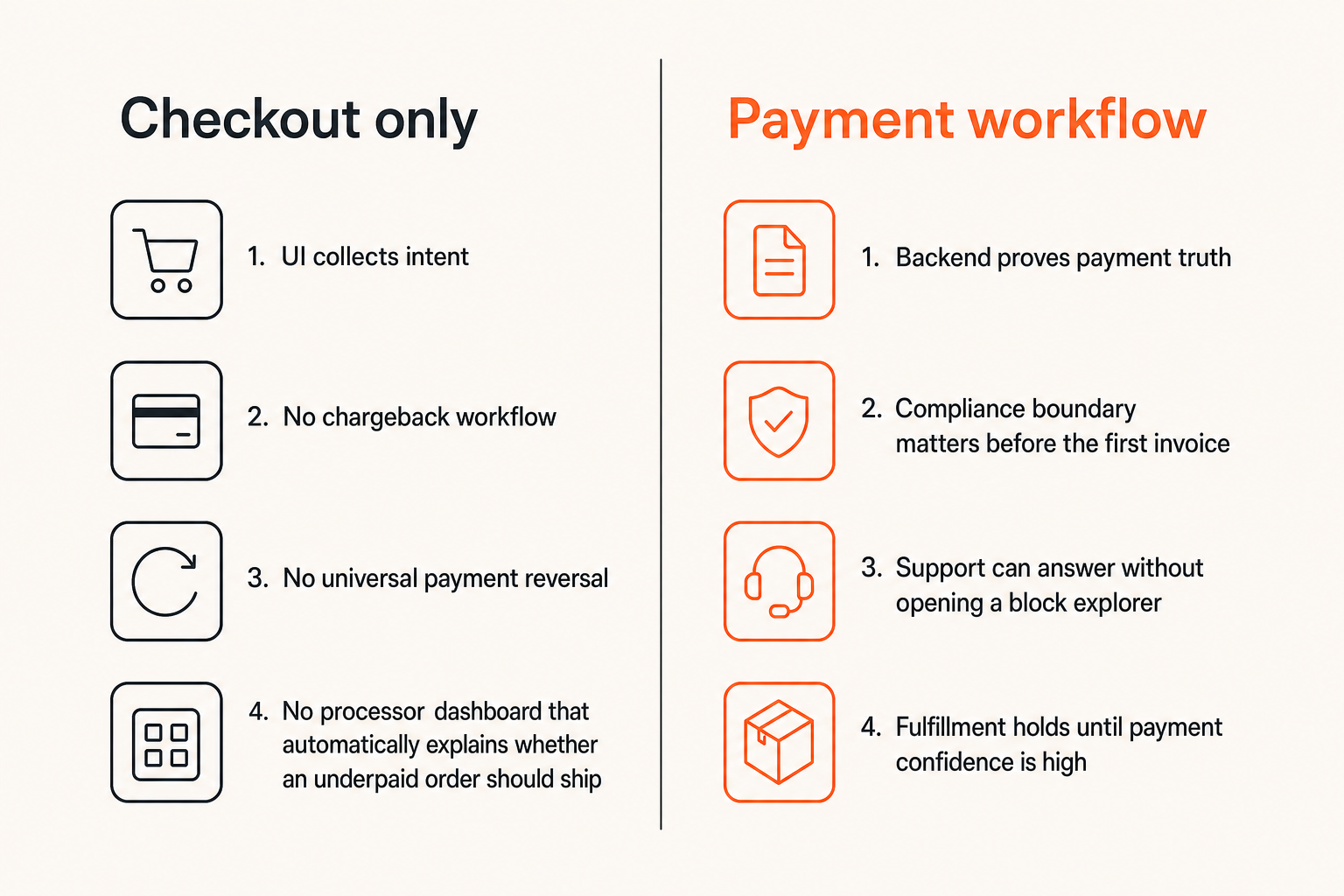
Melanotan 2 peptides sit in a category where normal payment assumptions break quickly. The merchant may be selling for research use only. The customer may expect consumer-style support. The processor may classify the category as high risk. The shipping team may need to hold fulfillment until payment confidence is high.
The mistake teams make is assuming that crypto removes this complexity. It removes some card-network constraints, but it adds operational responsibilities. There is no card chargeback workflow to lean on. There is no universal payment reversal. There is no processor dashboard that automatically explains whether an underpaid order should ship.
A useful way to think about it is this: the UI collects intent, but the backend proves payment truth. For melanotan 2 peptides, payment truth needs to include invoice amount, asset, network, deposit address, confirmations, order ID, customer support context, fulfillment status, refund policy, and audit trail.
Practical rule: If support cannot answer why an order did or did not ship without opening a block explorer, your crypto payment workflow is not production-ready.
The compliance boundary matters before the first invoice
This article is not legal, medical, or regulatory advice. It also should not be read as a recommendation to sell, buy, consume, or market melanotan 2 peptides for any human use. Merchants need their own counsel, product review, labeling discipline, and jurisdiction-specific compliance process.
From a payments architecture perspective, the key is separation. Your payment system should not make product claims. It should record order metadata, process payment state, and enforce merchant-defined policies. Product legality, labeling, and customer eligibility belong to the merchant workflow.
That separation matters because payment logs are evidence. If the checkout, receipt, and support transcript contradict the product policy, the payment system will not save the business. It will simply document the inconsistency.
Define what your business will and will not process
Separate product policy from payment rails
Before selecting wallets, APIs, or checkout pages, define the merchant policy. Which products are allowed? Which geographies are blocked? Which claims are prohibited? Which orders require manual review? Which events stop fulfillment?
For peptide merchants, this is not bureaucratic theater. It is how you prevent your payment system from becoming a blind acceptance layer for orders the business should not process. A crypto gateway should be able to accept payment, but the merchant should decide when payment can be requested at all.
A basic policy matrix is more useful than a long internal memo:
| Decision area | Good operating rule | Bad operating rule |
|---|---|---|
| Product eligibility | SKU must be approved before checkout | Any catalog item can request payment |
| Geographic rules | Block restricted regions before invoice creation | Detect restricted orders after payment |
| Fulfillment release | Ship only after confirmed payment state | Ship after customer sends a screenshot |
| Refund handling | Refund policy tied to order state | Manual wallet refund from support laptop |
| Evidence | Store event history and policy decisions | Rely on chat logs and spreadsheet notes |
Related reading from our network: teams designing interoperable systems face similar ownership problems in AI workflows, where identity, events, credentials, and audit trails must be defined before automation scales: standards def for AI agent systems.
Keep claims, checkout, and fulfillment aligned
What breaks in practice is drift. Marketing edits product copy. Support promises something in a ticket. Fulfillment ships because a wallet received funds. Finance later finds the invoice was expired or underpaid. Nobody owns the full chain.
The fix is to make payment state a dependency of fulfillment, not an optional note. If an order is not eligible, do not create a crypto invoice. If an invoice expires, do not ship because the customer paid the old address later. If a refund is required, create a tracked refund event tied to the original order.
Practical rule: Do not use payment acceptance as a substitute for merchant policy. Payment should execute a decision the business already made.
For background on the broader high-risk merchant problem, we previously covered the payment architecture for peptide categories in peptide payments crypto infrastructure.
Melanotan 2 peptides checkout architecture
Invoice creation and wallet assignment
A melanotan 2 peptides checkout should create an invoice object, not just display a wallet address. The invoice is the contract between storefront, payment gateway, chain observer, fulfillment system, and support team.
At minimum, the invoice should include:
- Merchant account ID
- Storefront order ID
- Invoice ID
- Customer-visible amount
- Asset and network
- Exchange-rate source and timestamp if fiat-denominated
- Deposit address or payment request
- Expiration time
- Required confirmation policy
- Fulfillment release rule
- Webhook destination
- Refund eligibility state
Address management is where many teams get sloppy. Reusing one static address may look simple, but it makes reconciliation harder and leaks business activity. Unique invoice addresses or deterministic payment references give the system a clean way to map deposits to orders.
If the storefront is fiat-priced, the invoice should freeze the exchange rate for a short window. If the customer pays after expiration, that should become an exception state, not an automatic shipment.
Expiration windows, price locks, and chain selection
Crypto payments are asynchronous. The customer can open a checkout page, copy an address, wait, send too little, send on the wrong network, or send after the invoice expires. Your architecture needs rules for each case.
Short expiration windows reduce price exposure but increase support load. Long windows reduce friction but create settlement risk. Stablecoins reduce volatility but add network and token-contract selection issues. Bitcoin may be operationally familiar, but confirmation time can affect fulfillment speed. Lightning can be fast, but only if the merchant and gateway handle invoice expiry and route failures cleanly.
The practical question is which failure mode your business can operate. A research peptide merchant with manual fulfillment may tolerate a longer confirmation window. A high-volume storefront needs automation with clear exception queues.
For developers integrating the payment layer, the gateway documentation should be treated as part of the architecture, not an afterthought. Start from the CoinPay developer docs when mapping checkout events, callbacks, and merchant-side order state.
The transaction state machine for melanotan 2 peptides
The states you need before fulfillment
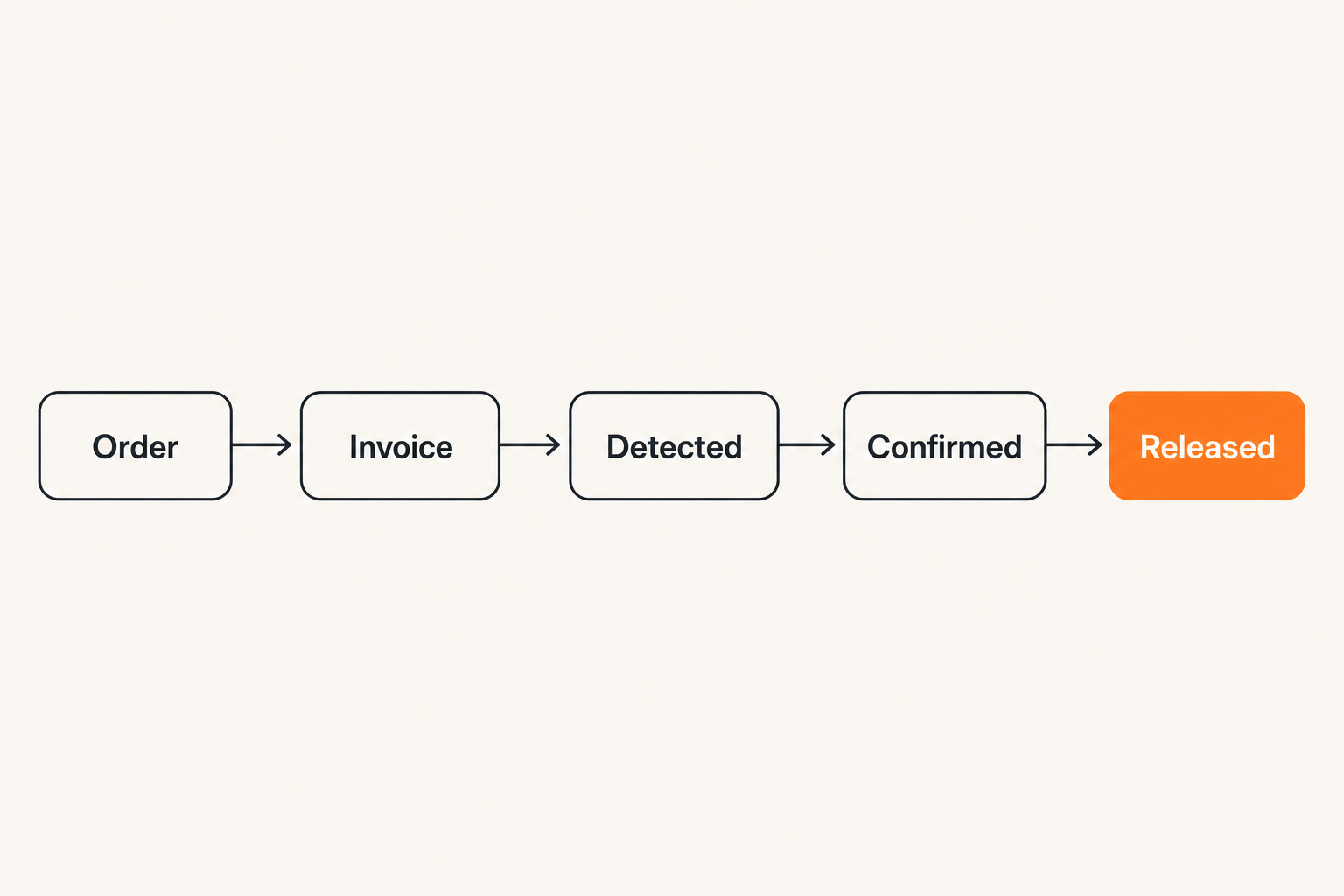
A payment system for melanotan 2 peptides needs a state machine. Not a status string buried in a database row. A real state machine with allowed transitions, timestamps, event IDs, and operational owners.
A practical minimum looks like this:
order_created— storefront order exists, no payment requested.policy_checked— merchant rules allow invoice creation.invoice_created— amount, asset, network, address, and expiry are locked.payment_detected— transaction observed but not final enough for fulfillment.payment_confirmed— confirmation policy met.fulfillment_released— warehouse or digital delivery can proceed.settled— finance view reflects funds and fees.exception— underpayment, overpayment, late payment, wrong network, or review hold.refunded— refund event completed and recorded.
This may feel heavy for a small merchant. It is cheaper than rebuilding order truth from wallet history when volume increases.
What breaks when you skip intermediate states
If you only track paid and unpaid, production will punish you. A transaction can be seen but not confirmed. It can be confirmed but underpaid. It can be paid after expiration. It can be paid to the correct address but from a customer who entered a restricted shipping region. It can be paid in the wrong asset on the right chain.
The mistake teams make is compressing all ambiguity into support work. The support team then invents policy in real time. One agent ships underpaid orders. Another cancels them. A founder refunds manually. Finance cannot reconcile because the order database says paid, the wallet says partial, and fulfillment says shipped.
Practical rule: Every ambiguous payment outcome needs a named state. If there is no state, the ambiguity becomes a support ticket.
Webhooks, idempotency, and retries
Treat every payment event as replayable
Webhooks are where crypto checkout becomes merchant infrastructure. The gateway sees chain activity and notifies your application. Your application updates order state. Fulfillment and support consume that state.
The webhook handler should assume every event can be duplicated, delayed, or retried. This is normal. Network timeouts happen. Merchant servers restart. Gateways retry. Queue workers process out of order.
A basic handler pattern is:
receive webhook
verify signature
read event_id and invoice_id
check if event_id already processed
load current invoice state
validate transition is allowed
write event and new state in one transaction
acknowledge webhook
publish internal order update
Do not perform fulfillment directly inside the webhook request. Webhook handlers should verify, persist, and enqueue. Fulfillment should be handled by downstream workers that can be retried independently.
Build for duplicate, late, and partial events
Idempotency is not optional. If a payment_confirmed webhook arrives twice, your system should not release the same order twice. If an invoice_expired event arrives after a payment_detected event, your system needs transition rules. If a customer sends two partial payments, the system should aggregate them only if your policy allows it.
Use idempotency keys for merchant API calls and event IDs for webhook processing. Store raw event payloads long enough to debug. Keep a normalized event table for reporting.
A minimal event table can include:
- Event ID
- Invoice ID
- Order ID
- Event type
- Asset
- Network
- Amount
- Transaction hash if applicable
- Confirmation count
- Previous state
- New state
- Received timestamp
- Processing result
What fails is treating webhooks like simple notifications. They are not emails. They are the payment ledger feeding your business workflow.
Reconciliation and settlement are the merchant operating system
Match orders, deposits, fees, and refunds
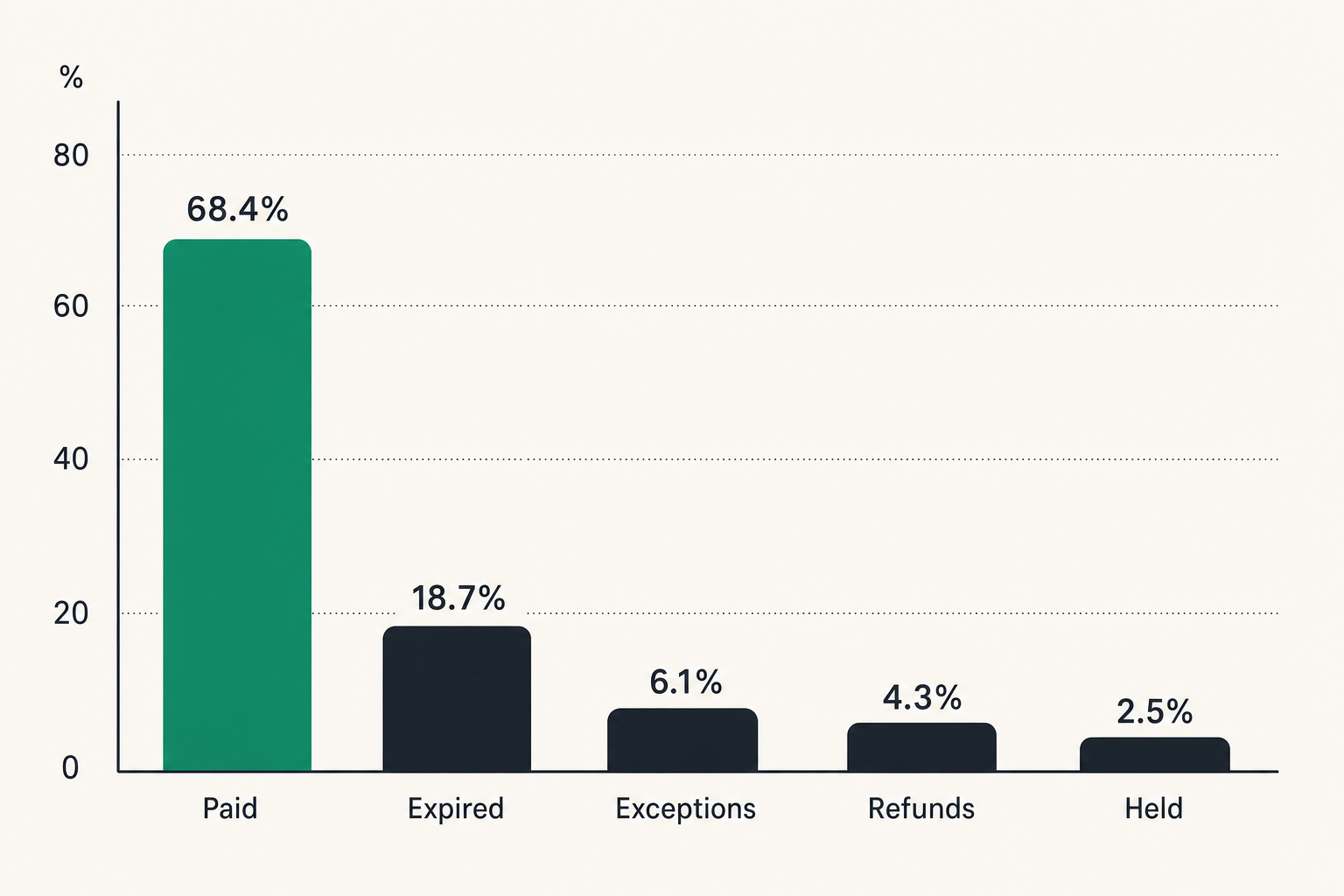
Reconciliation is where many melanotan 2 peptides payment setups become fragile. The founder checks the wallet. Support checks the ecommerce platform. Finance checks a spreadsheet. None of them match exactly.
A production workflow reconciles four views:
| View | Source of truth | Main question |
|---|---|---|
| Storefront | Ecommerce order system | What did the customer order? |
| Payment gateway | Invoice and event ledger | What payment state was reached? |
| Blockchain | On-chain transaction data | What funds moved? |
| Finance | Settlement and fee records | What value did the merchant retain? |
The practical question is not whether a transaction exists on-chain. It is whether the transaction matches the invoice and whether the invoice matches the order.
For high-risk categories, reconciliation also protects the business from accidental fulfillment. If a payment is detected but not confirmed, finance may see incoming value while fulfillment still needs to wait. If an overpayment occurs, support needs a defined refund workflow, not a manual promise.
Design reports for finance and support
Finance needs exportable records. Support needs searchable order history. Engineering needs event logs. Compliance needs policy evidence. These are different views of the same system.
A useful daily reconciliation report includes:
- Orders created
- Invoices created
- Paid invoices
- Expired invoices
- Underpaid invoices
- Overpaid invoices
- Late payments
- Refunds initiated
- Refunds completed
- Fees and settlement totals
- Orders held for manual review
Related reading from our network: logistics teams face the same operational truth that the storefront is only one part of the system; the shipping workflow behind online selling is a useful analogy for payment, fulfillment, and support coupling: how to sell products online in 2026.
Escrow, disputes, and trust controls
When escrow changes buyer behavior
In sensitive categories, trust is not just a marketing issue. Buyers want confidence that funds will not disappear. Merchants want protection from fraudulent claims and operational abuse. Escrow can help when the order has a real delivery milestone and both sides understand the release conditions.
Escrow is not useful if the merchant has no evidence workflow. You need shipment tracking, order metadata, support transcripts, and clear release triggers. Otherwise, escrow simply moves the argument into another system.
A useful escrow design defines:
- Who funds the escrow
- What event releases funds
- What evidence pauses release
- Who can open a dispute
- How long each party has to respond
- What happens when the buyer is silent
- What happens when fulfillment cannot complete
For merchants that need conditional release rather than immediate settlement, CoinPay escrow is relevant because the payment workflow can be modeled around milestone-based trust instead of a single irreversible handoff.
Dispute evidence should be structured data
The mistake teams make is collecting dispute evidence after the dispute starts. By then, the evidence is scattered across email, fulfillment notes, chain explorers, and chat apps.
Capture dispute data as the order moves:
- Checkout terms accepted
- Invoice amount and expiry
- Payment confirmation time
- Customer shipping details if applicable
- Fulfillment release time
- Tracking number or delivery event
- Support messages tied to order ID
- Refund or replacement decision
This does not eliminate disputes. It changes the cost of handling them. Instead of asking what happened, support can ask which policy applies.
Practical rule: Escrow without structured evidence is delayed conflict, not risk management.
Common failure modes in peptide crypto payments
The mistakes teams make in production
The same failure modes appear repeatedly when teams launch crypto payments for peptide and research chemical merchants.
First, they treat the wallet as the ledger. A wallet is not an order system. It does not know the SKU, invoice expiry, policy check, customer support context, or fulfillment state.
Second, they rely on screenshots. Screenshots are not payment confirmation. They can be wrong, stale, or unrelated to the invoice.
Third, they use one deposit address. That makes order matching harder, privacy worse, and support more dependent on manual review.
Fourth, they ship on detection instead of confirmation. This can work until it does not. Chain reorganizations, low-fee transactions, wrong networks, and underpayments all create edge cases.
Fifth, they do not define refund paths. Crypto refunds require address verification, asset choice, fee handling, and audit trail. A refund is a payment workflow in reverse.
Sixth, they allow marketing, support, and payment state to drift. The checkout says one thing, the product page implies another, and support promises a third.
What works instead
What works is boring infrastructure:
- Invoice per order
- Explicit policy check before invoice creation
- Unique address or payment reference
- Clear expiration and rate-lock rules
- Webhook signature verification
- Idempotent event processing
- State machine with exception states
- Reconciliation reports
- Structured dispute evidence
- Refund workflow tied to original payment
That changes the conversation from finding a workaround to operating a payment system. It also gives founders a realistic picture of cost. Crypto can reduce dependency on some traditional processors, but it does not remove the need for operations.
Related reading from our network: decentralized compute operators face similar retry, validation, and payment ownership problems when moving workloads across providers; the same workflow-first thinking appears in this guide to evaluating an Akash network alternative.
Implementation sequence for developers and merchants
A practical rollout plan
A clean rollout reduces production surprises. Do not start by adding a payment button to a live checkout. Start by modeling the workflow.
- Define merchant policy for melanotan 2 peptides orders, restricted regions, claims, and manual review.
- Map the order lifecycle from cart to fulfillment to refund.
- Create invoice objects that include amount, asset, network, expiry, and order ID.
- Implement webhook verification and idempotent event handling.
- Build the payment state machine and allowed transitions.
- Connect fulfillment release only to approved payment states.
- Create support views for invoice history and exceptions.
- Create finance reports for deposits, fees, settlements, and refunds.
- Test underpayment, overpayment, expired payment, duplicate webhook, delayed webhook, and wrong-network scenarios.
- Launch with manual review for exceptions before increasing volume.
This is not overengineering. It is the minimum structure that prevents payment chaos from becoming founder work.
Testing edge cases before traffic arrives
Most bugs do not appear in happy-path testing. They appear when a customer opens three checkout tabs, pays the expired invoice, sends the wrong token, or contacts support before confirmations complete.
Test cases should include:
- Customer abandons checkout and returns after expiry
- Customer sends slightly less than required
- Customer sends more than required
- Customer pays twice
- Customer sends on unsupported network
- Webhook arrives twice
- Webhook arrives after server downtime
- Confirmation count changes after detection
- Refund is requested before fulfillment
- Refund is requested after fulfillment
- Manual review blocks invoice creation
The practical question is not whether your checkout works during the demo. It is whether the system remains explainable when customers behave like customers.
Where coinpayportal.com fits
Product fit for non-custodial merchant workflows
CoinPayPortal is built for developers and merchants building crypto payment infrastructure, which is exactly the lens needed for melanotan 2 peptides payments. The point is not to pretend the category is simple. The point is to give the merchant a payment layer that can support real operating rules.
A non-custodial payment gateway is useful when the merchant wants clearer control over settlement boundaries, checkout logic, and operational state. The merchant still owns product compliance, labeling, support, and fulfillment policy. The gateway should help with invoice creation, payment detection, confirmations, callbacks, and merchant-side integration.
For high-risk merchants, the important feature is not a shiny checkout page. It is whether the system can connect payment events to order workflows without forcing the team to reconcile everything manually.
What to own internally
Even with a gateway, merchants should own several internal decisions:
- Product eligibility and jurisdiction rules
- Customer communication policy
- Fulfillment release rules
- Refund thresholds and approval process
- Support scripts for payment exceptions
- Finance reconciliation cadence
- Security controls for admin access
- Wallet and treasury policy
Do not outsource judgment to infrastructure. Infrastructure should make judgment enforceable.
A useful split is simple: the gateway handles crypto payment mechanics; the merchant handles business rules. When those boundaries are explicit, the integration is easier to maintain and easier to audit.
Closing the loop on melanotan 2 peptides payments
Operational checklist before you go live
Before accepting crypto for melanotan 2 peptides, walk through the system as an operator, not as a shopper.
Ask these questions:
- Can an ineligible order create an invoice?
- Can fulfillment release before payment confirmation?
- Can support see why an order is held?
- Can finance match deposits to invoices?
- Can engineering replay webhook events safely?
- Can refunds be tracked to the original payment?
- Can disputes be reviewed from structured evidence?
- Can the merchant explain custody and settlement boundaries?
- Can the team stop checkout quickly if policy changes?
If the answer is no, the checkout is not the system yet. It is only the front door.
Melanotan 2 peptides payments in 2026 are best treated as a workflow architecture problem: policy first, invoice state second, chain settlement third, fulfillment last. That order keeps teams out of the most expensive mistakes.
Try coinpayportal.com
coinpayportal.com is for developers and merchants building crypto payment infrastructure. If you need a practical payment layer for checkout, webhooks, settlement, and merchant operations, Try coinpayportal.com.
Try CoinPay
Crypto payments, escrow, and wallets — multi-chain, Lightning-ready, and fast to integrate.
Get started →