Lab 34 Peptides and Proteins: Payment Architecture for High-Risk Research Merchants

If you sell research-use products, the payment stack usually breaks before the storefront does. A page for lab 34 peptides and proteins can load fast, rank, and convert, then still fail at the point where money, compliance, fulfillment, and support need to agree on one version of the truth.
Teams think the problem is getting a processor to approve the category. The real problem is building a checkout and settlement workflow that survives processor risk reviews, customer confusion, partial payments, delayed confirmations, refund requests, chargeback-like disputes, and internal handoffs.
That changes the conversation. Lab 34 peptides and proteins is not only a product taxonomy or SEO term. For operators, it is a payment architecture problem. The practical question is how to accept crypto payments without turning every order into a manual investigation.
This guide is written for developers, merchants, fintech founders, and blockchain engineers who need a working system, not a generic definition. We will treat the category as a real production workflow: checkout state, custody boundaries, webhooks, reconciliation, settlement, evidence, and support.
Table of contents
- Lab 34 peptides and proteins is a workflow problem
- Lab 34 peptides and proteins checkout architecture
- What crypto payments change for peptide merchants
- The payment state machine you actually need
- Webhooks, reconciliation, and back-office truth
- Custody, escrow, and settlement boundaries
- Compliance and evidence without pretending payments solve everything
- Common failure modes in production
- Implementation workflow for developers
- Where coinpayportal.com fits
Lab 34 peptides and proteins is a workflow problem
The storefront is not the system
The mistake teams make is treating the product page as the center of the business. The page matters, but it is only the first visible surface. In a lab 34 peptides and proteins operation, the fragile parts usually sit behind the button: payment creation, quote locking, address generation, confirmation tracking, order release, settlement, refund handling, and support evidence.
If those pieces are loosely connected, the customer sees a checkout. Your team sees Slack messages, spreadsheet rows, wallet screenshots, and unresolved tickets.
A useful way to think about it is this: the storefront expresses intent, but the payment system proves whether that intent became a settled transaction. Those are different facts. Mixing them is how merchants ship unpaid orders or hold paid orders in limbo.
Practical rule: never let a product order become fulfillment-ready because a customer clicked pay. It becomes fulfillment-ready only when the payment state machine says the settlement rule has been satisfied.
Why crypto enters the conversation
Many peptide and research chemical merchants look at crypto because conventional payment processors can be unstable for high-risk categories. Approval can be slow. Account reviews can be opaque. Reserves can change. Payouts can be delayed. Sometimes the merchant is not rejected because the business is illegal; they are rejected because the processor does not want the monitoring burden.
Crypto does not magically remove business risk. It changes where the operational responsibility sits. Instead of relying on card network abstractions, you need to manage wallet addresses, exchange rates, chain confirmations, refunds, and customer education.
That can be a good trade if the architecture is explicit. It is a bad trade if the team assumes a crypto address is the same thing as a checkout system.
Where teams underestimate operational risk
What breaks in practice is not usually the happy path. It is the customer who sends the wrong amount, the wallet that pays after the invoice expires, the support agent who cannot see the transaction, the warehouse team that receives conflicting order status, or the founder who manually marks orders paid without leaving an audit trail.
Related reading from our network: teams making infrastructure choices face similar operational tradeoffs in IaaS in cloud computing for decentralized compute builders, especially when reliability depends on more than a single API call.
Lab 34 peptides and proteins checkout architecture
Separate product intent from payment intent
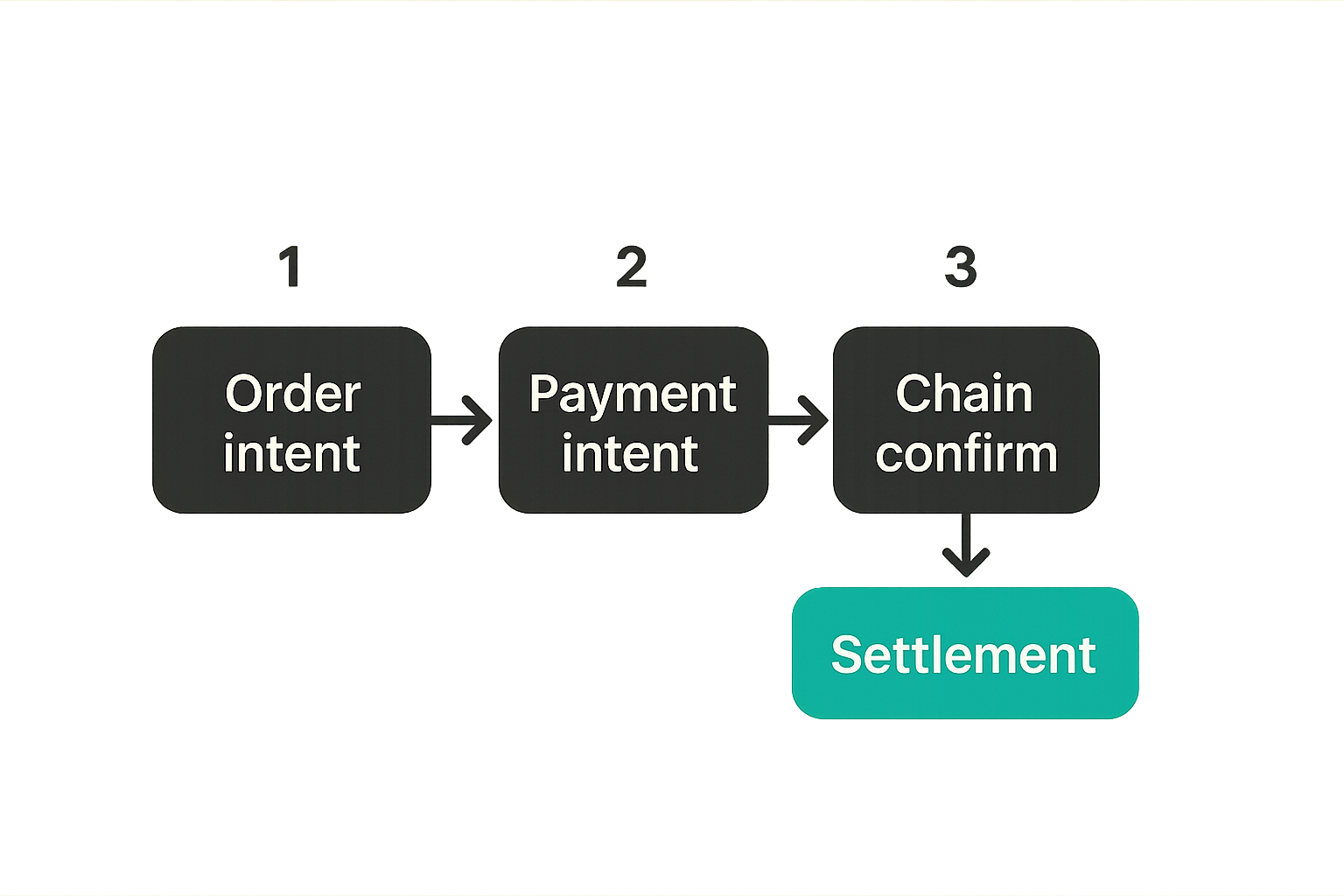
For lab 34 peptides and proteins checkout architecture, you want two records before money moves.
The first is the order intent: customer, cart, shipping destination, product classification, required attestations, tax or fee rules, and fulfillment constraints. The second is the payment intent: amount due, currency, network, receiving address, quote expiry, confirmation policy, and settlement destination.
Do not overload one object with both jobs. Product intent can change if inventory, shipping, or compliance checks fail. Payment intent should be immutable enough to reconcile later.
A simple model looks like this:
order_id -> payment_intent_id -> blockchain_transaction_id -> settlement_batch_id
Each link is important. The order explains what the customer wanted. The payment intent explains what they were asked to pay. The transaction proves what arrived. The settlement batch explains where funds went.
Make payment state explicit
A crypto checkout should not have only paid and unpaid. That binary model is too weak for production.
Use states such as:
created: order exists but no payment invoice has been issuedinvoice_open: payment address or invoice is activedetected: funds seen but not confirmed enoughpartially_paid: amount received is below toleranceoverpaid: amount received exceeds toleranceconfirmed: confirmation policy satisfiedexpired: quote or invoice window endedrefunding: refund workflow startedsettled: funds moved according to policycancelled: order closed before settlement
The exact names matter less than consistency. Every state should answer one question: what is the next safe action?
Practical rule: a payment state is not a label for humans. It is a permission boundary for software.
Design for customer error
Customers using crypto will make mistakes. Some will send from exchanges that batch withdrawals. Some will select the wrong network. Some will send a rounded amount. Some will pay after walking away for an hour.
Your checkout should explain:
- accepted assets and networks
- exact amount due
- whether underpayments are accepted within a tolerance
- invoice expiration time
- confirmation expectations
- refund policy for wrong-network or late payments
- support information needed for investigation
For adjacent implementation guidance, CoinPay's technical notes and merchant-side updates are collected on the CoinPay blog, where related crypto payment workflows are discussed from the builder side.
What crypto payments change for peptide merchants
Card rails hide state until they do not
Card payments feel simple because the processor packages authorization, capture, dispute windows, fraud tooling, and payout reporting into a familiar interface. But for high-risk merchants, that simplicity can be conditional. The account can be reviewed. Payouts can be reserved. A transaction can look approved and still become a dispute or processor issue later.
That does not mean cards are bad. It means card rails hide complexity until the processor decides your category needs more scrutiny.
Blockchain rails expose settlement mechanics
Crypto payments expose the mechanics. You see the transaction. You decide confirmation thresholds. You decide whether to accept a late payment. You decide how to refund. You decide how to map wallet activity to orders.
That is more control, but also more responsibility. A developer cannot simply drop a wallet address into checkout and call it infrastructure.
The practical question is whether your team wants transparent settlement mechanics enough to own the operational work around them.
The comparison that matters
| Area | Conventional card processor | Crypto payment workflow |
|---|---|---|
| Approval | Processor policy controls access | Merchant can accept directly, subject to its own legal and platform constraints |
| Settlement visibility | Abstracted through processor reports | Visible on-chain, then mapped internally |
| Disputes | Formal chargeback process | Support, refund, escrow, and evidence process |
| Failure mode | Holds, reserves, account shutdowns | Wrong amounts, wrong networks, stale invoices, missing reconciliation |
| Engineering need | Processor integration and risk tooling | State machine, webhooks, wallet monitoring, settlement logic |
Neither side is free. Crypto just moves the work from processor dependency into architecture and operations.
The payment state machine you actually need
Minimum viable states
For lab 34 peptides and proteins merchants, a minimum viable payment state machine should prevent three bad outcomes: fulfilling unpaid orders, ignoring paid orders, and losing track of exceptions.
A lean workflow can be:
- Create order intent after cart and policy checks.
- Create payment intent with amount, asset, network, and expiry.
- Display payment instructions and lock the quote for a defined window.
- Detect incoming transaction and attach it to the payment intent.
- Wait for the required confirmation threshold.
- Mark payment confirmed or route the exception.
- Release fulfillment only after confirmation and internal checks.
- Settle funds according to wallet and treasury policy.
- Reconcile order, payment, transaction, and settlement records.
This is not overengineering. This is the minimum shape of a system that can answer support and finance questions later.
Idempotency and retries
Payment systems retry. Webhooks retry. Customers refresh pages. Admins click buttons twice. If your integration is not idempotent, normal behavior creates duplicate records.
Use idempotency keys when creating payment intents. A good key includes the merchant account, order ID, and payment attempt number. Do not use only the customer ID. Customers can have multiple valid orders.
Example pattern:
idempotency_key = merchant_id + ':' + order_id + ':' + attempt_number
When receiving webhook events, store event IDs and transaction IDs before applying state changes. If the same event arrives twice, acknowledge it without changing state twice.
Practical rule: every payment event handler should be safe to run more than once.
Timeouts and expiration
Crypto invoices need expiration because exchange rates move. But expiration is not the same as rejection. A customer can pay late. The chain can confirm late. An exchange withdrawal can be delayed.
A practical policy separates quote expiry from transaction handling:
- quote expires after a short window
- late transaction is still detected
- late transaction routes to review or refund
- support sees why the order did not auto-release
- finance can reconcile the funds even if fulfillment is blocked
This avoids the worst outcome: funds arrive, the order is expired, and nobody knows what to do.
Webhooks, reconciliation, and back-office truth
Webhooks are notifications, not truth
Webhooks are useful, but they are not your source of truth. They are delivery mechanisms. A webhook can be delayed, duplicated, dropped, or received out of order.
Treat the webhook as a trigger to fetch or verify current payment status. Then apply a state transition based on your own rules.
The mistake teams make is putting all business logic inside the webhook handler with no replay path. That works in staging. In production, it fails when a deployment is in progress, a queue backs up, or an endpoint returns a temporary error.
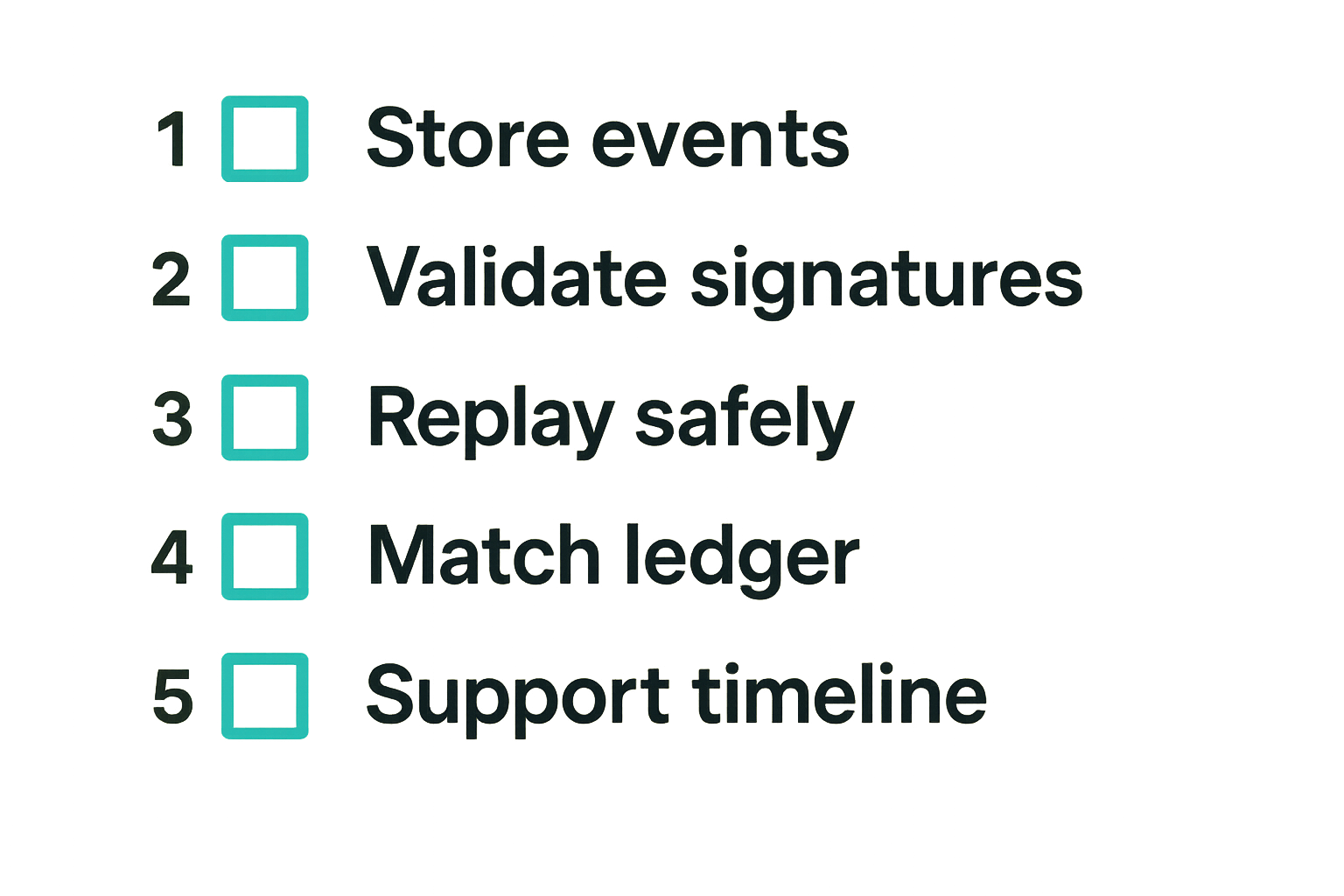
A safer pattern:
- Receive webhook.
- Validate signature.
- Store raw event.
- Enqueue processing job.
- Fetch current payment status.
- Apply idempotent transition.
- Emit internal event for fulfillment, finance, or support.
Reconciliation should be boring
Reconciliation is not a finance afterthought. It is the control loop that proves your system is not lying.
At minimum, reconcile:
- orders created
- invoices issued
- transactions detected
- confirmations completed
- amounts expected versus received
- settlements executed
- refunds initiated and completed
- exceptions still open
Run reconciliation on a schedule, not only when support complains. If the ledger shows confirmed funds and the order is not released, you need to know quickly. If an order is marked paid without a transaction, you need to know before fulfillment.
Support needs the same ledger
Support agents should not ask engineering to inspect a block explorer for every ticket. Give them a payment timeline tied to the order:
- invoice created
- address shown
- customer amount due
- transaction detected
- confirmation count
- final decision
- refund or exception notes
This is especially important in categories where customers may already be anxious about payment acceptance. Clear status reduces tickets and prevents agents from improvising policy.
Related reading from our network: the same principle applies in media operations, where fragmented tools create support ambiguity; see information technology for streaming, torrents, IPTV, and home media operations for an adjacent operations-focused comparison.
Custody, escrow, and settlement boundaries
Non-custodial does not mean unmanaged
Non-custodial payment architecture means the merchant is not giving a processor full control over funds in the same way a hosted balance might. It does not mean there is no management layer.
You still need policies for receiving addresses, wallet rotation, treasury wallets, refunds, fee handling, internal permissions, and audit records. A non-custodial model can reduce some counterparty exposure, but it increases the need for clear operational ownership.
The key question is simple: who can move funds, under what condition, with what evidence, and where is that action logged?
When escrow is useful
Escrow is useful when trust needs to be staged. For example, a marketplace or brokered transaction may need funds held until both parties satisfy a workflow condition. In peptide and research-use commerce, escrow can also be relevant where shipment timing, buyer confirmation, or dispute handling need more structure than a direct pay-and-ship model.
If your business model needs staged release, review how a purpose-built crypto escrow workflow separates payment receipt from release conditions instead of treating settlement as a single event.
Escrow should not be bolted on later as a manual wallet. It should be part of the payment state machine from the beginning.
Settlement policy belongs in code
Settlement policy should be explicit enough that two operators do not make different decisions on the same facts.
Define:
- confirmation thresholds by asset and network
- tolerance for underpayment and overpayment
- late payment handling
- refund requirements
- escalation rules
- treasury wallet routing
- fee treatment
- evidence required before manual release
Do not bury these rules in a private founder note. Put them in configuration, document them in the runbook, and log every exception.
Compliance and evidence without pretending payments solve everything
Payments do not replace merchant policy
Crypto payments do not decide whether a merchant can sell a product, ship to a region, or make a claim. Those are merchant policy, legal, and compliance questions.
For lab 34 peptides and proteins, the payment system should support policy enforcement, not pretend to be the policy. If products are research-use only, if certain destinations are restricted, or if attestations are required, those checks should happen before payment release and fulfillment.
The practical architecture is layered:
- product catalog classification
- customer attestation capture
- destination and shipping checks
- payment intent creation
- settlement confirmation
- fulfillment release
- evidence retention
Payments are one layer. They should not be the only control.
Capture evidence at order time
Evidence is much easier to capture before a problem occurs. Store the order snapshot, product names or SKUs, customer attestations, shipping decision, invoice amount, asset, network, payment address, transaction ID, and admin actions.
Do not rely on mutable product pages. If a support issue happens two weeks later, you need the facts as they existed when the customer paid.
This matters for refunds, blocked shipments, account reviews, vendor disputes, and internal audits. It also matters when a customer claims they paid for something different than what the order record shows.
Do not leak sensitive context into payment metadata
Be careful with metadata. Do not put sensitive product details, customer health information, or unnecessary descriptors into public or third-party-visible payment fields.
Use internal references instead. A payment provider or webhook payload can carry order_id and merchant_id without exposing every SKU detail. Your internal system can resolve those identifiers when authorized users need context.
Related reading from our network: CI/CD teams face a similar boundary problem around secrets and scanner credentials, and security license architecture for CI/CD is a useful adjacent read on keeping sensitive operational context out of the wrong layer.
Common failure modes in production
Partial and overpaid orders
Partial payments happen when customers misread the amount, wallets subtract fees, or exchange withdrawals do not match the invoice. Overpayments happen when customers round up or send duplicate transactions.
What fails is pretending these are rare. Build exception paths:
- accept small underpayments only if policy allows
- auto-release only within configured tolerance
- route material underpayments to support
- record overpayment balance or refund decision
- prevent duplicate fulfillment on duplicate transactions
Do not let support invent policy ticket by ticket.
Network congestion and stale rates
Network fees and confirmation times vary. Rate volatility creates another problem: the fiat value expected at invoice creation may not match the value when funds settle.
You need a quote window and a late-payment policy. You also need customer messaging that does not overpromise instant confirmation on every network.
What works is being explicit: this asset, this network, this amount, this expiry, this confirmation rule. What fails is showing a generic wallet address and expecting the customer to infer the rest.
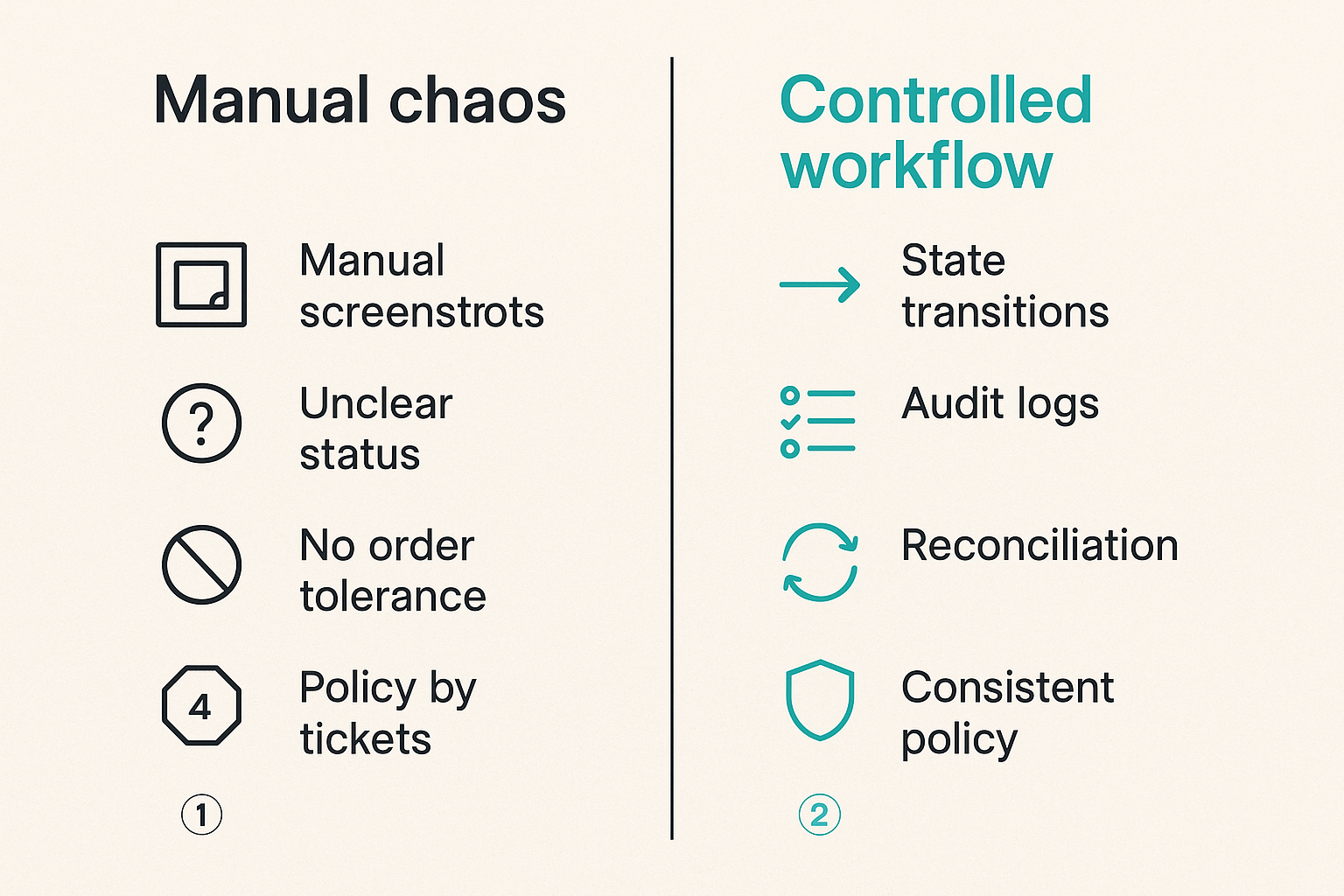
Manual overrides without audit trails
Manual overrides are not the enemy. Unlogged manual overrides are.
Every admin action should capture:
- who made the change
- previous state
- new state
- reason code
- free-text note if needed
- timestamp
- linked evidence
This protects the merchant from accidental fulfillment, insider abuse, support confusion, and finance mismatches. It also gives engineering enough information to fix recurring workflow problems instead of guessing.
Implementation workflow for developers
Build the integration in layers
A clean implementation sequence keeps payment risk from leaking everywhere in the app:
- Model orders and payment intents separately.
- Add idempotent payment intent creation.
- Implement hosted or embedded crypto checkout.
- Validate and store webhook events.
- Build state transitions as a service, not controller logic.
- Add reconciliation jobs that compare internal state with provider state.
- Gate fulfillment on confirmed payment state and merchant policy checks.
- Build support views before launch, not after the first incident.
- Add refund and exception workflows.
- Review logs and permissions before production traffic.
The order matters. If you start with the UI and add reconciliation later, you will spend the first month cleaning up edge cases manually.
Test the ugly paths first
Most teams test successful payment and stop. That is not enough.
Test:
- customer opens invoice and never pays
- customer pays after expiry
- customer underpays
- customer overpays
- webhook arrives twice
- webhook arrives before the page redirects
- webhook endpoint is down
- transaction confirms after support cancels the order
- admin manually marks an order paid
- refund is requested after settlement
A useful staging environment lets developers replay webhook events and simulate state transitions. Without replay, every production incident becomes a one-off debugging session.
Operational runbooks matter
Developers build the system, but operators run it. The runbook should explain what to do when an order is partially paid, when a customer sends the wrong asset, when funds arrive late, when an address is reused, when a refund is requested, and when fulfillment is blocked.
For API-level details, developers can start with the CoinPay documentation and map those primitives into their own order, fulfillment, and finance systems.
The mistake teams make is assuming integration ends when the checkout page works. In production, integration ends when support, finance, fulfillment, and engineering can all follow the same record without private context.
Where coinpayportal.com fits
Product fit for high-risk merchant workflows
coinpayportal.com is useful when a merchant wants crypto payment infrastructure without pretending the UI is the whole system. For lab 34 peptides and proteins merchants, the fit is architectural: payment creation, real-time processing, fee handling, non-custodial boundaries, and workflows that can be connected to the systems merchants already operate.
This matters because high-risk categories do not need more dashboard theater. They need payment events that can drive order state, support evidence, reconciliation, and settlement decisions.
A good payment gateway should make the hard parts explicit: invoice state, transaction mapping, confirmation status, webhooks, and operational visibility. It should not force merchants to manage everything with copied wallet addresses and screenshots.
What to own internally
Even with a strong payment gateway, the merchant must own the business rules. That includes product eligibility, customer attestations, shipping restrictions, refund policy, fulfillment release, accounting treatment, and support language.
The gateway can help execute the payment workflow. It cannot decide your entire merchant policy. Keeping that boundary clear prevents bad assumptions during audits, disputes, or scaling.
The closing point is simple: lab 34 peptides and proteins payment acceptance is not won by adding a crypto logo to checkout. It is won by building a system where payment state, order state, settlement, and support evidence stay aligned.
Try coinpayportal.com
You are writing for developers and merchants building crypto payment infrastructure. Try coinpayportal.com to build crypto checkout workflows with production payment state, webhooks, and merchant operations in mind.
Try CoinPay
Crypto payments, escrow, and wallets — multi-chain, Lightning-ready, and fast to integrate.
Get started →