Glow Peptide Payments: Crypto Checkout Architecture for High-Risk Peptide Merchants

Glow peptide merchants usually discover the payment problem at the worst possible time: after traffic is working, customers are ready to buy, and the processor decides the account is too risky.
Teams think the problem is finding a checkout button that accepts crypto. The real problem is building a payment workflow that can survive high-risk merchant operations, unclear customer intent, blockchain settlement delays, refunds, support disputes, and accounting cleanup.
That changes the conversation. Glow peptide payments are not a front-end feature. They are an architecture decision across checkout state, wallet routing, inventory release, order fulfillment, and merchant support.
The practical question is simple: when a customer sends funds, can your system prove what happened, update the order correctly, and recover when something goes wrong?
Table of contents
- Why glow peptide payments fail in the real world
- Glow peptide is a checkout architecture problem
- Map the merchant workflow before touching APIs
- Design the payment state machine for peptide orders
- Glow peptide risk controls that do not kill conversion
- Webhooks, confirmations, and reconciliation
- What breaks when teams implement crypto checkout badly
- What works in production
- Production checklist for glow peptide payment infrastructure
- Where coinpayportal.com fits
Why glow peptide payments fail in the real world
Processor risk is not a bug
Many glow peptide sellers are not trying to run a complex fintech stack. They want a checkout that works, an order queue that stays clean, and a payment trail they can defend when a customer asks where the package is.
The mistake teams make is treating payment rejection as a temporary account problem. They assume another card processor, another merchant account, or another payment app will solve it. In production, the pattern repeats: approval, volume, review, hold, termination, scramble.
For peptide and research-adjacent merchants, the category itself creates processor risk. Your checkout architecture has to assume payment rails can change, settlement can be delayed, and support teams need evidence. If the business depends on one brittle payment provider, the store is one policy review away from downtime.
The UI is the easy part
A crypto payment button can be added quickly. That is not the same as a working payment system.
The hard parts are less visible: invoice expiration, exchange-rate locking, chain selection, confirmation thresholds, webhook retries, order matching, refund handling, and reconciliation against merchant wallets. These are not nice-to-have details. They decide whether your support team can operate the store without manually reading block explorers all day.
A useful way to think about it is this: the checkout UI captures intent, but the payment system proves settlement.
What changed in 2026
By 2026, more customers understand stablecoins, wallets, and direct crypto payments. That helps conversion, but it also raises expectations. Customers expect clear instructions, fast status updates, and support that can answer payment questions without confusion.
At the same time, merchants are more aware of custody risk. They do not want a gateway silently holding funds longer than necessary. They want routing, records, and automation without giving up control of settlement.
Related reading from our network: teams building decentralized infrastructure face a similar separation between routing, validation, and settlement in IaaS in cloud computing, even though the product category is different.
Practical rule: Do not evaluate a crypto checkout by how fast it renders. Evaluate it by how well it handles the five percent of orders that do not settle cleanly.
Glow peptide is a checkout architecture problem
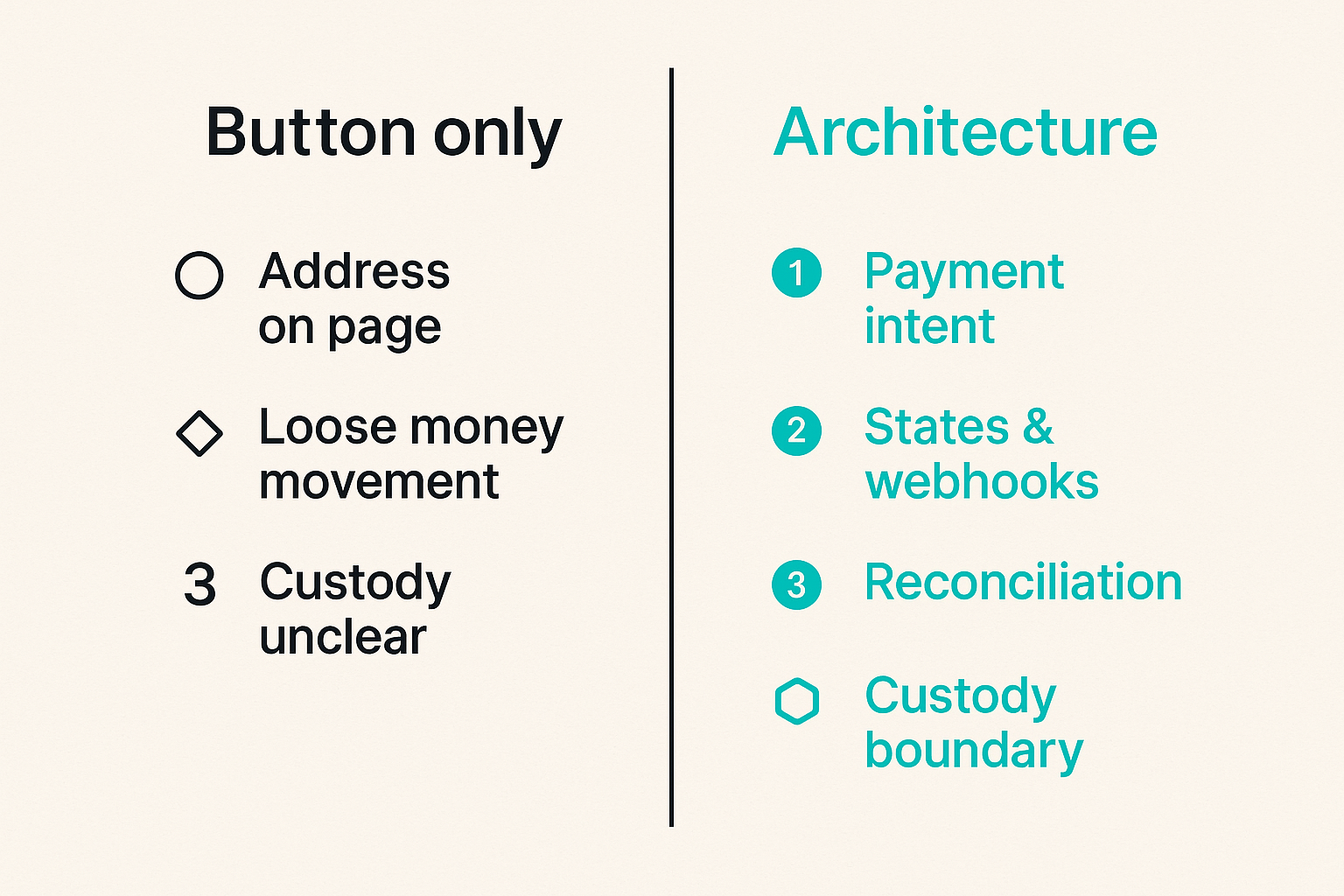
Payment intent beats payment button
A glow peptide checkout should start by creating a payment intent, not by dumping a wallet address on the page.
The payment intent is the object that connects customer, cart, price, currency, network, invoice expiration, expected amount, and order reference. It gives the system something durable to reconcile against when the blockchain event arrives later.
Without a payment intent, you get loose money movement. A customer sends funds, a webhook fires, and the store tries to infer what the payment meant after the fact. That is fragile, especially when two customers send similar amounts or one customer retries after an expired quote.
Custody boundaries matter
The practical question is whether the gateway ever controls merchant funds or only coordinates payment instructions and status.
For high-risk merchants, custody is not a small detail. It affects trust, accounting, support, and failure recovery. Non-custodial flows reduce the number of parties holding funds, but they require better event handling because the gateway must still know what happened on-chain.
If your team is designing from scratch, make the custody boundary explicit in the first diagram. Who creates the address? Who watches the chain? Who signs refunds? Who records settlement? Who can pause an order?
The comparison that matters
| Approach | What looks good | What breaks in practice | Better operating model |
|---|---|---|---|
| Static wallet address on checkout | Fast to launch | Hard to match payments to orders | Unique invoice or payment intent per order |
| Manual block explorer checks | Cheap at low volume | Support bottleneck and human error | Automated watcher plus dashboard context |
| One status field for everything | Simple database | Confuses paid, confirmed, fulfilled, refunded | Separate payment, order, and fulfillment states |
| Custodial black box | Fewer moving parts at first | Settlement trust and support opacity | Clear custody boundary and exportable ledger |
| No expiry window | Fewer failed checkouts | Rate drift and stale invoices | Expiring invoice with retry path |
That changes the conversation from crypto acceptance to operational reliability. A glow peptide merchant does not need novelty. It needs fewer ambiguous orders.
Map the merchant workflow before touching APIs
Start with order states
Before choosing a payment API, map the store workflow. Most teams skip this and then force payment events into whatever order states already exist in Shopify, WooCommerce, a custom cart, or an internal ERP.
At minimum, define these order states:
- cart created
- payment intent created
- awaiting payment
- payment detected
- payment confirmed
- ready for fulfillment
- fulfilled
- refund requested
- refunded
- canceled or expired
This does not mean every platform needs all of these states as native order statuses. It means your system needs to represent them somewhere. If not, support will invent states manually in notes, spreadsheets, or chat threads.
Separate customer status from blockchain status
Customer-facing language should not expose every internal event. A customer does not need to know that a transaction is in mempool propagation or waiting for a third confirmation. They need to know whether the payment was received and what happens next.
Internally, however, the distinction matters. Payment detected is not the same as payment confirmed. Confirmed is not the same as ready to ship. Shipped is not the same as final from a refund standpoint.
The mistake teams make is collapsing all of this into paid. Paid is useful for a human, but weak as a system state.
Define ownership for exceptions
Every payment system needs an exception owner. This is even more important for glow peptide merchants because customer trust can degrade quickly when payment status is unclear.
Define who owns:
- underpaid invoices
- overpaid invoices
- expired payments that arrive late
- wrong-network payments
- duplicate payments
- customer refund claims
- fulfillment holds
- wallet or node monitoring alerts
If nobody owns these, the developer becomes support, the founder becomes reconciliation, and the customer gets inconsistent answers.
For a deeper category-specific view, we previously covered the broader infrastructure problem in peptide payments for crypto merchants, including why processor fragility changes the architecture discussion.
Design the payment state machine for peptide orders
The minimum viable state model
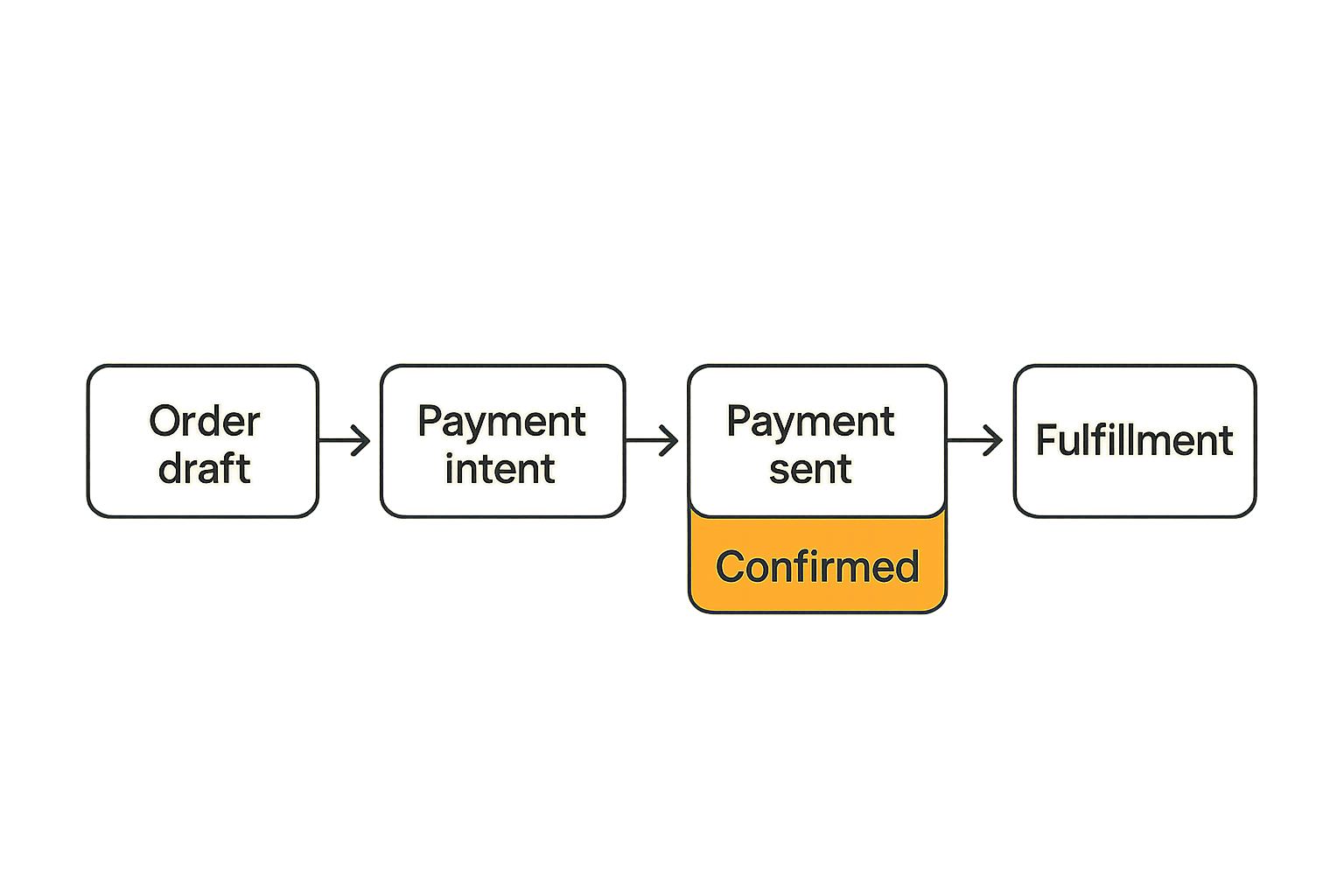
A solid glow peptide payment flow has three separate but connected state machines:
- Payment state
- Order state
- Fulfillment state
Payment state answers: what happened to the money?
Order state answers: what does the store believe about the purchase?
Fulfillment state answers: what should operations do next?
Mixing these creates hidden bugs. For example, if a payment is detected but not confirmed, should inventory be reserved? Maybe yes for a short window. Should the package ship? Usually no. Should the customer see a success screen? Yes, but with careful language.
A practical implementation sequence
A useful implementation path looks like this:
- Create an order draft with a stable internal order ID.
- Create a payment intent with expected amount, asset, network, expiry, and customer reference.
- Show the customer a payment screen with address, amount, network, timer, and status polling.
- Watch the chain or gateway event stream for matching transactions.
- Record payment detected as an immutable ledger entry.
- Wait for the configured confirmation threshold.
- Mark payment confirmed and update the order state.
- Release the order to fulfillment or trigger manual review.
- Export settlement and fee data for reconciliation.
- Preserve the event trail for support and disputes.
This sequence is intentionally boring. Boring is good. Payment systems should not depend on interpretation at runtime.
Idempotency is not optional
Webhooks retry. Customers refresh pages. Wallets rebroadcast. Your API worker might process the same event twice. If that creates two fulfilled orders, your payment system is unsafe.
Every state transition should be idempotent. Use deterministic keys such as payment_intent_id plus transaction_hash plus network. Store processed event IDs. Make fulfillment release depend on a transition that can happen once.
Example event handling shape:
receive payment_detected event
validate signature
load payment intent
check event_id has not been processed
record ledger entry
if amount and network match invoice
  move payment state to detected
else
  move payment state to exception
mark event_id processed
emit internal order update
Practical rule: A webhook handler should be safe to run twice. If running it twice changes money, inventory, or fulfillment twice, the design is not production-ready.
Glow peptide risk controls that do not kill conversion
Risk is workflow not just compliance text
Risk controls are often treated as a legal page problem. Add disclaimers, add terms, move on. That is not enough.
In payment operations, risk control means the system can slow down, hold, review, or reject specific orders without breaking the whole checkout. This is where architecture matters. You need a path for manual review that does not require editing database rows or asking a developer to replay webhooks.
For glow peptide merchants, useful risk inputs may include order value, customer history, shipping region, velocity, mismatched contact data, payment timing, and prior support patterns. The goal is not to create a surveillance machine. The goal is to route ambiguous orders into a review lane before fulfillment.
Use escrow only where it changes trust
Escrow can be useful when trust between buyer and seller is the actual bottleneck. It is not a universal fix for checkout reliability.
If the merchant ships directly and has clear refund policies, escrow may add friction without solving the core problem. If the transaction involves higher-value orders, marketplace sellers, or conditional release, escrow can make the workflow clearer.
The important point is to model escrow as a separate state path. Funds pending release, funds released, funds disputed, and funds returned are not the same as ordinary paid or refunded states. If your workflow needs escrow primitives, design them intentionally rather than bolting them on after the first dispute. CoinPay provides an escrow flow for merchants that need conditional release rather than a simple direct-payment checkout.
Support evidence should be generated automatically
Support should not have to ask engineering whether a customer paid. The payment system should show:
- invoice ID
- order ID
- quoted amount
- received amount
- asset and network
- transaction hash
- confirmation count
- timestamps
- current payment state
- refund or exception notes
This is not just convenience. It reduces support time and prevents bad refunds. If a customer claims payment, the support agent needs a single operational view, not five browser tabs and a Slack thread.
Related reading from our network: local coordination systems run into the same ownership problem when trust, routing, and follow-up are not explicit, which is the core argument in Supreme Community.
Webhooks confirmations and reconciliation
Webhook events must be boring
Webhook design should be predictable. Avoid clever event names and ambiguous payloads. Your application should know exactly what each event means and what it is allowed to change.
Useful event types include:
- payment_intent.created
- invoice.expired
- transaction.detected
- transaction.confirmed
- transaction.underpaid
- transaction.overpaid
- refund.requested
- refund.completed
- payout.recorded
The event should include stable identifiers, asset, network, expected amount, received amount, transaction hash where applicable, and timestamps. It should not require the receiver to guess the order from the amount alone.
Confirmations should map to fulfillment risk
Confirmation thresholds should not be copied from a random forum post. They should map to order value, asset, network, and fulfillment risk.
For low-value digital access, one confirmation or even detected payment may be acceptable depending on the chain and risk tolerance. For physical peptide products, shipping too early can create avoidable loss. For higher-value orders, a stricter confirmation policy may be justified.
The practical question is not how many confirmations are standard. The practical question is what failure you are willing to absorb.
Reconciliation is where weak systems get exposed
Reconciliation is the test of whether your payment architecture is real.
At the end of the day, can the merchant answer:
- which orders were paid?
- which invoices expired?
- which payments were partial?
- which funds arrived in which wallet?
- which network fees were incurred?
- which refunds were issued?
- which orders are blocked on review?
If not, the checkout is only half-built. For merchants building custom integrations, the CoinPay documentation is the right place to start thinking in terms of API events, gateway behavior, and integration boundaries rather than only front-end payment screens.
What breaks when teams implement crypto checkout badly
Underpayment and overpayment edge cases
Underpayment is common when customers manually type amounts, use wallets with fees they do not understand, or pay after an exchange-rate window moves. Overpayment happens when customers round up, retry, or send from a wallet that handles amounts strangely.
Bad systems mark both as paid or failed with no nuance. Good systems create exception states.
Underpaid orders may require customer top-up, merchant approval, or cancellation. Overpaid orders may require automatic credit, refund flow, or manual review. Either way, the system should preserve the original invoice amount and received amount.
Duplicate callbacks and race conditions
What breaks in practice is rarely the happy path. It is the race between a webhook, a polling job, a customer refresh, and an admin action.
Example: a transaction is detected. The webhook worker marks the payment detected. At the same time, a background reconciler sees the same transaction and also tries to update the order. Then an admin sees the customer email and manually marks the order paid. Without idempotency and transition rules, the order history becomes unreliable.
This is why every update needs a source, timestamp, previous state, new state, and actor. Human actions should be recorded like system actions.
Refunds without a ledger
Refunds are where many crypto checkout implementations become operationally dangerous.
If refunds are handled outside the payment system, the order may say refunded while the wallet says nothing happened. Or the wallet may show a refund transaction while the order remains fulfilled. Or a support agent may refund the wrong asset to the wrong address.
A refund flow needs request, approval, destination capture, execution, transaction hash, status, and final reconciliation. Do not reduce refunds to a note field.
We covered similar state-management failures in more depth in peptide transactions in crypto payments, especially the difference between transaction events and merchant workflow states.
What works in production
Stable addresses and expiring invoices
The best pattern for most merchants is a unique invoice with a clear expiration window. The customer sees exactly what to send, where to send it, and how long the quote is valid.
The address strategy depends on the gateway and wallet design. Some systems derive unique addresses per invoice. Others use memo or reference fields on networks that support them. The key is that matching must be deterministic. If two customers can send the same amount to the same address with no reliable reference, support pain is guaranteed.
Clear customer instructions
Customers should not need to understand your architecture. They need simple payment instructions:
- send only the selected asset
- use only the selected network
- send the exact amount
- complete payment before the timer expires
- do not send from an exchange if refunds require wallet control
- contact support with the invoice ID, not just a screenshot
This copy belongs in the checkout, confirmation page, and support templates. It should be consistent. Conflicting instructions create expensive support tickets.
Merchant dashboards with operational context
A merchant dashboard should show more than paid and unpaid. It should show operational context:
- payment aging
- invoices close to expiry
- payments detected but unconfirmed
- exception queue
- refund queue
- settlement export
- webhook delivery status
This is where gateway design becomes merchant operations. A founder does not want to ask whether crypto payments are working. They want to see which orders need action.
Related reading from our network: even home media and streaming workflows have a similar reliability lesson, where the interface is only one layer and the real system is routing, storage, and recovery; see world wide technology for streaming and home media for an adjacent infrastructure example.
Practical rule: If the dashboard cannot explain why an order is blocked, the payment system will push that complexity into support.
Production checklist for glow peptide payment infrastructure
Checkout and invoice controls
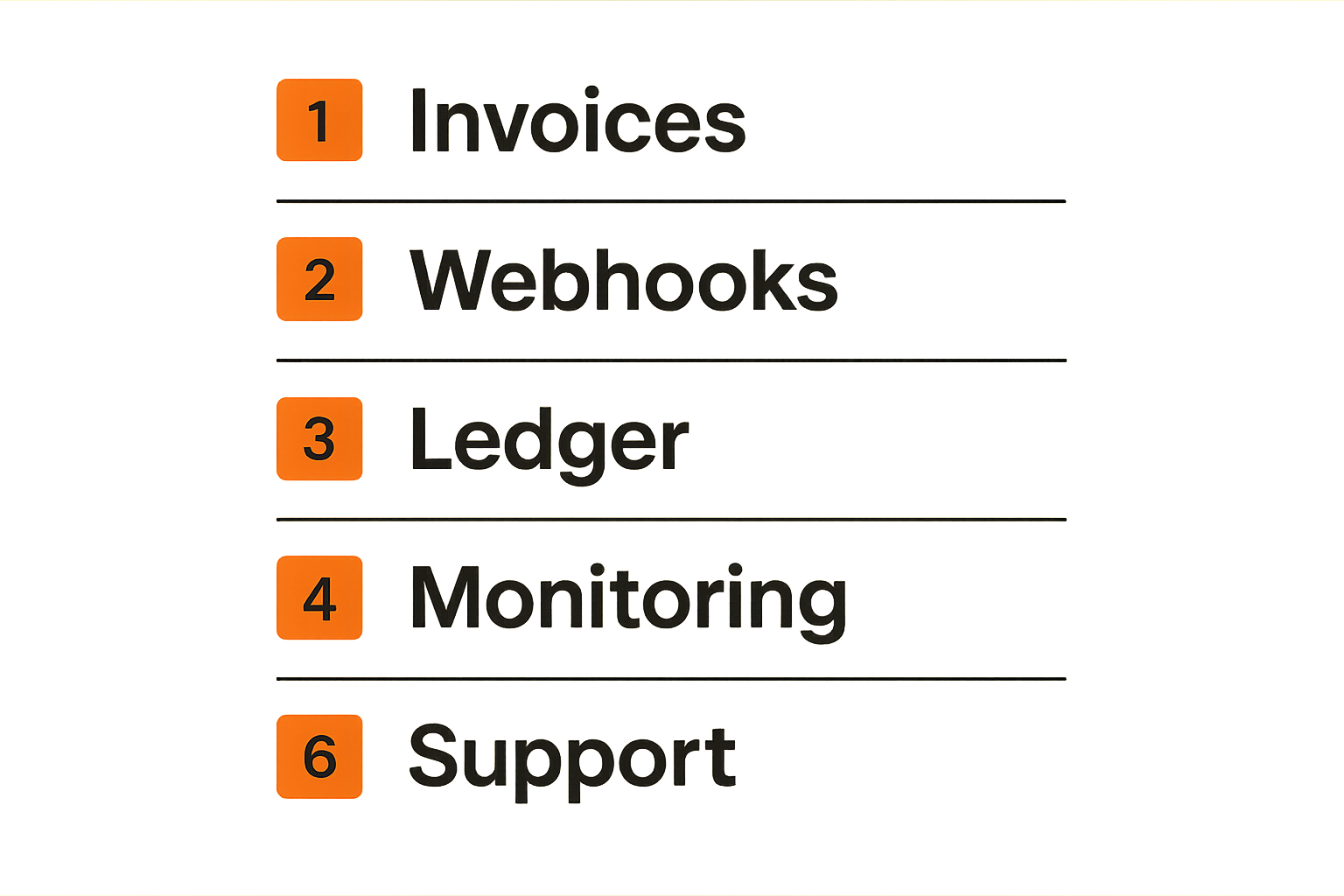
Use this as a practical checklist before going live:
- unique payment intent per order
- explicit asset and network selection
- invoice expiration timer
- deterministic order matching
- customer-visible status updates
- retry path for expired invoices
- clear wrong-network warning
- exact amount display with copy buttons
The mistake teams make is launching with only the QR code and wallet address. That may work for a few early orders, but it will not scale cleanly once support volume increases.
Back office controls
Back office controls matter as much as checkout controls. Operators need to act without editing the database.
Minimum back office features:
- searchable invoice and order IDs
- transaction hash lookup
- manual review queue
- refund request workflow
- notes with actor history
- exportable ledger
- webhook replay or retry visibility
- role-based access for sensitive actions
Do not give every admin the ability to override payment status. Separate view, review, refund, and fulfillment permissions.
Monitoring and escalation controls
Monitoring should cover both infrastructure and business workflow.
Track:
- webhook failures
- delayed confirmations
- invoice expiration rates
- underpayment frequency
- overpayment frequency
- refund backlog
- orders stuck in review
- wallet watcher lag
A chart of total volume is not enough. You need exception metrics because exceptions are where the margin disappears.
Where coinpayportal.com fits
Build around non-custodial flows
CoinPay is built for developers and merchants who need crypto payment infrastructure without turning checkout into a custody black box. For glow peptide merchants, that matters because the business needs payment reliability, customer clarity, and settlement control.
The product fit is architectural: create payment flows, route customers through crypto checkout, handle real-time processing, and keep the merchant workflow connected to payment events.
This is not about pretending crypto removes operational work. It does not. It changes where the work sits. Good infrastructure makes that work visible, repeatable, and less dependent on manual intervention.
Use the gateway as infrastructure
For developers, the gateway should behave like infrastructure:
- predictable API behavior
- stable identifiers
- webhook delivery
- clear payment states
- operational dashboards
- supportable transaction records
- merchant-controlled settlement assumptions
For merchants, the value is simpler: fewer ambiguous orders and fewer processor surprises.
The practical question is not whether crypto payments are trendy. The practical question is whether your glow peptide checkout can keep taking orders when traditional rails become unreliable.
Closing thought on glow peptide payments
Glow peptide payments work best when teams stop treating them as a payment-method toggle. The real system is the workflow around intent, settlement, confirmation, fulfillment, refunds, and support.
If you build that workflow intentionally, crypto checkout becomes a resilient part of the business. If you skip it, the blockchain will not save you from bad state management.
Practical rule: Build the payment workflow first, then choose the gateway surface that supports it. Not the other way around.
Try coinpayportal.com
You are writing for developers and merchants building crypto payment infrastructure. Try coinpayportal.com.
Try CoinPay
Crypto payments, escrow, and wallets — multi-chain, Lightning-ready, and fast to integrate.
Get started →