GHK Peptide Payments: Crypto Checkout Architecture for High-Risk Merchants

GHK peptide merchants usually discover the payment problem at the worst possible time: after the store is live, ads are running, inventory is moving, and the processor suddenly asks for more documentation or freezes settlement.
Teams think the problem is finding a processor willing to approve GHK peptide sales. The real problem is building a payment workflow that does not collapse when one provider changes its risk policy.
That changes the conversation. This is not only about accepting crypto. It is about checkout state, settlement, refunds, support evidence, custody boundaries, and repeatable operations for a category that conventional payment rails often treat as fragile.
The practical question is simple: if your GHK peptide storefront lost card processing tomorrow, could orders still be paid, matched, fulfilled, reconciled, and supported without manual chaos?
Table of contents
- GHK peptide payments are an infrastructure problem
- What makes GHK peptide commerce difficult
- The checkout stack that actually matters
- Compliance boundaries and merchant trust
- Settlement and reconciliation for GHK peptide orders
- Escrow, refunds, and disputes
- Implementation workflow for a GHK peptide crypto checkout
- What works for GHK peptide merchants
- What fails in production
- Product fit: using coinpayportal.com for GHK peptide payments
GHK peptide payments are an infrastructure problem
The processor risk is operational, not theoretical
GHK peptide sellers sit in a category where payment approvals can be temporary. A merchant account can look stable until a review, complaint, chargeback cluster, policy update, or banking partner change forces a new risk decision.
The mistake teams make is treating approval as the finish line. Approval is only one dependency in a longer system. You still need checkout continuity, settlement visibility, refund handling, order matching, and a support trail.
If the business is built around a single payment processor, then payment risk becomes business continuity risk. One outage or account review can stop cash collection even when demand is healthy.
Practical rule: for high-risk commerce, payment approval is not resilience. Resilience means the order workflow survives when one rail becomes unavailable.
Why crypto enters the conversation
Crypto payments are attractive because they reduce dependence on card networks, chargeback rules, and processor category decisions. But crypto is not magic. It removes some failure modes and introduces others.
You no longer have card chargebacks in the same way, but you do have irreversible transfers. You avoid some processor holds, but you must handle address accuracy, network choice, confirmations, volatility, refunds, and customer education.
For peptide sellers, the value is not only accepting Bitcoin, USDT, USDC, or another digital asset. The value is building a payment workflow where funds can be verified on-chain, matched to an order, and moved through fulfillment without waiting for a card processor to permit the category.
If you want a deeper category-specific overview, our prior guide on peptide payments and crypto infrastructure covers the broader payment stack for peptide and research chemical merchants.
The decision is payment architecture
A useful way to think about it is this: a checkout page is the user interface for a larger payment state machine.
The UI asks the buyer to pay. The architecture decides what happens when the buyer sends the wrong amount, pays late, uses the wrong network, opens a support ticket, requests a refund, or places a repeat order.
That is why GHK peptide payments should be designed like infrastructure. The goal is not a pretty payment button. The goal is predictable state transitions and operational evidence.
What makes GHK peptide commerce difficult
Research-use positioning creates payment scrutiny
GHK peptide is commonly sold in contexts where labeling, claims, and permitted use matter. Payment providers care about that context. They may review product pages, marketing language, refund patterns, customer complaints, and fulfillment behavior.
The payment system cannot fix sloppy merchandising. If product positioning creates risk, the checkout layer will inherit that risk.
This is where developers and founders need to work with operations, compliance, and support. The storefront, terms, product metadata, payment receipts, and post-purchase emails should tell one consistent story.
Chargebacks, frozen funds, and category risk
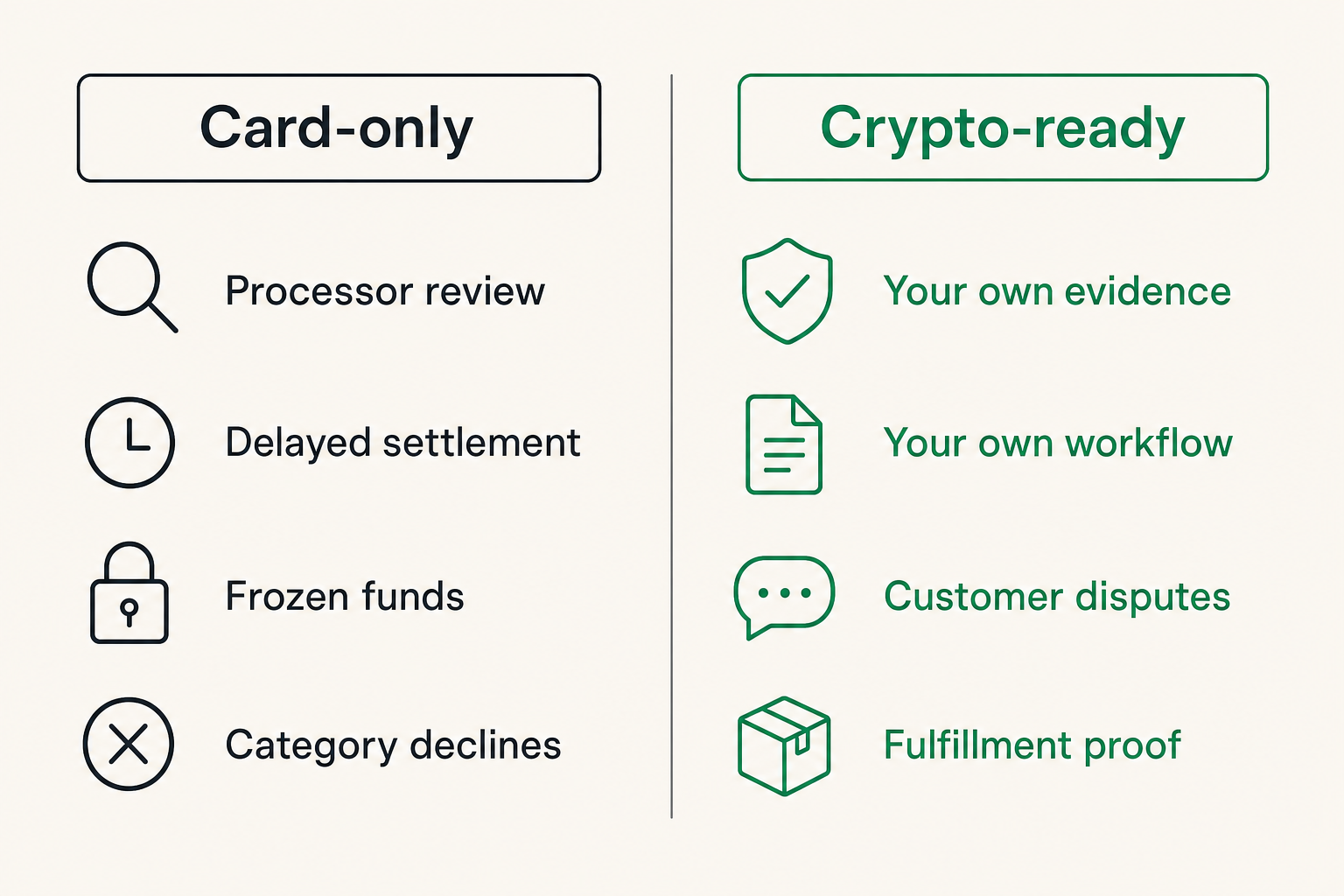
Card processors manage risk by delaying settlement, holding reserves, terminating accounts, or declining categories entirely. For a GHK peptide seller, the issue is not just chargeback percentage. It is the combination of product category, customer expectations, claims language, and fulfillment proof.
Crypto changes the chargeback model, but it does not remove customer disputes. Buyers can still claim they paid, claim they paid too much, ask for refunds, or dispute delivery. The difference is that you need your own evidence and workflow instead of relying on a card network process.
| Payment issue | Card-heavy setup | Crypto-ready setup |
|---|---|---|
| Processor review | Can freeze settlement or terminate account | Less dependent on card processor approval |
| Chargebacks | Network-driven dispute process | Merchant-defined refund and support process |
| Order matching | Processor transaction ID | Invoice ID plus on-chain transaction hash |
| Settlement | Batch deposits and reserves | Wallet or gateway settlement by asset and network |
| Buyer error | Usually handled by processor forms | Requires clear payment instructions and support tooling |
Support requests become payment evidence
What breaks in practice is support. A buyer sends funds from an exchange. The exchange delays the withdrawal. The buyer sends on the wrong network. The amount is short because of fees. The order expires and the buyer pays anyway.
If your team cannot connect the ticket to the invoice, wallet address, transaction hash, order status, and fulfillment decision, crypto will feel messy.
Practical rule: every support ticket about payment should be answerable from structured order data, not from someone manually searching a block explorer.
Related reading from our network: teams building broader commerce systems face similar operational tradeoffs in how to sell products online in 2026, especially when payment, fulfillment, and support need to work as one system.
The checkout stack that actually matters
Hosted checkout versus embedded invoice flow
A hosted checkout sends the buyer to a payment page where the gateway controls instructions, address display, expiration timers, and confirmation status. It is usually faster to launch and easier to support.
An embedded invoice flow keeps the buyer inside your store. It gives more control but pushes more responsibility onto your application: address display, QR generation, timer logic, payment status polling, and error messaging.
For most GHK peptide merchants, hosted checkout is the better first version. The business needs reliability more than custom UI. Embedded flows make sense once volume, support data, and customer behavior justify the engineering cost.
The payment state machine is the core
The core object is not a transaction. It is an invoice that moves through states.
A practical state model looks like this:
- created
- displayed_to_customer
- pending_payment
- partially_paid
- paid_unconfirmed
- confirmed
- expired
- overpaid
- refunded
- cancelled
- manual_review
These states should map to order behavior. For example, confirmed can release the order to fulfillment. partially_paid can trigger a support workflow. expired can prevent automatic fulfillment even if a late transaction arrives.
The mistake teams make is storing only paid or unpaid. That binary model fails immediately when real buyers interact with real networks.
Wallet, network, and asset selection
Asset selection should be boring. Stablecoins may reduce volatility for buyers and merchants, but network choice still matters. Bitcoin is widely understood, but confirmation timing and fee behavior may affect support. Lightning can be useful for speed, but merchant and customer wallet readiness varies.
Do not offer every token because it looks flexible. Every asset and network adds documentation, monitoring, refund logic, treasury decisions, and support cases.
Practical rule: each new payment asset must earn its place by reducing friction more than it increases support load.
Compliance boundaries and merchant trust
Do not let payment rails write your policy
Your payment gateway should enforce payment logic. It should not be the only place where your product policy lives.
For GHK peptide commerce, policy belongs across the storefront, catalog, order system, support scripts, shipping rules, and payment receipts. If those systems disagree, the payment layer becomes a weak patch over a larger problem.
This matters because a high-risk merchant often has to prove operational maturity. Clear policies, consistent language, and structured evidence make the business easier to operate even when no regulator or processor is asking.
Product metadata should help operations
Do not treat product metadata as only SEO content. It should support order handling.
Useful fields include:
- product SKU
- product category
- research-use notice status
- restricted destination flags
- fulfillment temperature or handling notes, if applicable
- refund eligibility
- support escalation rules
None of this needs to be exposed to the buyer in raw form. But your order system should know it. When a payment is confirmed, fulfillment and support should receive the context they need.
Reputation is part of payment conversion
Crypto checkout asks buyers to do something with lower reversibility. That increases the importance of trust signals: consistent order confirmations, clear payment windows, visible support access, and proof that previous buyers had normal experiences.
If a merchant uses reputation features, they should connect to real operations rather than decorative badges. A customer is more likely to complete a crypto payment when the store explains what happens after payment, how confirmations work, and how support handles mistakes.
For merchants that need a trust layer around repeat orders or counterparty confidence, CoinPay also provides a merchant reputation surface that can sit alongside payment acceptance.
Settlement and reconciliation for GHK peptide orders
Invoice IDs must survive every system
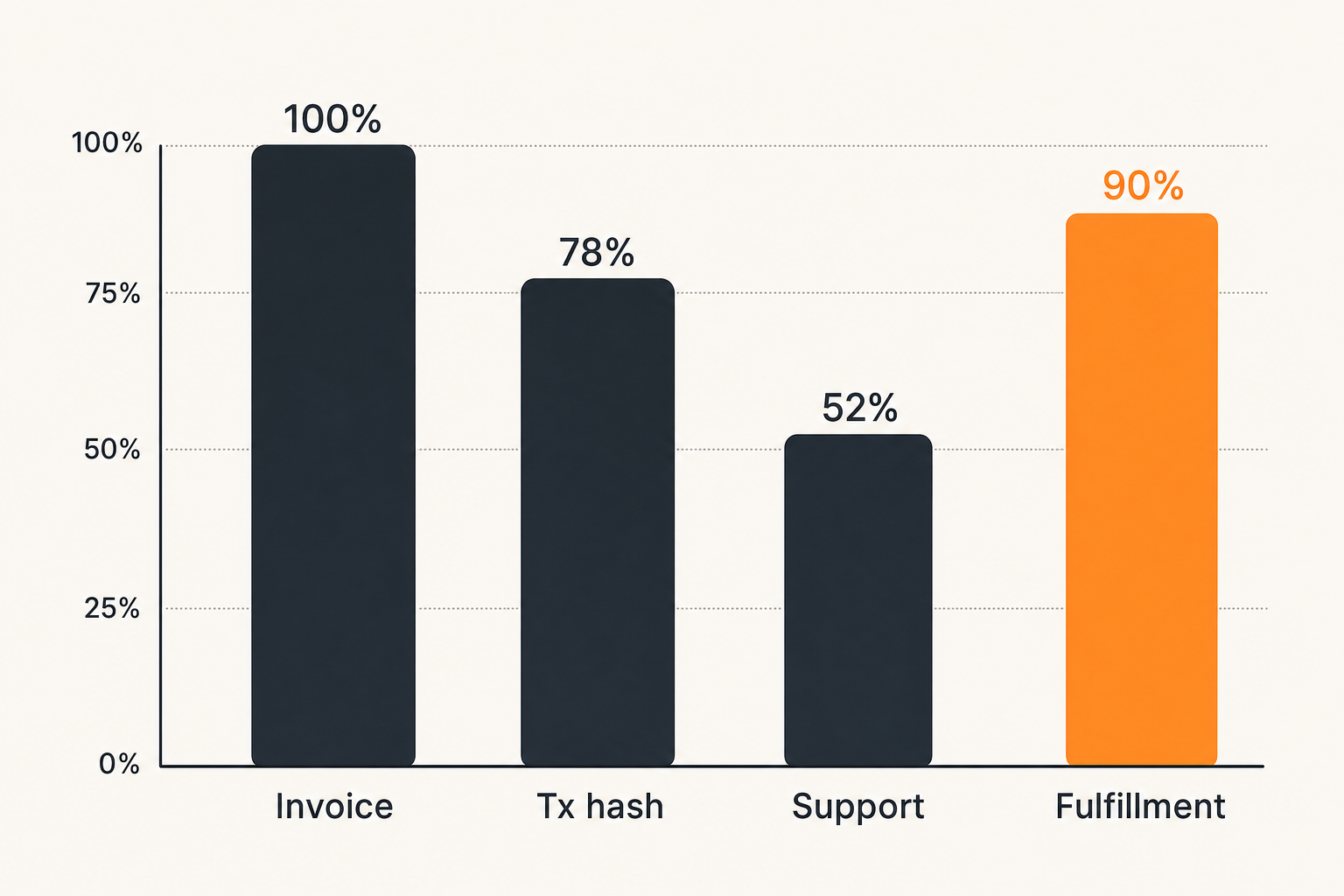
Reconciliation fails when identifiers change between systems. Your storefront has one order ID, the gateway has another invoice ID, the blockchain has a transaction hash, and support has a ticket ID.
You need a stable mapping table.
Minimum useful fields:
- internal_order_id
- payment_invoice_id
- customer_id or customer_email_hash
- asset
- network
- quoted_amount
- received_amount
- confirmation_count
- transaction_hash
- payment_status
- fulfillment_status
- refund_status
- created_at
- expires_at
- confirmed_at
This is not bureaucracy. It is how you avoid manual investigation.
Webhooks need retries, signatures, and idempotency
A payment webhook is not a notification. It is part of your financial state machine. Treat it accordingly.
Your webhook receiver should verify the signature, check the invoice ID, apply idempotency, and update only allowed state transitions. If the same confirmed event arrives twice, the second event should not trigger duplicate fulfillment.
A minimal event handling pattern:
on payment_event:
  verify_signature(event)
  invoice = find_invoice(event.invoice_id)
  if event.id already_processed:
    return 200
  if transition_allowed(invoice.status, event.status):
    update_invoice_status()
    record_transaction_hash()
    enqueue_fulfillment_if_confirmed()
  store_event_audit_log()
  return 200
The practical question is not whether webhooks work on a happy path. The question is what happens when your server is down, the gateway retries, the customer refreshes checkout, and fulfillment workers process jobs out of order.
Related reading from our network: similar event and interoperability issues show up in AI agent platforms, where standards for workflow ownership and audit trails become more useful than glossary-level standards.
Underpaid, overpaid, and late payments
Crypto payments create edge cases that card forms hide.
Underpaid orders happen when buyers subtract exchange fees or misread the amount. Overpaid orders happen when buyers round up or send from a wallet with poor UX. Late payments happen when the invoice expires but the transaction still lands on-chain.
Define the behavior before launch:
| Scenario | Bad default | Better default |
|---|---|---|
| Underpaid | Mark unpaid with no guidance | Hold order and request top-up or refund path |
| Overpaid | Ignore excess | Confirm order and record refundable balance |
| Late payment | Auto-fulfill expired order | Route to manual review with transaction evidence |
| Wrong network | Search manually | Use support workflow and published network warnings |
| Duplicate payment | Ship twice | Match to invoice and hold duplicate credit |
This is where checkout architecture becomes merchant operations.
Escrow, refunds, and disputes
When escrow fits the order flow
Escrow is not required for every GHK peptide transaction. It fits best where the buyer needs additional confidence, order size is higher, fulfillment timing is longer, or both parties want a structured release condition.
A simple escrow workflow can look like this:
- Buyer creates an order and sends crypto to an escrow-controlled invoice.
- Merchant receives notification that funds are locked.
- Merchant fulfills according to agreed terms.
- Buyer or system confirms release conditions.
- Funds are released to the merchant or routed into a dispute workflow.
Escrow can increase trust, but it adds state. You need rules for release, cancellation, dispute evidence, and timeouts.
For merchants exploring this pattern, CoinPay offers an escrow payment flow that is better treated as a workflow component than a decorative checkout feature.
Crypto refunds are a separate workflow
A refund is not simply the reverse of a crypto payment. You may not know the refund address. The original sender may have paid from an exchange deposit system. Network fees may change. The asset price may move.
A practical refund workflow asks for a verified refund address, records the refund request, checks order eligibility, obtains approval if needed, sends the refund, stores the transaction hash, and notifies the customer.
Do not send refunds blindly to the original sending address unless your policy and wallet data support that decision.
Customer evidence should be structured
Disputes are easier when evidence is structured from the start. Keep invoice events, blockchain transaction hashes, email confirmations, shipment records, support notes, and refund decisions connected to the same order.
This helps with customer service, internal review, and any future payment provider discussion. It also reduces the emotional cost of support. The operator does not have to guess. The system shows what happened.
Practical rule: if a payment decision could affect fulfillment or refunds, it deserves an audit trail.
Implementation workflow for a GHK peptide crypto checkout
Step 1: map the order states
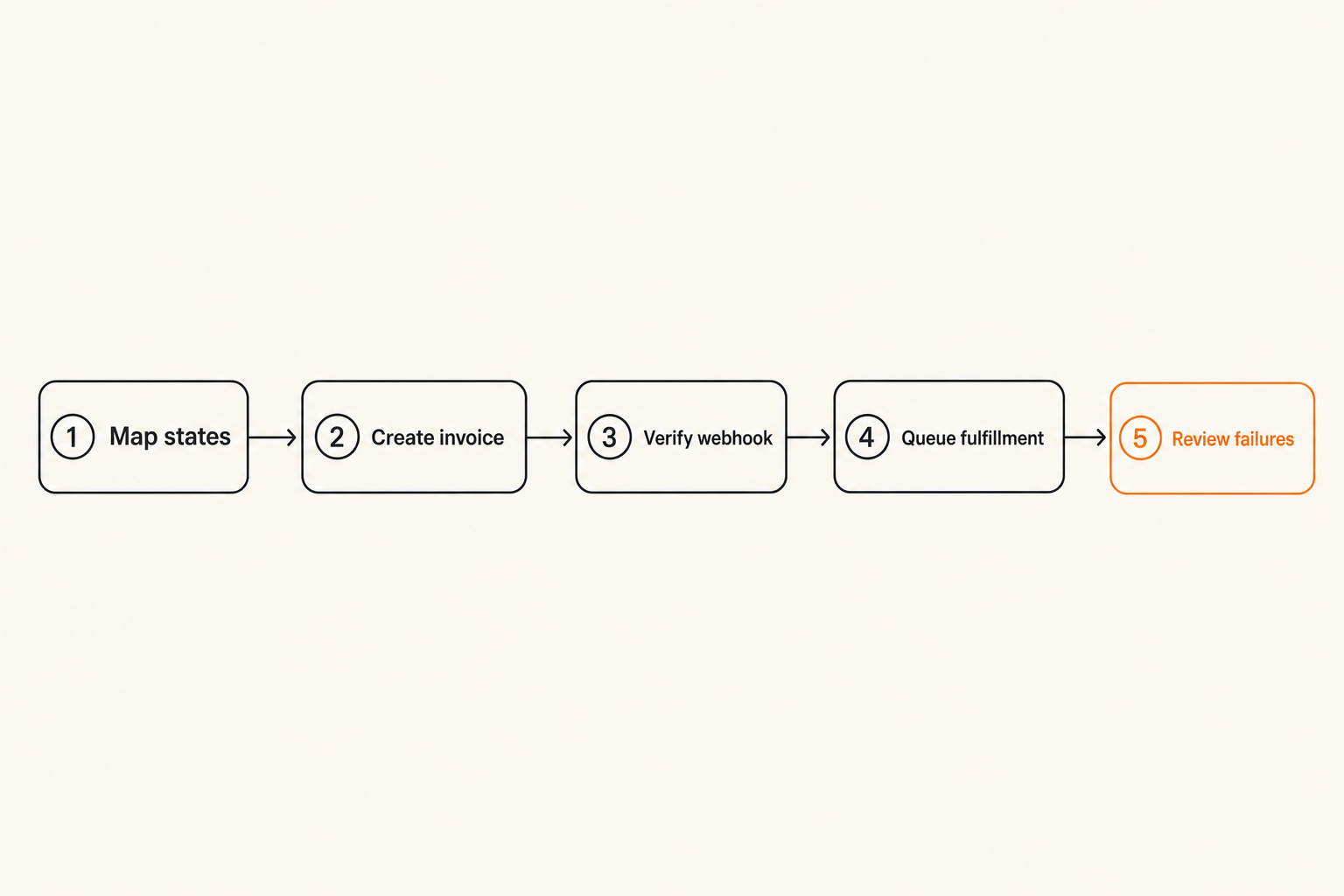
Start on paper before touching an API. Map every order state and decide which system owns it.
A simple implementation sequence:
- Define order states in the storefront.
- Define payment invoice states in the payment gateway.
- Map which payment states unlock fulfillment.
- Define manual review states for exceptions.
- Define refund and cancellation states.
- Add support-facing explanations for each exception.
- Test with small orders before opening full traffic.
The mistake teams make is integrating the payment button first. That creates a demo, not a payment system.
Step 2: integrate the payment API
Your integration should create an invoice from the server side, not from untrusted browser data. The server should calculate the order total, create the payment request, store the invoice mapping, and return the checkout URL or payment instructions to the browser.
Implementation checklist:
- create invoices server side
- store gateway invoice ID immediately
- verify webhook signatures
- process webhook events idempotently
- do not trust client-side payment status
- require confirmations before fulfillment
- log raw events for audit
- expose a support view for invoice status
The docs matter here. Builders should read the gateway behavior before designing the order model, not after. CoinPay publishes implementation details in its developer documentation for teams wiring checkout and payment status into production systems.
Step 3: observe failures before scaling
Run a controlled launch. Use internal test orders, small live transactions, and known edge cases.
Test these cases deliberately:
- exact payment
- underpayment
- overpayment
- expired invoice
- delayed confirmation
- webhook retry
- duplicate webhook
- refund request
- customer support lookup
You are not trying to prove the happy path. You are trying to find the edge cases before customers do.
Related reading from our network: infrastructure teams making compute decisions face the same basic lesson in cloud computing for AI, video, and decentralized compute builders: the workflow matters more than the label on the service.
What works for GHK peptide merchants
Start with a narrow payment surface
The best first crypto checkout is usually narrow. One or two assets. One or two networks. Clear instructions. Strong support visibility.
That may sound less ambitious, but it is how you reduce operational noise. You can add more assets later after you know which buyers actually use crypto and which support issues repeat.
A narrow launch also makes accounting easier. Finance can reconcile fewer settlement paths, support can learn fewer failure modes, and engineering can monitor fewer integrations.
Make crypto instructions unambiguous
Good instructions reduce tickets. Tell the buyer the asset, network, exact amount, expiration time, and what confirmation means. Warn clearly if sending on the wrong network can delay or lose funds.
Do not assume buyers understand wallet behavior. Some will pay from exchanges. Some will scan QR codes. Some will copy addresses. Some will wait too long and then send anyway.
The checkout should explain what happens next in plain language:
- send exactly this amount
- use only this network
- wait for confirmation
- do not close support evidence if payment is delayed
- contact support with the invoice ID and transaction hash
Separate fulfillment from payment approval
Payment confirmation should enqueue fulfillment. It should not directly ship the order inside the webhook handler.
Use a queue or job system. The webhook updates payment state. A fulfillment worker checks order eligibility, inventory, compliance flags, fraud rules, and shipping constraints before release.
This separation prevents duplicate shipment, gives operations a manual hold path, and makes the system easier to debug.
What fails in production
Treating a wallet address like a gateway
The most common failure is posting a static wallet address on the checkout page and asking customers to send funds.
That can work for a tiny manual operation, but it does not scale. You lose per-order address mapping, automated amount matching, expiration handling, event logs, and support visibility.
A wallet receives funds. A gateway manages payment workflow. Those are different jobs.
Ignoring support operations
Many developers build the payment path and forget the support path. Then the first real buyer sends from an exchange, pays late, or asks for a refund, and the operator has to inspect wallets manually.
Support needs a dashboard or internal view showing invoice status, expected amount, received amount, asset, network, transaction hash, confirmations, order state, and next action.
If support cannot resolve common cases without engineering, the system is not production-ready.
Choosing assets for hype instead of reliability
Adding trending tokens may look good in marketing copy, but it creates real costs. More assets mean more liquidity decisions, more wallet monitoring, more refund complexity, more customer confusion, and more accounting work.
The practical filter is simple: does this asset make checkout easier for the buyer segment you actually serve?
If not, leave it out.
Product fit: using coinpayportal.com for GHK peptide payments
Where CoinPay fits in the architecture
CoinPay is useful when a merchant wants crypto payment acceptance without pretending the UI is the whole system. The important parts are invoice creation, payment tracking, automatic fee handling, real-time processing, and operational workflows around checkout.
For GHK peptide merchants, that means CoinPay should sit between the storefront and the wallet layer as payment infrastructure. Your store owns catalog, compliance language, customer records, fulfillment, and support policy. CoinPay helps with the crypto payment workflow that connects buyer payment to merchant settlement.
That is the right boundary. The payment gateway should not run your peptide business. It should give your business a reliable way to collect and verify crypto payments.
When CoinPay is not the right layer
CoinPay does not replace legal review, product policy, inventory controls, customer support, or tax accounting. If the storefront makes unsupported claims, ships into restricted destinations, or lacks refund rules, a payment gateway will not fix that.
It also does not remove the need for operational discipline. You still need idempotent webhook handling, internal order states, reconciliation, and support processes.
The strongest setup is boring: clear catalog policy, narrow asset support, auditable invoice states, documented refund rules, and a gateway that handles payment events cleanly.
For GHK peptide sellers, that boring setup is usually the difference between a fragile workaround and a payment system.
Try coinpayportal.com
You are writing for developers and merchants building crypto payment infrastructure. If you need a non-custodial crypto checkout layer for GHK peptide payments, start with Try coinpayportal.com.
Try CoinPay
Crypto payments, escrow, and wallets — multi-chain, Lightning-ready, and fast to integrate.
Get started →