Freelancing Crypto in 2026: Payment Architecture for Developers, Merchants, and Independent Operators

Freelancing crypto sounds simple until a client pays the wrong network, sends a partial amount, asks for a refund, or disputes whether a milestone was delivered. Then the wallet address is not the system. It is just the place where the failure becomes visible.
Teams think the problem is accepting crypto. The real problem is operating a payment workflow that can survive real clients, real invoices, real accounting, and real support.
That changes the conversation. Freelancing crypto in 2026 is less about which coin looks modern and more about invoice state, confirmations, custody boundaries, reconciliation, escrow, and support handoffs. If those pieces are not designed, the freelancer becomes the payment processor manually.
The practical question is: can a freelancer or platform accept crypto without turning every payment into a one-off investigation?
Table of contents
- Freelancing crypto is payment infrastructure, not a wallet choice
- The freelancing crypto payment model
- Checkout and invoicing architecture for freelancers
- Webhooks, confirmations, and payment state
- Reconciliation is where freelancing crypto succeeds or fails
- Escrow and milestone payments without chaos
- Risk controls for client and freelancer operations
- Developer implementation sequence for freelancing crypto
- What breaks when teams implement it badly
- Where CoinPayPortal fits in a freelancer payment stack
Freelancing crypto is payment infrastructure, not a wallet choice
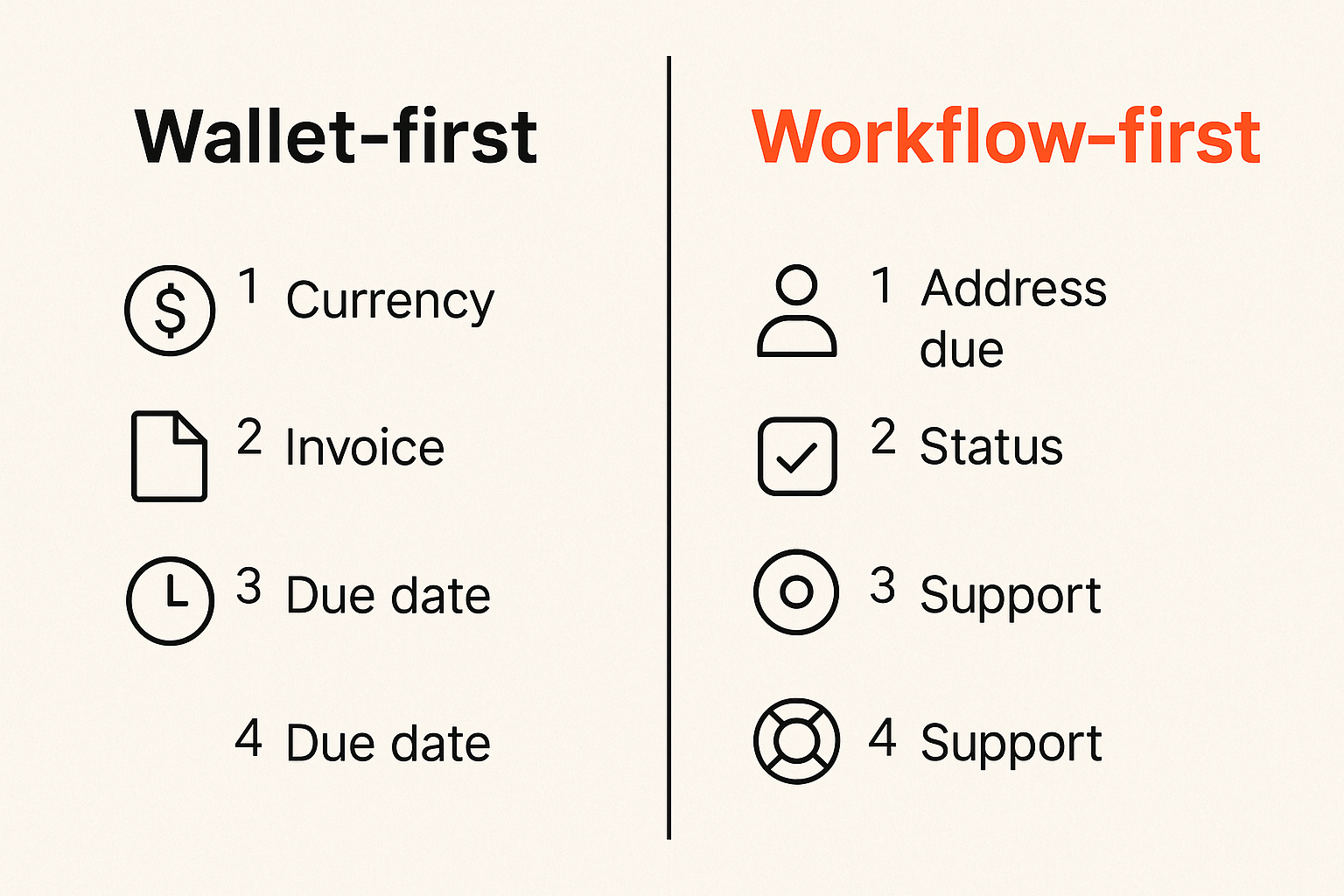
The workflow starts before the invoice
A useful way to think about freelancing crypto is to start with the job, not the asset. A designer sells a brand package. A developer ships a smart contract audit. A video editor delivers a batch of assets. The payment flow has to represent that commercial reality.
Before an invoice exists, the freelancer needs answers to basic operational questions:
- Who is the client of record?
- What work is covered by the payment?
- Is payment due upfront, on delivery, or by milestone?
- Which currency is the price denominated in?
- Which network and token are acceptable?
- What happens if the client pays late or sends the wrong amount?
The mistake teams make is treating these questions as support issues instead of product requirements. If the workflow does not encode them, the freelancer ends up resolving payment ambiguity through screenshots and chat threads.
Why merchants and freelancers need the same controls
Freelancers often think they are too small to need merchant-grade controls. In practice, they face the same failure modes as larger sellers, just with less operational backup.
A merchant selling software needs order IDs, payment status, refunds, support notes, and accounting exports. A freelancer selling services needs the same things: invoice IDs, milestone references, delivery status, refund policy, and tax records.
This guest contribution is informed by the team at ugig.net, where the focus is on helping freelancers and gig economy professionals turn tools into repeatable work systems rather than one-off hacks.
Practical rule: if a crypto payment cannot be tied to a specific invoice, client, deliverable, and settlement record, it is not production-ready for freelancing.
What changes in 2026
By 2026, many clients are comfortable paying with stablecoins or crypto assets, especially across borders. The problem is not awareness. The problem is operational trust.
Clients want to know the amount will be recognized. Freelancers want to know the payment is final enough to start or release work. Platforms want to avoid becoming a manual dispute desk. Developers want clean APIs, webhook events, and deterministic state transitions.
That is why freelancing crypto should be designed as a payment architecture. Wallets matter, but they are not enough. The system needs to know what the wallet activity means.
The freelancing crypto payment model
Parties, trust, and settlement
A crypto freelancing transaction usually has four layers:
| Layer | Practical role | Common failure if ignored |
|---|---|---|
| Client | Sends payment for work | Pays wrong chain, wrong token, or wrong amount |
| Freelancer | Provides service and receives funds | Cannot match payment to invoice |
| Gateway or payment layer | Creates invoice, tracks payment, sends events | Webhooks missing, duplicate status updates |
| Accounting and operations | Records revenue, fees, taxes, refunds | End-of-month cleanup becomes manual |
The chain transaction is only one event in the model. The business transaction includes pricing, terms, delivery, confirmation, and settlement.
For example, a freelancer may quote 2,000 USD for a project and accept USDC on a supported network. The client sees a crypto checkout page. The payment layer watches the address or invoice. Once confirmations pass the configured threshold, the invoice moves from pending to paid. The freelancer sees a business record, not just a transaction hash.
That changes the conversation from did money arrive to did the right invoice reach the right state under the agreed terms.
Custody boundaries
Custody is where many freelancers and platforms get vague. Vague custody is dangerous because it creates unclear responsibility.
There are three common models:
| Model | Who controls funds | Best fit | Main risk |
|---|---|---|---|
| Direct wallet | Freelancer controls address | Simple solo work | Manual tracking and privacy leakage |
| Payment gateway | Gateway tracks or routes payment | Professional invoicing and checkout | Integration must be correct |
| Escrow or marketplace wallet | Platform holds until release | Milestones and disputes | Higher operational and compliance burden |
The practical question is not which model is purest. It is which model matches the promise made to the client. If you promise escrow, you need release logic. If you promise instant direct payment, you need clear refund expectations. If you promise invoice automation, you need reliable payment status.
Stablecoins versus volatile assets
For freelancing, stablecoins are usually the operational default because the job is often priced in fiat terms. A freelancer may be open to Bitcoin, ETH, or other assets, but volatility introduces a quoting problem.
If a project is priced at 1 ETH, the freelancer is speculating. If it is priced at 2,000 USD payable in ETH, the system needs a rate source, quote expiry, and rules for late payments.
Practical rule: denominate the commercial obligation separately from the settlement asset. The invoice should know the price, accepted token, network, quote expiry, and underpayment tolerance.
This matters when support cases happen. If the client pays after the quote expires and the token price moved, the freelancer needs a policy the system can enforce. Otherwise every late payment becomes a negotiation.
Checkout and invoicing architecture for freelancers
Hosted checkout versus direct wallet requests
The simplest crypto freelancing flow is sending a wallet address in a message. That can work for trusted repeat clients, but it does not scale well.
A hosted checkout flow gives the client an invoice page with amount, token, network, expiry, and payment instructions. It also gives the freelancer a status record. Direct wallet requests are faster to set up, but they shift every edge case to the freelancer.
| Approach | What works | What breaks in practice |
|---|---|---|
| Direct wallet address | Quick for trusted clients | No invoice state, weak reconciliation, privacy reuse |
| Static QR code | Easy for tips or donations | Not tied to unique job or client |
| Hosted crypto checkout | Clear payment instructions and tracking | Requires gateway configuration |
| API-created invoice | Best for platforms and apps | Requires engineering ownership |
The mistake teams make is optimizing for the first payment instead of the fiftieth. The first payment only needs an address. The fiftieth needs records, filters, exports, and support context.
Required invoice fields
A freelancer-ready crypto invoice should include more than an amount and wallet address. At minimum, store:
- invoice ID
- client ID or client email
- project or milestone ID
- fiat price and currency
- accepted crypto asset
- network
- crypto amount quoted
- quote creation time
- quote expiry time
- payment address or checkout session ID
- status
- transaction hash or hashes
- confirmation count
- fees, if known
- notes for fulfillment or delivery
This is not bureaucracy. It is how you avoid losing the story of the payment.
A compact invoice object might look like this:
{
  "invoice_id": "inv_10492",
  "client_id": "client_778",
  "project_id": "proj_landing_page",
  "fiat_total": "1500.00",
  "fiat_currency": "USD",
  "asset": "USDC",
  "network": "polygon",
  "quoted_amount": "1500.00",
  "expires_at": "2026-05-27T18:30:00Z",
  "status": "pending_payment"
}
Idempotency and duplicate payment handling
In production, clients refresh pages, click buttons twice, switch wallets, and ask whether they need to resend. Your invoice creation endpoint should be idempotent so the same business action does not create multiple open invoices.
Use an idempotency key tied to the business action, not the browser session. For example:
idempotency_key = client_id + project_id + milestone_id + invoice_version
Duplicate payments are a different issue. A client may accidentally pay twice. Your system should detect multiple transactions against the same invoice and move them into a review or overpaid state instead of silently marking everything as normal.
Practical rule: idempotency prevents duplicate invoices; reconciliation detects duplicate payments. You need both.
Webhooks, confirmations, and payment state
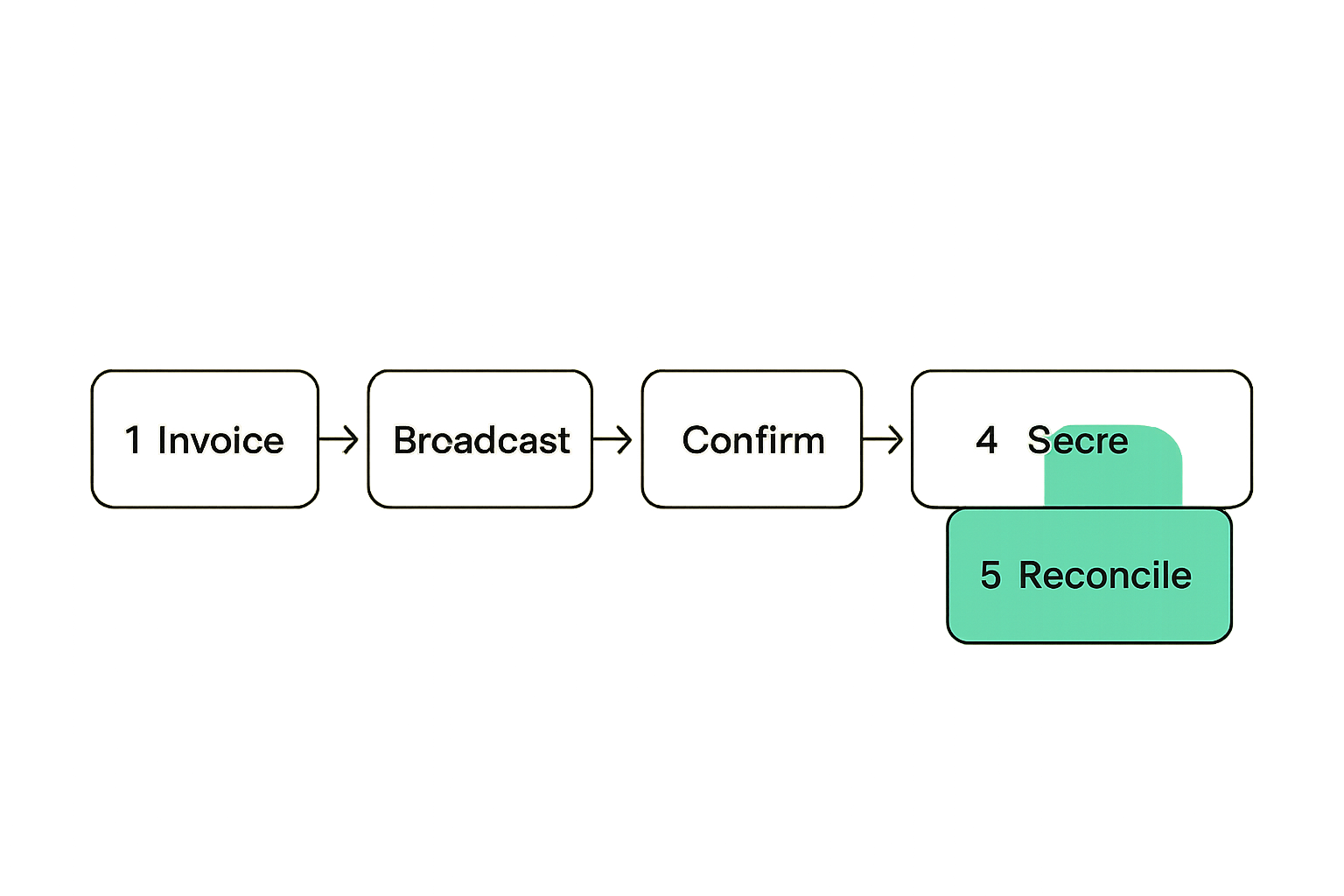
The payment status lifecycle
Crypto payments are asynchronous. A client can submit a transaction, but that does not mean the freelancer should immediately release work. The payment needs to move through explicit states.
A practical lifecycle looks like this:
created— invoice exists, no payment observed.pending_payment— checkout opened or payment instructions displayed.payment_detected— transaction observed but not final enough.confirming— confirmations are increasing.paid— confirmation threshold met and amount is acceptable.settled— funds are available under the chosen custody model.expired,underpaid,overpaid, orfailed— exception states.
What breaks in practice is treating detected as paid. For some service categories, that may be acceptable. For high-value deliverables, it usually is not.
Retry rules and signature verification
Webhooks are the bridge between payment infrastructure and the freelancer’s business system. They are also a common source of subtle bugs.
A webhook endpoint should:
- verify the webhook signature;
- reject unsigned or invalid payloads;
- process events idempotently;
- return quickly;
- enqueue longer work for background processing;
- tolerate retries and out-of-order delivery;
- log event IDs and invoice IDs together.
Do not trigger delivery directly from an unverified webhook. Store the event, validate it, update invoice state, then let fulfillment logic react to the state change.
A simple handler pattern:
receive webhook
verify signature
if event_id already processed:
  return 200
store raw event
load invoice
apply valid state transition
enqueue fulfillment if invoice.status == paid
return 200
Handling partial, late, and overpaid invoices
Partial payments are common when clients copy amounts incorrectly or pay network fees from the wrong balance. Late payments happen when a quote expires but the checkout page remains open in a browser tab. Overpayments happen when clients round up or send twice.
Do not collapse all of these into failed. They need distinct states because the operational response is different.
| Condition | Example | Recommended state | Operator action |
|---|---|---|---|
| Partial payment | 980 USDC sent for 1,000 USDC invoice | underpaid | Request remaining amount or adjust invoice |
| Late payment | Payment after quote expiry | late_payment | Review rate policy |
| Overpayment | Client sends 1,050 USDC | overpaid | Mark paid and decide refund or credit |
| Wrong network | Token sent on unsupported chain | unsupported_payment | Escalate with recovery policy |
The point is not to automate every exception. The point is to make exceptions visible and structured.
Reconciliation is where freelancing crypto succeeds or fails
Map chain events to business records
Reconciliation is the unglamorous part that determines whether freelancing crypto remains usable after the first month. A wallet balance tells you what is there. It does not tell you why.
You need a mapping between chain events and business records:
- transaction hash to invoice ID;
- invoice ID to client;
- client to project;
- project to revenue category;
- fees to cost category;
- refunds to original payment.
Without this mapping, accounting becomes forensic work. The freelancer scrolls through wallet history and chat messages trying to reconstruct income. That may work at low volume, but it fails as soon as there are multiple clients, tokens, or networks.
Separate revenue, fees, and network costs
A crypto payment can include several economic components. The invoice amount may be revenue. Network fees may be paid by the client or the freelancer depending on the flow. Gateway fees may be deducted before settlement. Conversion fees may apply if the freelancer settles into another asset or currency.
Your records should separate these components rather than storing one net number.
Example ledger-style view:
| Field | Amount | Meaning |
|---|---|---|
| Gross invoice | 1,500.00 USDC | Client obligation |
| Gateway fee | 15.00 USDC | Processing cost |
| Network fee | 0.10 MATIC | Chain fee |
| Net received | 1,485.00 USDC | Amount available to freelancer |
This is especially important when freelancers work across borders. The payment may settle quickly, but reporting obligations still depend on clean records.
Export data your accountant can use
A useful export is not a screenshot. It is structured data with stable identifiers.
At minimum, support CSV or API exports that include:
- invoice ID;
- client name or client ID;
- payment date;
- settlement date;
- fiat value at invoice time;
- token and network;
- transaction hash;
- gross amount;
- fees;
- net amount;
- refund references;
- project or category.
The practical question is whether a freelancer can close the month without opening five dashboards. If not, the payment stack is incomplete.
Escrow and milestone payments without chaos
When escrow makes sense
Escrow is useful when trust is incomplete and the deliverable can be evaluated before release. It is common for larger freelance jobs, marketplace work, code audits, design packages, and staged consulting.
But escrow is not just a checkbox. If a platform says funds are held until delivery, the platform needs rules for deposit, milestone acceptance, release, refund, timeout, and dispute review.
Escrow adds value when:
- the project has clear milestones;
- both parties agree on acceptance criteria;
- the payment amount justifies the extra process;
- there is a defined dispute path;
- the platform is prepared to operate the workflow.
Escrow fails when it is used to hide unclear scope. If the deliverable is vague, holding funds will not fix the relationship.
Milestone release workflow
A basic milestone workflow can be implemented without making the user experience heavy:
- Freelancer creates a milestone invoice.
- Client funds the milestone using the supported crypto checkout.
- System marks the milestone as funded after confirmations.
- Freelancer submits deliverables.
- Client accepts, requests revisions, or opens a dispute.
- Funds are released, partially released, or refunded according to policy.
- Ledger records tie the release to the original deposit and milestone.
The key is separating funded from released. A funded milestone means the client has committed funds. It does not always mean the freelancer can withdraw them.
Disputes need evidence, not vibes
Disputes are where weak workflows become expensive. The platform or freelancer needs evidence: scope, messages, files, timestamps, invoice terms, payment status, and delivery records.
For solo freelancers, this may be as simple as storing signed proposals and delivery links next to the invoice. For marketplaces, it means building a dispute record that support can review without asking both parties to resend everything.
Practical rule: escrow should reduce ambiguity. If it creates more ambiguity, the milestone terms are not specific enough.
Risk controls for client and freelancer operations
Address screening and compliance context
Not every freelancer needs the same compliance stack as a regulated financial institution, but ignoring risk entirely is a bad default. A freelancer or platform may need to understand whether funds come from high-risk sources, whether a client is in a restricted region, or whether a payment triggers internal review.
The practical approach is risk-tiered:
| Risk tier | Example | Control |
|---|---|---|
| Low | Repeat client paying small stablecoin invoice | Standard checkout and records |
| Medium | New client, larger cross-border invoice | Extra identity and project context |
| High | Unusual payment source or large urgent request | Manual review before delivery |
This is not about turning every freelancer into a compliance department. It is about giving operators enough context to avoid obvious mistakes.
Refunds, chargeback expectations, and reversibility
Crypto payments are generally not chargeback-based in the same way card payments are. That can be useful for freelancers who have dealt with post-delivery reversals. But it also means refund policies need to be explicit.
A client should know:
- when a refund is available;
- which asset will be refunded;
- whether network fees are deducted;
- what happens if the asset price changes;
- how long manual review takes;
- whether partial refunds are possible.
If the freelancer accepts payment in one asset and refunds in another, that needs to be stated. If refunds are based on fiat value rather than token quantity, that also needs to be stated.
Operational limits and approvals
Even small teams need limits. A freelancer may be comfortable automatically accepting a 300 USDC invoice but want manual approval for a 20,000 USDC project. A marketplace may require review before releasing high-value escrow.
Common controls include:
- maximum automatic invoice amount;
- allowed tokens and networks;
- allowed client regions;
- manual review thresholds;
- withdrawal approval rules;
- refund approval rules;
- role-based access for assistants or finance staff.
The mistake teams make is adding these controls only after an incident. Build them before volume forces the issue.
Developer implementation sequence for freelancing crypto
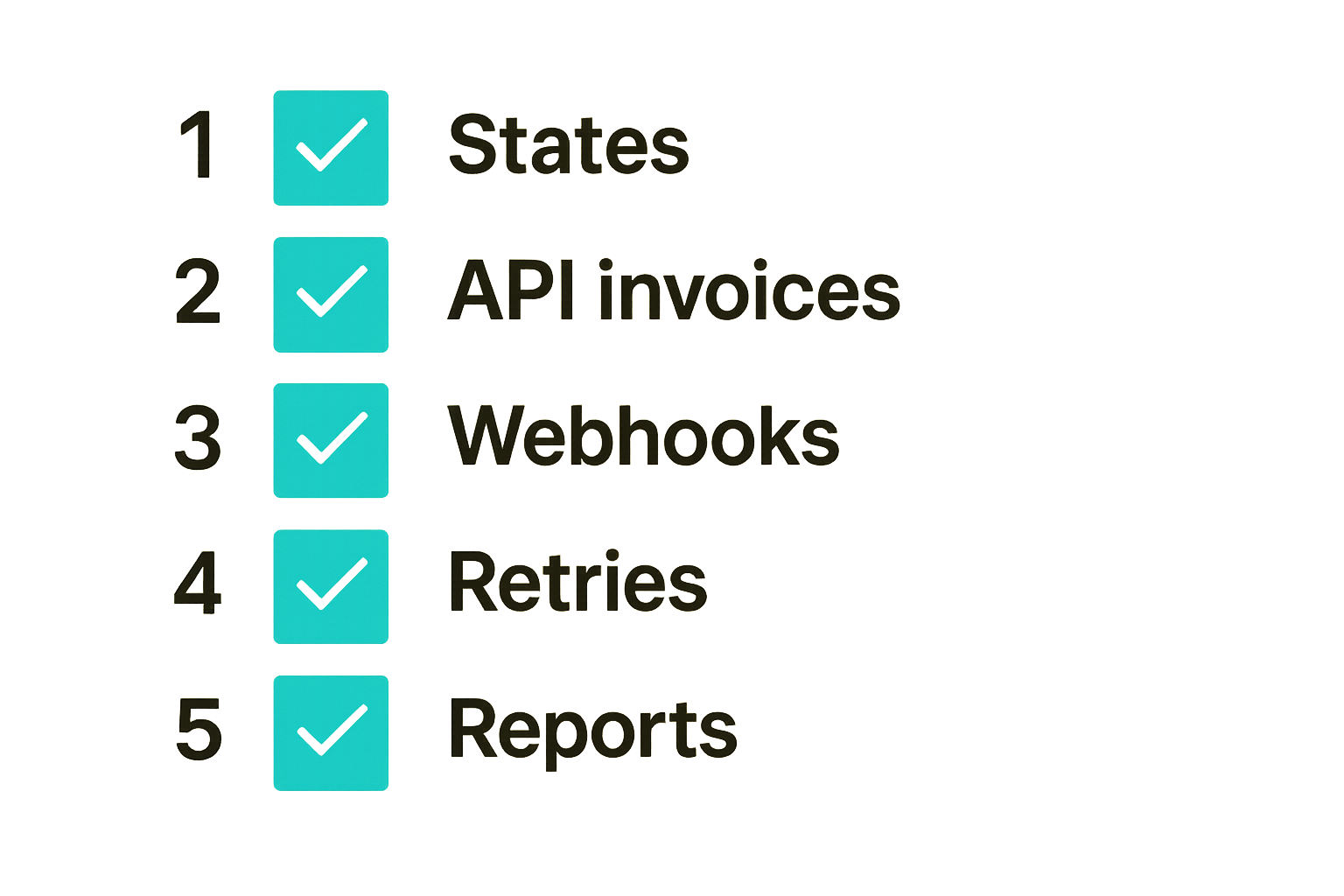
Step 1 define payment states
Start with state design. Do not begin with buttons or wallet logos. The system needs a finite set of statuses and legal transitions.
A minimal state machine:
created -> pending_payment
pending_payment -> payment_detected
payment_detected -> confirming
confirming -> paid
paid -> settled
pending_payment -> expired
confirming -> underpaid
confirming -> overpaid
paid -> refunded
Keep exception states explicit. Support and accounting depend on them.
Step 2 create invoices through an API
Once states are defined, create invoices through an API or gateway that returns a checkout URL, payment instructions, and an invoice identifier.
The application should store the returned gateway invoice ID next to its own business ID. Never rely only on an external dashboard.
Implementation sequence:
- User selects project milestone or service package.
- Application calculates fiat price and accepted assets.
- Backend creates invoice with idempotency key.
- Gateway returns checkout session and payment metadata.
- Application stores invoice mapping.
- Client pays through hosted checkout or wallet instructions.
- Webhooks update local invoice state.
This sequence keeps the source of truth clear. Your app owns the business context. The gateway owns payment observation and payment events.
Step 3 verify webhooks before fulfillment
Fulfillment may mean starting work, releasing a file, granting access, or marking a milestone funded. Do not do that from the client browser after a redirect. Browser redirects are user experience signals, not payment truth.
Use server-side webhook verification. Then update internal state. Then trigger fulfillment.
if invoice.status changed to paid:
  if invoice.type == upfront_project:
    notify freelancer to begin
  if invoice.type == digital_delivery:
    release asset
  if invoice.type == escrow_deposit:
    mark milestone funded
This pattern keeps payment confirmation separate from user navigation.
Step 4 reconcile daily
Daily reconciliation sounds excessive until the first missing payment. It does not need to be manual. A scheduled job can compare gateway records, local invoice records, wallet transactions, and settlement reports.
A daily job should flag:
- invoices paid externally but not updated locally;
- local paid invoices missing transaction hashes;
- gateway events not processed;
- expired invoices with later payments;
- refunds not tied to original invoices;
- settlement amounts that do not match expected net amounts.
The goal is not perfection. The goal is fast detection while the client, freelancer, and transaction context are still fresh.
What breaks when teams implement it badly
What fails
Bad freelancing crypto systems tend to fail in predictable ways.
First, they reuse static wallet addresses for every client. That makes it hard to identify who paid and can leak business activity.
Second, they rely on screenshots as proof. Screenshots are not state. They can help support, but they should not drive fulfillment.
Third, they ignore quote expiry. A client pays an old amount after prices move, and nobody knows whether the invoice is valid.
Fourth, they treat all exceptions as manual support. Underpayments, overpayments, wrong-network payments, and late payments need different handling.
Fifth, they do not reconcile. The stack appears to work until tax season or a client asks for a receipt.
What works
What works is boring and durable:
- unique invoice identifiers;
- unique payment sessions;
- explicit token and network choices;
- clear quote expiry;
- server-side webhook validation;
- structured exception states;
- daily reconciliation;
- exportable records;
- documented refund and escrow policies.
A freelancer does not need enterprise complexity. But they do need enough structure that payment operations do not depend on memory.
A simple readiness checklist
Before offering crypto payments for freelance work, ask:
- Can every payment be tied to one invoice?
- Can every invoice be tied to one client and project?
- Do you know when payment is detected versus confirmed?
- Do you handle underpayments and overpayments differently?
- Do you store transaction hashes and settlement records?
- Can you export income and fee data?
- Do clients see clear network and token instructions?
- Is your refund policy written down?
- Do you have a process for disputes?
If the answer is no to several of these, the issue is not crypto adoption. The issue is workflow design.
Where CoinPayPortal fits in a freelancer payment stack
Gateway layer, not your whole business system
A payment gateway should not pretend to be your entire freelance business. Your CRM, proposal tool, project management system, and accounting process still matter.
The gateway layer should do the payment-specific work well:
- create checkout sessions;
- present supported crypto payment options;
- track payment status;
- emit reliable webhook events;
- help connect transactions to invoices;
- support settlement and operational reporting.
That separation is healthy. It lets developers and merchants build the business workflow they need while relying on payment infrastructure for the parts that are easy to get wrong.
Product fit for developers and merchants
CoinPayPortal fits best where a freelancer, merchant, or platform wants to accept crypto without reducing the workflow to send me a wallet address. Developers can connect invoice creation, checkout, webhook handling, and reconciliation into their own application logic.
For solo freelancers, that can mean professional crypto invoices and cleaner records. For agencies, it can mean milestone payments that finance can track. For marketplaces, it can mean a payment layer that plugs into onboarding, escrow, release, and dispute flows.
The useful way to evaluate any gateway is simple: does it reduce payment ambiguity for both sides? If it does, freelancing crypto becomes a business process. If it does not, it is just another wallet interaction.
Freelancing crypto will keep growing because cross-border work is growing, remote teams are normal, and clients want flexible settlement. But the winners will not be the teams with the flashiest checkout button. They will be the teams that make state, trust, settlement, and support boring.
Try coinpayportal.com
CoinPayPortal helps developers and merchants build crypto payment flows with checkout, payment tracking, and gateway infrastructure for real operations. Try coinpayportal.com.
Try CoinPay
Crypto payments, escrow, and wallets — multi-chain, Lightning-ready, and fast to integrate.
Get started →