Encrypted Messaging Crypto: A Practical Architecture for Payment Teams
Encrypted messaging crypto usually enters the backlog after something uncomfortable happens.
A customer sends a wallet address in a support thread. A merchant asks for a transaction hash over chat. A developer pastes webhook payloads into a private group to debug settlement. Everyone involved believes the channel is encrypted, so the workflow feels safe enough.
Teams think the problem is choosing a secure messenger. The real problem is deciding what payment state is allowed to move through messaging at all.
That changes the conversation. Encrypted messaging crypto is not a feature label. For merchants, fintech founders, and blockchain engineers, it is an architecture decision about checkout state, customer identity, custody boundaries, support workflows, and reconciliation. The UI is not the system. The system is what happens when a payment is pending, delayed, disputed, underpaid, overpaid, refunded, or manually reviewed.
Table of contents
- Why encrypted messaging crypto is a payments architecture problem
- Start with the threat model, not the messenger
- What belongs in encrypted messaging crypto workflows
- A reference architecture for private payment coordination
- Implementation workflow from order to settlement
- Encryption, keys, and identity decisions
- Webhooks, retries, idempotency, and reconciliation
- Failure modes in encrypted messaging crypto
- What works, what fails, and what to measure
- Where CoinPayPortal fits in encrypted messaging crypto
Why encrypted messaging crypto is a payments architecture problem

Payment data is conversation state
Payment teams often treat messaging as separate from payment infrastructure. The checkout flow lives in the gateway. The webhook handler updates the order. The ledger reconciles settlement. Chat is just where humans talk.
In production, that separation does not hold. A support message can influence whether an order is shipped. A transaction hash sent by a buyer can trigger manual confirmation. A merchant account manager can ask finance to refund an address. A developer can use a chat thread as the informal incident log for a failed webhook.
The mistake teams make is assuming that encrypted chat automatically makes these actions safe. Encryption protects content in transit and, depending on the design, from the service provider. It does not decide whether the content should exist in that channel, who is allowed to act on it, or how that action is written back to the payment system.
Practical rule: If a message can change order state, refund state, shipment state, or customer trust, treat it as part of the payment workflow.
Why this matters in 2026
Crypto payments have moved past the simple donate button. Merchants now need multi-chain support, hosted checkout, API-driven invoices, stablecoin settlement, refund handling, subscription logic, and customer support across time zones.
At the same time, customers expect private communication. They do not want wallet addresses, transaction IDs, order disputes, and identity documents floating through unmanaged channels. Builders also know that public blockchains expose enough information already. Adding sloppy messaging on top makes correlation easier.
The practical question is not whether encrypted messaging crypto is good or bad. The practical question is: where does private communication sit in the payment stack, and what is it allowed to do?
The boundary you need to define
A useful way to think about it is this:
- The payment gateway is the authority for payment intent, amount, currency, network, address generation, expiration, and confirmation rules.
- The ledger or accounting system is the authority for settlement, balances, fees, and reconciliation.
- The support system is the authority for tickets, customer contact history, escalation, and resolution.
- The encrypted messaging layer is a coordination channel, not the source of truth.
When teams define that boundary early, private communication becomes useful. When they do not, chat becomes a shadow payment system with worse controls.
Start with the threat model, not the messenger
Who can see which part of the workflow
Before choosing any encrypted messaging product, map who can see which parts of the payment workflow. Include customers, support agents, finance operators, developers, vendors, compliance reviewers, and automated bots.
For each role, ask:
- Can they see the order ID?
- Can they see wallet addresses?
- Can they see transaction hashes?
- Can they see personally identifiable information?
- Can they trigger a refund or manual release?
- Can they export the conversation?
- Can they invite new participants?
This sounds basic, but it is where many implementations fail. The team debates cryptography while the workflow still allows a contractor to screenshot refund instructions from a group chat.
The team at qrypt.chat works on private communication problems from the messaging side, and the same lesson applies to payments: encryption is only useful when the surrounding workflow respects the sensitivity of the data.
Metadata is still operational data
Even strong encryption may leave metadata. Depending on the system, metadata can include participants, timestamps, message sizes, device identifiers, contact graph information, delivery status, or IP-level network traces.
For payment operations, metadata can be revealing. If a VIP merchant always messages finance before large withdrawals, the timing alone may leak business activity. If a support channel spikes after a token network incident, message volume can reveal operational stress. If a customer and merchant chat immediately before an on-chain transaction, correlation becomes easier.
You do not need to solve every metadata problem to ship. But you do need to avoid pretending it does not exist.
Practical rule: Do not put business logic in a channel where you cannot reason about content, metadata, retention, and access together.
Custody and support increase the blast radius
Crypto payment systems have different custody models. Some merchants receive directly into their own wallet. Some use payment processors that generate addresses and forward funds. Some keep balances with a provider before withdrawal. Some use escrow-style flows.
The more your support workflow touches custody, the more careful messaging needs to be. A chat message that says please resend to this address is not a harmless support note. It can redirect funds. A message that asks for a seed phrase is obviously wrong, but subtler problems happen more often: refund addresses, exchange deposit addresses, unsigned invoices, and manual approval notes.
If your team supports high-value payments, stablecoin settlement, or B2B invoices, assume attackers will target the messaging layer because it is where humans can be persuaded.
What belongs in encrypted messaging crypto workflows
Send context, not authority
Encrypted messaging crypto works best when messages provide context but do not create authority.
Good message content looks like this:
- Your invoice INV-18492 is waiting for payment.
- The checkout link expires in 14 minutes.
- We detected a payment on the selected network and are waiting for confirmations.
- Support ticket T-5812 has been escalated to finance.
- A refund review has started. Check your merchant dashboard for the authoritative status.
Bad message content looks like this:
- Send funds to this address copied into chat.
- Your payment is confirmed because an agent said so.
- Reply with your private key or seed phrase.
- Use this new refund address from a support message.
- Ignore the dashboard and follow the instructions in this thread.
The difference is not tone. It is authority. In the good examples, the user is directed back to a controlled system. In the bad examples, the message itself becomes the control plane.
Use references instead of raw secrets
A private message can safely carry references that point to server-side records. For example:
- invoice_id: INV-18492
- order_id: ORD-77104
- support_ticket_id: T-5812
- payment_intent_id: PI-2026-06-0019
- correlation_id: req_8f31c2
Those references should be useless without authenticated access to the merchant dashboard, checkout page, or API. That is the pattern you want. The message helps the user find the right object, but the sensitive action happens somewhere with access control, validation, logging, and rate limits.
A common implementation is to send a short message with a signed, expiring link to the checkout or support portal. The link should not expose private data by itself. It should resolve to a page that checks session state, token validity, merchant account context, and order status.
What should never be sent in chat
Some data should not move through messaging, even encrypted messaging, unless you have a very specific reason and controls around it.
Avoid sending:
- Seed phrases, private keys, raw signing keys, or recovery codes
- Unmasked identity documents
- Full card details or bank account details
- Admin API keys or webhook signing secrets
- Raw database exports
- Permanent deposit addresses used as instructions outside checkout
- Refund approval commands without a second system of record
- Screenshots that reveal balances, internal risk notes, or customer PII
Practical rule: If rotating the value would be painful, do not paste it into chat. If you cannot rotate it at all, definitely do not paste it into chat.
A reference architecture for private payment coordination
Keep the checkout system authoritative
The checkout system should generate the payment intent, present the network and amount, handle address assignment, track expiration, listen for on-chain activity, apply confirmation rules, and update the order. Messaging should not replace any of that.
This matters because crypto payments have state transitions that look simple but are easy to mishandle:
- created
- waiting_for_payment
- detected
- underpaid
- overpaid
- confirming
- confirmed
- expired
- refunded
- failed_manual_review
If chat becomes the place where these states are decided, you lose consistency. One agent says confirmed, another sees pending, the ledger says underpaid, and the customer gets shipped goods before settlement.
The gateway, not the message, should answer: is this payment valid for this order right now?
Treat messaging as a notification and coordination layer
Messaging is useful when it is scoped correctly. It can notify a customer that payment was detected. It can ask a merchant operator to review a high-value order. It can tell support that a customer claims to have paid from a different wallet. It can coordinate an incident response when a webhook endpoint is down.
But the message should link back to the system that owns the decision. For example:
- Customer message: Payment detected. Confirmations are still pending. View status in checkout.
- Support message: Customer reports payment from alternate sender wallet. Review order in admin.
- Finance message: Refund request created. Approve or reject in dashboard.
- Developer message: Webhook delivery failed after retries. Inspect event log.
This keeps the private channel useful without turning it into an unstructured database.
Use event-driven glue between systems
The clean pattern is event-driven. The payment system emits events. A notification service formats safe messages. The messaging provider delivers them. User replies create support events, not direct payment mutations.
A minimal event could look like this in application terms:
payment.detected -> notification.payment_detected -> encrypted_message.sent -> support_thread.updated
The important part is the direction of authority. The payment event triggers the message. The message does not invent the payment event.
For inbound messages, use a controlled path:
customer.reply -> support_ticket.updated -> operator.review -> payment_action.requested -> payment_system.validates -> state_changed
That extra review and validation step is not bureaucracy. It is how you avoid letting chat become a payment API with no schema.
Implementation workflow from order to settlement
A practical sequence for developers
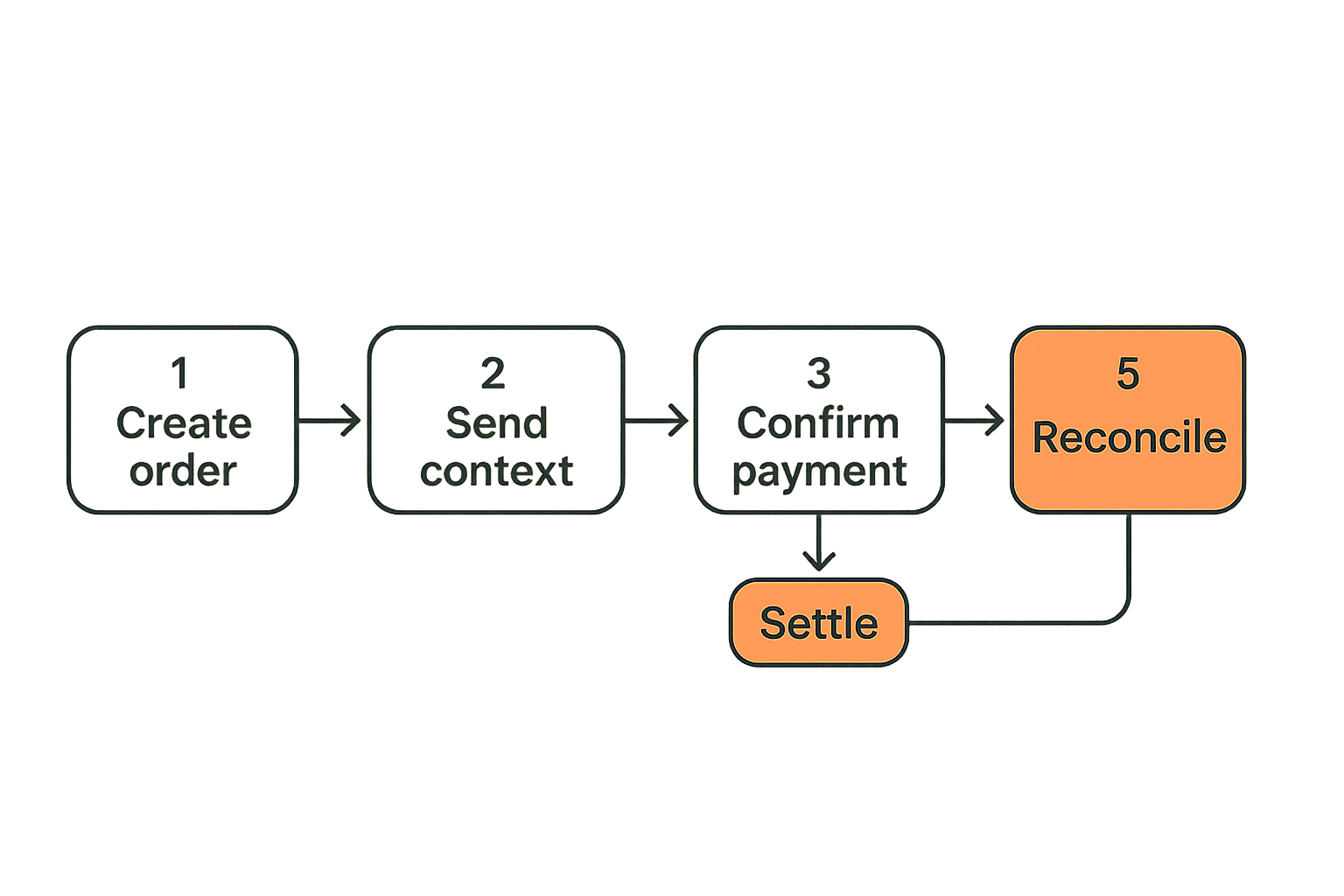
Here is a production-oriented sequence for integrating encrypted messaging crypto into a merchant payment flow.
- Create the order in your commerce system with a stable internal order ID.
- Create a payment intent through your crypto payment gateway or internal payment service.
- Generate a checkout URL that displays the authoritative amount, network, asset, expiration, and payment address.
- Store a correlation ID that ties order, payment intent, customer, and support thread together.
- Send an encrypted message containing only safe context and the checkout link.
- Listen for payment events through webhooks or blockchain indexers.
- Update the order state server-side after validation and confirmation rules are met.
- Send encrypted status updates that reflect server-side state, not agent opinion.
- Route customer replies into a support ticket with the same correlation ID.
- Reconcile settlement against ledger entries before fulfillment or withdrawal where risk requires it.
This sequence looks longer than just pasting an address into chat. It is also the difference between a controlled payment flow and a support channel that can lose money.
Use explicit payment status language
Ambiguous status language causes support load. Crypto payments are not always instantly final. A transaction can be broadcast but not confirmed. It can be detected on the wrong network. It can be below the required amount. It can arrive after invoice expiration. It can be replaced, dropped, or delayed by fee conditions.
Use consistent language in messages:
- Waiting for payment: no valid transaction detected yet.
- Payment detected: transaction seen, but not final for fulfillment.
- Confirming: transaction has some confirmations, waiting for policy threshold.
- Confirmed: payment meets the merchant rule for this order.
- Underpaid: received amount is below the required amount.
- Expired: payment window closed before a valid transaction was confirmed.
- Manual review: an operator must inspect before order state changes.
Do not use paid unless the backend has decided the order can move forward.
Design the support handoff before you need it
Support handoff is where private payment messaging often gets messy. A customer says they paid. An agent asks for a transaction hash. Finance checks a wallet. Engineering checks webhook logs. Someone posts screenshots.
Design the handoff in advance:
- Give support a read-only payment timeline.
- Let customers submit transaction hashes through a controlled form.
- Mask wallet addresses where full visibility is not needed.
- Provide finance with settlement and refund context inside the dashboard.
- Keep developer logs separate from customer-facing messages.
- Attach internal notes to tickets instead of group chats.
What breaks in practice is not usually the cryptography. It is the handoff between systems that were never designed to share state safely.
Encryption, keys, and identity decisions
End-to-end encryption is different from transport encryption
Transport encryption protects data between client and server. End-to-end encryption is designed so the service provider cannot read message contents. Both can be useful, but they are not interchangeable.
For payment teams, the distinction affects search, moderation, export, compliance review, bot automation, and support tooling. If support managers need to review escalations, how is that done? If a regulated merchant needs records, what is retained? If an automated notification service sends messages, where are plaintext templates rendered?
End-to-end encryption can reduce provider-side exposure, but it also forces architectural decisions. You need to know where messages are encrypted, where keys live, how devices join conversations, and how business records are preserved without breaking privacy promises.
Plan for device loss and key recovery
Device loss is not an edge case. Support agents change laptops. Merchants replace phones. Contractors leave. Founders rotate devices. If a private messaging system cannot handle this cleanly, teams create workarounds.
Key recovery choices are tradeoffs:
- No recovery improves confidentiality but can make business history unavailable.
- User-managed recovery gives control but creates support burden.
- Escrowed recovery improves continuity but adds a sensitive trust point.
- Multi-device sync improves usability but expands the attack surface.
For payment operations, the right answer depends on what is in the channel. If messages carry only safe references and status updates, recovery risk is lower. If messages contain sensitive customer documents or refund decisions, recovery design becomes much more important.
Verify merchant identity without training users to trust chat
One of the worst patterns is teaching customers that payment instructions are valid because they arrived in a private message. That trains users to trust the channel instead of the merchant domain, authenticated checkout, or signed payment request.
Better patterns include:
- Message links that resolve only on the merchant domain or trusted checkout domain.
- Clear warnings that payment addresses are only valid on the checkout page.
- Merchant identity shown consistently in checkout, email, and support.
- Signed invoice payloads where applicable.
- Admin actions that require dashboard authentication and role permissions.
The message can tell the user where to look. It should not be the thing they trust for irreversible payment instructions.
Webhooks, retries, idempotency, and reconciliation
Message delivery is not payment finality
A message delivered successfully does not mean a payment happened. A message read receipt does not mean a customer understood the network. A customer reply does not mean a transaction is valid.
Payment finality comes from your backend rules: chain observation, confirmation depth, amount validation, asset validation, address matching, invoice expiration, risk checks, and ledger posting. The messaging system can reflect those rules, but it should not substitute for them.
This is especially important during incidents. If webhook delivery is delayed, support may receive customer claims before the backend updates. If the chain is congested, customers may send transaction hashes that are not confirmed. If an indexer is behind, the payment may be real but not yet visible to your system.
Your messages should make room for uncertainty without making promises the system cannot keep.
Make commands idempotent
If you allow any action to start from a message, such as requesting a refund review or escalating a failed payment, make the command idempotent.
A customer might tap twice. A webhook might retry. A support integration might send the same event again. A mobile device might reconnect and replay queued messages. Without idempotency, you get duplicate tickets, duplicate refund reviews, or inconsistent order notes.
A practical pattern:
- Generate an idempotency key from action type, payment intent ID, customer ID, and time window.
- Store the first accepted command result.
- Return the existing result for retries.
- Make downstream systems accept the same idempotency key.
- Log duplicates as duplicates, not new business events.
This is standard payment engineering, but teams forget it when the trigger is chat because chat feels human. The backend should not care. Every state-changing request needs repeat-safe behavior.
Build the reconciliation loop as a first-class workflow
Reconciliation is where the truth comes out. Did the order state match the on-chain transaction? Did settlement match the ledger? Did fees match expected values? Did support promise a refund before finance approved it?
Encrypted messaging crypto should feed reconciliation without becoming the ledger. Store references from messages to payment objects. Store event IDs for notifications sent. Store support ticket IDs for disputes. Store operator decisions in the system that owns the decision.
At reconciliation time, you should be able to answer:
- Which messages were sent for this payment intent?
- Which support replies were attached to the order?
- Which backend event caused each status message?
- Who approved a refund, and in which system?
- Did any message contain payment instructions inconsistent with checkout?
If the answer requires scrolling through a group chat, the architecture is not ready.
Failure modes in encrypted messaging crypto
Over-sharing secrets because the channel feels private
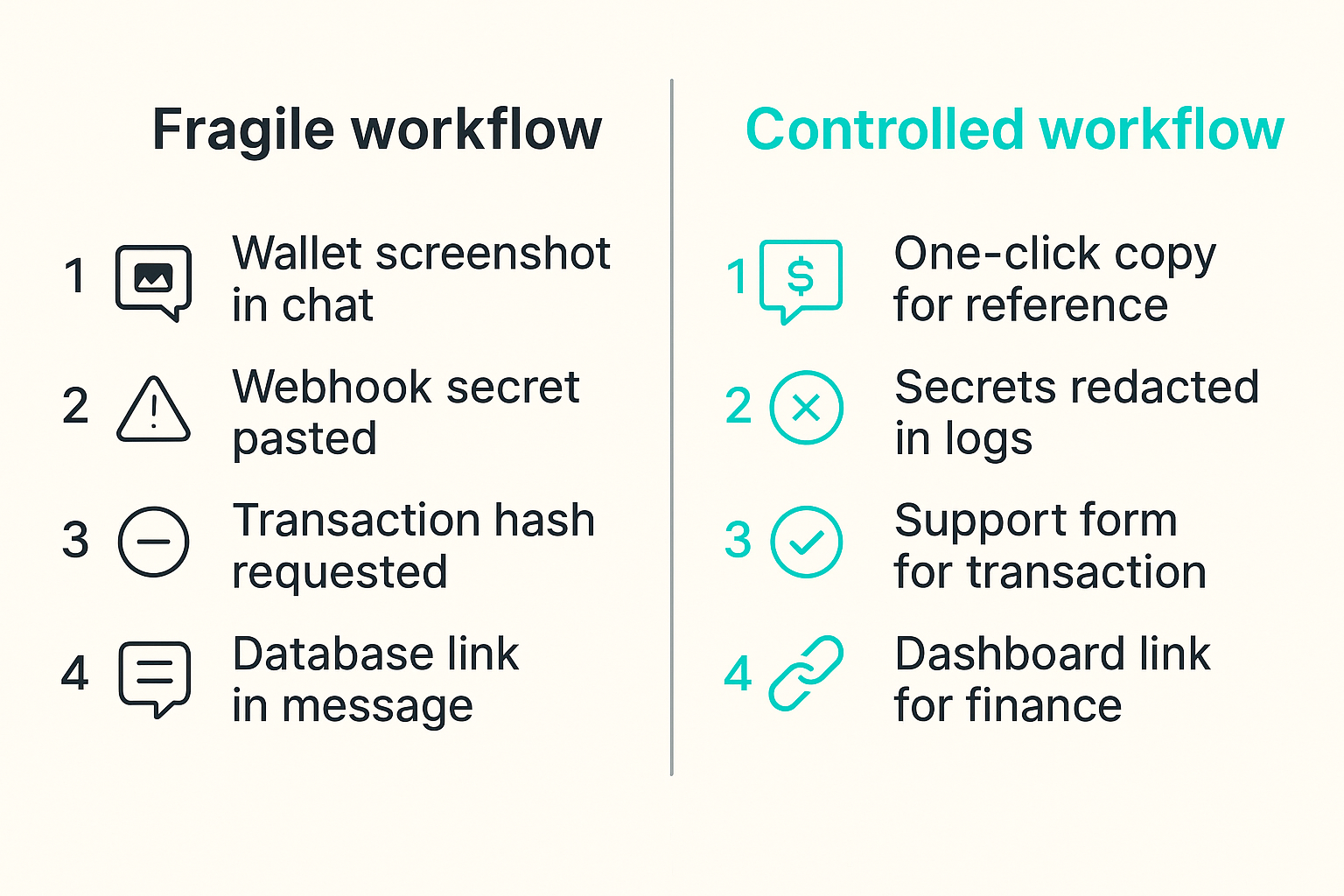
Encryption can create false confidence. People paste more because the channel feels safer. In payment operations, that can include wallet screenshots, API keys, customer identity data, seed phrase warnings from confused users, exchange deposit details, or internal risk notes.
The fix is not only policy. Build tooling that makes the safe path faster:
- One-click copy for safe order references.
- Automatic redaction of webhook secrets in logs.
- Support forms for transaction hashes.
- Dashboard links instead of pasted database rows.
- Role-based views for finance and support.
If the secure workflow is slower than the insecure workaround, the workaround wins during incidents.
Manual copy-paste breaks auditability
Manual copy-paste is the enemy of payment integrity. An agent copies an address from a dashboard into chat. A customer copies it into a wallet. Another agent later cannot prove where it came from. If funds are lost, everyone reconstructs the timeline from screenshots.
This breaks auditability in three ways:
- The copied value may be wrong or stale.
- The message may not be linked to the payment intent.
- The final action may not be recorded in the system of record.
For crypto payments, wrong network and wrong address errors can be irreversible. Do not make manual text transfer the normal path for payment instructions.
Compliance blind spots appear in side channels
Even teams that are not heavily regulated need operational records. Refund disputes, fraud investigations, tax reporting, merchant support, and accounting reviews all require reliable history.
Side channels create blind spots. A private chat may contain business decisions that never reach the ticketing system. A developer group may contain incident details that never reach the postmortem. A finance thread may approve a refund without the approval being attached to the ledger.
The solution is not to ban private communication. The solution is to design where decisions are recorded. Messaging can notify, discuss, and coordinate. Decisions that affect money should be recorded in systems built for money.
What works, what fails, and what to measure
Comparison table for payment teams
| Design choice | What works | What fails |
|---|---|---|
| Payment instructions | Checkout page owns address, amount, network, and expiration | Agent pastes wallet address into encrypted chat |
| Status updates | Messages reflect backend payment state | Messages use informal labels like paid or good to go |
| Customer replies | Replies create support events with correlation IDs | Replies trigger direct payment mutations |
| Refunds | Dashboard approval with roles, logs, and idempotency | Refund address collected and approved in chat |
| Debugging | Redacted logs linked to event IDs | Raw webhook payloads pasted into group threads |
| Reconciliation | Ledger, payment intent, and messages share references | Finance reconstructs state from screenshots |
| Identity | Merchant domain and authenticated checkout establish trust | Users are trained to trust any private message |
The table is intentionally boring. Boring is good here. Crypto payments already have enough complexity at the chain, wallet, and settlement layers. Do not add a second informal control plane through chat.
A practical checklist
Before shipping encrypted messaging crypto workflows, review this list:
- Define which system owns each payment state.
- Ban private keys, seed phrases, raw secrets, and permanent payment instructions from chat.
- Use payment intent IDs, order IDs, and ticket IDs as references.
- Send checkout links instead of copied addresses.
- Make all message-triggered actions idempotent.
- Route customer replies into support tickets.
- Store notification event IDs for auditability.
- Redact logs before they can be shared.
- Define retention and export behavior for business records.
- Test delayed webhooks, duplicate messages, expired invoices, underpayments, and refunds.
Practical rule: If you cannot test the workflow under retries, delays, and human mistakes, it is not production-ready.
Metrics that show whether the workflow is healthy
You do not need vanity metrics. You need operational signals that show whether messaging is reducing confusion or moving risk into a hidden channel.
Track:
- Percentage of payment support tickets with a valid correlation ID.
- Number of manual address shares detected or reported.
- Time from customer payment claim to backend status resolution.
- Duplicate refund requests prevented by idempotency.
- Messages sent from backend events versus manual operator messages.
- Underpaid or wrong-network payments routed to support.
- Reconciliation exceptions involving support communication.
These metrics make the workflow visible. Without them, teams only notice the messaging layer when something goes wrong.
Where CoinPayPortal fits in encrypted messaging crypto
Keep checkout and settlement authoritative
CoinPayPortal is most useful when it remains the authoritative payment surface for merchants: checkout creation, payment status, webhook delivery, and merchant-facing payment operations. That is the place where amounts, assets, networks, expiration windows, and settlement logic belong.
If your team wants encrypted messaging around crypto payments, the clean architecture is to keep CoinPayPortal or your payment backend as the source of truth and use messaging to communicate safe context. A customer can receive a private status update, but the checkout page should still be where they verify payment details. An operator can receive an escalation, but the dashboard should still be where they approve actions.
That separation gives builders a cleaner model: messaging helps humans coordinate; payment infrastructure decides money state.
Use private messaging for verified coordination
The right product fit is not encrypted chat replacing checkout. It is encrypted messaging supporting the messy edges around checkout:
- Notify customers when payment is detected or confirmed.
- Route delayed payment claims into support.
- Alert merchants about high-value manual reviews.
- Coordinate refund requests without exposing raw secrets.
- Give developers event IDs when webhook delivery fails.
- Keep sensitive discussion out of public or unmanaged channels.
This is where encrypted messaging crypto becomes practical. It improves privacy and support experience without weakening the payment system.
Try coinpayportal.com
Build crypto payment flows where checkout, webhooks, settlement, and merchant operations stay authoritative. Use private messaging as coordination, not as a shadow ledger. Try coinpayportal.com for encrypted messaging crypto workflows built around real payment infrastructure.
Try CoinPay
Crypto payments, escrow, and wallets — multi-chain, Lightning-ready, and fast to integrate.
Get started →