Community Building Crypto: The Payment Architecture Behind Communities That Last

Community building crypto looks simple until real money, real contributors, and real customer expectations enter the system.
A Telegram group can grow fast. A Discord server can look busy. A token launch can create a few weeks of attention. Then the same operational questions show up: who gets paid, what counts as contribution, how do refunds work, which wallet is authoritative, who handles disputes, and how does the merchant reconcile activity across chains and internal systems?
Teams think the problem is engagement. The real problem is operational trust.
That changes the conversation. Community building crypto is not just social content, moderation, or token distribution. For developers and merchants, it is a workflow architecture problem: identity, incentives, payment state, settlement, support, and governance all have to connect without turning the community into a support nightmare.
This guest contribution comes from the team at d0rz.com, who focus on building and sustaining real communities and local networks. The angle here is practical: if your crypto community is tied to commerce, memberships, creator payouts, merchant loyalty, referrals, or local networks, the payment layer is not a side feature. It is part of the community contract.
Table of contents
- Why community building crypto fails when payments are bolted on
- Community building crypto is an operating system, not a Discord count
- Map the participants before you choose incentives
- Build trust boundaries into the community payment model
- Design the contribution loop before the token
- Make settlement boring: wallets, invoices, webhooks, reconciliation
- What works for merchant-led crypto communities
- Measure trust and throughput, not vanity
- Common failure modes in community building crypto
- Where CoinPayPortal fits in community building crypto
Why community building crypto fails when payments are bolted on
The visible community is not the system
The visible layer is easy to copy: chat rooms, announcements, memes, quests, AMAs, referral links, token badges, and leaderboards. Those are surface area. They can help, but they do not create a durable operating model.
The hidden layer is where most crypto communities either mature or collapse. It includes:
- how a member proves they paid;
- how a merchant recognizes a valid wallet;
- how a contributor gets approved for a payout;
- how refunds and disputes are handled;
- how rewards map to actual economic value;
- how support teams see payment history without asking users to paste transaction hashes every time.
The mistake teams make is treating the community as a marketing channel and the payment system as a checkout widget. In practice, the two become one system as soon as users can buy, earn, redeem, stake, subscribe, or receive payouts.
Practical rule: If community status depends on payment activity, payment state must be part of the community architecture from day one.
That does not mean every community needs a token. It means every crypto-enabled community needs a clear model for trust, participation, and value transfer.
Why this matters more in 2026
By 2026, the novelty curve is weaker. Users have seen token launches, NFT gates, airdrop farming, fake engagement, and projects that disappear after the incentive budget runs out. Merchants and fintech teams are also more cautious. They want lower fees, faster settlement, global reach, and better user ownership, but they do not want to inherit avoidable operational risk.
The practical question is no longer whether crypto can attract attention. It can. The practical question is whether the community can survive routine operations: failed payments, wrong-chain deposits, delayed confirmations, chargeback expectations, fraud attempts, contributor disputes, and tax or accounting reviews.
A useful way to think about it is this: a community is only as strong as the workflows it can repeat without founder intervention.
Community building crypto is an operating system, not a Discord count
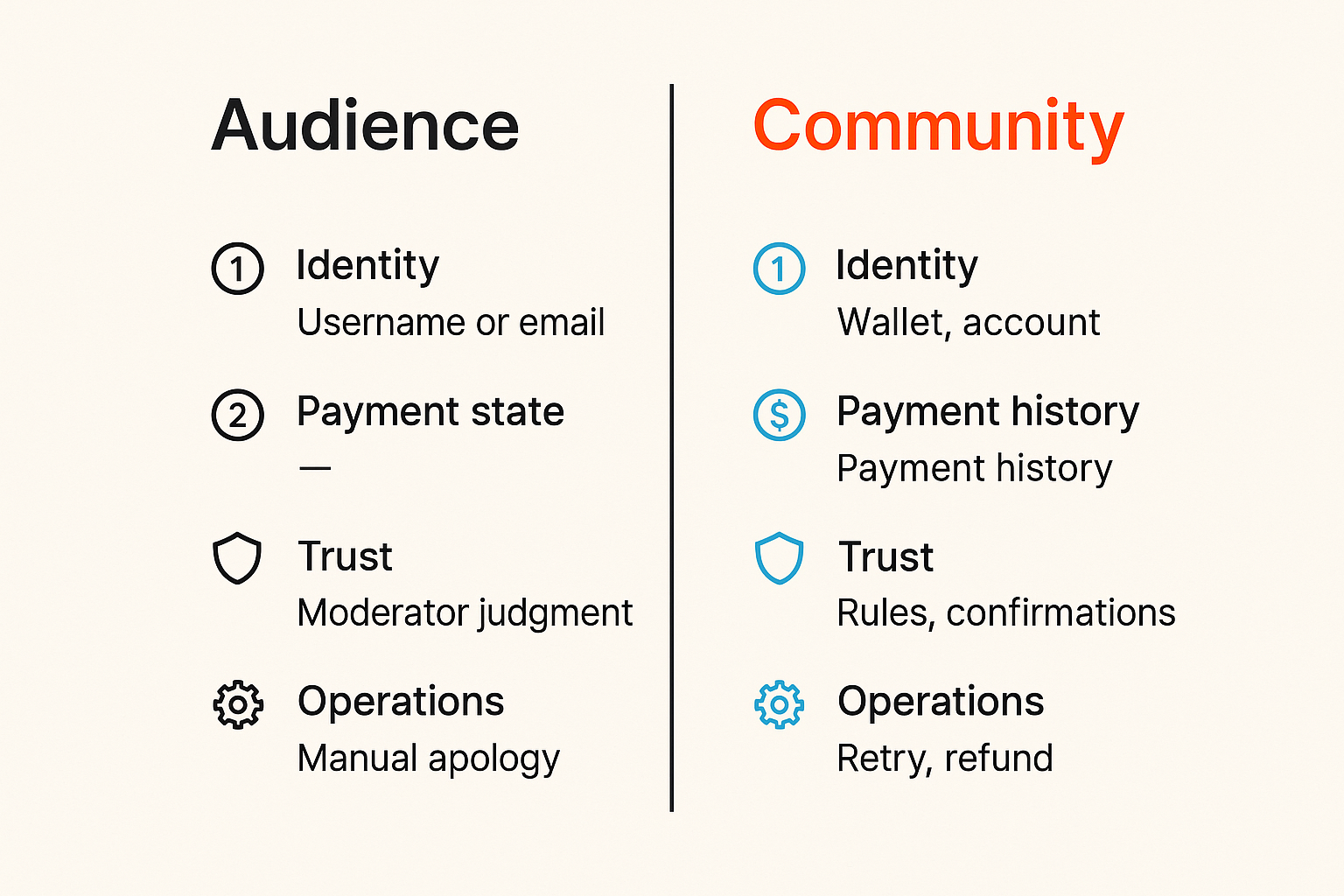
What changes when money moves
Once money moves through the community, every social action has an operational shadow.
A referral is not just a share link. It may trigger a reward. A membership role is not just a badge. It may represent paid access. A contributor task is not just participation. It may create a payable liability. A merchant discount is not just a perk. It may require settlement and reconciliation.
That changes the conversation. Community building crypto is less about broadcasting to holders and more about designing an operating system where financial events and community events stay in sync.
Here is the simplest comparison:
| Area | Engagement-first community | Payment-aware crypto community |
|---|---|---|
| Member identity | Username or email | Wallet, account, payment history, permissions |
| Incentives | Likes, roles, points | Discounts, payouts, revenue share, access rights |
| Trust model | Moderator judgment | Rules, confirmations, audit trail, support context |
| Failure handling | Manual apology | Retry, refund, escalation, reconciliation |
| Success metric | Activity volume | Retained value and completed workflows |
What breaks in practice is the gap between the social system and the financial system. If a payment succeeds but the role is not granted, support gets involved. If a payout is promised but not tracked, trust drops. If rewards are distributed without fraud controls, the best operators leave and the farmers stay.
The four layers to design
A durable crypto community usually needs four connected layers:
- Identity layer: wallet addresses, customer accounts, merchant accounts, contributor profiles, permissions, and risk signals.
- Payment layer: invoices, deposits, checkouts, subscriptions, payouts, escrow, settlement, and confirmations.
- Community layer: roles, tasks, events, governance, moderation, reputation, and member history.
- Operations layer: support queues, reconciliation, analytics, compliance review, dispute handling, and incident response.
Most teams start with the community layer because it is visible. Strong operators start by asking how these layers exchange state.
For example, when a user pays for a membership, the system should know:
- what invoice was created;
- which chain and asset were expected;
- whether the amount matched;
- how many confirmations are required;
- which community permission should change;
- what happens if the transaction arrives late or partially paid;
- which admin can override the result;
- how the event appears in accounting.
That is not hype. That is production work.
Map the participants before you choose incentives
Merchants, members, operators, and contributors
Before deciding whether to use tokens, points, NFTs, stablecoins, or simple crypto checkout, map the participants. A community payment system has more roles than most teams admit.
Common roles include:
- Members who buy access, products, services, event tickets, or subscriptions.
- Merchants who accept crypto payments and need settlement clarity.
- Contributors who create content, moderate, organize, translate, code, sell, or support.
- Operators who approve payouts, resolve disputes, and maintain the workflow.
- Partners who may sponsor, distribute, resell, or co-market.
- Treasury owners who control funds and approve budget.
The incentive model should make these roles clearer, not blur them. If everyone is a community member, no one owns fulfillment. If everyone is a contributor, no one knows who can approve payments. If the treasury is a black box, every delay becomes suspicious.
Practical rule: Define who can earn, who can approve, who can pay, who can refund, and who can override before you launch rewards.
This matters for merchants because community growth often turns into operational load. A local marketplace accepting crypto, a creator network paying affiliates, or a SaaS company offering token-gated access all need clean role boundaries.
The mistake of rewarding the loudest account
The mistake teams make is rewarding activity that is easy to measure instead of activity that creates durable value.
Message count is easy. Retained buyers are harder. Retweets are easy. Resolved support cases are harder. Quest completions are easy. Verified referrals that settle without dispute are harder.
In crypto communities, incentive leakage is normal when the system rewards shallow actions. Farmers optimize faster than operators. If your reward rules are vague, you should assume someone will automate against them.
Better incentive questions look like this:
- Did the member complete a payment and remain active after access was granted?
- Did a referral convert into a settled transaction?
- Did a contributor complete a task that an operator approved?
- Did a merchant receive usable order data and settle funds correctly?
- Did the action reduce support load or increase trust?
The practical question is not what can we reward. It is what can we verify without creating a manual review queue that kills the team.
Build trust boundaries into the community payment model
Custody is a product decision
Crypto teams sometimes talk about custody as if it is only a legal or wallet engineering topic. For community building crypto, custody is also a product decision.
If users pay directly into a merchant wallet, the community experience depends on how quickly the system detects and maps that payment. If funds go through an escrow model, the community needs clear release rules. If a platform wallet holds balances for members or contributors, operators need permissioning, accounting, and security controls.
A few common models:
| Model | Where funds go | Works well for | Main operational risk |
|---|---|---|---|
| Direct merchant payment | Merchant-controlled wallet | Simple commerce and invoices | Payment matching and support visibility |
| Platform-mediated checkout | Payment processor or gateway flow | Merchants needing order state | Integration quality and webhook handling |
| Escrow | Held until condition is met | Services, marketplaces, local jobs | Dispute rules and release authority |
| Internal balance | Platform ledger plus settlement | Contributor payouts or credits | Custody obligations and ledger accuracy |
No model is universally best. The right answer depends on user expectations, transaction size, regulatory exposure, dispute frequency, and support capacity.
A useful way to think about it is to separate control from visibility. Even when a merchant controls the wallet, the platform still needs enough visibility to update community state and provide support. Even when a gateway manages checkout, the merchant still needs reconciliation and exportable records.
Escrow, deposits, and reversible expectations
Crypto settlement can be final at the network level while user expectations remain reversible at the product level. That mismatch matters.
A member who pays for an event ticket expects a refund if the event is canceled. A buyer in a local marketplace expects mediation if the seller disappears. A contributor expects a payout after an approved task. A merchant expects not to lose access to order context when funds settle.
Escrow and deposits can help, but only if rules are explicit:
- What condition releases funds?
- Who can approve release?
- What evidence is required for a dispute?
- What happens if the payer uses the wrong network?
- What happens if the amount is underpaid or overpaid?
- How long are pending payments held open?
Practical rule: Do not let blockchain finality become a substitute for product-level dispute design.
The community will judge the system by outcomes, not by chain semantics. If the product says access is paid, users expect access. If the product says a contributor earned a payout, contributors expect payment. The workflow has to make those promises concrete.
Design the contribution loop before the token
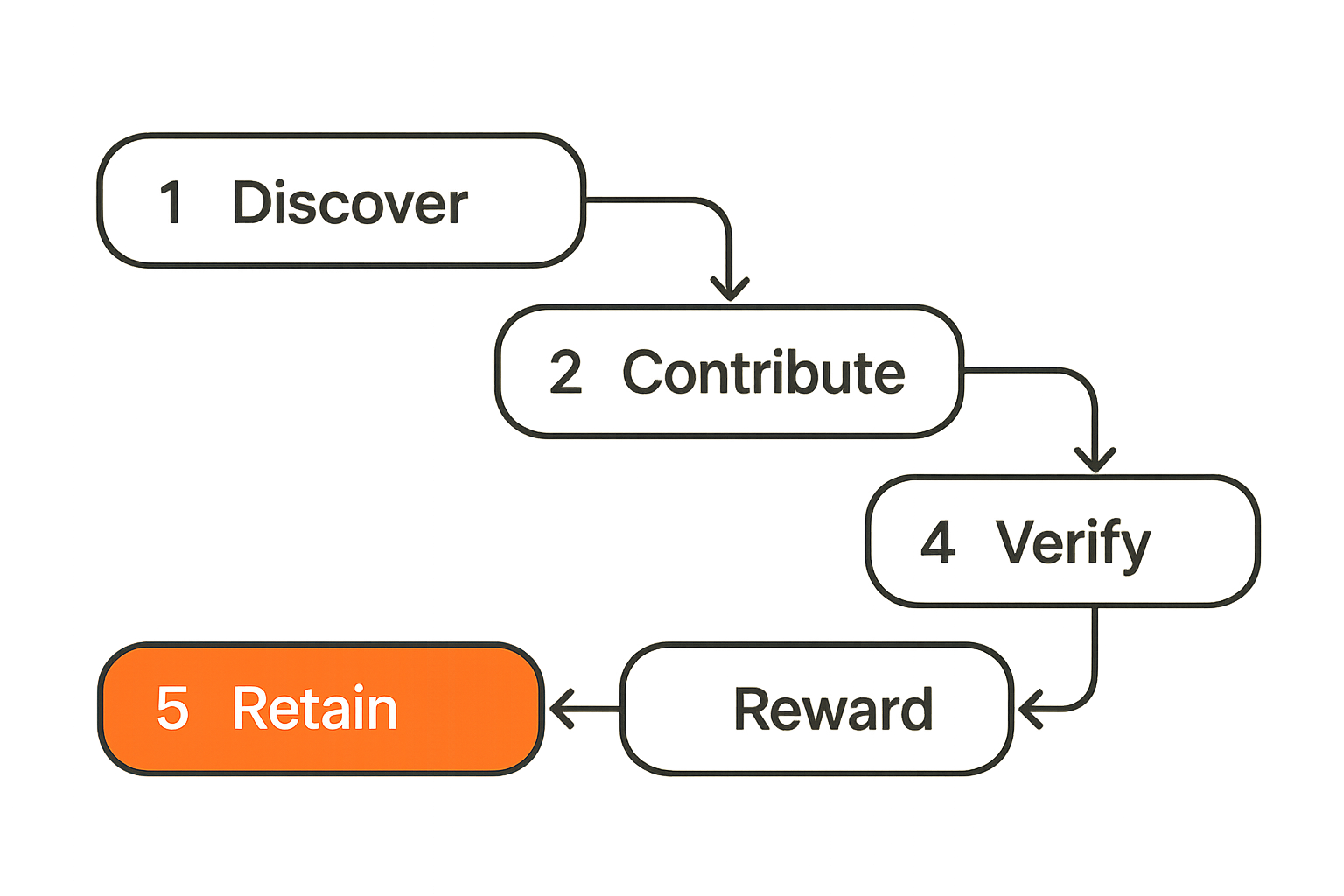
A practical contribution workflow
Tokens can be useful, but they should not be the first design artifact. The contribution loop should come first.
A practical sequence looks like this:
- Define valuable actions. List the actions that create value: referrals, sales, moderation, local event hosting, documentation, support, translation, product feedback, merchant onboarding, or development.
- Attach verification. Decide how each action is proven. Some actions can be verified by payment events. Others need operator approval or peer review.
- Set reward rules. Define amounts, timing, caps, eligibility, and fraud checks. Avoid unlimited rewards for low-quality actions.
- Connect payment rails. Decide whether rewards are paid in stablecoins, native tokens, credits, discounts, or fiat-equivalent balances.
- Automate status changes. Update roles, access, reputation, or dashboards based on verified events.
- Create a support path. Give operators a way to inspect the event, override errors, and communicate decisions.
The important part is not whether the reward is on-chain. The important part is whether the workflow is observable and repeatable.
A minimal contribution event might look like this:
{
  "event_type": "referral_settled",
  "member_id": "mem_8421",
  "wallet": "0xabc...789",
  "merchant_id": "m_104",
  "invoice_id": "inv_5592",
  "reward_asset": "USDC",
  "reward_amount": "5.00",
  "status": "approved_for_payout"
}
In production, this event should be connected to an invoice, a customer, a wallet, and an operator-visible audit trail. Otherwise, the first payout dispute becomes archaeology.
Where token incentives help and where they distort
Token incentives help when they coordinate behavior that already has a real use case. They distort when they become the use case.
What works:
- rewarding verified referrals that become paying customers;
- giving loyal buyers discounts or access rights;
- paying contributors for approved work;
- coordinating local merchants around shared promotions;
- using community reputation to prioritize support or opportunities.
What fails:
- rewarding generic chat activity;
- issuing points with no redemption path;
- promising future token value as the main reason to join;
- letting bots farm tasks without payment or identity checks;
- changing reward rules without an audit trail.
The practical question is whether the incentive makes a useful behavior easier to repeat. If it only creates temporary speculation, the community becomes fragile when rewards slow down.
Make settlement boring: wallets, invoices, webhooks, reconciliation
State machines beat spreadsheet memory
Payment-aware communities need state machines. Spreadsheets and manual chat notes do not scale when payments, roles, rewards, and support all depend on the same events.
A basic checkout or membership state machine might include:
invoice_createdpayment_detectedconfirmingpaidunderpaidoverpaidexpiredrefundedaccess_grantedaccess_revoked
The system should not assume that payment and access happen at the same time. Blockchain payments can arrive late. Users can send from exchanges. Network fees can change. Some chains require more confirmations for higher-value payments. Some users send the wrong amount.
What breaks in practice is when teams only store a transaction hash and a role flag. That is not enough context for support or reconciliation.
A better payment record includes:
- expected asset and network;
- expected amount;
- received amount;
- invoice expiration time;
- customer account or wallet mapping;
- confirmation policy;
- webhook delivery history;
- order or membership object;
- settlement destination;
- operator notes and overrides.
Idempotency, retries, and payment finality
Webhooks are where many crypto community integrations become unreliable. A payment event fires. The community bot grants access. A retry fires. The system grants duplicate rewards. Or the webhook fails once, access is never granted, and support has to intervene.
The fix is not complicated, but it must be designed:
- Use idempotency keys for every payment and reward event.
- Store webhook delivery attempts and processing results.
- Treat external events as inputs to an internal state machine.
- Make access grants and payout approvals idempotent.
- Reconcile periodically against source-of-truth payment data.
- Alert operators on stuck states, not every normal confirmation delay.
Example pseudo-handler:
async function handlePaymentWebhook(event) {
  const key = event.idempotency_key;
  const existing = await db.events.findByKey(key);
  if (existing?.processed) return { ok: true };

  await db.transaction(async tx => {
    await tx.events.upsert({ key, payload: event, processed: false });
    await applyPaymentState(tx, event.invoice_id, event.status);
    await tx.events.markProcessed(key);
  });

  return { ok: true };
}
This is not glamorous, but it is the difference between a community that trusts automated access and a community that floods admins with screenshots.
Practical rule: Every financial event that changes community status should be idempotent, auditable, and reversible at the product layer.
What works for merchant-led crypto communities
Memberships and gated access
Merchant-led communities are usually strongest when crypto payments unlock a clear benefit. Examples include paid memberships, wholesale groups, local buyer clubs, premium content, early product drops, service retainers, event access, or support tiers.
The payment architecture should answer three questions:
- What did the member buy?
- What access or benefit should change?
- How does the operator see and fix the state?
For a simple membership, the flow can be:
- Member selects plan.
- System creates invoice with asset, network, amount, expiration, and customer ID.
- Member pays.
- Payment gateway confirms funds.
- Webhook updates internal membership status.
- Community platform grants access.
- Reconciliation job verifies the membership and payment ledger match.
The UI may look like a checkout. The real system is payment state plus access control plus support visibility.
What works is a narrow promise: pay with crypto, get specific access, renew or expire cleanly. What fails is vague access with manual role assignment, no expiration logic, and no audit trail for who granted what.
Local commerce, referrals, and loyalty
Community building crypto can be especially useful for local or niche merchant networks because the payment rail and the relationship graph can reinforce each other.
A local food market, creator collective, gaming community, fitness network, or cross-border service group may use crypto payments for:
- member discounts;
- stablecoin settlement;
- affiliate rewards;
- event tickets;
- prepaid credits;
- shared promotions;
- contributor payouts;
- merchant-to-merchant settlement.
The important constraint is that loyalty should be tied to real commerce, not just wallet noise. A wallet that made one tiny transaction should not have the same status as a member who purchased repeatedly, referred real buyers, and resolved issues cleanly.
A useful rule is to separate earning from redemption. Earning can be based on verified actions. Redemption should be controlled by merchant rules: caps, eligible products, expiration, minimum order value, and abuse checks.
This is where crypto payments become more than a checkout option. They become a shared ledger of participation, as long as the product does not expose raw complexity to users.
Measure trust and throughput, not vanity
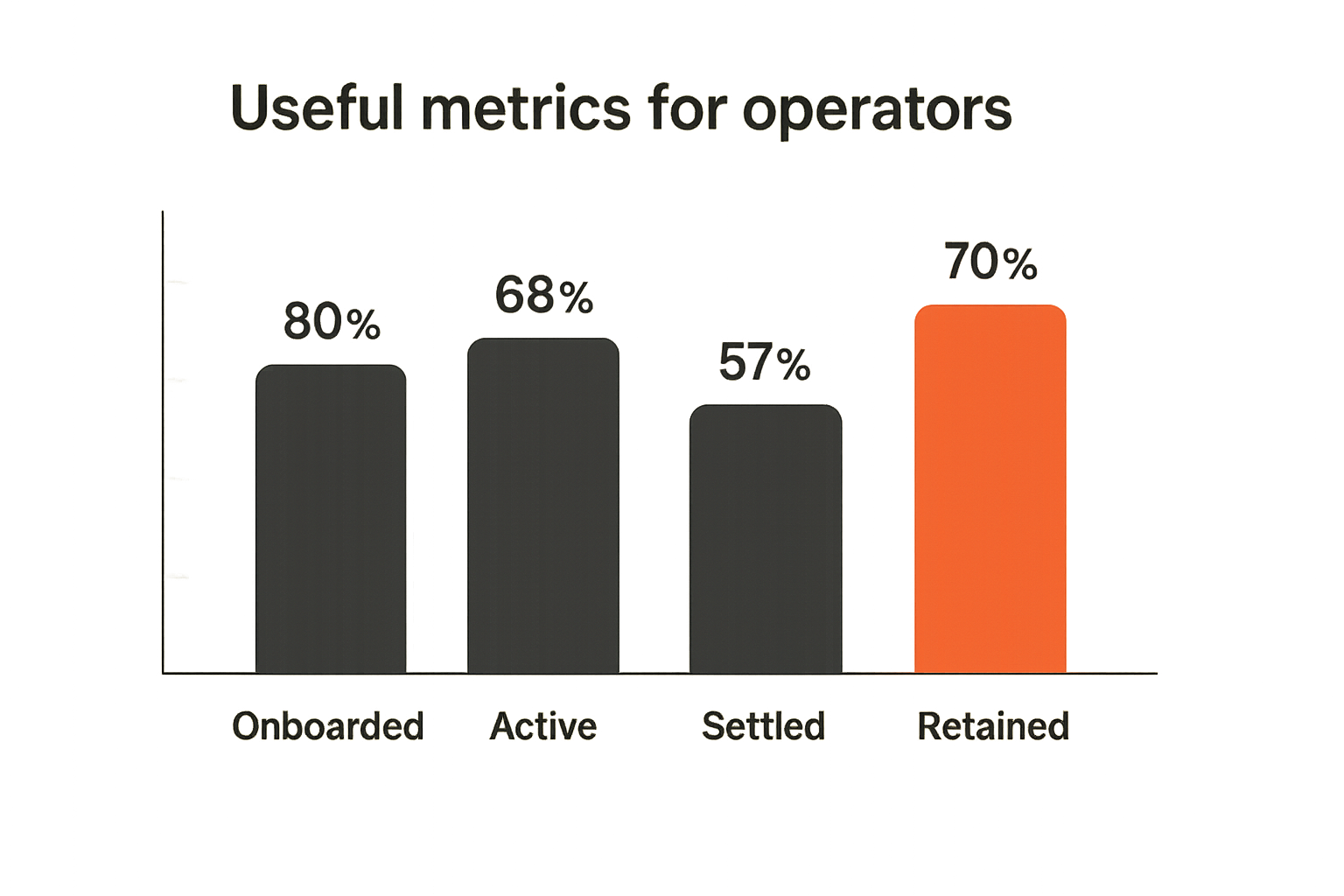
Useful metrics for operators
If the dashboard only shows member count, message count, or token holders, it is not enough for operators.
Better metrics connect community activity to payment and fulfillment:
- paid members activated;
- payment success rate by asset and network;
- invoices expired without payment;
- underpaid or overpaid invoices;
- average confirmation-to-access time;
- support tickets per 100 payments;
- rewards approved versus rewards disputed;
- referral transactions settled;
- payout cycle time;
- retained paying members after 30, 60, or 90 days;
- merchants with successful reconciliation.
These metrics reveal workflow health. If payment success is high but access grants lag, the integration is broken. If referrals are high but settled orders are low, incentives are being gamed. If payout disputes rise, contribution rules are unclear.
The mistake teams make is celebrating activity while ignoring operational debt. A loud community with unreliable payment workflows is not healthy. It is a queue forming in public.
Dashboards that connect social and payment state
A useful operator dashboard should let the team move from a community question to a payment answer quickly.
For example:
- A member says they paid but did not get access.
- Support searches by wallet, email, invoice ID, or transaction hash.
- The dashboard shows invoice status, confirmations, amount received, webhook attempts, access status, and operator notes.
- If the payment is valid, support can trigger an idempotent access grant.
- If the payment is invalid, support can explain the exact issue.
That workflow shortens investigation time and reduces public frustration. It also protects operators from making inconsistent decisions in chat.
Dashboards should not expose every internal detail to every admin. Permissions matter. A moderator may need to verify membership status but not approve refunds. A finance operator may need settlement exports but not community moderation tools. A founder may need high-level health metrics and escalation visibility.
The practical question is not whether the community has analytics. It is whether the analytics help operators resolve real payment and trust issues.
Common failure modes in community building crypto
What breaks when incentives are vague
Vague incentives create predictable failure modes.
First, farmers exploit the rules. If rewards are paid for superficial actions, scripts and coordinated groups will optimize for those actions. The community may look active while real users get crowded out.
Second, contributors lose trust. If payout approval depends on private judgment or shifting criteria, good contributors stop investing effort. The loudest disputes become the governance process.
Third, merchants cannot forecast cost. If discounts, rewards, or referrals are not capped, the program can become expensive before it becomes valuable.
Fourth, support becomes the policy engine. When rules are unclear, every edge case goes to a human. That slows down response and creates inconsistent outcomes.
What works is boring clarity:
- eligible actions;
- verification method;
- reward amount or formula;
- payout timing;
- caps and limits;
- dispute window;
- operator authority;
- audit trail.
What fails is telling the community to contribute and promising that the team will take care of rewards later. Later becomes a spreadsheet. The spreadsheet becomes a fight.
What breaks when payments are manual
Manual payment operations are survivable at tiny scale and dangerous after that.
Common issues include:
- admins checking explorers by hand;
- users sending screenshots as proof;
- duplicate rewards after webhook retries;
- access granted without confirmed payment;
- refunds handled outside the ledger;
- payout approvals lost in chat threads;
- no clear link between invoice, wallet, member, and order;
- reconciliation delayed until finance asks for exports.
Manual workflows also create security risk. The more often operators copy addresses, paste transaction hashes, and move funds under pressure, the more likely mistakes become.
The fix is not to automate everything blindly. The fix is to automate state transitions that should be deterministic and reserve human judgment for real exceptions.
A practical implementation sequence:
- Create a canonical payment object for every checkout, membership, reward, or payout.
- Store external identifiers: wallet, invoice, transaction hash, chain, asset, and customer account.
- Process webhooks through an idempotent event table.
- Trigger access, reward, or status changes from internal state, not raw webhook payloads.
- Build an operator view for stuck, disputed, underpaid, overpaid, and expired states.
- Run scheduled reconciliation against gateway and wallet data.
- Export settlement and reward data for finance.
This sequence is not overengineering. It is how teams avoid turning every community payment into a custom support case.
Where CoinPayPortal fits in community building crypto
Payment infrastructure as community infrastructure
For merchants and developers, the cleanest community strategy is often to keep the social layer flexible and make the payment layer reliable.
That means using payment infrastructure that can support invoices, crypto checkout, webhook-driven state changes, merchant records, settlement visibility, and reconciliation. The community tool can be Discord, Telegram, a custom app, a marketplace, a membership portal, or a local network directory. The payment system should still behave consistently.
CoinPayPortal fits this architecture as the payment layer merchants can integrate into community workflows without pretending the UI is the whole product. The useful pattern is:
- create a payment request from your app;
- attach it to a member, order, plan, referral, or contribution;
- receive payment status updates;
- update internal community state;
- reconcile settlement and support cases from a reliable record.
This keeps the community promise grounded. Members are not just interacting with a chat bot. They are moving through a defined commerce workflow. Merchants are not just accepting coins. They are operating a payment-backed community model.
Community building crypto works when trust and settlement are designed together. If the community offers access, rewards, loyalty, referrals, or contributor payouts, the payment layer is part of the product architecture, not a plugin added after launch.
Try coinpayportal.com
CoinPayPortal helps developers and merchants build crypto payment flows with practical checkout and integration workflows for real operations. If you are designing community building crypto around payments, memberships, rewards, or merchant settlement, Try coinpayportal.com.
Try CoinPay
Crypto payments, escrow, and wallets — multi-chain, Lightning-ready, and fast to integrate.
Get started →