Cloud Computing Peptide Payments: Architecture for Biotech Compute, Crypto Checkout, and Settlement

Cloud computing peptide projects rarely fail because somebody forgot to add a payment button. They fail because the compute job, the quote, the customer balance, and the final settlement all drift out of sync.
A peptide design run may start as a small inference request, turn into a longer simulation, fail halfway through, retry on a different GPU, and produce a result that needs manual review before release. If the payment system only understands paid or unpaid, support will own the mess.
Teams think the problem is cloud access for peptide workloads. The real problem is state management across compute, custody, billing, and settlement.
That changes the conversation. The practical question is not whether a merchant can accept USDC, BTC, ETH, or another asset. The practical question is how a biotech compute platform can quote variable workloads, reserve funds, execute jobs, release outputs, refund failures, and reconcile everything without creating an accounting spreadsheet nobody trusts.
This post treats cloud computing peptide as an architecture problem for developers and merchants building crypto payment infrastructure around scientific compute.
Table of contents
- Why cloud computing peptide workloads are a payment architecture problem
- What makes peptide compute different from ordinary SaaS
- The commercial model credits jobs or escrow
- Reference architecture for cloud computing peptide payments
- Workflow from quote to settlement
- Webhooks retries and idempotency for scientific jobs
- Wallets custody and compliance boundaries
- Common failure modes in cloud computing peptide infrastructure
- What works operational rules for merchants and compute providers
- Where CoinPayPortal fits in the stack
- Closing checklist for cloud computing peptide teams
Why cloud computing peptide workloads are a payment architecture problem
The visible problem is GPU access
Most teams start with infrastructure. They need GPUs, CPUs, storage, queues, job runners, container images, model weights, molecular datasets, logs, and result artifacts. That is real work.
But once a customer is paying for the run, the platform becomes a transaction system. A payment received event now has to line up with a quote, a job definition, a resource reservation, a compute outcome, a deliverable, and a settlement record.
The mistake teams make is assuming payment can be bolted on after the compute pipeline works. In production, payment state becomes part of the pipeline.
The real problem is paid state
A peptide workload is not like selling a static PDF. The platform may not know the final cost at submission time. A docking batch may finish early. A molecular dynamics job may run longer than expected. A peptide design workflow may produce unusable candidates and require a rerun.
If your data model only has order_id, amount, and paid_at, it is too thin. You need job state, quote state, payment state, release state, and settlement state.
Practical rule: never let a compute worker decide whether a customer has paid. Workers should execute authorized jobs, not interpret payment events.
Why crypto payments fit but do not solve everything
Crypto payments fit this market because customers may be cross-border, banks may slow procurement, and builders often want API-native settlement. Stablecoins are especially useful for teams that price compute in USD but want faster settlement than traditional rails.
Still, a wallet transaction is not the same thing as a fulfilled order. A confirmed payment answers one question: did value arrive? It does not answer whether the peptide job should start, whether the result should be released, or whether a partial refund is due.
A useful way to think about it is this: crypto is the settlement rail, not the business workflow.
What makes peptide compute different from ordinary SaaS
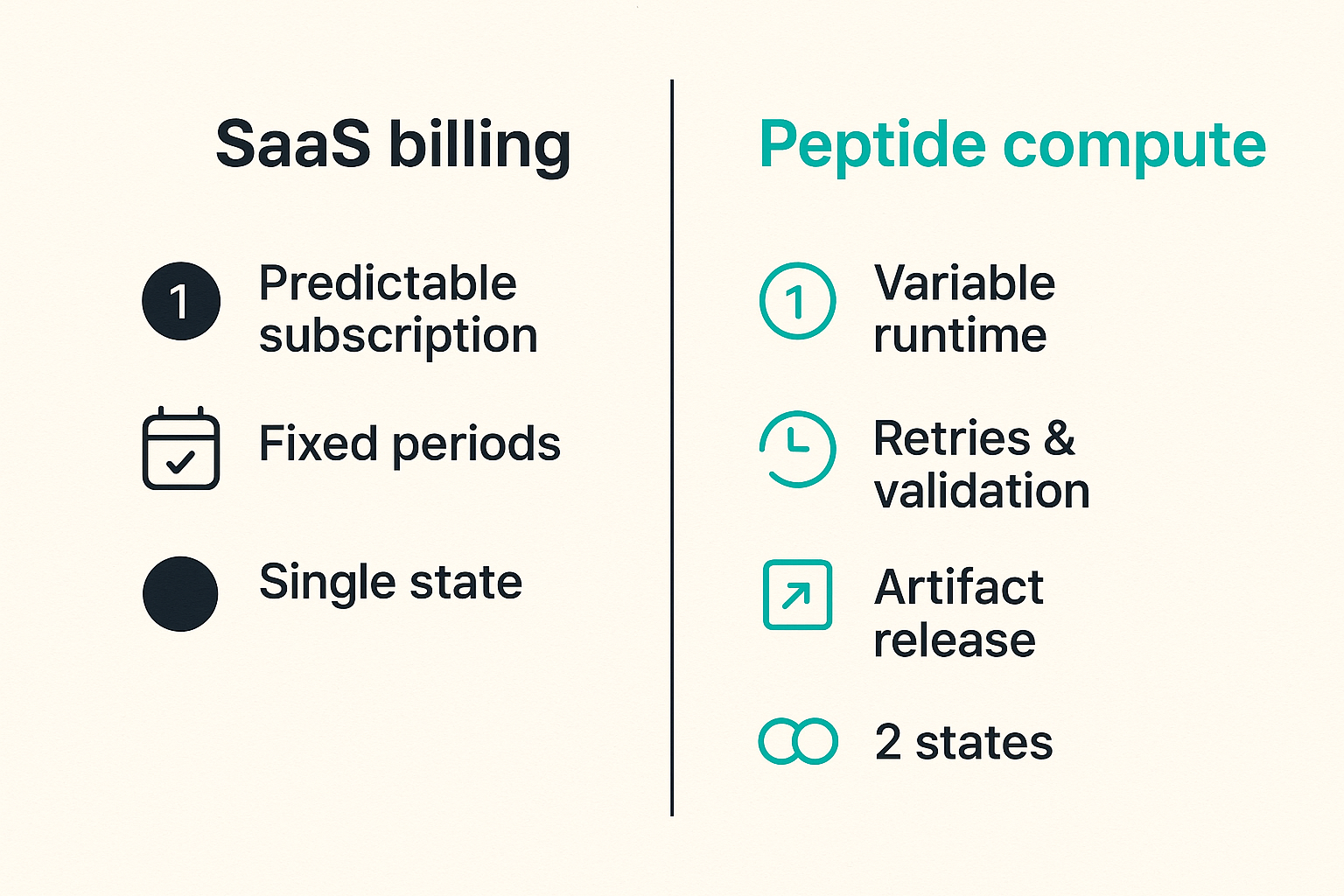
Runtime is uncertain
A normal SaaS subscription has predictable billing periods. Peptide compute is closer to metered infrastructure with scientific uncertainty. Even if the platform sells packages, the underlying workload consumes variable resources.
Common variables include:
- sequence length or library size
- number of candidates generated
- model selection and inference depth
- docking targets and conformer count
- simulation duration
- post-processing and visualization
- failed runs and retries
A platform can hide that complexity from the customer, but it should not hide it from the ledger.
Outputs have release conditions
Scientific compute often has a release step. Maybe the customer paid for a result file, a ranked peptide library, a structure prediction, a confidence report, or a downloadable artifact. The output may need to pass validation before it is useful.
That means completion and release are different states. A job can be compute_complete but not customer_released. Reasons include failed validation, flagged inputs, manual review, export generation, or pending final settlement.
What breaks in practice is tying artifact access directly to blockchain confirmation. The chain can confirm payment long before the compute output is ready, and the output can be ready before a risk check or refund decision is complete.
Support needs technical context
When a customer asks why a peptide job cost more than expected, support needs more than a transaction hash. They need the original quote, pricing assumptions, job parameters, worker logs, status transitions, and any retry history.
This is where many payment integrations become expensive. The gateway shows payment success. The compute dashboard shows job failed. The database shows output pending. Nobody can answer the customer without querying three systems.
The fix is not a bigger admin panel. The fix is a shared transaction model that links job_id, quote_id, payment_id, wallet transaction, customer account, and artifact_id.
The commercial model credits jobs or escrow
Credits are simple until usage gets granular
Credits are attractive because they reduce checkout friction. A customer tops up once and submits many runs. For small peptide workflows, this can work well.
The downside is liability and reconciliation. If credits are prepaid value, you need clear rules for expiration, refundability, bonus credits, and account transfer. If credits map to compute units, you need a stable conversion between credits and resource consumption.
| Model | Best fit | What works | What fails |
|---|---|---|---|
| Prepaid credits | Repeat users and small runs | Fast job submission, simple UX | Liability tracking, refunds, unused balances |
| Per-job checkout | Bounded jobs with clear price | Clean invoice per run | Poor fit for variable runtime |
| Escrow or authorization | High-variance or high-value jobs | Protects both sides before release | More states, more support logic |
| Subscription plus overage | Enterprise accounts | Predictable base revenue | Requires strong metering and invoices |
Per-job checkout works for bounded workloads
Per-job checkout is easiest when the platform can produce a deterministic quote. For example, a fixed peptide sequence analysis or a small batch ranking job may have a stable price.
The checkout request should include enough metadata to reconstruct the business decision later:
- quote_id
- job_template
- input hash, not necessarily raw sensitive input
- customer_id
- expiry timestamp
- fiat amount and crypto asset options
- pricing version
- refund policy reference
Do not price a quote forever. Market rates, network fees, and compute availability change. A stale quote is a support ticket waiting to happen.
Escrow fits high-trust and high-variance jobs
Escrow is useful when neither side wants to take full risk upfront. The customer locks funds. The provider starts work. Funds are released when agreed conditions are met.
For peptide compute, those conditions may be technical rather than subjective: job accepted, minimum output generated, validation passed, artifact delivered, or final usage measured.
As a guest contribution from the team at c0mpute.com, our bias is that decentralized compute and crypto payments only become useful when the payment state machine is explicit enough for both machines and humans to audit.
Practical rule: choose the commercial model before choosing the checkout UI. Credits, per-job payments, and escrow produce different ledgers.
Reference architecture for cloud computing peptide payments
Separate checkout from execution
Checkout should authorize value. Execution should consume resources. Settlement should move value to the merchant or provider account. These are related, but they are not the same operation.
A clean architecture has at least these services or modules:
- pricing service
- checkout or payment service
- job orchestration service
- worker pool
- artifact storage
- ledger and reconciliation service
- admin and support surface
The checkout service should not know how to run peptide simulations. The worker should not know how to detect underpayment. The ledger should know how to connect both.
Make the job ledger authoritative
The job ledger is the timeline of what happened. It should be append-oriented, even if your application also stores current status for fast reads.
Example ledger events:
quote.created
quote.expired
payment.pending
payment.confirmed
job.authorized
job.queued
job.started
job.retry_scheduled
job.compute_complete
artifact.generated
artifact.released
settlement.completed
refund.issued
This does not require a complex event-sourcing platform on day one. A relational table with immutable rows is enough for many teams. The important part is that every state transition has an actor, timestamp, correlation ID, and reason.
Treat exchange rates as versioned inputs
If the customer sees a USD quote and pays in crypto, the exchange rate is part of the contract. Store it. Store the provider, timestamp, expiry, asset, network, expected amount, and tolerated variance.
Do not recalculate the historical invoice from a live price feed. That creates phantom discrepancies.
A minimal quote record might include:
quote_id: q_7h91
fiat_currency: USD
fiat_amount: 420.00
asset: USDC
network: polygon
crypto_amount: 420.00
rate_source: internal_quote_v3
expires_at: 2026-06-04T18:30:00Z
pricing_version: peptide_batch_v12
That record is not just for checkout. It is for refunds, disputes, revenue recognition, and customer trust.
Workflow from quote to settlement
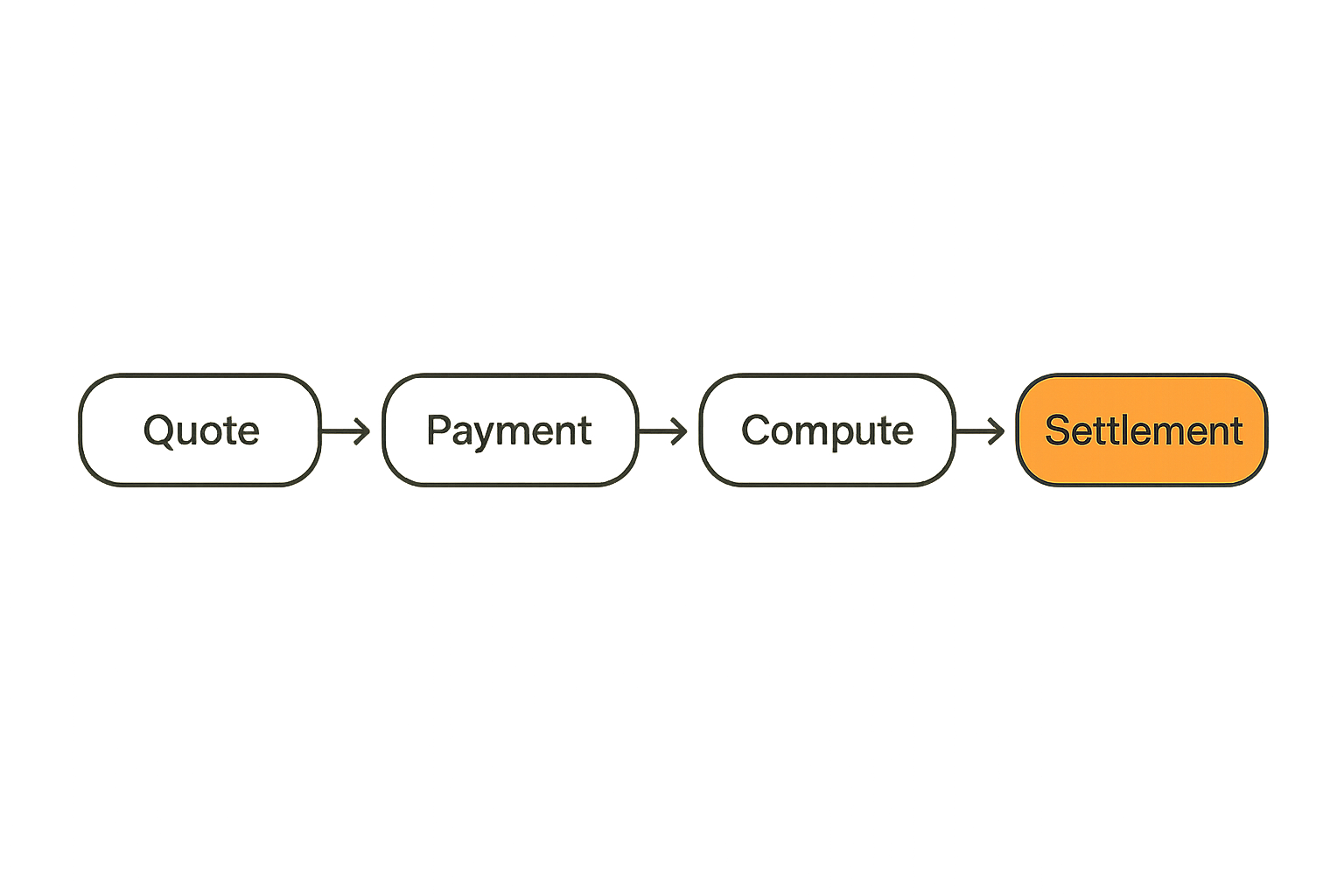
The minimum viable state machine
The minimum viable state machine for a cloud computing peptide platform should make invalid transitions hard.
For example, a job should not move from draft to running. It should move from draft to quoted, quoted to payment_pending, payment_pending to authorized, authorized to queued, queued to running.
If a payment arrives after quote expiry, it should not silently start the job. If a job fails after partial compute, it should not automatically refund everything unless that is your policy. If an artifact is generated but settlement fails, release rules need to be explicit.
A numbered implementation sequence
A practical implementation sequence looks like this:
- Customer submits job parameters for peptide analysis, design, docking, or simulation.
- Pricing service validates inputs and creates a quote with expiry, pricing version, and resource assumptions.
- Payment service creates a checkout session for the quote and records accepted assets and networks.
- Customer pays, and the payment system emits a confirmation webhook.
- Application verifies the payment status through the payment API, not only the webhook payload.
- Job orchestration marks the job authorized and places it into the queue.
- Worker executes the job and writes progress events, usage metrics, and failure reasons.
- Artifact service stores outputs and marks them generated but not necessarily released.
- Ledger calculates final usage, refunds, overages, or settlement release.
- Customer receives the result, invoice, and transaction reference.
This sequence is not glamorous, but it is where production reliability comes from.
Where manual review belongs
Manual review should be a state, not a side conversation. If certain peptide jobs require review because of inputs, export controls, abuse risk, data quality, or enterprise terms, model that directly.
A job in review should have a reason code and a timeout. Customers can tolerate waiting if the status is clear. They get frustrated when the system says paid but nothing moves.
Practical rule: if support can pause or release a job, that action must write to the same ledger as automated events.
Webhooks retries and idempotency for scientific jobs
Webhooks are notifications not truth
Webhooks are delivery mechanisms. They tell your system something changed. They are not the final source of truth.
When a payment webhook arrives, your application should verify it. That usually means checking signature validity, event age, event type, payment status, amount, asset, network, quote_id, and whether the event was already processed.
Then query the payment provider or internal payment record before authorizing compute. This extra step prevents workers from starting expensive jobs based on spoofed, duplicated, stale, or partial events.
Idempotency keys prevent double execution
Scientific jobs are expensive enough that duplicate execution matters. If a webhook retries five times, the customer should not receive five queued jobs. If the customer refreshes checkout, they should not create five payment intents for the same quote.
Use idempotency keys at three boundaries:
- quote creation: customer_id plus normalized input hash plus pricing version
- checkout creation: quote_id
- job authorization: payment_id plus job_id
A simple guard looks like this:
if ledger.exists(event_type: job.authorized, job_id: job_id):
    return already_authorized

if payment.status == confirmed and quote.status == active:
    ledger.append(job.authorized, job_id, payment_id)
    queue.publish(job_id)
The exact syntax does not matter. The invariant matters: one authorization event should produce one executable job.
Retries need a dead-letter path
Retries are healthy until they become invisible loops. A worker can retry failed peptide inference, a webhook can retry delivery, and a settlement job can retry network submission. Each retry needs a cap and a dead-letter path.
Dead-lettered events should be visible to operators with enough context to decide what to do next. A payment event that cannot be matched to a quote is not just a log line. It may be a customer deposit that needs action.
Good retry design includes:
- exponential backoff
- maximum attempt count
- reason codes
- replay tooling
- operator ownership
- customer-safe status messages
Wallets custody and compliance boundaries
Do not mix customer funds with compute balances casually
If customers prepay credits, you may be holding value. If customers escrow funds, you may be controlling conditional release. If customers pay per job and funds settle directly, your responsibility may be narrower.
The architecture should match the legal and operational model. This is not legal advice, but it is an engineering warning: data models that blur customer balances, merchant revenue, and provider payouts create risk.
Keep separate ledgers for customer-facing balances and merchant settlement. They can reconcile to the same payments, but they should not be the same table with a balance column and hope.
Know what your platform is actually holding
There are several custody patterns:
- customer pays directly to merchant-controlled wallet
- customer pays to a payment processor that settles to merchant
- customer deposits into platform balance
- customer locks funds in smart contract escrow
- enterprise customer receives invoice and pays later
Each pattern changes who can refund, who bears network-fee cost, who handles charge disputes, and who owns treasury operations.
For a peptide compute marketplace with multiple providers, custody is even more sensitive. The platform may collect from customers and pay compute providers. That means provider payouts, commissions, withholding, and failed settlement handling belong in the system design.
Design for invoices and audit trails
Many biotech customers still need invoices, purchase records, tax documents, or internal approvals. Crypto settlement does not remove procurement reality.
A useful invoice should connect:
- customer account
- quote and job identifiers
- service description
- fiat price
- crypto asset and network
- transaction hash or payment reference
- settlement status
- refund or credit memo if applicable
That audit trail is also how you defend your own revenue numbers. Instant settlement is good. Explainable settlement is better.
Common failure modes in cloud computing peptide infrastructure
The paid job that never starts
This usually happens when checkout succeeds but the compute orchestrator never receives or trusts the event. Causes include webhook failure, missing metadata, expired quote handling, queue outage, or idempotency bugs.
Customer experience: I paid and nothing happened.
Operator fix: create a reconciliation job that scans confirmed payments without matching job.authorized events. Run it on a schedule. Alert on age, not just count.
The completed job with no settlement
This happens when compute and artifact systems mark success, but the settlement process fails or never runs. The customer may receive the output while the merchant never closes the financial record.
Causes include network congestion, unsupported asset routing, treasury rules, missing provider payout account, or a ledger transition that was skipped after a manual release.
Operator fix: settlement should be a first-class state with dashboards. Do not treat it as a background afterthought.
The refund nobody can explain
Refunds become messy when teams refund from the payment dashboard without updating the job ledger. Now the gateway says refunded, the app says completed, and the invoice says paid.
Operator fix: refunds must be initiated through the application or imported back into it as ledger events. The refund reason should reference job state and policy, not a vague support note.
Practical rule: every money movement needs a matching business event. If the business event is missing, reconciliation will eventually become manual archaeology.
What works operational rules for merchants and compute providers
Keep the customer promise narrow
The best payment architecture starts with a narrow promise. For example:
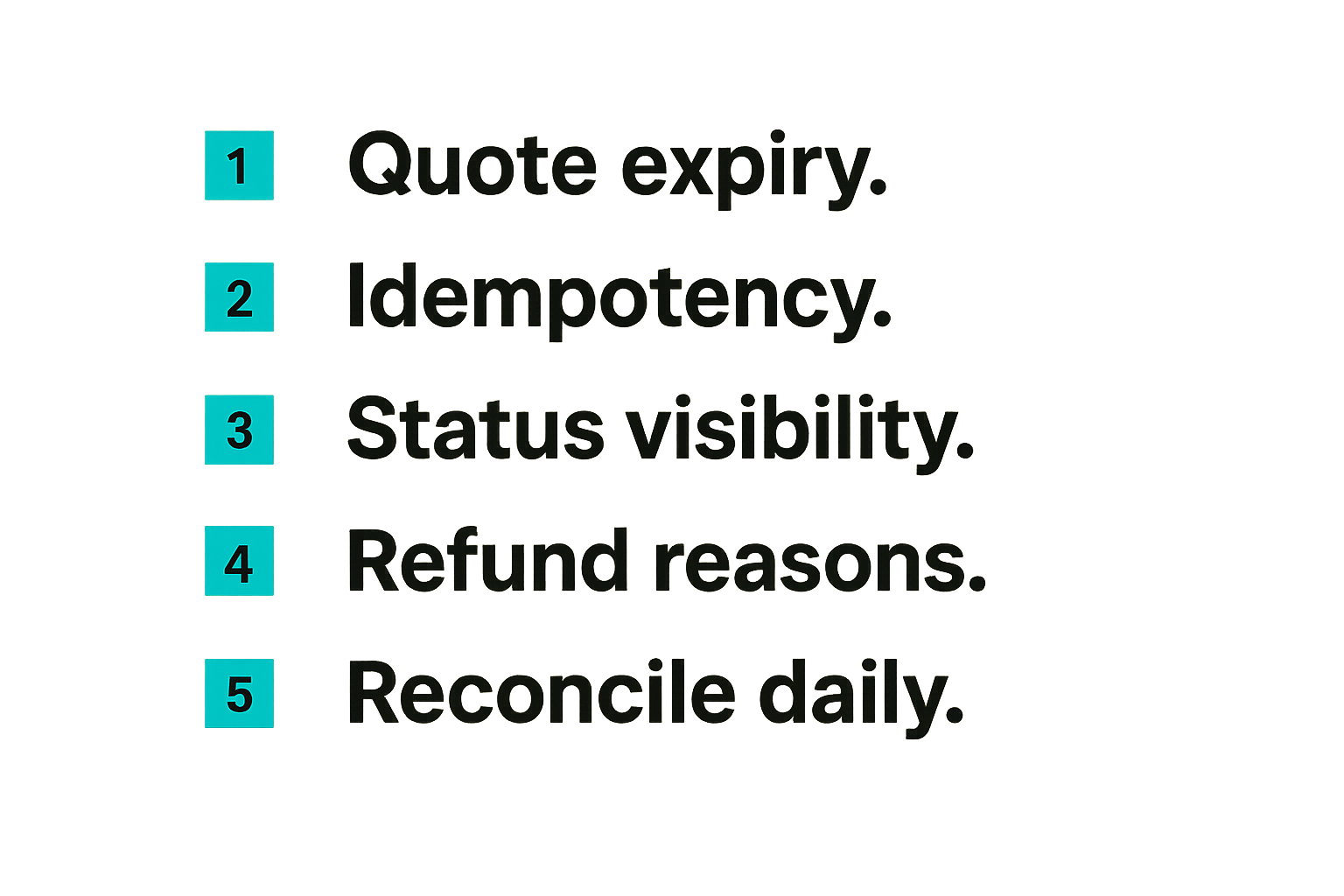
- The quote is valid for 20 minutes.
- Payment authorizes one peptide batch job using the submitted parameters.
- If validation fails before compute starts, the customer receives a full refund.
- If compute fails after retries, the customer receives either a rerun or a partial refund according to policy.
- Artifacts are released after successful completion and settlement validation.
This is not just terms-of-service language. It defines your state machine.
Expose enough status to reduce tickets
Customers do not need to see every internal event. They do need clear status. Good public states might be:
- awaiting payment
- payment confirmed
- queued
- running
- validating output
- ready for download
- refund pending
- refunded
- failed with support review
Avoid showing paid as the only success state. In a compute product, paid is just one milestone.
Reconcile daily even if settlement is instant
Crypto teams sometimes assume confirmation equals reconciliation. It does not. Reconciliation means your internal records agree with payment records, job records, invoices, refunds, and settlements.
Daily checks should include:
- confirmed payments without authorized jobs
- authorized jobs without payment confirmation
- completed jobs without artifact release decision
- released artifacts without settlement completion
- refunds without ledger reason codes
- balances that do not match transaction history
This is boring operational work. It is also what keeps finance, support, and engineering aligned.
Where CoinPayPortal fits in the stack
Use payment infrastructure for payment problems
For developers and merchants, CoinPayPortal belongs at the payment boundary: checkout, supported crypto assets, payment status, confirmation handling, merchant settlement, and the API surface that lets your application react to payment events.
That boundary matters. You do not want your peptide job runner parsing chains, watching addresses, handling checkout UX, and deciding when funds are good. You want it to receive a clean authorization signal after your application verifies the payment.
Keep domain logic in your application
CoinPayPortal should not decide whether a peptide candidate library passed validation or whether a molecular simulation deserves a partial refund. That belongs to your product logic.
The mistake teams make is pushing business rules into whichever tool is easiest to configure. That works during demos and fails during exceptions.
A healthier split:
| Responsibility | Payment layer | Application layer |
|---|---|---|
| Accept crypto payment | Yes | No |
| Track quote metadata | Reference only | Yes |
| Verify payment event | Yes and app re-check | Yes |
| Authorize compute | No | Yes |
| Release artifact | No | Yes |
| Initiate policy refund | Executes payment action | Decides reason |
| Reconcile business state | Provides records | Owns ledger |
The integration boundary that scales
The integration should be small and explicit. Your application creates checkout sessions from quotes. It receives payment events. It verifies status. It writes ledger events. It authorizes jobs.
That pattern scales from a single merchant selling peptide analysis runs to a compute marketplace coordinating multiple providers and payouts. It also keeps your future options open if you later add enterprise invoicing, prepaid balances, smart contract escrow, or provider settlement rules.
Closing checklist for cloud computing peptide teams
Decisions to make before launch
Before launching cloud computing peptide payments, decide:
- Are customers buying credits, jobs, subscriptions, or escrowed outcomes?
- What is the authoritative quote object?
- When does compute become authorized?
- What happens when payment arrives late or underpaid?
- What events release artifacts?
- Who can issue refunds, and what ledger event is written?
- How are exchange rates stored?
- What does support see when a customer sends a transaction hash?
If these answers are vague, the system will still launch. It will just outsource ambiguity to operators.
Signals to monitor in production
Monitor the gaps between systems, not only uptime. The most useful signals are often mismatch counters:
- payment confirmed but job not queued
- job failed but refund decision missing
- quote expired but payment received
- artifact generated but not released
- settlement pending beyond threshold
- webhook retries above baseline
- manual review queue age
These signals catch the problems customers feel before finance finds them at month-end.
The final test
Here is the practical test: pick one customer order and reconstruct the entire story in under five minutes. You should be able to see the quote, payment, job execution, retries, output, release, settlement, and any refund decision without asking engineering to grep logs.
If you cannot do that, the architecture is not ready for serious cloud computing peptide revenue. The payment button may work, but the business workflow is fragile.
Cloud computing peptide is a useful category because it forces the payment stack to deal with reality: variable compute, expensive retries, scientific outputs, cross-border customers, and settlement records that must survive audits.
Try coinpayportal.com
CoinPayPortal helps developers and merchants accept crypto payments with an API-first workflow that fits real checkout, confirmation, and settlement operations. Try coinpayportal.com.
Try CoinPay
Crypto payments, escrow, and wallets — multi-chain, Lightning-ready, and fast to integrate.
Get started →