Cloud Computing Crypto: Payment Architecture for High-Risk Merchants

A crypto checkout that works in a demo can still fail on the first busy Monday.
The buyer pays. The chain confirms. Your storefront still says unpaid. Support opens a ticket. Ops checks three dashboards. Finance asks why the settlement amount does not match the invoice. Nobody knows whether to ship.
Teams think the problem is cloud computing crypto. The real problem is payment state moving across systems that were never designed to trust each other by default.
That changes the conversation. Cloud hosting, wallets, nodes, APIs, Lightning, webhook handlers, queues, and merchant dashboards are not separate topics. For high-risk ecommerce merchants, they are one operational workflow: accept funds, prove what happened, settle correctly, and support the buyer without creating compliance or custody problems.
This guest contribution comes from the team at c0mpute.com, where builders work with decentralized compute, AI inference, transcoding workloads, and machine-to-machine payment patterns. The overlap with merchant crypto payments is simple: compute is useful only when the workflow around it is reliable.
Table of contents
- Why cloud computing crypto is a payment architecture problem
- Where cloud compute touches crypto checkout
- The reference architecture for resilient crypto payments
- Cloud computing crypto workflows that actually matter
- What works: practical design rules
- What fails in production
- Security, compliance, and trust boundaries
- Developer implementation sequence
- Metrics payment teams should watch
- Product fit: crypto checkout infrastructure for high-risk merchants
- Closing: make cloud computing crypto boring
Why cloud computing crypto is a payment architecture problem
The checkout UI is only the edge
The mistake teams make is treating crypto checkout like a page component. Add a QR code, show a wallet address, wait for payment, mark the order paid. That is the visible part. It is not the system.
The real system includes price locks, quote expiration, blockchain monitoring, Lightning invoices, confirmation rules, webhook delivery, retry logic, database state, settlement reporting, customer support, and fulfillment triggers. If those pieces are not designed together, the UI becomes a false promise.
A buyer does not care that your cloud function timed out or your webhook receiver was redeploying. They care that they sent funds and expect the order to move.
Practical rule: Never design crypto checkout around the happy path. Design it around the moment a buyer has paid and your application has not noticed yet.
Compute moves money indirectly
Cloud computing crypto sounds like a hosting decision: run nodes here, deploy APIs there, use serverless for callbacks, put workers on queues. In practice, compute does not just run code. It moves payment decisions.
A worker that confirms a transaction can release an order. A pricing service can decide how much crypto is owed. A webhook handler can create a finance record. A reconciliation job can decide whether a merchant should investigate an exception.
That means normal cloud engineering choices become payment controls. Retries, idempotency keys, logs, message ordering, and database locks are no longer backend details. They are revenue protection.
High-risk merchants need boring reliability
High-risk merchants, including peptide sellers and regulated research product operators, already deal with more friction than standard retail. Card processing may be limited. Bank relationships may be sensitive. Buyer support can be more complicated. Crypto helps only if it reduces operational drag instead of creating a new category of exceptions.
The practical question is not, “Can we accept crypto?” Most teams can. The practical question is, “Can we accept crypto repeatedly, during traffic spikes, with clean books and defensible workflows?”
Boring reliability beats clever architecture. You want fewer manual decisions, fewer edge-case tickets, fewer finance mysteries, and clear separation between what your business controls and what the payment network controls.
Where cloud compute touches crypto checkout
Pricing and quote generation
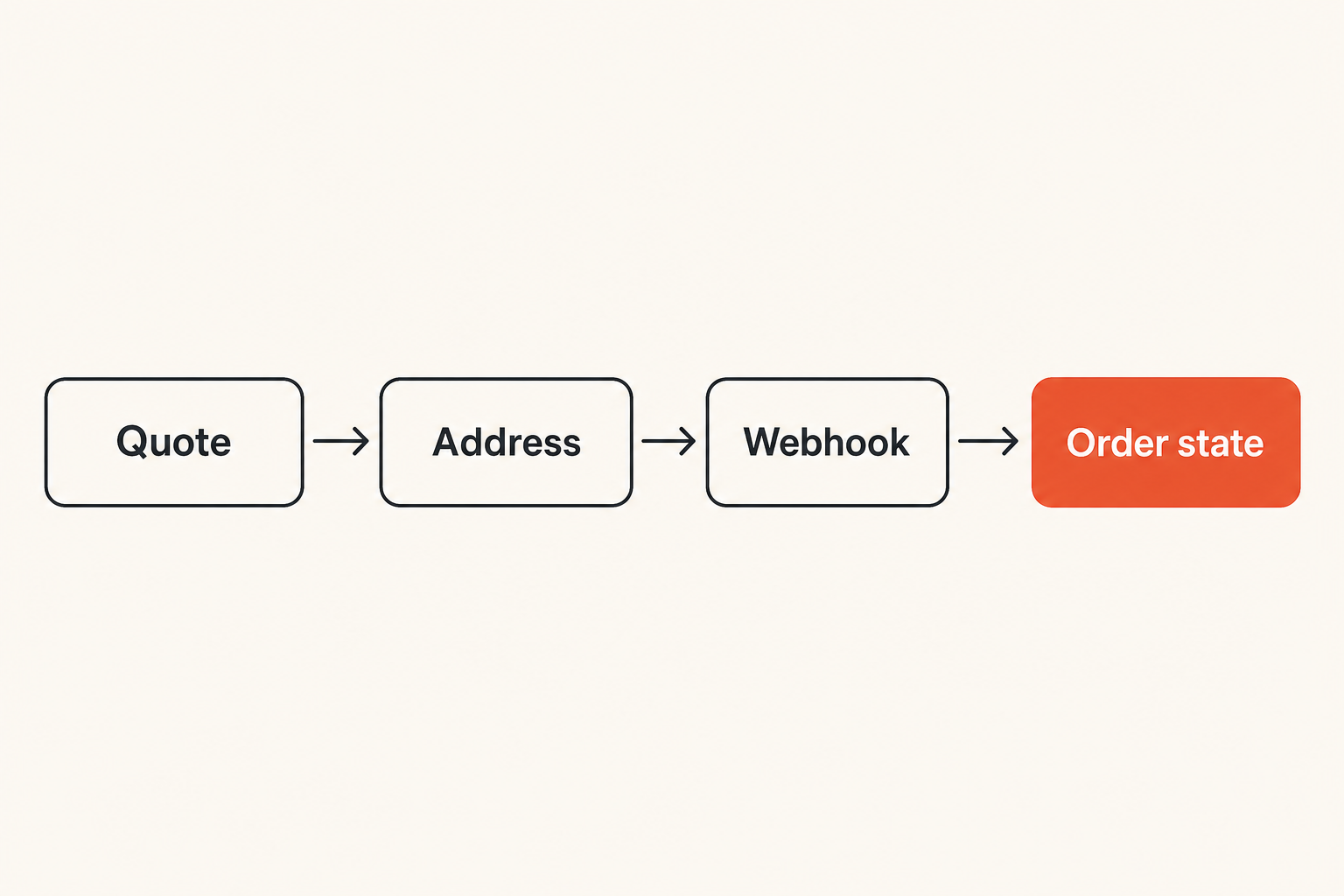
Every crypto checkout starts with a quote. A cart priced in USD must become a payable amount in BTC, USDT, USDC, LTC, or another supported asset. That quote has a timestamp, an exchange-rate source, an expiration window, a rounding policy, and a tolerance rule.
What breaks in practice is ambiguity. If a buyer sends slightly less because of wallet fees, is the order underpaid? If they send after the quote expires, do you honor the original rate? If network fees spike, who absorbs the difference?
A useful way to think about it is that pricing is a contract between your checkout and your ledger. The UI displays the contract. The backend enforces it.
Good quote records include:
- order ID
- fiat amount
- crypto asset and network
- quoted crypto amount
- quote source
- quote timestamp
- expiration timestamp
- acceptable variance
- payment address or invoice
- final status
Wallet creation and address routing
Cloud infrastructure often creates the payment destination dynamically. That can mean generating deposit addresses, assigning reusable addresses, creating Lightning invoices, or routing buyers to a hosted checkout page.
Each option has tradeoffs.
| Approach | What works | What fails |
|---|---|---|
| Unique address per order | Easier reconciliation and buyer support | Requires address management and monitoring |
| Reused merchant address | Simple setup | Harder to match payments to orders |
| Lightning invoice | Fast buyer experience | Requires invoice expiration and liquidity awareness |
| Hosted checkout | Less merchant engineering | Requires trust in provider workflows |
| Self-hosted node stack | More control | More operational burden |
The mistake teams make is optimizing for implementation speed only. Address strategy determines reconciliation quality. Reconciliation quality determines support load.
Webhooks, confirmations, and order state
Webhooks are where cloud computing crypto becomes operational. Your payment provider or node watcher sees a payment event and calls your system. Your system verifies the event, updates order state, and triggers downstream actions.
But webhooks are delivery attempts, not truth. They can arrive late. They can arrive twice. They can arrive out of order. Your endpoint can be down. Your database can reject a write. Your fulfillment system can be slow.
Practical rule: A webhook should wake up your system. It should not be the only way your system knows what happened.
A resilient implementation uses webhooks for speed and periodic reconciliation for correctness. The webhook gives you fast order updates. The reconciler catches missed events, delayed confirmations, and state drift.
The reference architecture for resilient crypto payments
Separate checkout, ledger, and fulfillment
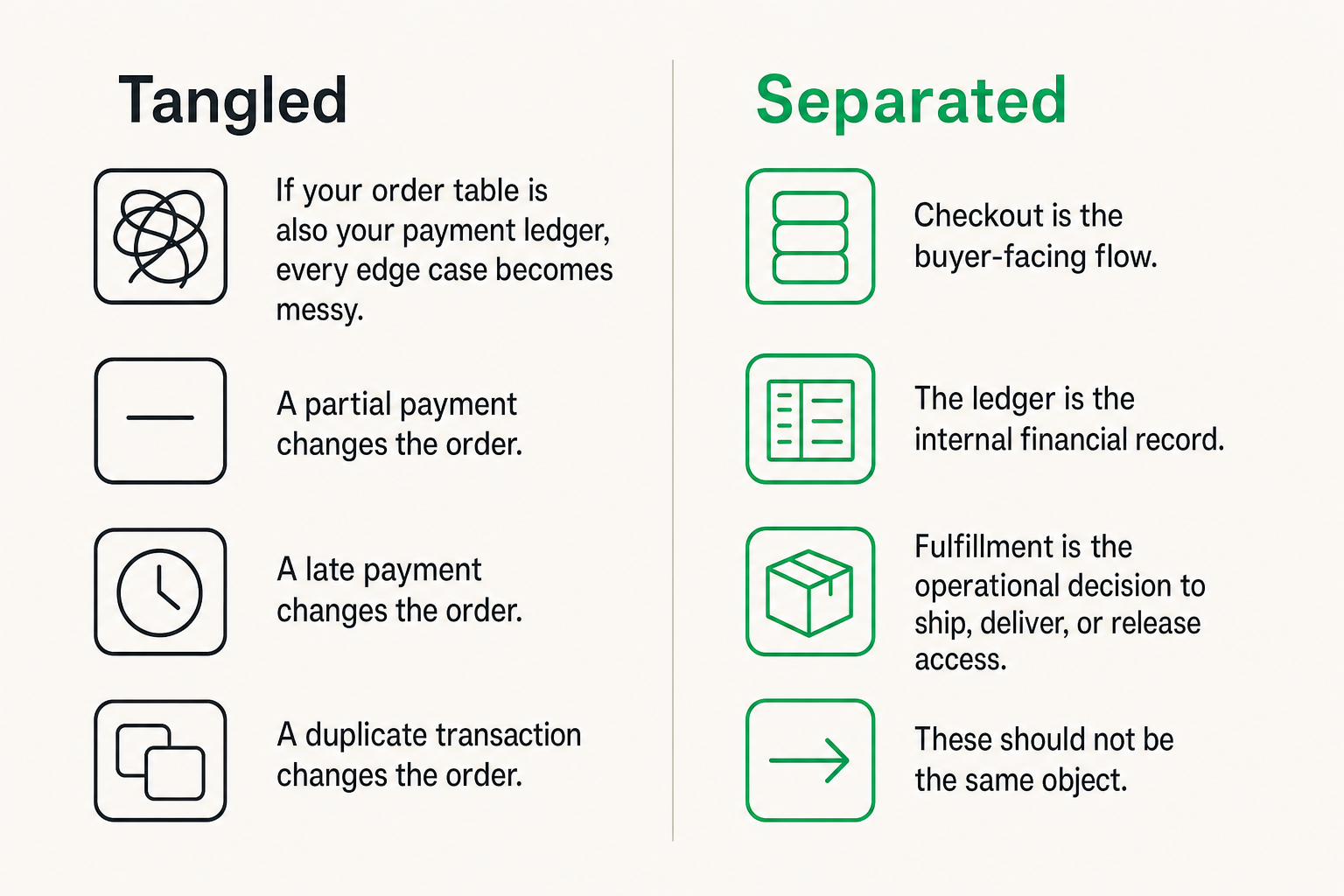
The most useful architecture pattern is separation of concerns. Checkout is the buyer-facing flow. The ledger is the internal financial record. Fulfillment is the operational decision to ship, deliver, or release access.
These should not be the same object.
If your order table is also your payment ledger, every edge case becomes messy. A partial payment changes the order. A late payment changes the order. A duplicate transaction changes the order. Finance then has to infer what happened from fields that were designed for ecommerce, not accounting.
A cleaner model looks like this:
{
  "order_id": "ord_1842",
  "payment_intent_id": "pi_9921",
  "asset": "USDC",
  "network": "polygon",
  "quoted_amount": "143.20",
  "received_amount": "143.20",
  "payment_state": "confirmed",
  "ledger_entries": [
    { "type": "quote_created", "amount": "143.20" },
    { "type": "payment_detected", "txid": "0x..." },
    { "type": "payment_confirmed", "confirmations": 20 }
  ],
  "fulfillment_state": "released"
}
The order can say what the customer bought. The payment intent can say what was requested. The ledger can say what actually happened. Fulfillment can decide what to do next.
Treat blockchain events as external facts
Blockchain events are not application events. They are external facts your application observes. That difference matters.
Your system can create an invoice. It cannot force a buyer to pay the exact amount. Your system can monitor a chain. It cannot guarantee block timing. Your system can mark a payment confirmed. It cannot rewrite the network when a transaction arrives late.
Treat observed events like immutable inputs. Record them, classify them, and attach decisions separately. This makes audits and support easier.
For example:
- Fact: transaction detected for 0.049 BTC
- Fact: required amount was 0.050 BTC
- Decision: mark as underpaid
- Action: notify buyer or create manual review
Do not collapse all of that into one field called paid=false.
Keep custody boundaries explicit
Custody is not just a legal word. It is an architecture boundary.
If funds touch infrastructure you control, you own more security, key management, and operational risk. If a provider controls the receiving flow and settles to you, you still need records, but your custody responsibilities differ. If you generate addresses but sweep to cold storage, you need a signing and sweep process. If you accept stablecoins, you need network and token-contract clarity.
The practical question is: who can move funds, under what conditions, and how is that action logged?
A simple custody boundary table helps teams avoid vague assumptions.
| Layer | Merchant-owned | Provider-managed | Operational concern |
|---|---|---|---|
| Checkout page | Optional | Common | Branding, conversion, buyer trust |
| Address generation | Sometimes | Common | Reconciliation and privacy |
| Private keys | Sometimes | Often provider | Theft, loss, access control |
| Settlement wallet | Usually | Sometimes | Finance ownership |
| Ledger records | Always needed | Often mirrored | Auditability |
Cloud computing crypto workflows that actually matter
The payment lifecycle
The payment lifecycle is the core workflow. It should be explicit enough that support, finance, and developers use the same language.
A practical lifecycle:
- Customer starts checkout.
- System creates a payment intent.
- System generates a quote and destination.
- Customer sends funds.
- Payment event is detected.
- Confirmation policy is applied.
- Ledger is updated.
- Order is released or flagged.
- Settlement is recorded.
- Reconciliation validates final state.
The important part is not the exact names. The important part is that every payment has a known state and every transition has a reason.
Practical rule: If support cannot explain the current payment state in one sentence, your state model is too vague.
The reconciliation lifecycle
Reconciliation is not an accounting chore to bolt on later. It is the mechanism that keeps cloud payment infrastructure honest.
A reconciler compares internal records against external sources: blockchain data, provider events, settlement files, wallet balances, and order statuses. It looks for mismatches.
Common reconciliation checks include:
- orders marked unpaid with matching on-chain payments
- orders marked paid without confirmed settlement
- duplicate transaction IDs attached to multiple orders
- underpaid or overpaid invoices
- expired quotes that later received funds
- webhook events received but not processed
- settlement totals that do not match ledger totals
Many teams skip this until the first messy month-end. By then, the data model is usually weak. Build reconciliation early, even if it starts as a daily report.
The support lifecycle
Support is where bad architecture becomes visible. A buyer says they paid. The support agent needs to answer without asking an engineer to query a node.
A good support view shows:
- order ID
- payment intent ID
- crypto asset and network
- quoted amount
- received amount
- destination address or invoice hash
- transaction ID
- confirmation count or status
- timestamps
- current decision
- next allowed action
The next allowed action matters. Can the agent resend checkout instructions? Mark for manual review? Request an additional payment? Refund? Escalate to compliance? Without allowed actions, support becomes improvisation.
What works: practical design rules
Use idempotency everywhere
Crypto payments are event-heavy. Buyers refresh pages. Wallets retry broadcasts. Providers retry webhooks. Cloud queues redeliver messages. Workers restart mid-job.
Idempotency means the same operation can run more than once without creating duplicate effects. It is not optional.
Use idempotency keys for:
- checkout creation
- quote generation
- webhook processing
- ledger entry creation
- fulfillment release
- refund initiation
- settlement import
For webhook processing, the key might be a provider event ID plus merchant account ID. For on-chain events, it might be network plus transaction ID plus output index or log index. For fulfillment, it might be order ID plus payment intent ID plus final paid status.
Make state machines visible
Payment states should be boring and visible. Avoid overloaded statuses like pending that mean five different things.
A workable payment state machine might include:
| State | Meaning | Typical next step |
|---|---|---|
| created | Payment intent exists | Await quote |
| quoted | Amount and destination shown | Await payment |
| detected | Payment seen but not final | Await confirmations |
| confirmed | Payment meets policy | Release order |
| underpaid | Payment below tolerance | Notify or review |
| overpaid | Payment above expected | Review or refund policy |
| expired | Quote expired without valid payment | New quote or support |
| failed | Processing error | Retry or escalate |
| settled | Funds accounted for | Close finance loop |
The mistake teams make is hiding this inside code. Put it in the dashboard. Put it in logs. Put it in support tooling. Make every transition traceable.
Design for partial failure
Partial failure is normal. The chain works but your database is down. Your database works but the provider webhook is delayed. The customer pays the correct amount but on the wrong network. The checkout expires but the transaction confirms later.
A resilient system has holding states, retry queues, and manual review paths. It does not force every payment into paid or unpaid immediately.
What works:
- durable queues for payment events
- retry policies with dead-letter queues
- reconciliation jobs independent of webhooks
- manual review states
- transaction-level audit logs
- alerting on stuck states
What fails:
- synchronous checkout logic that must complete all steps immediately
- direct fulfillment from unverified webhook payloads
- no record of raw events
- no path for late, partial, or duplicate payments
What fails in production
Duplicate orders and missing credits
Duplicate orders usually happen when checkout creation is not idempotent. The buyer clicks twice, the frontend retries, or the browser refreshes after a timeout. Now two payment intents exist for one cart.
Missing credits happen when the opposite failure occurs: the buyer paid, but the system lost the processing event. This can happen during deploys, queue outages, webhook downtime, or database errors.
Both problems come from treating the payment event as a single linear request. In production, it is a distributed workflow.
A useful operator test: can you replay all payment events from the last 24 hours without corrupting your ledger? If not, recovery will be painful.
Webhook dependence without recovery
Webhook-only systems are fragile. They look fine during low volume because most events arrive and process quickly. They fail under stress because there is no second source of truth.
The better pattern is webhook plus poller plus reconciler:
- webhook for fast notification
- poller for active status checks on open payments
- reconciler for periodic truth comparison
This is not overengineering. It is basic payment hygiene.
Practical rule: If a missed webhook can permanently lose payment state, your architecture is not payment-grade.
Cloud lock-in without operational ownership
Cloud lock-in is not always bad. Managed databases, queues, serverless functions, and hosted checkout systems can be the right choice. The failure mode is not using managed services. The failure mode is not knowing how payment-critical behavior depends on them.
Ask practical questions:
- What happens if the webhook endpoint is unavailable for 30 minutes?
- How many retries happen, and over what window?
- Can events be replayed from the provider dashboard or API?
- What is the maximum queue delay before support notices?
- Can finance export ledger data without engineering?
- Can you change settlement wallets safely?
- Who owns incidents after business hours?
Cloud computing crypto becomes dangerous when teams outsource architecture thinking but keep the operational consequences.
Security, compliance, and trust boundaries
Secrets and signing keys
Payment systems accumulate secrets: API keys, webhook signing secrets, wallet keys, database credentials, admin tokens, and settlement wallet access. In high-risk commerce, sloppy access control can become an existential problem.
Minimum controls should include:
- secret storage outside source code
- environment separation for test and production
- least-privilege API keys
- webhook signature verification
- admin action logging
- key rotation procedures
- restricted settlement wallet access
- multi-person approval for sensitive changes
Do not let every developer, contractor, or support user access payment controls. Support needs visibility and allowed actions. Finance needs reports. Developers need logs and test tools. Very few people need the ability to redirect funds.
KYC, sanctions, and category risk
Crypto payments do not remove compliance obligations. They change the tools and workflows. High-risk categories still need clear policies around prohibited jurisdictions, sanctioned entities, suspicious activity, refunds, chargeback-like disputes, and product restrictions.
The practical architecture point is that compliance decisions should be attached to records. If an order is blocked, reviewed, released, or refunded, the reason should be visible. If a wallet screening provider is used, store the result and timestamp. If a buyer is denied service, support needs a controlled script, not guesswork.
This is also where custody boundaries matter. A merchant that never controls private keys has a different operational profile from a merchant sweeping funds from self-hosted wallets. Do not blur the difference in internal procedures.
Buyer trust without false promises
Crypto checkout can be unfamiliar to buyers. Trust comes from clarity, not hype.
Good checkout copy explains:
- which asset and network to use
- exact amount due
- quote expiration time
- whether network fees are included
- expected confirmation behavior
- what happens if the buyer underpays or overpays
- how to contact support with a transaction ID
Avoid vague claims like instant settlement when your fulfillment policy waits for confirmations. Avoid saying irreversible payments are refundable without explaining your refund process. Avoid hiding network selection details.
Buyer trust improves when the system behaves predictably and support can see the same facts the buyer sees.
Developer implementation sequence
Start with the ledger
Most teams want to start with the checkout screen. Start with the ledger instead.
Define the records you need before money moves:
- Merchant account
- Customer order
- Payment intent
- Quote
- Destination address or invoice
- Observed payment event
- Ledger entry
- Fulfillment decision
- Settlement record
- Support action
Then define allowed transitions. A payment intent can be quoted, detected, confirmed, expired, underpaid, overpaid, failed, or settled. A fulfillment decision should depend on payment state plus risk rules, not raw webhook payloads.
This gives developers a stable core. Checkout can change. Providers can change. Assets can change. The ledger remains the source of operational truth.
Add checkout and webhooks
After the ledger exists, add checkout creation and webhook processing.
A practical implementation sequence:
- Create a payment intent when the order is ready for payment.
- Generate a crypto quote with a clear expiration.
- Display asset, network, destination, amount, and instructions.
- Receive webhook events at a signed endpoint.
- Verify the signature before processing.
- Store the raw event before applying business logic.
- Deduplicate by event ID or transaction identity.
- Update payment state through the state machine.
- Trigger fulfillment only after the state qualifies.
- Reconcile open and recently closed payments on a schedule.
A webhook handler should be small. Verify, store, enqueue, acknowledge. Heavy logic belongs in workers where retries and observability are easier.
Add monitoring and runbooks
Monitoring should reflect payment reality, not just server health. CPU and memory matter, but they will not tell you that 37 paid orders are stuck in detected.
Create alerts for:
- webhook failure rate
- queue age
- open payments past expiration
- detected payments not confirmed after expected windows
- paid orders not released
- ledger entries missing settlement records
- reconciliation mismatches
- unusual underpayment or overpayment patterns
- admin changes to wallets or provider settings
Runbooks should answer what operators do next. If webhooks are down, do you pause checkout or keep accepting payments? If reconciliation finds a paid order marked unpaid, who can release it? If settlement is delayed, who communicates with finance?
The mistake teams make is alerting engineers but giving payment operations no procedure.
Metrics payment teams should watch
Operational metrics
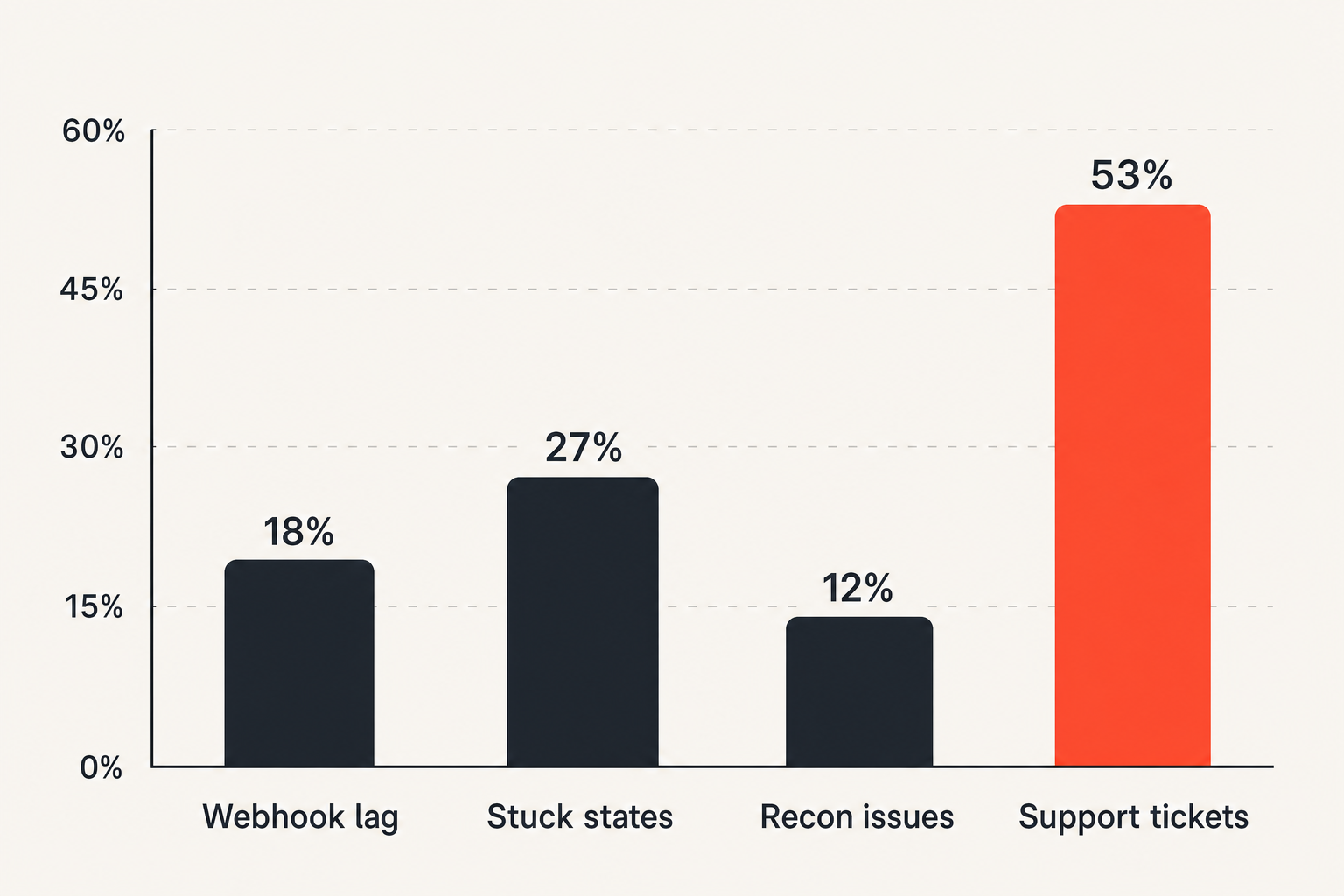
Operational metrics show whether the payment workflow is healthy.
Track:
- checkout creation success rate
- quote generation latency
- webhook delivery and processing latency
- queue depth and oldest message age
- payments stuck by state
- confirmation time by asset and network
- reconciliation exception count
- manual review volume
The useful metric is usually not a single number. It is a trend by asset, network, provider, and merchant category. If one network creates most support tickets, that is an operations decision, not a philosophical debate about blockchains.
Financial metrics
Financial metrics connect checkout activity to money.
Track:
- quoted fiat amount
- quoted crypto amount
- received crypto amount
- exchange-rate source
- variance between quote and receipt
- underpaid amount
- overpaid amount
- settlement amount
- fees
- settlement timing
- unresolved balance differences
Finance should not need engineering to answer basic questions. How much was accepted yesterday? How much settled? Which orders are exceptions? Which assets create the most variance? Which payments need review?
If the answer requires copying transaction hashes into multiple explorers, the architecture is not finished.
Support metrics
Support metrics are often the earliest warning that payment infrastructure is weak.
Track:
- tickets per paid order
- “I paid but order unpaid” tickets
- average time to locate transaction
- average time to resolve payment exception
- refund or adjustment requests
- underpayment follow-up rate
- expired quote complaints
A spike in support tickets may reveal a wallet UX issue, a confusing network selector, a delayed webhook path, or a broken quote rule. Treat support as an observability layer.
Product fit: crypto checkout infrastructure for high-risk merchants
When hosted infrastructure helps
Hosted crypto checkout infrastructure helps when the business problem is accepting payments reliably, not proving that your team can run every component from scratch.
It is especially useful when you need:
- fast checkout deployment
- payment pages buyers can understand
- asset and network support without custom node operations
- webhook-driven order updates
- settlement reporting
- merchant dashboards
- support visibility
- fewer custom payment edge cases
For high-risk merchants, the biggest advantage is often operational compression. Instead of building pricing, address assignment, webhook handling, and dashboard views internally, the team can focus on catalog, compliance boundaries, fulfillment, and customer operations.
When custom compute still belongs to you
Hosted checkout does not mean your architecture disappears. Your store, order system, support workflows, analytics, compliance logic, and fulfillment rules still belong to you.
Custom compute still makes sense for:
- product-specific risk rules
- internal order orchestration
- inventory and fulfillment logic
- customer notification flows
- finance exports and BI pipelines
- custom reconciliation reports
- fraud and abuse review
- enterprise integration layers
A useful way to think about it is this: outsource commodity payment rails where possible, own the business-specific decision layer where necessary.
How CoinPayPortal fits
CoinPayPortal fits the part of the architecture where merchants need a resilient crypto checkout path without turning payment operations into a full-time infrastructure project.
For a peptide seller or high-risk ecommerce operator, the goal is not to run the most elaborate cloud computing crypto stack. The goal is to give buyers a clear way to pay, receive reliable payment signals, reconcile funds, and keep support from drowning in transaction questions.
The product-fit question is straightforward:
- Do you need crypto checkout that is easier to operate than a self-built stack?
- Do you need payment events your store can act on?
- Do you need a clearer support and reconciliation workflow?
- Do you want to reduce dependency on fragile manual payment handling?
If yes, hosted crypto payment infrastructure is not a shortcut. It is a boundary decision.
Closing: make cloud computing crypto boring
The operator takeaway
Cloud computing crypto is useful when it makes the payment workflow more reliable. It is a liability when it spreads state across APIs, wallets, queues, and dashboards without ownership.
Teams think the problem is picking the right cloud stack or the right coin. The real problem is designing the payment lifecycle so money, orders, settlement, and support stay aligned.
The practical question is always the same: when a buyer pays, can your system prove what happened and take the correct next step?
The next practical step
Do not start by debating infrastructure vendors. Start by drawing your current payment state machine. Then mark every place where state can be lost, duplicated, delayed, or misunderstood.
Look for the weak points:
- checkout quote rules
- webhook retry behavior
- ledger structure
- fulfillment triggers
- reconciliation reports
- support visibility
- custody and admin controls
- settlement records
Fix those and cloud computing crypto becomes less exotic. It becomes payment operations with better rails and stricter workflow discipline.
Try coinpayportal.com
CoinPayPortal helps high-risk merchants accept crypto payments with practical checkout infrastructure, webhooks, and merchant operations workflows. Try coinpayportal.com.
Try CoinPay
Crypto payments, escrow, and wallets — multi-chain, Lightning-ready, and fast to integrate.
Get started →