CI/CD Security Peptide for Crypto Payment Infrastructure: A Practical Pipeline Control Model

A crypto checkout can look clean in staging and still fail in production because the release path was trusted too much. The wallet logic is reviewed. The webhook handler has tests. The payment status UI works. Then a pipeline variable leaks, a dependency changes under the build, or a deployment job pushes a hotfix without the same controls as the main branch.
That is where CI/CD security peptide becomes useful. Not as a buzzword. As a small chain of connected controls that protects the path from commit to settlement-impacting production code.
Teams think the problem is CI/CD tooling. The real problem is release trust. If your payment gateway, crypto invoice service, or merchant dashboard is built by an automation chain, then that chain is part of your payment infrastructure.
The practical question is not whether you use GitHub Actions, GitLab CI, Jenkins, Buildkite, or another runner. The practical question is whether the pipeline can prove what changed, who approved it, which secrets were available, what artifact shipped, and how quickly you can contain a bad release.
Table of contents
- CI/CD security peptide as a release architecture problem
- Map the payment release path before buying tools
- CI/CD security peptide controls that matter first
- Secrets, wallets, and custody boundaries in pipelines
- Build integrity for checkout APIs and webhook services
- Deployment gates that do not slow every commit
- Observability for pipeline and payment state
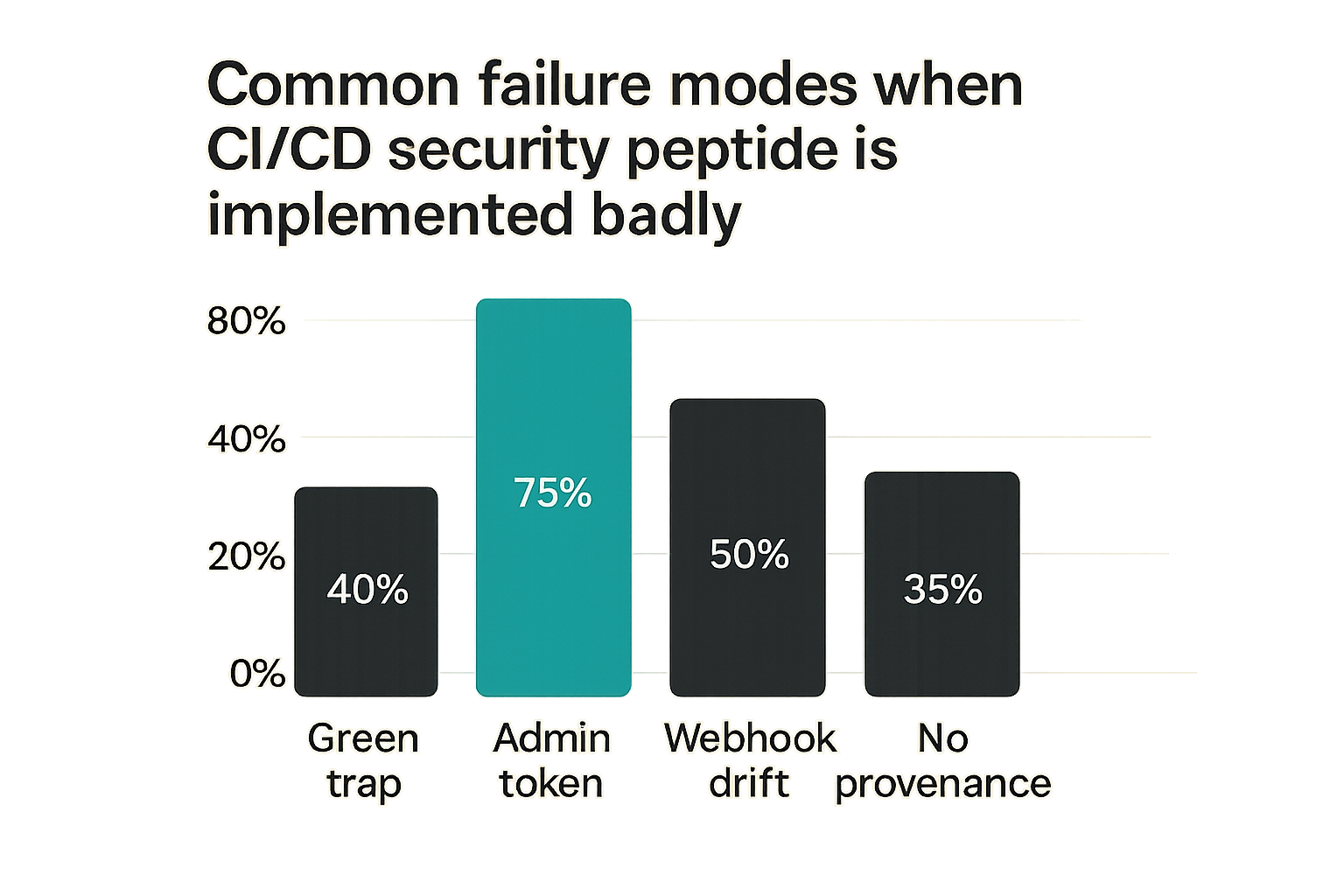
- Common failure modes when CI/CD security peptide is implemented badly
- A practical implementation sequence for merchants and fintech teams
- Where CoinPayPortal fits in the architecture
CI/CD security peptide as a release architecture problem
Why payment teams should care
In a crypto payment stack, code changes can affect checkout creation, address assignment, webhook verification, invoice expiry, exchange-rate display, settlement routing, refund logic, and merchant reporting. Those are not cosmetic features. They are money movement and money-state features.
The mistake teams make is treating the pipeline as a developer convenience while treating the payment API as critical infrastructure. In production, they are connected. A compromised runner can publish a modified container. A permissive deploy key can push code to the checkout service. A poisoned package can change how webhook signatures are verified.
That changes the conversation. CI/CD security is not only about catching vulnerable libraries. It is about controlling which automation is allowed to modify the systems that decide whether an order is paid, pending, expired, underpaid, overpaid, or refunded.
The peptide model in plain terms
A useful way to think about CI/CD security peptide is as a short chain of controls that only works when the links are connected:
- Pipeline triggers are verified.
- Execution permissions are scoped.
- Package and image inputs are pinned.
- Tokens and secrets are isolated.
- Identity, artifact, deployment, and evidence are traceable.
The word peptide is a useful mental model because the value is in the chain. One strong control does not compensate for four missing controls around it. Signed artifacts help, but not if the signing key lives in every pull request job. Secret scanning helps, but not if deployment tokens are long-lived and shared across environments.
Practical rule: Do not secure CI/CD as a collection of settings. Secure it as the release path for payment state.
What changes when the pipeline is treated as production
When the pipeline is treated as production, ownership changes. The team stops asking whether a job passed and starts asking what the job was allowed to touch.
That means payment engineers, platform engineers, and security engineers need a shared map of release authority. The team at vu1nz.com frames this well for DevSecOps teams: the relevant unit of defense is often the workflow that moves code, secrets, and artifacts, not the repository alone.
For a merchant or fintech team, this framing keeps the work grounded. You do not need theater. You need fewer paths to production, clearer custody boundaries, and enough evidence to investigate when checkout behavior changes unexpectedly.
Map the payment release path before buying tools
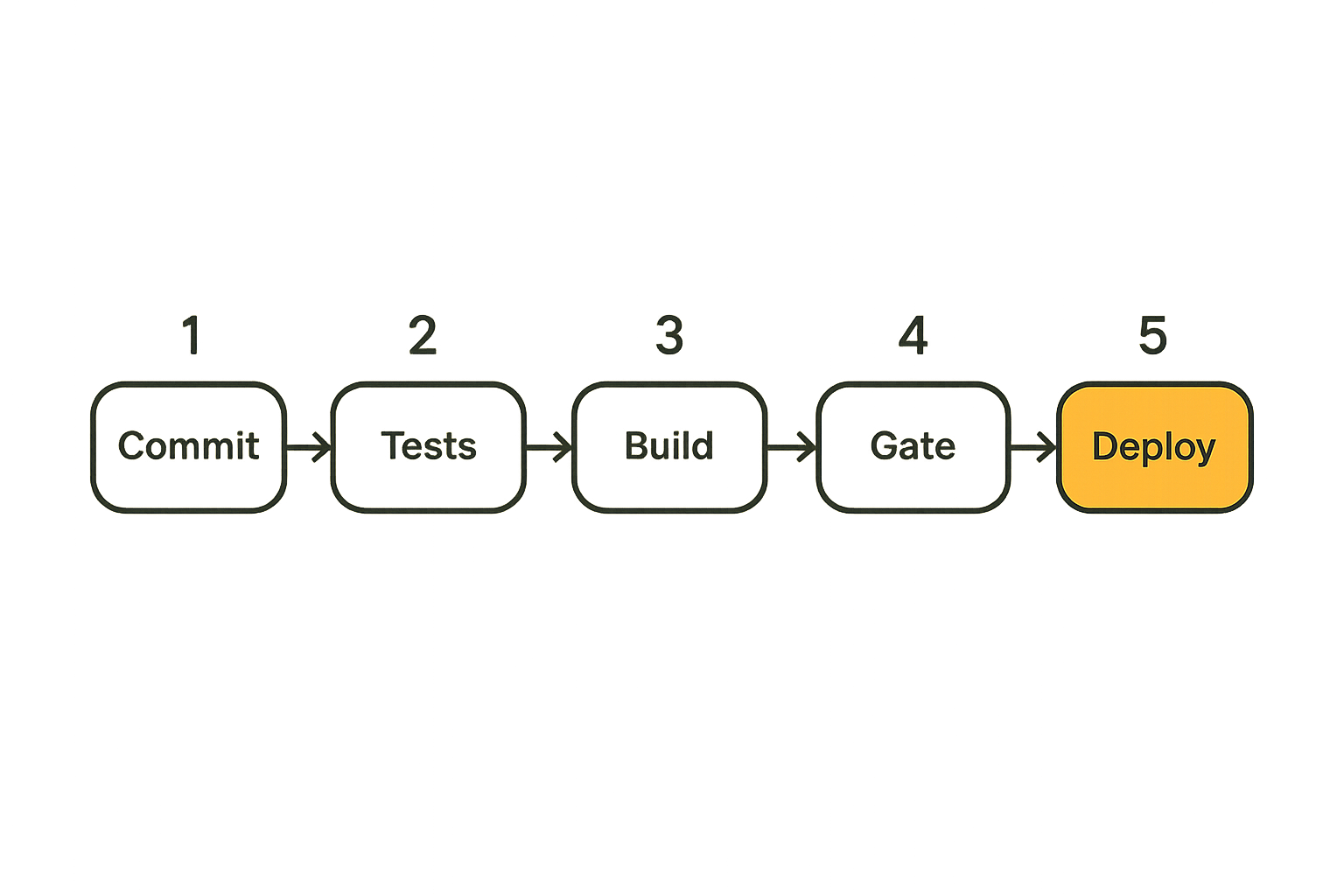
Start with settlement-impacting code
Before you add scanners, policies, or approval steps, identify which services can change payment outcomes. Most teams have more of these than they think.
Common settlement-impacting components include:
- Checkout session creation.
- Invoice amount and expiry calculation.
- Wallet address allocation.
- Webhook verification and event handling.
- Order status transitions.
- Refund and payout workflows.
- Merchant balance and reconciliation jobs.
- Admin tooling that can replay, override, or cancel payment events.
These components deserve stronger CI/CD controls than a marketing page or analytics dashboard. That does not mean every commit should wait for a security committee. It means your release path should reflect the blast radius of the code.
Draw trust boundaries around automation
Most pipeline diagrams show stages: test, build, deploy. That is not enough. Security diagrams need trust boundaries.
Ask these questions for every job:
- Can this job read secrets?
- Can it write artifacts?
- Can it deploy to an environment?
- Can it comment on or modify a pull request?
- Can it access production data or logs?
- Can it mint cloud credentials?
- Can it publish packages or containers?
A pull request test job from an untrusted branch should not have the same authority as a deployment job from a protected release branch. A dependency update bot should not inherit the same permissions as a maintainer-triggered production deployment.
Separate build risk from runtime risk
Build risk and runtime risk overlap, but they are not the same. Runtime controls catch abnormal behavior after deployment. Build controls decide what is allowed to become runtime behavior.
For example, a webhook service might have strong runtime signature checks. Good. But if CI can deploy a build that disables those checks, runtime security becomes a promise with no enforcement.
A payment team needs both:
| Area | Build-time control | Runtime control | Why it matters |
|---|---|---|---|
| Webhooks | Tests for signature validation | Reject invalid signatures | Prevent forged payment events |
| Checkout API | Artifact provenance | Request authentication | Prevent unknown code from serving checkout |
| Wallet routing | Protected deployment job | Key isolation | Prevent unauthorized address logic changes |
| Reconciliation | Dependency lockfile review | Ledger anomaly alerts | Prevent silent accounting drift |
| Admin tools | Approval gate | Action audit log | Prevent unreviewed payment overrides |
CI/CD security peptide controls that matter first
Permissions should be temporary and scoped
The first control is boring and effective: reduce what jobs can do. In many real incidents, the damaging path is not sophisticated cryptography failure. It is an overpowered token in an ordinary workflow.
For crypto payment infrastructure, scope permissions by environment and action. A test job should not deploy. A build job should not read production webhook secrets. A deployment job should not publish packages unless that is its explicit purpose.
A practical baseline:
pipeline_permissions:
  pull_request_tests:
    secrets: none
    deploy: false
    artifact_write: false
  main_branch_build:
    secrets: minimal
    deploy: false
    artifact_write: true
  production_deploy:
    secrets: production_deploy_only
    deploy: true
    artifact_write: false
This is not vendor-specific. The same principle applies across CI/CD platforms. Default deny, then grant only what the job needs.
Events should be verified before jobs run
What breaks in practice is event trust. Teams assume a job is safe because it runs in their pipeline. But pipelines can be triggered by forks, tags, scheduled jobs, bot commits, reusable workflows, manual dispatches, and dependency update events.
Each trigger needs a policy. For example:
- Pull requests from forks run tests without secrets.
- Tags deploy only if created by a trusted release identity.
- Manual production deploys require a protected branch and a second reviewer.
- Scheduled jobs can read monitoring data but cannot write production config.
- Dependency bot changes run tests but cannot auto-deploy settlement-impacting code.
Practical rule: A CI/CD trigger is an authentication event. Treat it like one.
Artifacts should be signed or traceable
You need to know which commit produced the container, function bundle, or package running in production. If you cannot answer that quickly, incident response slows down.
Signing is one approach. Provenance records are another. The minimum practical requirement is traceability from production artifact back to:
- Repository.
- Commit SHA.
- Build job.
- Triggering identity.
- Dependency lockfile.
- Deployment approval.
- Environment.
For a payment processor, this matters during disputes and outages. If a merchant reports that invoices were marked expired too early, you should be able to connect the behavior to a release, a config change, or an external network condition without guessing.
Secrets, wallets, and custody boundaries in pipelines
Never let CI become a wallet
The fastest way to turn a build problem into a custody problem is to put wallet authority in CI. CI should not hold private keys that can move funds. It should not sign mainnet transactions. It should not have broad access to production custody systems.
There are exceptions for tightly controlled internal systems, but most merchant teams should avoid them. If a pipeline needs to deploy code that interacts with wallets, the deployment credential should authorize deployment, not fund movement.
Better patterns include:
- Use a payment gateway for checkout and settlement workflows.
- Keep signing keys in dedicated custody infrastructure or an HSM-backed service.
- Use environment-specific API credentials with narrow scopes.
- Require runtime service identity for sensitive wallet operations.
- Avoid storing seed phrases, private keys, or broad admin API tokens in CI variables.
Treat testnet and mainnet differently
Testnet secrets are not harmless. They often reveal naming conventions, service boundaries, wallet logic, and operational habits. But mainnet credentials deserve a different class of control.
Separate the two completely:
| Control | Testnet | Mainnet |
|---|---|---|
| CI access | Limited | Highly restricted |
| Deployment approval | Optional for low-risk changes | Required for settlement-impacting changes |
| Secret rotation | Regular | Release-aware and incident-aware |
| Logging | Verbose allowed | Redacted by default |
| Wallet authority | Simulated or capped | Outside CI |
The practical question is not whether testnet is safe. It is whether a testnet compromise helps an attacker understand or reach mainnet.
Rotate around releases, not calendar reminders
Calendar-based rotation is useful, but release-aware rotation is better for sensitive payment systems. Rotate credentials when access patterns change.
Good rotation moments include:
- A new production deployment workflow is introduced.
- A runner image changes.
- A maintainer leaves the project.
- A third-party integration is replaced.
- A secret is exposed to a broader job than intended.
- A payment service moves from testnet to mainnet.
Rotation should be automated enough that teams actually do it. Manual runbooks that require tribal knowledge usually fail during pressure.
Build integrity for checkout APIs and webhook services
Lock dependencies without freezing delivery
Crypto payment applications depend on SDKs, HTTP clients, cryptographic libraries, database drivers, queue clients, and framework packages. A dependency change can modify payment behavior even when your own code looks unchanged.
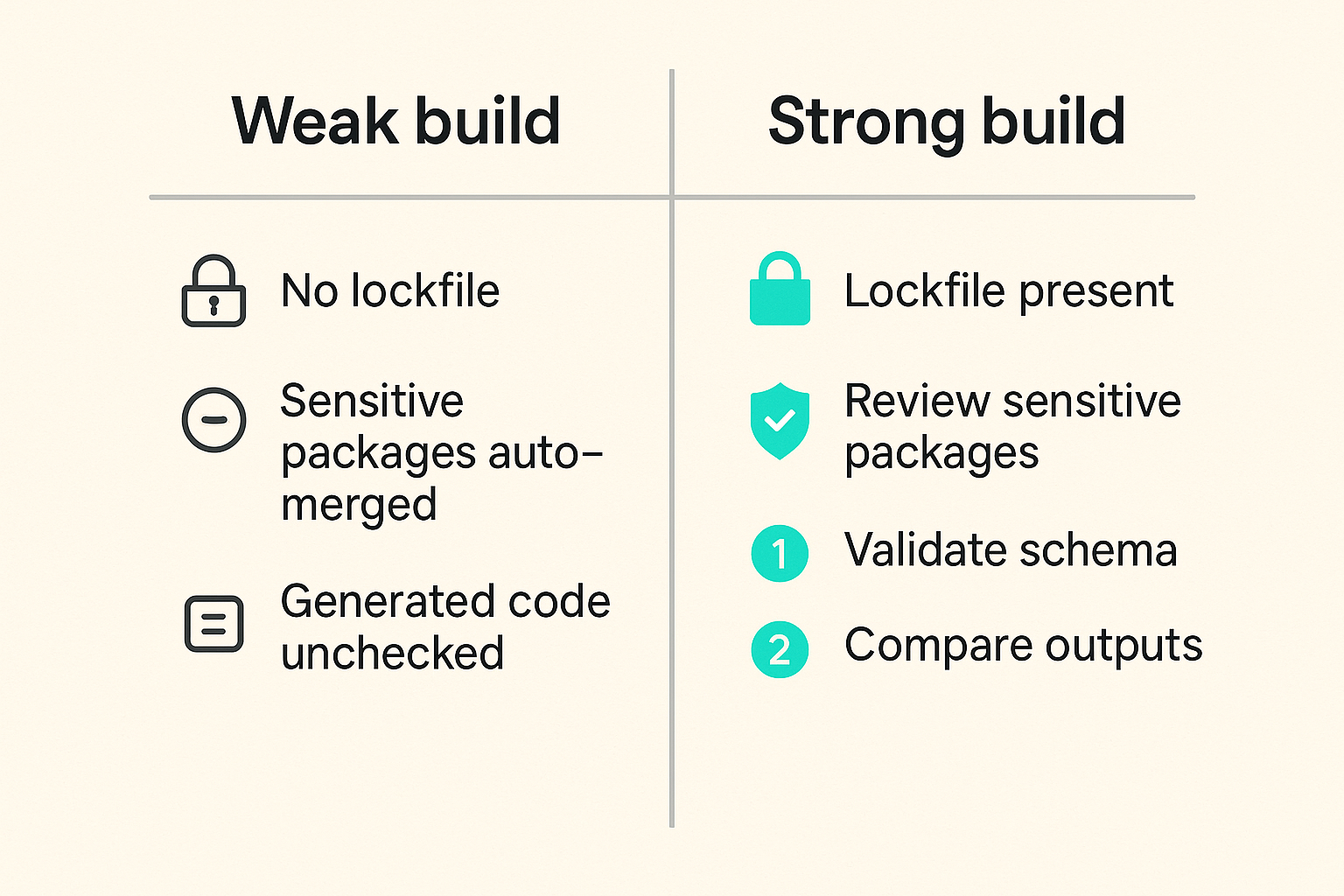
Lockfiles are basic hygiene. They do not solve everything, but they reduce surprise. Combine them with review rules for sensitive packages:
- Payment gateway SDKs.
- Signature verification libraries.
- Address parsing libraries.
- Decimal and currency math packages.
- Queue and retry libraries.
- ORM or migration tooling.
The mistake teams make is reviewing application diffs while auto-merging dependency diffs that touch payment-critical behavior. That is backwards. If a package affects amount calculation or signature validation, it deserves attention.
Verify generated clients and SDKs
Many payment teams generate API clients from OpenAPI specs or internal schemas. That is efficient, but generated code can hide behavior changes. A small schema update can change retry logic, error handling, required fields, or enum values.
Add checks for generated code:
- Validate the schema source.
- Generate clients in CI from a pinned tool version.
- Fail the build if generated output differs from committed output.
- Run contract tests against checkout creation and webhook processing.
- Publish the client only from a protected release workflow.
This keeps SDK generation from becoming an unreviewed release channel.
Make idempotency part of release testing
Payment systems live in retries. Networks fail, webhooks arrive twice, customers refresh pages, queues redeliver messages, and merchants replay events during support investigations.
Your CI/CD pipeline should test idempotency before deployment. Not every edge case, but the core ones:
- Creating the same checkout request twice with the same idempotency key.
- Receiving the same paid webhook twice.
- Receiving pending, paid, and confirmed events out of order.
- Retrying a refund request after a timeout.
- Replaying reconciliation jobs for the same settlement window.
A green unit test suite is not enough if it never exercises duplicate or out-of-order events.
Practical rule: If a release can change payment state transitions, CI should test duplicate, delayed, and replayed events.
Deployment gates that do not slow every commit
Use risk-based environments
Not all environments need the same friction. The goal is not to make developers hate the pipeline. The goal is to prevent low-trust changes from reaching high-impact systems.
A sensible model:
| Environment | Allowed trigger | Secrets | Approval | Typical use |
|---|---|---|---|---|
| Preview | Pull request | None or fake | No | UI and API review |
| Integration | Main branch | Test credentials | No or light | Contract testing |
| Staging | Release branch | Testnet or sandbox | Optional | End-to-end payment flow |
| Production | Protected tag or release | Production scoped | Yes | Merchant-facing services |
This keeps feedback fast while protecting the final mile.
Require human approval only where it changes outcomes
Human approval is expensive if it becomes a rubber stamp. Use it where judgment matters:
- Production release of checkout or webhook services.
- Database migrations affecting payment ledgers.
- Changes to custody integration or payout routing.
- Changes to admin roles and override workflows.
- Emergency hotfixes that bypass normal soak time.
Do not require approval for every documentation change or isolated test update. Over-approval creates alert fatigue in the release process. People click approve because the system trained them to ignore the gate.
Make rollback a tested path
Rollback is often documented but not tested. That is a problem for payment systems because data shape changes can make rollback unsafe.
Test rollback for:
- API version changes.
- Database migrations.
- Webhook event schema changes.
- Queue consumer behavior.
- Feature flags that alter payment state transitions.
The practical implementation is simple: include a rollback step in staging drills. Deploy version N, generate checkout and webhook traffic, deploy version N+1, then roll back and verify that payment state remains consistent.
Observability for pipeline and payment state
Correlate build IDs with transactions
When a merchant reports a payment issue, support teams usually start with transaction IDs, wallet addresses, invoice IDs, or order IDs. Engineering starts with logs, metrics, and recent deploys. Those views need to meet.
Add build metadata to runtime logs and admin views:
- Service version.
- Commit SHA.
- Build ID.
- Deployment time.
- Feature flag state.
- Schema version.
This does not mean exposing internals to customers. It means your internal support and engineering tools should show which release processed a transaction.
Alert on control failures, not just job failures
A failed build is visible. A skipped control is more dangerous.
Alert on events such as:
- Production deploy without artifact provenance.
- Job requested secrets outside its policy.
- Deployment from an unprotected branch.
- Lockfile changed without required review.
- Webhook contract tests skipped.
- Runner image changed unexpectedly.
- Manual approval performed by the same person who authored the change.
These alerts should go to the owning team, not a black hole. If no one owns the workflow, no one owns the risk.
Preserve evidence for disputes and incidents
Payment teams need evidence. Not because every issue is an attack, but because disputes and support cases require reconstruction.
Keep records for:
- Build logs.
- Deployment approvals.
- Artifact hashes.
- Configuration changes.
- Webhook deliveries and responses.
- Retry attempts.
- Admin overrides.
Retention depends on your business and regulatory environment, but deleting pipeline evidence after a few days can leave you blind during merchant escalations.
Common failure modes when CI/CD security peptide is implemented badly
The green pipeline trap
A green pipeline only proves that the configured jobs passed. It does not prove that the right jobs ran, with the right permissions, against the right artifact.
What fails:
- Security jobs are optional or allowed to fail.
- Tests run on source code, but deployment uses a rebuilt artifact.
- Production deploys can be triggered outside the protected path.
- Release notes reference one commit while the container contains another.
What works:
- Required checks for payment-critical repositories.
- Build once, promote the same artifact.
- Deployment only from protected workflows.
- Artifact identity visible in production.
The admin token shortcut
Many teams start with a broad admin token because it gets the pipeline working. Then the token stays forever. Months later, it can deploy, read secrets, publish packages, and modify infrastructure.
This is how a convenience credential becomes a systemic risk.
Fix it by splitting authority:
- One token for artifact publishing.
- One identity for deployment.
- One identity for reading non-production secrets.
- No CI identity for fund movement.
- Short-lived credentials where supported.
The point is not elegance. The point is limiting blast radius when a runner, dependency, or workflow is compromised.
The silent webhook regression
Webhook regressions are dangerous because they can look like normal payment delays. A release changes signature parsing, timestamp tolerance, retry response codes, or idempotency behavior. Payments continue arriving, but some orders never advance.
Prevent this with contract tests and canaries:
- Replay known valid webhook payloads.
- Replay invalid signatures and expect rejection.
- Test duplicate delivery.
- Test out-of-order delivery.
- Verify response codes that control retries.
- Monitor paid-but-not-fulfilled gaps after deployment.
This is where CI/CD security peptide connects directly to merchant operations. The pipeline is protecting not just code integrity, but order integrity.
A practical implementation sequence for merchants and fintech teams
Week one inventory and blast radius
Start with inventory. Do not begin by rewriting all workflows.
A practical week-one sequence:
- List repositories that affect checkout, settlement, reconciliation, webhooks, admin overrides, or merchant balances.
- List every CI/CD workflow in those repositories.
- Mark which jobs can access secrets, publish artifacts, or deploy.
- Identify long-lived credentials and shared tokens.
- Map production deploy paths.
- Document which tests protect payment state transitions.
- Assign an owner for each workflow.
By the end of week one, you should know where the highest-risk automation lives.
Week two controls and policy
In week two, apply the controls that reduce blast radius fastest.
Prioritize:
- Remove secrets from pull request jobs.
- Restrict production deploys to protected branches or tags.
- Split broad tokens into scoped credentials.
- Require lockfile review for payment-critical dependencies.
- Store artifact identity with each deployment.
- Add webhook contract tests as required checks.
- Disable unused workflows and stale deploy keys.
Do not chase perfect maturity. Focus on controls that close real paths to production compromise.
Week three validation and drills
Controls are only useful if they work under pressure. Validate them.
Run small drills:
- Attempt to deploy from an unprotected branch and confirm it fails.
- Open a forked pull request and confirm secrets are unavailable.
- Modify a payment SDK lockfile and confirm required review triggers.
- Deploy a staging release and confirm build metadata appears in logs.
- Replay webhook payloads and confirm idempotent behavior.
- Rotate a deployment credential and confirm the runbook is accurate.
This is where many teams find drift between policy and reality. That is good. Finding drift in a drill is cheaper than finding it during an incident.
Where CoinPayPortal fits in the architecture
Keep payment integration boundaries clear
For merchants and developers, the best CI/CD control is sometimes deleting custom payment code. Every line of wallet handling, checkout state, or settlement workflow you own becomes something your pipeline can break.
A gateway boundary helps. Your application should create checkout sessions, receive signed payment events, reconcile orders, and expose merchant-facing state. It should not casually absorb custody logic or chain-specific edge cases unless that is core to your business.
That boundary also simplifies pipeline security. You can focus controls on the integration points that matter: API credentials, webhook handlers, order state transitions, and reconciliation jobs.
Design webhooks as production contracts
Webhooks should be treated as contracts, not callbacks. A contract has versioning, validation, replay behavior, and evidence.
For CI/CD, that means:
- Store sample payloads for every event type you depend on.
- Test signature verification in every release.
- Test idempotency and ordering behavior.
- Log delivery IDs and processing outcomes.
- Make webhook handler changes visible in release review.
If your checkout UI is polished but your webhook pipeline is fragile, merchant support will feel it. The UI is not the whole system. State, trust, settlement, and support are the real work.
Use the gateway to reduce custom custody code
CoinPayPortal is most useful when it lets your team keep a clean boundary between commerce logic and crypto payment operations. That does not remove your CI/CD security responsibility. It narrows it to the code you actually should own.
Your pipeline still needs to protect API integration, webhook processing, order updates, and merchant dashboards. But you can avoid turning every merchant application into a custody platform with a fragile release process.
The closing point on CI/CD security peptide is simple: secure the chain that ships payment behavior. If your pipeline can change checkout, webhook, or reconciliation logic, it is part of your crypto payment infrastructure.
Try coinpayportal.com
CoinPayPortal helps developers and merchants integrate crypto payments with cleaner checkout, webhook, and settlement workflows. Try coinpayportal.com.
Try CoinPay
Crypto payments, escrow, and wallets — multi-chain, Lightning-ready, and fast to integrate.
Get started →