Biotech Peptides Payments: A Practical Crypto Checkout Architecture for High-Risk Merchants

Biotech peptides merchants do not usually fail because they forgot to add a payment button. They fail because one processor changes its risk policy, funds are frozen, customers start opening tickets, and the team has no clean way to keep orders, invoices, wallets, and settlement records aligned.
Teams think the problem is finding a payment processor that will tolerate biotech peptides. The real problem is building a payment workflow that does not collapse when one provider, bank, or policy reviewer changes position.
That changes the conversation. This is not just a checkout page problem. It is an architecture problem: state management, custody boundaries, webhooks, customer communication, reconciliation, refunds, compliance language, and support tooling.
The practical question is: if you sell legal research-use products in a category that payment companies often classify as high-risk, how do you design the crypto payment infrastructure so the business can keep operating without turning every order into a manual exception?
Table of contents
- Why biotech peptides payments are an infrastructure problem
- Map the biotech peptides transaction lifecycle
- Decide custody settlement and compliance boundaries
- Build checkout for high-risk merchant reality
- Webhooks are the control plane for biotech peptides
- What works and what fails in production
- Support operations for biotech peptides merchants
- Developer implementation sequence for biotech peptides payments
- Compliance language and category risk
- Where coinpayportal.com fits in the architecture
Why biotech peptides payments are an infrastructure problem
The payment processor is not the system
The mistake teams make is treating the processor as the payment system. In a low-risk SaaS product, that assumption often works. The processor hosts the checkout, stores the customer, tracks the payment, handles cards, and emits enough events to keep the app updated.
For biotech peptides, that model is brittle. The category is often reviewed as high-risk even when the merchant sells research-use products, maintains documentation, and ships only where allowed. If a card processor, acquiring bank, or platform risk team changes policy, the merchant can lose payment acceptance with little warning.
A useful way to think about it is this: the processor is only one execution rail. Your business still owns the order state, invoice state, customer communication, fulfillment state, refund policy, compliance record, and accounting trail.
If those parts live only inside a processor dashboard, you do not have payment infrastructure. You have dependency exposure.
For a deeper adjacent walkthrough, we covered the same operational pattern in peptide payments and crypto infrastructure, where the real issue is merchant continuity rather than payment-button selection.
The risk model changed before the stack did
Many peptide merchants started with normal e-commerce assumptions: card checkout, order confirmation email, shipping workflow, support inbox. Then the category became harder to underwrite. Payment providers began asking sharper questions about product claims, acceptable-use policies, shipping restrictions, labeling, documentation, and customer intent.
The stack did not evolve at the same speed. Teams still had one checkout path, one processor, one set of order states, and one refund process designed for card rails.
Crypto payments do not magically remove business risk. They do change the control surface. Instead of asking whether a processor will always keep you live, you ask whether your system can create invoices, detect settlement, reconcile payments, and communicate clearly without depending on card network approval for every transaction.
That changes the conversation from permission to architecture.
The merchant operation is part of the architecture
Payment architecture is not only code. It includes support macros, refund rules, fulfillment holds, admin dashboards, wallet operations, accounting exports, and policy reviews.
For biotech peptides, this matters because customers may be technical, international, impatient, or unfamiliar with crypto checkout. Some will underpay. Some will send from an exchange. Some will send the wrong asset on the wrong network. Some will ask whether a transaction is confirmed before your backend sees enough confirmations.
Practical rule: if support cannot explain the payment state in one sentence, your checkout state machine is too vague.
Your architecture needs to make the operational truth visible. Paid is not enough. You need states like invoice_created, quote_expired, payment_detected, underpaid, overpaid, confirmed, settlement_ready, refunded, canceled, and manual_review.
Map the biotech peptides transaction lifecycle
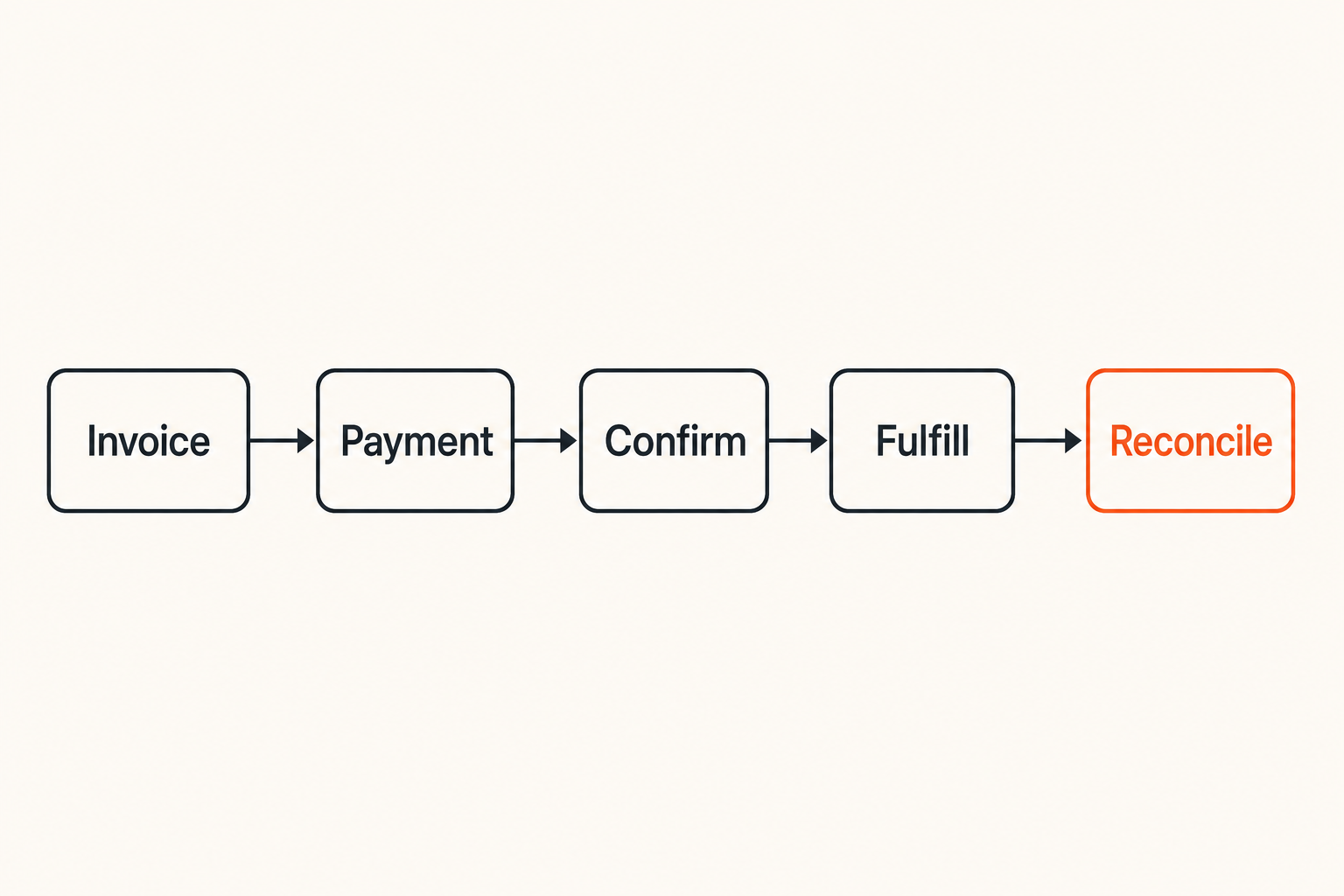
From catalog intent to invoice
The lifecycle starts before a wallet address is shown. A buyer adds products to a cart. The site calculates taxes or fees where applicable. The merchant checks shipping eligibility. The checkout creates an invoice with a fiat-denominated total and one or more crypto payment options.
The invoice should be a durable object in your system, not just a transient screen. It should include:
- merchant order ID
- invoice ID
- fiat amount
- selected asset and network
- quoted crypto amount
- quote expiration timestamp
- receiving address or payment request
- customer-visible status
- internal risk flags
- webhook event history
The practical question is whether you can reconstruct the transaction later without opening five dashboards. If the answer is no, accounting and support will suffer.
For adjacent reading from our network: Coinbase cryptocurrency exchange architecture for decentralized compute builders discusses a similar separation between exchange access, payment state, and settlement workflows.
From on-chain payment to fulfillment
Once payment is sent, your system needs to move from intent to evidence. A blockchain transaction is not the same as final settlement. The checkout may detect a mempool transaction, then wait for confirmations, then mark the invoice as confirmed.
For biotech peptides, fulfillment should not begin simply because a customer says they paid. It should begin when your system has enough objective evidence according to your risk tolerance.
Common confirmation policy inputs include:
- asset and network used
- transaction value
- chain finality profile
- fraud or double-spend risk
- fulfillment reversibility
- customer history
- operational urgency
For small stablecoin transactions on faster networks, your threshold may be different than for higher-value payments on slower chains. The architecture should make that policy configurable. Hard-coding a single confirmation rule into checkout logic is how teams create hidden operational risk.
From refund request to audit trail
Refunds are where weak crypto payment implementations show up. A customer asks for a refund, but the original payment came from an exchange deposit address. The asset moved in price. The order was partially fulfilled. The support agent has no verified refund address. Accounting wants the fiat value at payment time and refund time.
Your refund workflow needs its own state model:
- refund_requested
- refund_approved or refund_rejected
- refund_address_collected
- refund_address_verified
- refund_transaction_sent
- refund_confirmed
- refund_record_closed
Do not treat refunds as a note on the order. Treat them as financial events with audit trails.
Practical rule: never send a crypto refund to an address unless the workflow records who provided it, when it was provided, and how it was verified.
Decide custody settlement and compliance boundaries
Non-custodial by default
For many merchants, the cleanest architecture is non-custodial payment acceptance: the gateway helps create invoices, detect payments, and update order state, while funds settle to merchant-controlled wallets. This reduces the amount of value sitting with a third party and keeps the custody boundary easier to reason about.
Non-custodial does not mean no operational responsibility. It means you must decide who controls keys, who can move funds, how treasury wallets are monitored, and how accounting records are exported.
A simple operating model is:
- gateway creates invoice and monitors payment
- customer pays a merchant-controlled address or route
- merchant backend receives signed events
- order system updates fulfillment state
- finance reconciles invoice to settlement record
- treasury handles conversion or holding policy
The mistake teams make is thinking non-custodial means hands-off. It does not. It means you control more of the settlement surface, so your internal process must be cleaner.
Settlement is not the same as checkout
Checkout is the customer-facing payment moment. Settlement is the merchant-facing financial outcome. They are related but not identical.
A checkout can succeed while settlement operations remain messy. Example: the customer pays correctly, the order ships, but finance cannot tell which wallet transaction maps to which invoice because multiple invoices reused an address or because the backend failed to persist the transaction hash.
Good settlement records include:
- invoice ID
- order ID
- customer ID where applicable
- asset
- network
- transaction hash
- receiving address
- amount paid in crypto
- fiat value at quote time
- fiat value at confirmation time
- fee estimate or observed fee where relevant
- final merchant action
If you are building directly, keep the data model boring and explicit. If you are integrating a gateway, read the event model carefully before launch. The CoinPay docs are the right starting point for teams that want to wire invoice creation, webhook handling, and merchant-side state updates into their own stack.
Where escrow changes the workflow
Escrow is not just a feature. It changes the trust model and the order lifecycle. In categories where buyers and sellers need extra confidence, escrow can hold funds until a release condition is met. That condition might be delivery confirmation, inspection, a dispute window, or an agreed milestone.
For biotech peptides, escrow may be useful in B2B transactions, larger research supply orders, or cases where the buyer wants proof that funds are not released before the merchant meets defined obligations. It is less useful for low-value instant retail orders where the operational cost of escrow exceeds the benefit.
If your workflow needs conditional release, study how crypto escrow affects order state before you bolt it onto an existing checkout. Escrow adds states such as funded, held, released, disputed, canceled, and refunded. Those states must be visible to support and finance, not hidden in a side dashboard.
Build checkout for high-risk merchant reality
Pricing quotes and expiration
Crypto checkout needs a quote window. If an order is priced in USD but paid in BTC, ETH, or a stablecoin, the customer needs a precise amount and a deadline. Without expiration, the merchant eats price movement or disputes the order after the fact.
For stablecoins, quote volatility is lower, but expiration still matters because address assignment, inventory reservations, and order holds should not stay open forever.
A practical quote object includes:
invoice_id: inv_90381
order_id: ord_44829
fiat_currency: USD
fiat_amount: 284.00
asset: USDC
network: polygon
crypto_amount: 284.00
expires_at: 2026-08-07T18:20:00Z
status: quote_active
Do not let customers reuse old payment screens. Expired invoices should either be canceled or requoted. If a late payment arrives, your system should classify it as late_paid and route it to manual review or automatic handling according to policy.
Wallet support and address hygiene
Wallet support is where crypto UX meets support cost. If you accept assets across multiple networks, your checkout must make network selection painfully clear. USDC on Ethereum is not the same operational event as USDC on Polygon or Solana.
Address hygiene matters:
- use unique addresses or unique payment identifiers where possible
- show asset and network together
- avoid ambiguous labels like send USDT without network context
- display copy buttons and QR codes carefully
- warn customers not to send from unsupported chains
- log address assignment permanently
The best checkout is not the one with the most coins. It is the one with the fewest ambiguous payment paths.
Practical rule: every supported asset-network pair is a support commitment. If you cannot monitor it, reconcile it, and refund it, do not offer it.
Idempotency and duplicate payment handling
Payment systems see duplicate clicks, browser refreshes, repeated webhook deliveries, and customers who submit multiple payments because they are unsure whether the first one worked. Your backend must be idempotent.
Idempotency means the same event can be processed more than once without creating duplicate fulfillment, duplicate emails, or duplicate accounting rows.
Use idempotency keys for invoice creation and event IDs for webhook processing. Store processed event IDs in a durable table. If the same event arrives again, acknowledge it but do not repeat side effects.
Pseudo-logic:
if event_id already_processed:
  return 200

store event_id
load invoice
apply valid state transition
write audit record
trigger downstream action once
return 200
What breaks in practice is not the first happy-path payment. What breaks is the second webhook retry that ships the same order twice.
Webhooks are the control plane for biotech peptides
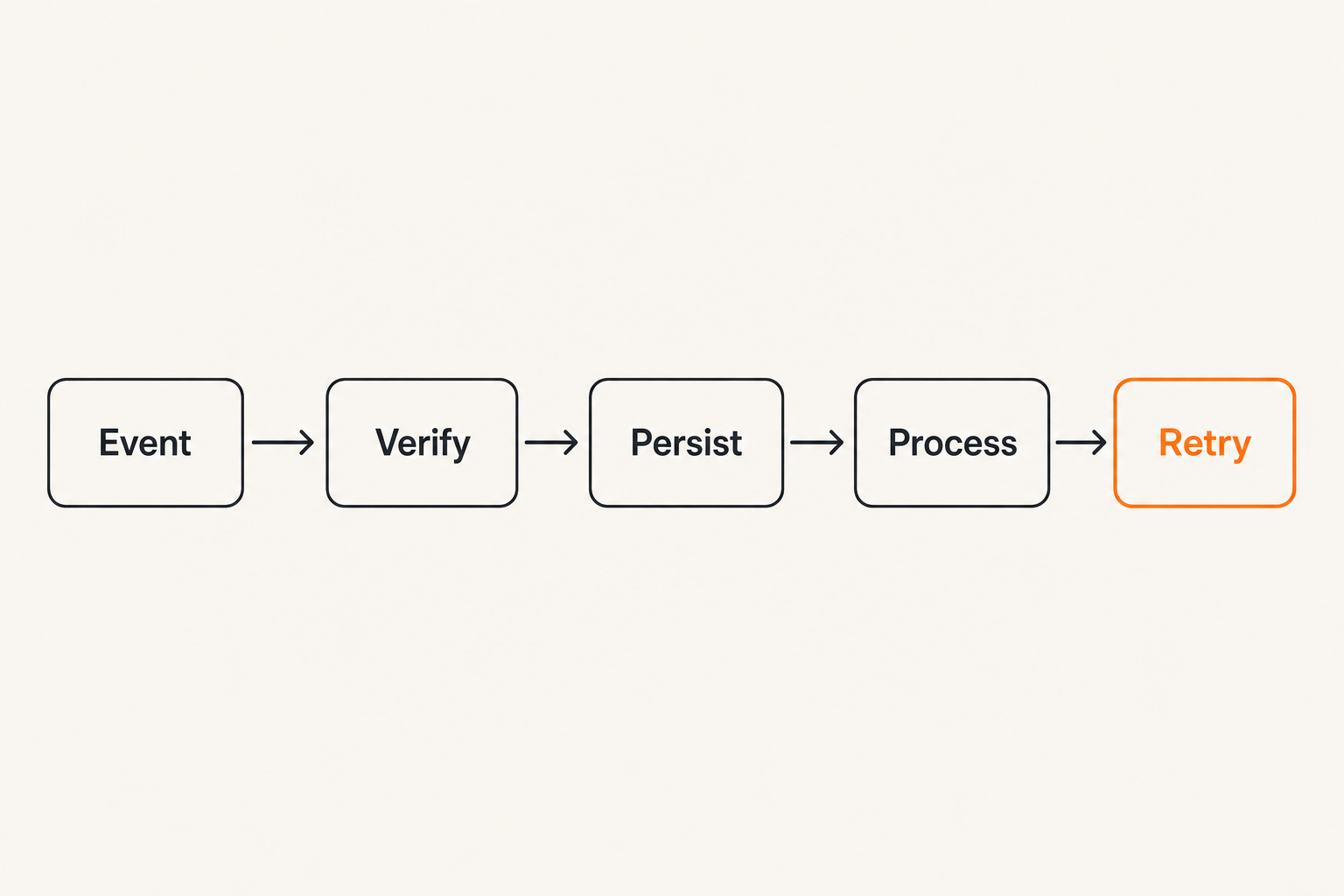
Events your backend must model
Webhooks are not optional plumbing. They are the control plane between payment detection and merchant operations. For biotech peptides, they determine when an order moves from awaiting payment to paid, confirmed, fulfillment-ready, or review-required.
At minimum, model these event types:
- invoice.created
- invoice.expired
- payment.detected
- payment.underpaid
- payment.overpaid
- payment.confirmed
- payment.failed
- refund.requested
- refund.sent
- refund.confirmed
Do not map every event straight to shipped. Payment events should update payment state. Fulfillment logic should decide whether payment state, inventory state, shipping policy, and compliance checks allow release.
This separation prevents a webhook from becoming a remote control for your warehouse.
Retry strategy and signature verification
Webhook delivery is not guaranteed to be clean. Networks fail. Your server times out. A deploy interrupts a handler. The provider retries. Sometimes events arrive out of order.
Your webhook endpoint should:
- verify the signature before parsing business logic
- persist the raw event or normalized event
- return quickly after durable storage
- process side effects asynchronously where possible
- handle retries idempotently
- alert on repeated failures
Signature verification is not a nice-to-have. Without it, anyone who discovers your endpoint could attempt to spoof payment confirmations.
A minimal handler shape:
receive request
verify signature
parse event
persist event with received_at
enqueue processor job
return 200
The processor job can then load current invoice state and apply valid transitions.
For adjacent reading from our network: OSINT tools in 2026 is not about payments, but the same workflow lesson applies: schemas, provenance, permissions, and audit controls matter once automation touches production decisions.
Reconciliation when events arrive late
Late events are normal. A customer may pay near expiration. A chain may congest. Your provider may retry after downtime. If your system assumes perfect ordering, you will create false negatives and manual cleanup.
Build a reconciliation job that periodically compares internal invoice state against observed payment data. It should ask:
- are there expired invoices with later payments?
- are there detected payments without confirmation updates?
- are there confirmed payments not linked to orders?
- are there orders marked paid without transaction hashes?
- are there refunds approved but not sent?
Reconciliation is not just finance work. It is how you discover integration bugs before customers do.
What works and what fails in production
What works
What works is boring architecture. Durable invoices. Explicit states. Signed webhooks. Configurable confirmation thresholds. Clear network labels. Reconciliation jobs. Support-visible audit trails. Refund workflows that do not rely on memory.
The strongest biotech peptides payment stacks usually share a few traits:
- the order system owns the business state
- the payment gateway owns payment detection and event delivery
- the merchant controls settlement policy
- support can see the same truth as engineering
- finance can export clean records
- exceptions are routed, not improvised
This is not glamorous, but it is what keeps the business running.
What fails
What fails is treating crypto as a workaround instead of a system.
Common weak patterns include:
- one shared address for all orders
- no invoice expiration
- no webhook signature verification
- shipping on unconfirmed payment claims
- unsupported networks listed because customers asked for them
- refund addresses collected casually through email
- payment state stored only in frontend session data
- manual spreadsheet reconciliation as the primary source of truth
The mistake teams make is assuming crypto reduces the need for process. In reality, crypto removes some card-rail constraints and adds new operational responsibilities.
Failure mode table
| Failure mode | What breaks in practice | Better design |
|---|---|---|
| Shared deposit address | Finance cannot match payments to orders | Unique invoice address or strong payment identifier |
| No quote expiration | Customer pays stale amount after price moves | Time-boxed quote with late-payment state |
| Unsigned webhooks | Fake confirmations can hit your backend | Verify signatures before state changes |
| No idempotency | Duplicate webhook ships twice | Store processed event IDs |
| Ambiguous networks | Customer sends valid asset on unsupported chain | Asset-network selection with explicit warnings |
| Refunds via email only | Wrong-address refunds and disputes | Verified refund workflow with audit trail |
| Processor dashboard as source of truth | Support and finance lose context | Internal invoice and settlement records |
Practical rule: if a payment exception cannot be represented as a state, it will become a support argument.
Support operations for biotech peptides merchants
Order state customers can understand
Customer-facing state should be simpler than internal state, but it must be accurate. Customers do not need to see every backend transition. They do need to understand what action, if any, is required.
Good customer states include:
- awaiting payment
- payment detected
- confirming on network
- payment confirmed
- action required
- expired
- refund in progress
- refunded
Avoid vague messages like pending when the real issue is underpayment or wrong network. A customer who underpaid needs a different message than a customer whose transaction is waiting for confirmations.
Support tools should show the internal version: transaction hash, network, amount expected, amount received, confirmations, webhook history, and recommended next action.
Disputes chargebacks and proof
Crypto payments do not have card chargebacks in the same way, but disputes still exist. Customers can claim they paid. They can claim they sent the right amount. They can claim the merchant failed to ship. They can post public complaints.
Your proof package should be easy to assemble:
- order record
- invoice quote
- payment address
- transaction hash
- confirmation timestamp
- fulfillment timestamp
- shipping record where applicable
- support conversation history
- refund decision and transaction if applicable
This is where payment architecture touches reputation. If you cannot explain what happened, the customer will write the story for you.
Reputation signals and merchant trust
High-risk does not mean low-trust. But merchants in sensitive categories need more visible operational discipline. Clear policies, accurate checkout messages, stable payment flows, and documented support processes all reduce friction.
Reputation systems can help buyers reason about counterparties, especially where transactions are larger or recurring. The point is not to outsource trust to a badge. The point is to make behavior legible over time: successful orders, dispute handling, response patterns, and consistency.
For adjacent reading from our network: machine learning engineer jobs and AEO architecture covers a different market, but the same principle applies to trust surfaces: structured information is easier for machines and humans to evaluate than scattered claims.
Developer implementation sequence for biotech peptides payments
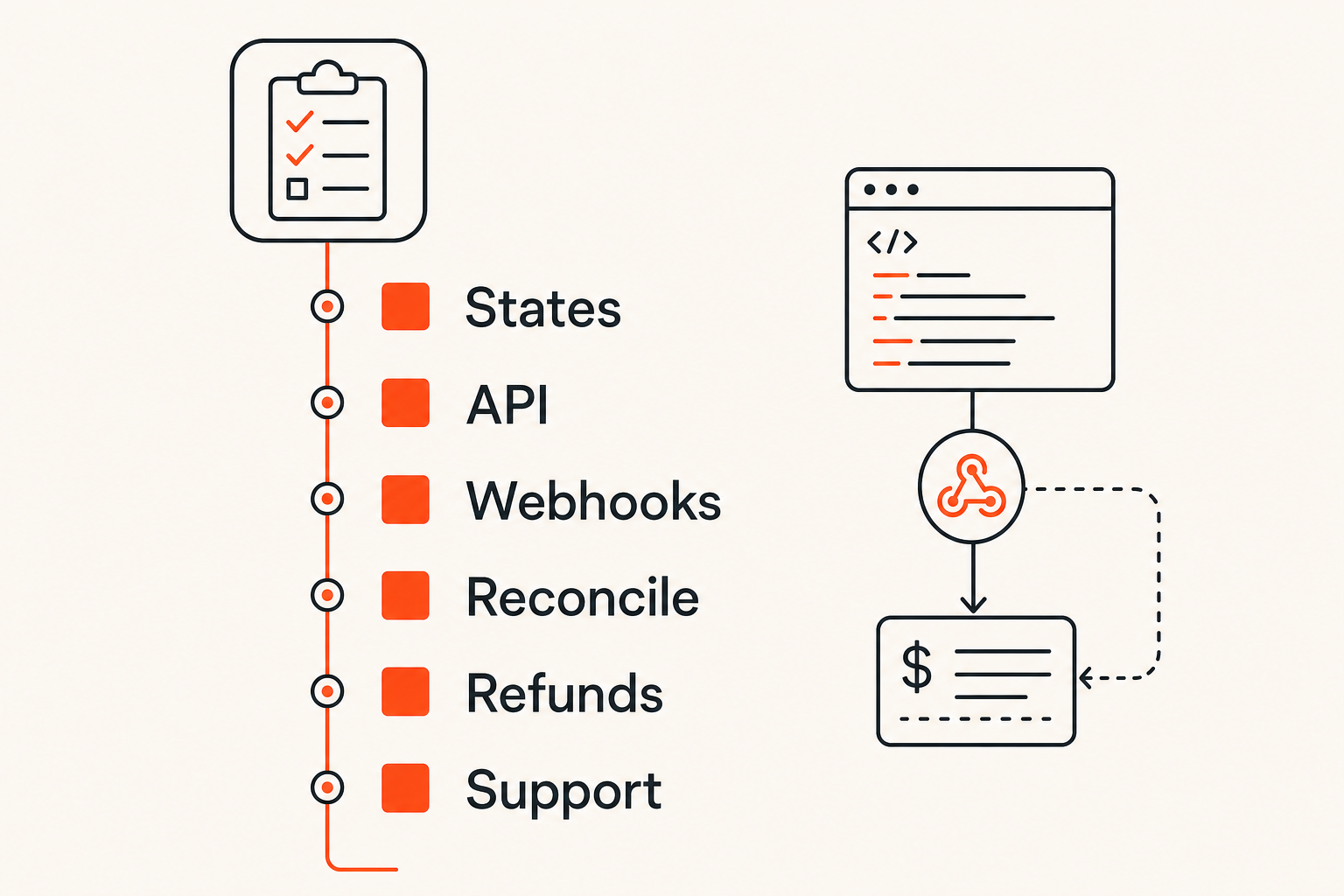
Step 1 model states before screens
Start with the state machine. Do not start with the checkout design.
A basic payment state model might look like this:
- cart_ready
- invoice_created
- quote_active
- quote_expired
- payment_detected
- payment_underpaid
- payment_overpaid
- payment_confirmed
- fulfillment_released
- refund_requested
- refund_sent
- closed
Then define allowed transitions. For example, quote_active can move to payment_detected or quote_expired. Payment_detected can move to payment_confirmed, payment_underpaid, or manual_review. Fulfillment_released should not be reachable from quote_active.
This gives engineering, support, and operations a shared language.
Step 2 integrate API and webhook handlers
Once states are defined, wire the integration.
A practical sequence:
- Create an invoice from your backend, not the browser.
- Store the invoice ID, order ID, amount, asset, network, and expiration.
- Redirect or render the payment instructions.
- Receive signed webhooks on a dedicated endpoint.
- Persist every event before applying business logic.
- Apply state transitions idempotently.
- Trigger fulfillment only from eligible confirmed states.
- Run scheduled reconciliation.
- Export settlement records for finance.
Keep the frontend thin. It can display status, but it should not decide whether an order is paid. The backend should own that decision based on verified events and reconciliation.
Step 3 test edge cases before launch
Most teams test the happy path and call the integration done. That is not enough for biotech peptides payments.
Test these cases before production:
- exact payment before expiration
- payment after expiration
- underpayment
- overpayment
- duplicate webhook delivery
- webhook delivered out of order
- unsupported network attempt
- customer closes browser after invoice creation
- refund to new address
- order canceled after payment detected
- provider downtime during payment confirmation
- reconciliation job finds missed payment
The practical question is not whether checkout works in demo mode. It is whether the business can survive messy customer behavior without engineering joining every support ticket.
Compliance language and category risk
Do not let marketing copy drive risk
Biotech peptides merchants often create their own payment problems through careless copy. Product pages, emails, ads, and checkout text can increase review risk if they imply uses, outcomes, or claims the business cannot support.
Payment architecture cannot fix bad positioning. If the merchant sells research-use products, the site should be consistent about research-use language, documentation, shipping restrictions, and customer eligibility. Do not let growth experiments rewrite the risk profile without review.
This is not legal advice. It is operational advice: payment systems inherit the risk created by the storefront.
Separate research-use disclaimers from payment events
Disclaimers belong in the customer journey, but they should not be tangled into payment event logic. For example, a customer acceptance checkbox may be required before invoice creation. That acceptance should be stored as an order compliance artifact, not buried in webhook processing.
Keep these concerns separate:
- catalog policy
- customer eligibility
- shipping restrictions
- invoice creation
- payment confirmation
- fulfillment release
- refund handling
When everything is mixed together, small policy changes become risky code changes. When the boundaries are clean, the business can adapt without destabilizing checkout.
Keep policy decisions outside checkout code
Hard-coded policy is a maintenance trap. If a shipping rule changes, a product category is paused, or a jurisdiction becomes unavailable, you should not need to redeploy payment handlers.
Use configuration, admin controls, or policy services where appropriate. The checkout should ask whether an order is eligible for invoice creation. It should not contain every business rule inline.
A simple rule engine can be enough:
if customer_country blocked:
  deny invoice

if product_category requires_review:
  hold order

if order_total above_threshold:
  require manual approval

if eligible:
  create invoice
The goal is not complexity. The goal is to keep payment infrastructure stable while policy evolves.
Where coinpayportal.com fits in the architecture
Product fit for peptide and biotech sellers
CoinPayPortal fits best when a merchant wants crypto payment acceptance as infrastructure rather than a one-off wallet address on a checkout page. The useful pieces are invoice creation, real-time processing, merchant-side integration, and non-custodial payment flows that can connect to your order system.
For biotech peptides merchants, the value is not that crypto makes risk disappear. It is that the payment workflow can be modeled explicitly: invoice, quote, payment, confirmation, settlement, fulfillment, refund, and reconciliation.
That is the part teams need when card processors become unreliable or expensive to maintain.
When not to use crypto payments
Crypto is not always the right answer. If your customers cannot pay with crypto, your support team cannot explain wallet mistakes, your finance team cannot reconcile on-chain payments, or your compliance posture is unclear, adding crypto may create more problems than it solves.
Do not use crypto payments as a way to avoid building policy. Use them when you are ready to own the workflow.
The closing point for biotech peptides is simple: the checkout UI is not the system. The system is the state machine, the webhook pipeline, the settlement record, the refund workflow, and the support process around it.
Try coinpayportal.com
coinpayportal.com is for developers and merchants building crypto payment infrastructure. If you need a practical crypto checkout path for biotech peptides or other high-risk merchant workflows, Try coinpayportal.com.
Try CoinPay
Crypto payments, escrow, and wallets — multi-chain, Lightning-ready, and fast to integrate.
Get started →