Apex Peptides Payment Architecture: Crypto Checkout, Webhooks, Escrow, and Settlement for High-Risk Merchants

Apex peptides merchants usually discover the payments problem at the worst possible time: after ads are running, carts are converting, and a processor decides the business is suddenly outside policy.
The first reaction is to look for another checkout button. That is understandable. It is also incomplete.
Teams think the problem is processor access. The real problem is payment architecture under high-risk operating conditions.
That changes the conversation. If you sell peptides, research compounds, or adjacent regulated products, the practical question is not whether crypto can replace a card processor. The practical question is whether your checkout, webhooks, order state, escrow rules, settlement process, and support workflow can survive real customers, delayed confirmations, refunds, disputes, and compliance review in production.
This guide treats apex peptides as a workflow and infrastructure problem, not a generic definition. The goal is a merchant payment system that is clear enough for developers, usable enough for operators, and boring enough to reconcile at the end of the day.
Table of contents
- Apex peptides is a payment workflow problem
- Map the apex peptides checkout state machine
- Choose the right payment gateway boundaries
- Design webhooks for reality, not demos
- Escrow and trust for peptide merchants
- Reconciliation and settlement are the real back office
- Compliance, product policy, and customer communication
- What works and what fails in production
- Implementation sequence for developers
- Where coinpayportal.com fits
Apex peptides is a payment workflow problem

The processor risk is only the symptom
Many apex peptides merchants experience payments as a recurring access problem. A processor approves the account, volume grows, risk review starts, reserves increase, and then the merchant is asked for more documents or removed entirely. The mistake teams make is treating this as a vendor search problem only.
Processor access matters, but it is not the whole system. If your internal workflow depends on instant card authorization, automatic capture, simple refunds, and bank settlement on a predictable schedule, then replacing the processor with a wallet address will break operations unless you redesign the surrounding process.
A useful way to think about it is this: crypto payments move part of the trust boundary from a centralized processor to your checkout and back office. That gives you more control, but it also makes state management more visible.
Practical rule: do not adopt crypto payments for apex peptides until you know who owns order state, payment state, refund state, and customer support state.
Why the UI is not the system
A checkout page is the visible part. The system is everything behind it: invoice creation, rate locking, address generation, network selection, webhook handling, fulfillment gating, refund policy, accounting export, and support tooling.
What breaks in practice is rarely the button. It is the edge case where a customer sends the wrong token, underpays by network fee, pays after invoice expiry, or opens a ticket with a transaction hash but no order number.
For adjacent peptide merchant architecture, our earlier guide to peptide payments and crypto infrastructure goes deeper on why high-risk merchants need production-grade payment operations instead of a wallet pasted into a checkout page.
Where crypto changes the operating model
Crypto can help merchants avoid some card-network constraints, but it introduces different operational questions. Settlement can be faster, but confirmation time varies. Chargebacks are not native, but customer disputes still exist. Funds can arrive directly, but reconciliation becomes a technical process.
That changes the conversation from can we accept crypto to can we operate a crypto payment workflow with fewer surprises than our existing processor stack.
Map the apex peptides checkout state machine
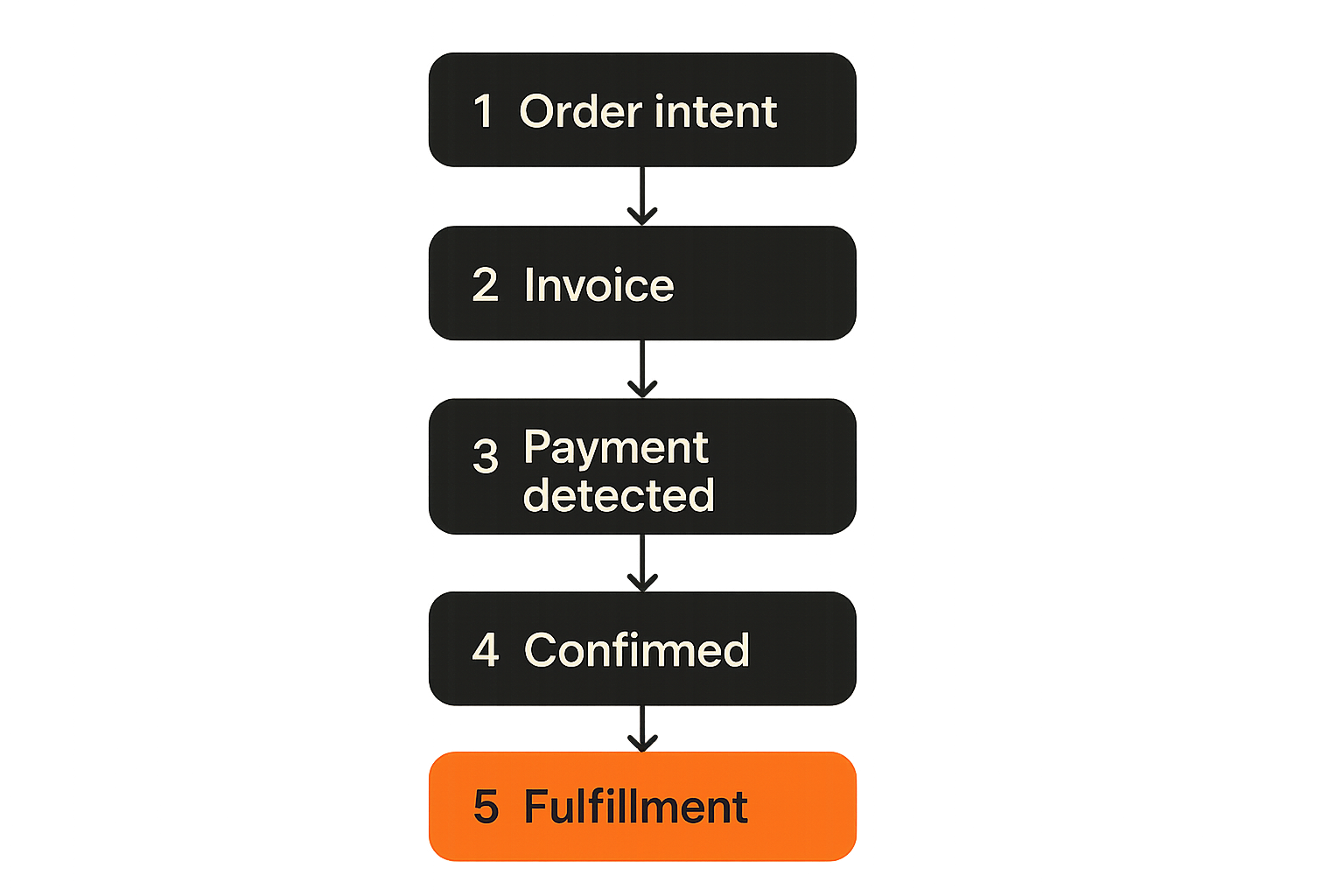
Start with order intent
The checkout should begin with order intent, not payment collection. An order intent records what the customer is trying to buy, the cart total, jurisdiction flags, shipping constraints, and the payment quote. It should exist before the customer is shown an address or QR code.
For apex peptides merchants, this matters because product eligibility, shipping rules, and compliance checks may need to happen before funds move. If you accept payment for an order you later cannot fulfill, you have created a support and refund workflow by accident.
A basic state machine looks like this:
- Create order intent.
- Validate product and shipping rules.
- Create crypto invoice with expiry and accepted networks.
- Wait for on-chain payment or supported off-chain confirmation.
- Mark payment as detected, confirming, paid, underpaid, overpaid, expired, or failed.
- Release order to fulfillment only after the required payment state is reached.
- Reconcile invoice, fees, rate, and settlement destination.
Separate payment state from order state
The mistake teams make is using paid as one universal flag. That works in a demo and fails in production.
Payment state answers whether value arrived. Order state answers whether the merchant can fulfill. Refund state answers whether value should move back. Support state answers whether a human needs to intervene.
| Layer | Example states | Owner | Why it matters |
|---|---|---|---|
| Order | created, approved, fulfilled, cancelled | commerce app | Prevents shipping before eligibility checks |
| Payment | pending, detected, confirmed, expired | gateway and webhook worker | Prevents false positives and duplicate fulfillment |
| Refund | requested, approved, broadcast, settled | operations and finance | Gives support a controlled path |
| Support | open, waiting, resolved | support team | Keeps customer communication attached to facts |
Practical rule: never let a blockchain transaction directly trigger fulfillment without passing through your own order policy layer.
Handle late and partial payments
Late and partial payments are normal. A customer may send funds after an invoice expires. A wallet may subtract network fees from the amount. A customer may send USDT on the wrong network. Your architecture needs explicit behavior for each case.
Do not hide these cases inside manual support notes. Add states. Add reason codes. Add operator actions. If an invoice is underpaid by a small tolerance, maybe the order can proceed. If it is underpaid beyond tolerance, support may request the difference or refund. If a payment arrives after expiry and the asset price moved, the merchant needs a policy before the ticket appears.
Related reading from our network: teams designing distributed systems face similar state-location tradeoffs in edge computing architecture, where moving execution closer to users also moves responsibility for retries, routing, and verification.
Choose the right payment gateway boundaries
Hosted checkout versus embedded checkout
Hosted checkout is usually safer for teams that want a fast launch with fewer wallet-specific UI problems. The gateway owns the invoice page, payment instructions, QR codes, and status updates. Your app owns the cart, order, and fulfillment decision.
Embedded checkout gives more control, but more responsibility. You will need to handle wallet UX, network warnings, copy behavior, expiry timers, and live payment status inside your own interface. That is reasonable for mature teams, but expensive if your first problem is processor instability.
A useful comparison:
| Decision | Hosted checkout | Embedded checkout |
|---|---|---|
| Speed to launch | Faster | Slower |
| UX control | Moderate | High |
| Wallet/network mistakes | Gateway can reduce them | Your team must handle them |
| Engineering load | Lower | Higher |
| Best fit | Merchant validation, early rollout | Mature checkout teams |
Non-custodial versus custodial flow
For peptide merchants, custody boundaries are not a footnote. They affect risk, accounting, support, and internal controls. In a non-custodial flow, funds move to merchant-controlled wallets or merchant-defined settlement paths. In a custodial flow, a provider may hold funds before payout.
Neither model removes the need for reconciliation. The question is who controls funds, who can reverse or release them, and who signs transactions. If you are building around high-risk commerce, clarity is more important than buzzwords.
The CoinPay non-custodial payment gateway positioning is relevant here because merchants need to understand where control sits, not just whether a checkout page exists.
What developers should own
Developers should own the source of truth for orders, customer-visible status, and policy decisions. The gateway should provide reliable invoice creation, payment detection, webhook delivery, and settlement primitives.
Do not outsource business rules entirely. A gateway cannot know whether a specific apex peptides order should ship to a specific region, whether the SKU requires manual review, or whether your support team should accept a late payment. Keep those rules in your commerce layer.
Design webhooks for reality, not demos
Idempotency is not optional
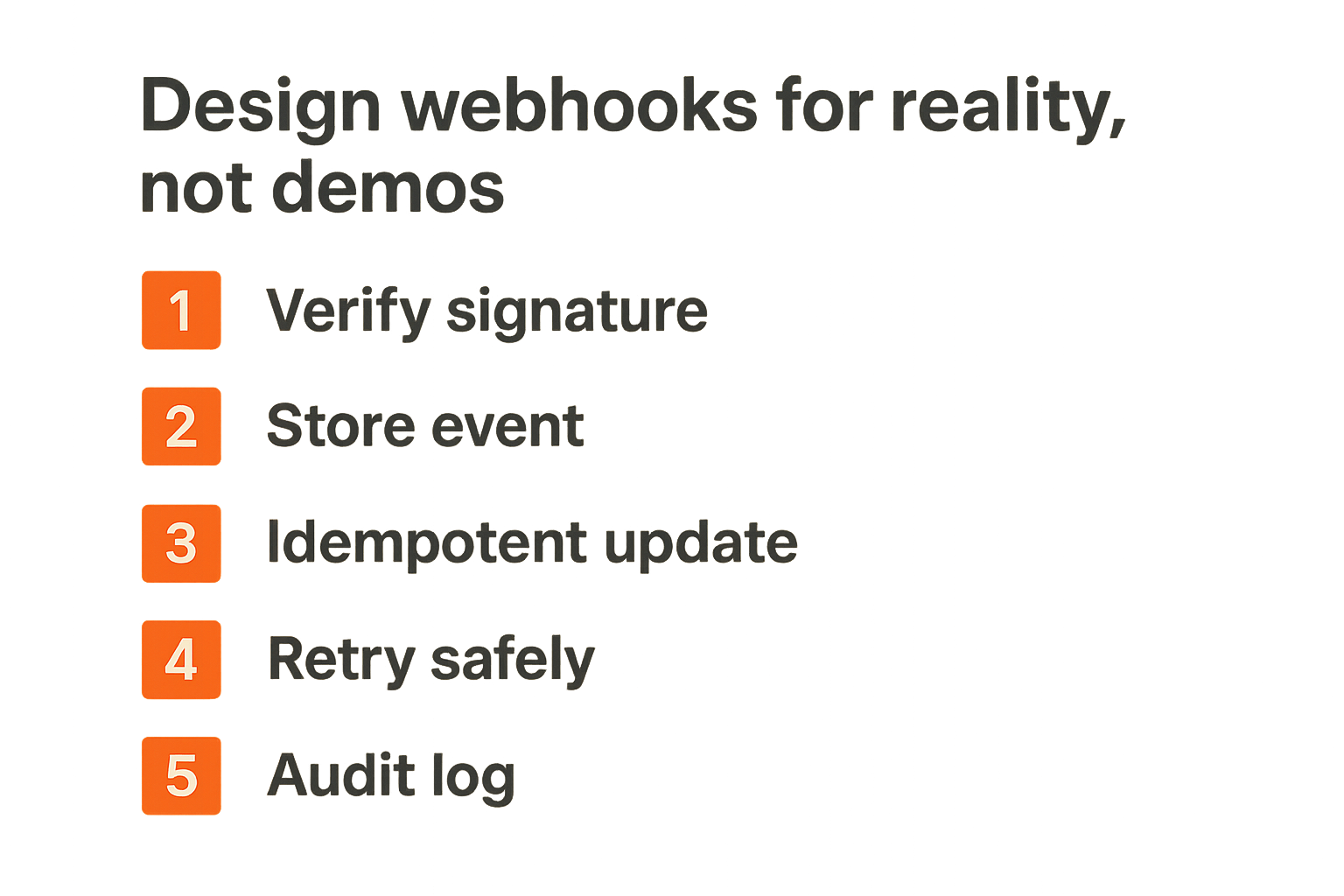
A webhook is not a function call. It is an asynchronous message that may arrive late, arrive twice, arrive out of order, or fail during processing. If your webhook handler cannot process the same event more than once safely, it is not production-ready.
At minimum, store the gateway event ID, invoice ID, payment state, previous state, received timestamp, signature verification result, and processing outcome. Then update your order using a state transition table rather than ad hoc if statements.
Practical rule: every payment webhook should be safe to retry, safe to ignore if stale, and safe to audit later.
Retry windows and duplicate events
Retries are good. Silent failure is bad. But duplicate events can create duplicate fulfillment if your system is careless.
Use a durable queue between webhook receipt and business processing. The receiver verifies the request and stores the event quickly. The worker performs state transitions, calls your commerce backend, and records the result. If the worker fails, the event can be retried without asking the gateway to resend manually.
This is especially important when a payment moves through detected, confirming, and confirmed. Your system should not send three shipment releases because three events arrived.
Webhook signatures and audit trails
Signature verification prevents a random request from marking an order paid. Audit trails prevent your own team from guessing what happened later.
Log enough to reconstruct the event without storing unnecessary sensitive data. For example: invoice ID, order ID, asset, network, amount expected, amount received, confirmation count, state transition, operator override, and refund reference. Keep payment metadata boring and factual.
If your developers need a concrete starting point for API behavior, invoice creation, and integration patterns, the CoinPay developer docs are the natural place to map gateway events into your application state machine.
Escrow and trust for peptide merchants
When escrow helps
Escrow can help when buyer and seller trust is incomplete. For apex peptides and adjacent research-product merchants, escrow may reduce anxiety around first-time orders, wholesale relationships, marketplace transactions, or higher-value purchases.
The practical question is not whether escrow sounds safer. The practical question is what condition releases funds and who can prove it. Shipment created is not the same as shipment delivered. Delivered is not the same as customer satisfied. A lab-use product may have documentation expectations that need to be handled outside the payment rail.
When escrow creates support debt
Escrow becomes support debt when release rules are vague. If funds are locked and neither side knows what evidence matters, every transaction becomes a dispute queue.
The mistake teams make is adding escrow as a trust feature without defining lifecycle states. Escrow needs created, funded, evidence submitted, released, disputed, refunded, and expired states. It also needs operator permissions and a clear customer-facing explanation.
Release conditions and evidence
Escrow works when release conditions are specific. Examples include buyer confirmation, tracking delivery, timeout after shipment, manual review, or milestone approval. Each condition has tradeoffs.
| Release model | Works when | Failure risk |
|---|---|---|
| Buyer confirmation | Relationship is high trust | Buyer forgets or delays |
| Delivery tracking | Shipping data is reliable | Carrier data can be wrong |
| Timed release | Low dispute rate | Bad actors exploit timing |
| Manual review | High-value orders | Operations load increases |
For merchants that need transaction-level trust controls, CoinPay's crypto escrow workflow is useful to evaluate as a primitive rather than a generic payment add-on.
Reconciliation and settlement are the real back office
Match invoices to chain activity
Reconciliation is where weak crypto payment systems become expensive. A finance operator should not have to search block explorers all afternoon to close the books.
Every invoice should map to expected amount, quoted currency, crypto asset, network, exchange rate, wallet address, transaction hash, confirmation status, fee treatment, settlement destination, and order ID. If one of those fields is missing, someone will eventually reconcile by screenshot.
That is not a process. That is a liability.
Normalize fees, rates, and networks
Apex peptides merchants often care about final received value more than nominal checkout value. Network fees, exchange-rate windows, and token/network mismatches can create small differences that add up operationally.
Define whether the customer pays network fees, whether the merchant absorbs pricing drift inside the invoice window, and how overpayments are handled. Stablecoins can reduce volatility, but they do not remove network risk or token confusion.
Give finance a daily close process
Daily close should be boring:
- Export all invoices created during the period.
- Match paid invoices to on-chain transaction hashes.
- Review underpaid, overpaid, expired, and late-paid invoices.
- Confirm settlement wallet balances or payout records.
- Record fees and rate differences.
- Mark exceptions for support follow-up.
Related reading from our network: remote finance, support, and engineering teams run into similar ownership problems when collaboration tools are not designed around workflow state; this guide on cloud based productivity and collaboration tools is a useful adjacent architecture lens.
Compliance, product policy, and customer communication
Keep claims out of payment metadata
Payment metadata should not become a product-claims database. Keep it minimal: order reference, invoice reference, amount, asset, network, and status. Sensitive product detail belongs in the commerce system with appropriate access controls, not in public chain notes or sloppy transaction comments.
This is not legal advice. It is basic operational hygiene. High-risk merchants should assume that payment records may be reviewed by banks, logistics partners, auditors, gateway providers, or internal compliance staff.
Design for review without oversharing
You need enough information to answer legitimate review questions without exposing unnecessary customer or product data. That means clean order IDs, policy flags, support notes, and settlement records.
What breaks in practice is the all-or-nothing export. Either the team cannot answer simple questions, or it dumps too much information into a support thread. Build scoped views for finance, support, engineering, and compliance.
Make payment instructions boring
Payment instructions should be precise and plain. Tell the customer which asset, which network, how long the quote is valid, what happens after payment, and what to do if they make a mistake.
Do not overpromise instant settlement. Do not imply reversibility if refunds require manual review. Do not bury network warnings below the QR code.
Related reading from our network: privacy-conscious teams face the same problem of giving users actionable instructions without leaking unnecessary data; this piece on coupon codes for encrypted messaging apps is a tangential but useful reminder that checkout and account flows often fail at the instruction layer.
What works and what fails in production
What works
What works is boring infrastructure with explicit ownership.
- Hosted or embedded checkout chosen deliberately, not by trend.
- Invoice expiry windows that match customer behavior.
- Webhooks stored before business logic runs.
- Idempotent state transitions.
- Fulfillment gated by order policy, not raw transaction detection.
- Clear underpayment, overpayment, and late-payment rules.
- Daily reconciliation with exception queues.
- Support tools that show order, payment, refund, and shipment state together.
Practical rule: if support cannot explain an invoice state in one screen, your payment architecture is not finished.
What fails
What fails is the wallet-address shortcut. A merchant posts an address, asks customers to send funds, and then relies on screenshots, block explorers, and manual emails. It may work for a few orders. It will not scale cleanly.
Also failing: treating stablecoins as a magic fix, ignoring webhook retries, shipping on unconfirmed transactions, storing no rate snapshot, or giving finance a CSV that cannot tie invoice IDs to transaction hashes.
Failure modes to test before launch
Test these before real volume:
- Customer sends payment after invoice expiry.
- Customer underpays by a small amount.
- Customer sends correct token on wrong network.
- Webhook arrives twice.
- Confirmed event arrives before detected event due to retry timing.
- Commerce API is down when payment confirms.
- Refund is approved but settlement wallet lacks the right asset.
- Support searches by transaction hash instead of order ID.
If these cases are not tested, they will be tested by customers.
Implementation sequence for developers
Build the minimum safe path
Do not start with every coin, every wallet, every chain, and every edge case. Start with one or two assets, one checkout path, and a complete state machine.
A minimum safe path includes:
- Order intent creation in your commerce backend.
- Payment invoice creation through the gateway.
- Customer-facing payment page or embedded instructions.
- Webhook receiver with signature verification.
- Durable event storage.
- Idempotent worker that updates payment state.
- Fulfillment gate that checks payment and order policy.
- Reconciliation export.
- Support view with invoice and transaction data.
Instrument the unhappy paths
Metrics should focus on operations, not vanity. Track invoice creation failures, payment detection time, confirmation time, expired invoices, underpayments, overpayments, webhook retries, manual overrides, refund cycle time, and support tickets per paid order.
A useful dashboard does not need to be fancy. It needs to tell operators where money is stuck and tell developers where automation is failing.
Run a controlled rollout
Start with a limited customer segment or order size. Keep manual review available. Compare support volume, reconciliation effort, payment completion rate, and fulfillment delays against your existing process.
The goal is not to declare crypto payments perfect. The goal is to decide whether the apex peptides payment workflow is more resilient, more controllable, and easier to operate than the processor setup it replaces.
Where coinpayportal.com fits
Use infrastructure to reduce operational ambiguity
The best payment infrastructure reduces ambiguity. It does not pretend risk disappears. It gives developers clean primitives and gives merchants a workflow they can operate.
For apex peptides merchants, that means invoice creation, real-time processing, non-custodial settlement options, escrow where appropriate, webhook-driven state updates, and documentation that developers can actually integrate against.
It also means being honest about what remains your responsibility: product policy, fulfillment rules, customer communication, refund decisions, and compliance posture.
A practical product fit
coinpayportal.com is a fit when you want to accept crypto without turning your back office into a manual block-explorer operation. The architecture still matters. You still need a state machine, webhook handling, reconciliation, and support ownership. But the gateway should remove the low-level payment plumbing so your team can focus on merchant operations.
If you are building apex peptides checkout flows in 2026, the winning pattern is not hype. It is controlled payment state, clear settlement boundaries, and support workflows that survive the messy cases.
Try coinpayportal.com
You are writing for developers and merchants building crypto payment infrastructure. If apex peptides payments are becoming an architecture problem instead of a processor problem, Try coinpayportal.com.
Try CoinPay
Non-custodial crypto payments — multi-chain, Lightning-ready, and fast to integrate.
Get started →