AOD 9604 Peptide Payments: Crypto Checkout Architecture for High-Risk Merchants

AOD 9604 peptide merchants usually do not fail because they forgot to add a payment button. They fail because the payment workflow has no reliable state model once a processor flags the business, a buyer sends the wrong amount, or fulfillment asks whether an order is actually paid.
Teams think the problem is payment acceptance. The real problem is operational control: invoices, wallets, confirmations, compliance notes, refunds, support tickets, and reconciliation all have to agree on the same truth.
That changes the conversation. A crypto checkout for an AOD 9604 peptide storefront is not just a UI decision. It is an architecture decision that affects treasury, customer support, fulfillment, risk review, and developer maintenance.
The practical question is not whether crypto can be accepted. The practical question is whether the merchant can operate a payment system that survives real buyers, real blockchain behavior, and real high-risk category constraints without turning every order into manual work.
Table of contents
- Why AOD 9604 peptide creates a payment architecture problem
- The real workflow for AOD 9604 peptide orders
- Checkout architecture for high-risk peptide merchants
- Payment state model and webhooks
- Wallet, custody, and settlement boundaries
- Compliance, content, and merchant controls
- Reconciliation for AOD 9604 peptide payments
- What breaks in production
- Implementation workflow for developers
- Where coinpayportal.com fits
- Closing checklist for AOD 9604 peptide merchants
Why AOD 9604 peptide creates a payment architecture problem
AOD 9604 peptide sits in a category where payment providers, ad networks, marketplaces, and banks may apply additional scrutiny. This article is not medical, legal, or regulatory advice. It is about the payment infrastructure problem faced by merchants that operate in peptide, research chemical, or adjacent high-risk verticals.
The mistake teams make is treating the processor problem as a vendor search. They move from one provider to another, keep the same fragile order flow, and then wonder why the same support and reconciliation problems come back.
Merchant risk is operational, not theoretical
High-risk category pressure shows up as operational load. A payment method disappears. A checkout gets paused. A customer support queue fills with paid-but-not-fulfilled orders. A fulfillment manager asks whether a transaction with one confirmation should ship. Finance asks why the on-chain amount does not match the order amount.
None of those are solved by a prettier checkout page. They are solved by a system that records intent, tracks payment state, assigns responsibility, and leaves an audit trail.
A useful way to think about it is this: the merchant is not only accepting money. The merchant is proving, internally, that the order went through a controlled workflow.
The checkout is only the visible part
The buyer sees a product page, cart, payment screen, wallet prompt, and confirmation page. The business sees something else: invoice creation, address assignment, exchange-rate lock, network selection, confirmation threshold, webhook delivery, inventory hold, settlement record, customer notification, and accounting export.
If those layers are not connected, the UI becomes a liability. It can tell the buyer an order is complete while the back office still sees uncertainty.
Practical rule: Do not design an AOD 9604 peptide crypto payment flow around the checkout screen. Design it around the order state machine.
For a deeper look at the broader category, we covered the merchant-side infrastructure problem in peptide payments and crypto infrastructure, including why high-risk sellers need payment workflows that can survive provider instability.
The real workflow for AOD 9604 peptide orders
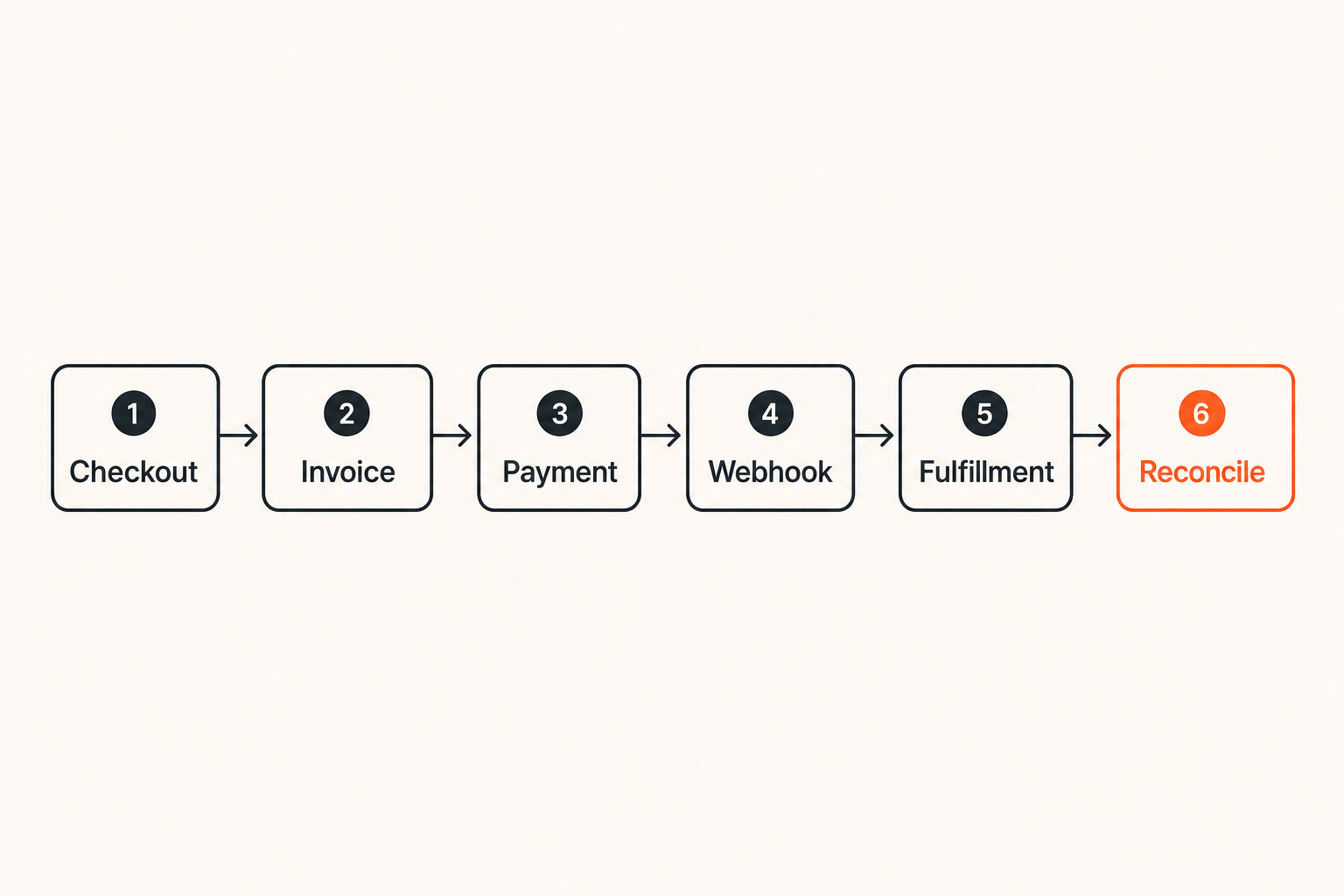
An AOD 9604 peptide order should move through explicit stages. The fewer implicit assumptions you leave in the system, the fewer support tickets you create later.
The practical question is: what must be true before fulfillment releases the order?
State starts before payment
The first reliable state is not paid. It is invoice_created. That record should exist before the buyer sends funds. It should include the merchant order ID, customer reference, fiat amount, crypto amount, accepted asset, chain, wallet address, expiry time, and a status such as waiting_for_payment.
This matters because crypto transactions are not initiated by your server in the same way card charges are. The buyer may send from an exchange, use the wrong network, send late, or split payment into multiple transfers. Your system needs an invoice object that can absorb those events without losing context.
A minimal order sequence looks like this:
- Buyer checks out and selects crypto.
- Merchant backend creates an invoice.
- Gateway returns payment address, amount, asset, network, and expiry.
- Buyer sends funds.
- Blockchain monitor detects transaction.
- Webhook updates invoice state.
- Fulfillment releases only after policy conditions are met.
- Finance reconciles invoice, transaction hash, and settlement wallet movement.
That is the workflow. Everything else is interface.
Fulfillment depends on settlement confidence
Different products and merchants will choose different confirmation rules. Some may mark an order as detected when a transaction appears in the mempool or pending state. Others may require one or more confirmations before fulfillment. The point is not that one number is universally correct. The point is that the policy must be explicit and implemented consistently.
A peptide merchant should avoid vague statuses like complete unless complete means something specific. For example: payment detected, sufficient amount received, required confirmations reached, no expiry conflict, order cleared for fulfillment.
Practical rule: Use separate statuses for detected, confirmed, paid, fulfilled, and reconciled. Collapsing them into paid creates avoidable ambiguity.
Related reading from our network: teams building decentralized systems face similar queue and validation issues, and computing in the 1970s offers practical lessons for decentralized compute builders that map surprisingly well to payment workflow design.
Checkout architecture for high-risk peptide merchants
A crypto checkout for AOD 9604 peptide sales has two jobs. It must be simple enough for buyers to complete, and structured enough for the merchant to operate after the buyer leaves the page.
What breaks in practice is over-optimizing the visible buyer flow while under-building the merchant-side state.
Hosted checkout versus API-first checkout
A hosted checkout can be faster to launch. It moves the buyer to a payment page controlled by the gateway, which can reduce frontend work and keep sensitive payment logic out of the storefront. For merchants that need speed, this can be the right first step.
An API-first checkout gives developers more control. The merchant can keep the buyer inside the storefront, customize the order review page, show chain-specific warnings, and integrate payment states deeply into the customer account area.
The tradeoff is not good versus bad. It is operational maturity versus implementation speed.
| Approach | Best fit | What you control | What can fail |
|---|---|---|---|
| Hosted checkout | Faster launch, smaller dev team | Product flow before redirect, fulfillment after webhook | Redirect failures, customer confusion, limited UI control |
| API-first checkout | Custom storefront, deeper integration | Invoice creation, UI states, customer account updates | More code paths, more webhook and retry responsibility |
| Manual wallet instructions | Very early testing only | Almost nothing beyond a wallet address | No invoice linkage, weak reconciliation, support overload |
What to capture at invoice creation
The invoice is the source of truth. At creation time, capture fields that support fulfillment and reconciliation later.
Useful invoice fields include:
- Internal order ID
- External customer ID or email hash
- Product category or SKU group
- Fiat amount and currency
- Crypto asset and network
- Expected crypto amount
- Payment address
- Rate lock timestamp
- Expiry timestamp
- Required confirmation policy
- Metadata for fulfillment system
- Risk or manual review flag
Avoid stuffing medical or promotional claims into payment metadata. Payment metadata should help identify, reconcile, and support the transaction. It should not become a duplicate product catalog full of uncontrolled descriptions.
If your team is building directly against a gateway, start with the CoinPay developer docs and map the documented invoice and webhook concepts into your own order lifecycle instead of bolting them on after launch.
Payment state model and webhooks
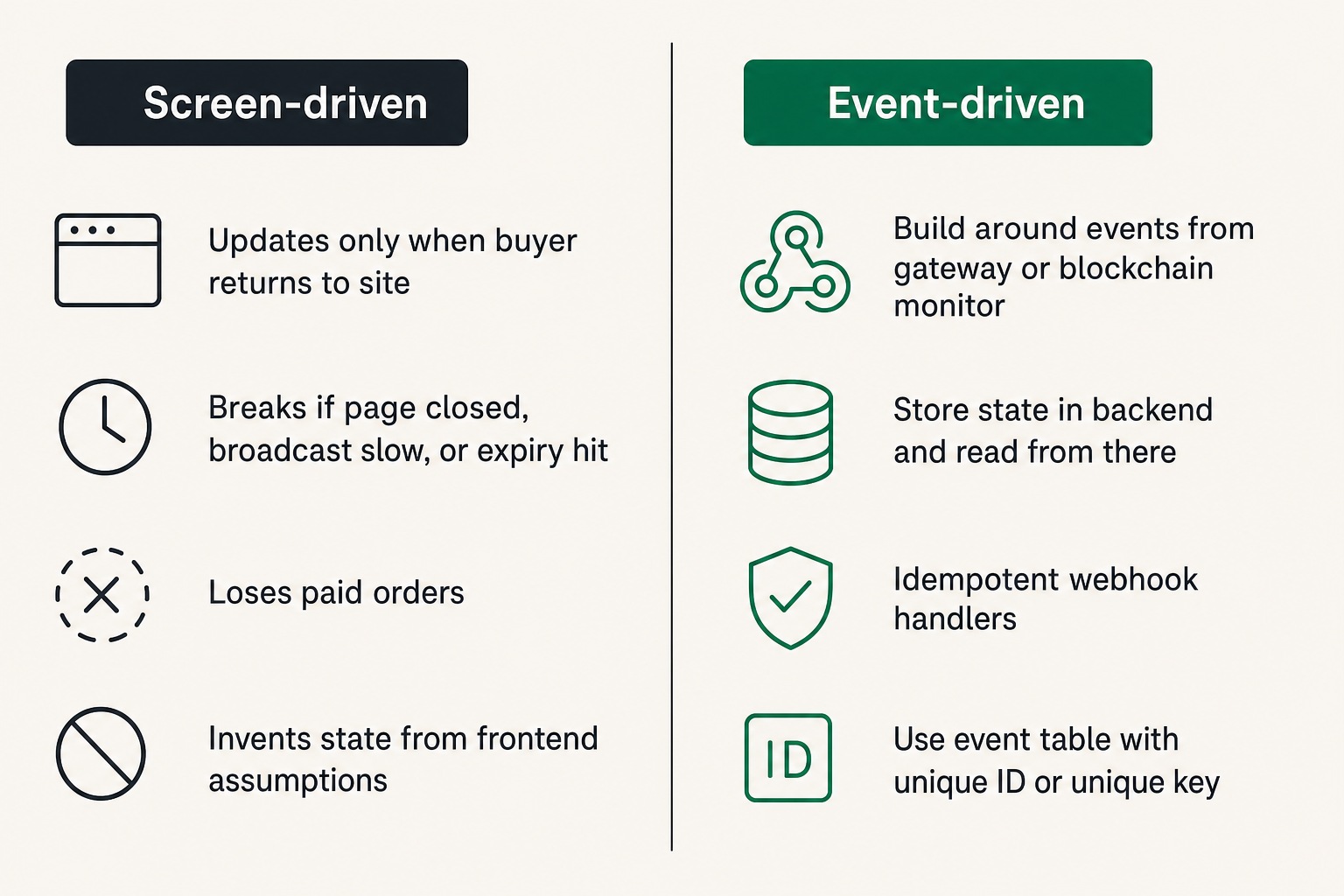
Webhooks are where many crypto payment integrations become unreliable. The webhook is not a notification decoration. It is the bridge between blockchain activity and merchant operations.
The mistake teams make is assuming webhooks arrive once, in order, and only when the storefront is ready. Production systems do not behave that politely.
Build around events, not screens
A buyer may close the payment page before the chain confirms. A mobile wallet may broadcast slowly. An exchange withdrawal may take longer than your invoice expiry window. If your system only updates order state when the buyer returns to the site, you will lose paid orders.
Build around events from the gateway or blockchain monitor:
- invoice.created
- payment.detected
- payment.partially_paid
- payment.confirmed
- payment.expired
- payment.overpaid
- payment.failed
- settlement.sent
- refund.created, if applicable
Your storefront should read state from the backend. It should not invent state based on frontend assumptions.
Idempotency and replay rules
Every webhook handler should be idempotent. If the same event arrives twice, the second delivery should not double-release inventory, double-credit a customer, or create duplicate accounting rows.
Use an event table with a unique event ID when available. If not available, build a unique key from invoice ID, transaction hash, event type, and confirmation count. Store the raw payload, signature verification result, processed timestamp, and processing outcome.
A simple handler pattern:
receive webhook
verify signature
store raw event
check idempotency key
load invoice
validate state transition
apply update in transaction
emit internal event for fulfillment
return success only after durable write
Practical rule: A webhook is not processed when your code reads it. It is processed when the state change is durably written and safe to replay.
For adjacent architecture thinking, peptide transactions in crypto payments goes deeper on state management, retries, and why transaction handling is the real production problem.
Wallet, custody, and settlement boundaries
Payment architecture becomes messy when nobody can answer a basic question: who controls the funds at each moment?
For AOD 9604 peptide merchants, this question matters because high-risk operations already have enough external uncertainty. Do not add internal uncertainty around custody, wallet access, and settlement ownership.
Non-custodial versus custodial assumptions
In a non-custodial model, the merchant controls the wallet or receives directly to merchant-controlled infrastructure. In a custodial model, a provider may receive funds and later settle to the merchant. Both models can be valid depending on jurisdiction, compliance, and operational needs, but they create different responsibilities.
The operational differences are practical:
| Boundary | Non-custodial flow | Custodial flow |
|---|---|---|
| Fund control | Merchant-controlled wallet | Provider-controlled account until settlement |
| Treasury work | Merchant manages keys and sweeps | Merchant tracks balances and payouts |
| Support evidence | On-chain records plus internal invoice data | Provider records plus settlement reports |
| Failure concern | Key management, address monitoring | Account holds, payout delays, provider policy |
If your team cannot explain the custody path in one diagram, the workflow is not ready.
Chain selection and confirmation policy
Chain selection should be a business rule, not a random list of logos. Each supported network creates support obligations. Buyers can select the wrong chain. Exchanges can delay withdrawals. Some assets have low fees but worse wallet support for your customer base.
A practical chain policy should define:
- Which assets and networks are accepted
- Minimum and maximum order amounts
- Confirmation requirements by chain
- Invoice expiry duration
- Whether late payments are accepted, refunded, or manually reviewed
- How underpayments and overpayments are handled
- Whether network fees are absorbed, passed on, or excluded from credit
AOD 9604 peptide merchants do not need every chain on day one. They need a small set that support reliable settlement and customer support.
Compliance, content, and merchant controls
This is where many merchants get careless. They assume crypto removes policy work. It does not. Crypto changes payment rails; it does not remove the need for merchant controls, accurate records, or careful product communication.
A payment system should not be used to launder poor operational discipline into a checkout page.
Separate payment policy from product claims
Product pages, disclaimers, shipping rules, age restrictions, jurisdictional restrictions, and acceptable-use policies belong in merchant operations and legal review. The payment layer should reference the order, amount, and fulfillment metadata needed to process payment. It should not become the place where product claims are created or modified.
This separation helps developers too. If payment metadata is stable and minimal, webhook handlers remain predictable. If product copy leaks into payment payloads, every catalog change can create downstream reconciliation and support noise.
Related reading from our network: visibility systems have their own policy and routing constraints, and ant colony optimization for AEO crawl paths is a useful adjacent model for thinking about how systems follow signals rather than intentions.
Audit trails that support disputes
Even when crypto payments are final on-chain, merchants still face support disputes. A customer may say they paid. Fulfillment may say the order never cleared. Finance may say the settlement report does not match revenue.
An audit trail should answer:
- Who created the order?
- What invoice was generated?
- What address and amount were shown?
- What transaction hash was detected?
- When did confirmations reach policy threshold?
- What webhook events were received?
- Who changed the fulfillment status?
- Was any refund or manual adjustment applied?
This is not bureaucracy. It is how a lean team avoids turning every support ticket into a blockchain archaeology project.
Reconciliation for AOD 9604 peptide payments
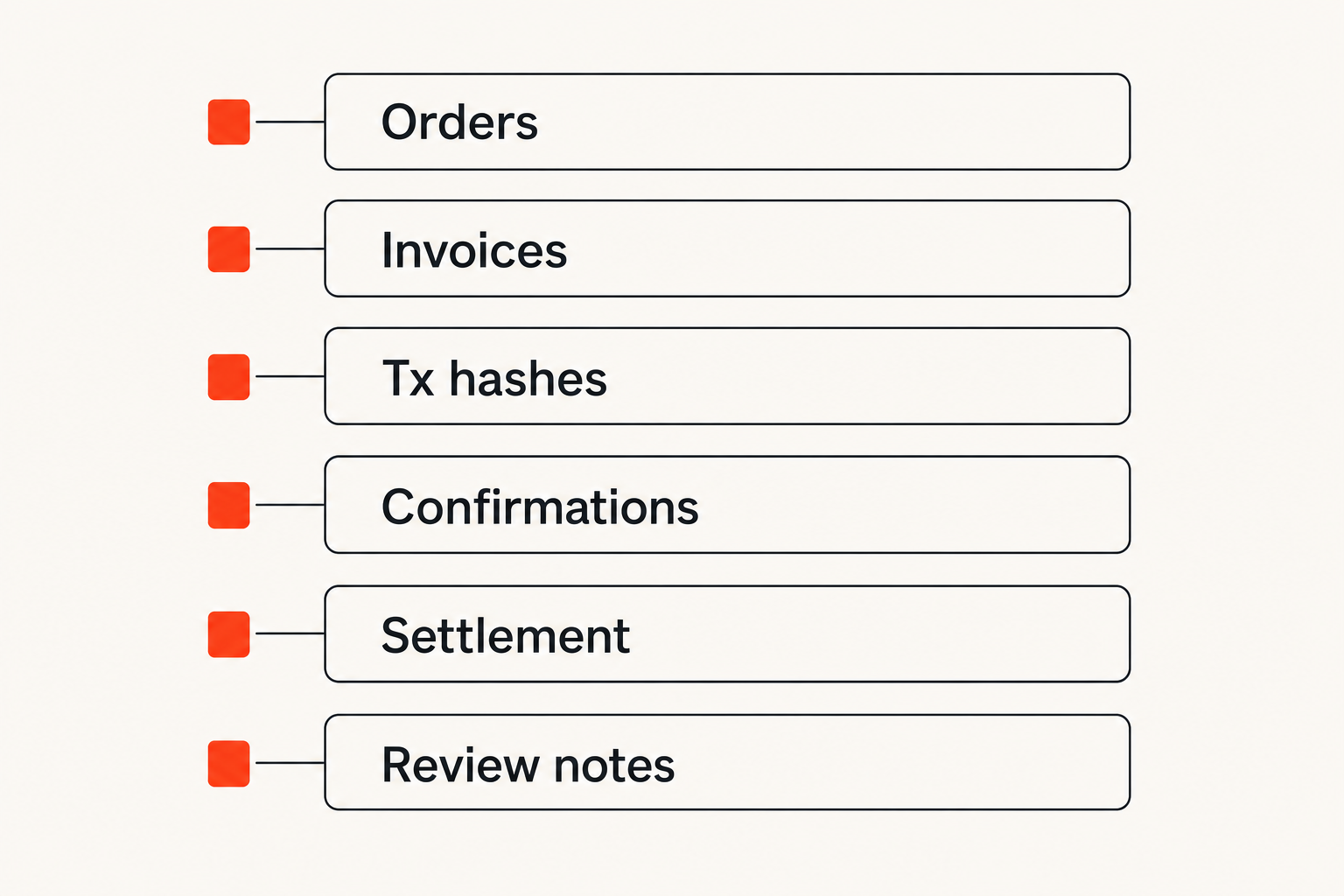
Reconciliation for AOD 9604 peptide payments is where the system proves whether it can operate beyond launch week. If checkout is the front door, reconciliation is the ledger discipline that keeps the business from drifting.
The mistake teams make is postponing reconciliation until volume arrives. By then, bad assumptions are already embedded in order states, wallet labels, and support processes.
Match invoices, transfers, and orders
At minimum, the reconciliation view should join three things: the merchant order, the crypto invoice, and the on-chain transaction. If settlement happens separately, add the settlement record as a fourth object.
A useful reconciliation row includes:
- Order ID
- Invoice ID
- Customer reference
- Expected fiat amount
- Expected crypto amount
- Received crypto amount
- Asset and network
- Transaction hash
- Confirmation count
- Invoice status
- Fulfillment status
- Settlement wallet or payout ID
- Difference amount
- Manual review notes
This gives finance, support, and operations the same screen. That matters. If each team keeps a separate spreadsheet, the payment system has already failed.
Handle underpayments, overpayments, and expiry
Crypto payments create edge cases that card teams are not used to handling. A buyer may send 99.5 percent of the requested amount because an exchange deducted a fee. Another buyer may send too much. Another may pay after the invoice expires because they left a withdrawal pending.
Define policies before launch:
| Scenario | Bad default | Better default |
|---|---|---|
| Underpayment | Mark failed and wait for complaint | Set tolerance, request top-up, or manual review |
| Overpayment | Ignore difference | Credit, refund, or flag by threshold |
| Late payment | Lose context after expiry | Detect and route to review |
| Wrong asset | Manual chaos | Reject unsupported asset or document recovery policy |
| Duplicate send | Double-fulfill | Link both transfers to one invoice and review |
Practical rule: Edge cases are not exceptions if they happen every week. Promote them into first-class payment states.
Merchants selling peptide products often benefit from escrow-like flows when buyer trust, order release, or dispute windows matter; the same architectural questions apply to crypto escrow payment workflows where settlement depends on conditions rather than a simple paid flag.
What breaks in production
Production failure rarely looks dramatic at first. It looks like a few stuck orders, a few missing webhooks, a few customers asking whether payment was received, and one person on the team becoming the unofficial payment detective.
That is the warning sign. When payment knowledge lives in a person instead of the system, scale will expose it.
Common failure modes
The most common failures are boring and expensive:
- One wallet address reused for many orders with no reliable invoice mapping
- Checkout page says paid before confirmation policy is satisfied
- Webhook handler fails silently and no retry process exists
- Duplicate webhook delivery creates duplicate fulfillment actions
- Expired invoices still accept funds but do not attach to orders
- Exchange-rate changes create accounting differences nobody can explain
- Customer support cannot see transaction hashes or payment status
- Finance exports show revenue without settlement traceability
- Manual refunds happen outside the system
The root cause is usually not blockchain complexity. The root cause is missing workflow ownership.
What works better
What works is not glamorous. It is explicit state, narrow chain support, durable event processing, and clear handoffs.
A resilient AOD 9604 peptide payment flow has these properties:
- Each order has exactly one current payment state
- Each state transition is caused by a recorded event
- Webhooks can be replayed safely
- Fulfillment reads backend state, not frontend guesses
- Finance can reconcile on-chain funds to invoices
- Support can search by order ID, invoice ID, address, or transaction hash
- Manual overrides require notes and operator identity
Related reading from our network: merchants trying to reduce platform dependency face similar control problems, and Fiverr alternatives for sellers in 2026 is a useful adjacent read on avoiding single-channel operational fragility.
Implementation workflow for developers
The implementation should start with the state machine, not the payment button. Developers who begin with UI often create hidden coupling between the checkout page and fulfillment logic.
A better build sequence starts from the backend and works outward.
Step-by-step build sequence
Use this sequence for a practical first release:
- Define accepted assets, networks, expiry windows, and confirmation rules.
- Create an invoice model linked to your order model.
- Add invoice creation to checkout before funds are requested.
- Store payment address, amount, asset, chain, and expiry.
- Build a webhook endpoint with signature verification.
- Store every raw webhook event before processing it.
- Implement idempotent state transitions.
- Add fulfillment gates based on confirmed payment state.
- Build support search by order ID, invoice ID, address, and transaction hash.
- Build reconciliation export before launch, not after.
- Test underpayment, overpayment, late payment, duplicate webhook, and webhook replay.
- Document manual review rules for operators.
This is not overengineering. It is the minimum structure needed to stop payment operations from becoming tribal knowledge.
Minimal schema and event fields
Your exact schema will depend on the stack, but the shape is consistent.
orders
- id
- customer_id
- total_fiat
- currency
- fulfillment_status

payment_invoices
- id
- order_id
- asset
- network
- expected_amount
- received_amount
- address
- expires_at
- status
- required_confirmations

payment_events
- id
- invoice_id
- event_type
- tx_hash
- confirmations
- payload_hash
- processed_at
- processing_result
Keep business logic in state transitions. For example, payment.detected can update received_amount, but only payment.confirmed with sufficient amount should release fulfillment. Manual review should be a state, not a Slack message.
Where coinpayportal.com fits
A payment gateway should reduce integration surface area without hiding the states that matter. That is the balance. If a tool abstracts too little, developers rebuild commodity payment plumbing. If it abstracts too much, operators lose visibility when something goes wrong.
For AOD 9604 peptide merchants, the useful product question is not whether a gateway sounds crypto-native. The useful question is whether it supports the workflow your business actually needs.
Use it as infrastructure, not magic
coinpayportal.com is for developers and merchants building crypto payment infrastructure. In practice, that means using a gateway as a controlled layer for invoice creation, payment status, real-time processing, and merchant-side integration, while still keeping your own order and fulfillment logic explicit.
The strongest integrations treat the gateway as infrastructure:
- The merchant backend owns order state.
- The gateway creates and monitors payment invoices.
- Webhooks update merchant payment state.
- Fulfillment gates read confirmed backend state.
- Reconciliation joins merchant records with payment records.
That changes the conversation from can we accept crypto to can we operate crypto payments cleanly.
Product-fit checklist
coinpayportal.com is a fit when your team wants:
- Crypto checkout for a merchant storefront
- Real-time payment processing behavior
- A non-custodial payment gateway model
- Developer-facing integration paths
- Cleaner handling of high-risk merchant payment flows
- Separation between payment infrastructure and product operations
It is not a substitute for legal review, product compliance, inventory controls, or customer support. No payment gateway should pretend to be. The value is in giving your team a reliable payment layer so the rest of the business can make clear decisions.
Closing checklist for AOD 9604 peptide merchants
AOD 9604 peptide payment infrastructure is not about adding a coin logo to checkout. It is about building an order-to-settlement workflow that developers can maintain and operators can trust.
Teams think the problem is finding a processor that says yes. The real problem is building a payment architecture that still works when the buyer sends late, the webhook retries, the network is slow, or support needs proof.
Decisions to make before launch
Before taking live orders, answer these questions:
- Which crypto assets and networks will you support?
- What confirmation threshold releases fulfillment?
- What happens to underpayments and overpayments?
- How long does an invoice remain valid?
- Who can manually override a payment state?
- Where are webhook events stored?
- Can support search by transaction hash?
- Can finance reconcile order, invoice, transfer, and settlement?
- What is the custody boundary?
- What product and jurisdictional controls sit outside the payment layer?
If the answers are written down and implemented in code, you have infrastructure. If they live in chat messages and assumptions, you have a future support incident.
AOD 9604 peptide merchants can use crypto payments effectively, but only when the system is designed around state, trust, settlement, and support. The checkout is the start of the workflow, not the whole system.
Try coinpayportal.com
coinpayportal.com is for developers and merchants building crypto payment infrastructure. Try coinpayportal.com and design your AOD 9604 peptide payment workflow around invoices, webhooks, settlement, and reconciliation from day one.
Try CoinPay
Crypto payments, escrow, and wallets — multi-chain, Lightning-ready, and fast to integrate.
Get started →