Alpha Omega Peptide Payments: Crypto Checkout Architecture for High-Risk Peptide Merchants

If you sell Alpha Omega Peptide products, the payment problem usually shows up as an account freeze, a declined onboarding application, or a processor email that says very little and changes everything.
Teams think the problem is finding a friendlier payment processor. The real problem is building a payment workflow that can survive processor volatility, category risk, delayed settlement, support tickets, and reconciliation without turning every order into a manual investigation.
That changes the conversation. Alpha omega peptide is not just a keyword for a product category. For developers, merchants, fintech founders, and blockchain engineers, it is an architecture problem: checkout state, custody boundaries, settlement records, webhooks, escrow, refunds, and customer trust.
The mistake teams make is treating crypto checkout as a button. In production, the UI is the least interesting part. What breaks in practice is state.
Table of contents
- Alpha Omega Peptide payments are a workflow problem
- Why Alpha Omega Peptide merchants get fragile payment stacks
- The checkout architecture that survives processor volatility
- State management for Alpha Omega Peptide crypto orders
- Settlement, custody, and reconciliation
- Escrow and trust workflows for sensitive peptide orders
- Implementation workflow for developers
- What works, what fails, and what breaks in production
- Operating metrics merchants should actually watch
- Product fit: where CoinPayPortal fits
Alpha Omega Peptide payments are a workflow problem
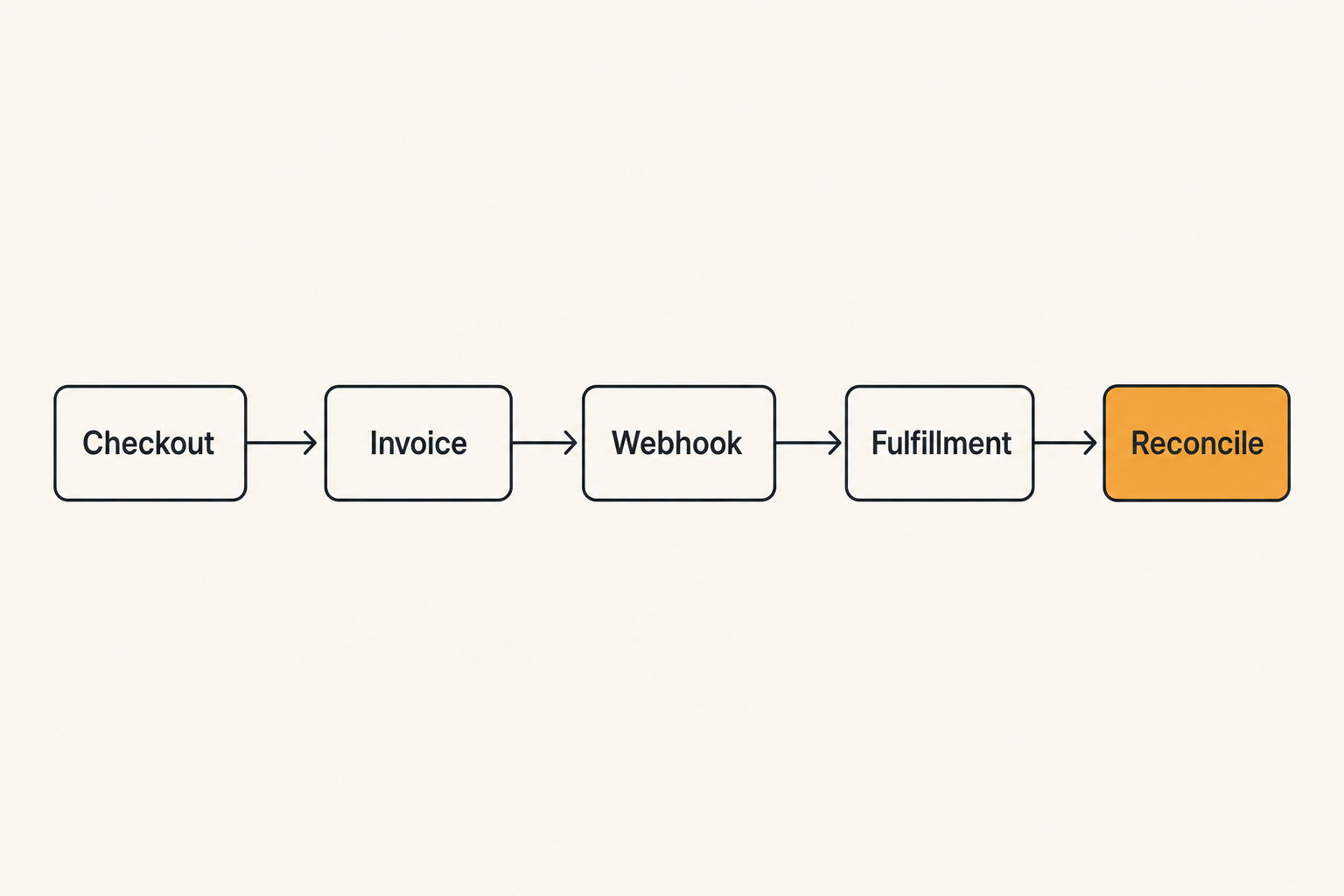
The processor risk is only the visible symptom
For peptide merchants, the obvious pain is payment access. Cards get restricted. PayPal is unreliable. Bank partners ask for additional documentation and still may decline the account. Some teams respond by opening more accounts and hoping one lasts longer than the last.
That is not a strategy. It is operational debt.
The deeper issue is that a high-risk merchant needs payment infrastructure that assumes interruption. You need to know which orders are unpaid, which are partially paid, which are waiting for confirmation, which are ready to fulfill, and which need manual review. If that information lives in screenshots, inboxes, and a spreadsheet maintained by the founder, the business is fragile even if today’s processor works.
Practical rule: Do not design Alpha Omega Peptide payments around the happy path. Design around the day your primary rail changes behavior without notice.
The payment UI is not the system
A checkout page can look clean and still fail operationally. Customers can send the wrong amount. Network fees can move. A blockchain transaction can arrive late. A webhook can be retried. A warehouse can ship before a payment reaches the required confirmation threshold.
The UI has one job: help the customer pay. The system has a larger job: preserve truth about the order.
A useful way to think about it is this: the checkout is a user interface on top of a ledger workflow. Your application needs records for the order, invoice, payment attempt, blockchain transaction, settlement destination, refund or adjustment, and support decision. Without that model, you will eventually reconcile by hand.
The practical question
The practical question is not whether crypto payments are modern, decentralized, or inevitable. The practical question is whether crypto improves the merchant workflow for a category where conventional processors often behave unpredictably.
For many Alpha Omega Peptide merchants, crypto works when it gives the business:
- A payment rail that customers can access directly.
- A clear on-chain record of payment attempts.
- A non-custodial or controlled custody boundary.
- Faster internal decisions about fulfillment.
- Less dependence on chargeback-prone card rails.
It fails when the merchant adds wallet addresses to a checkout page and calls that infrastructure.
Why Alpha Omega Peptide merchants get fragile payment stacks
Category risk and chargeback exposure
Peptide and research chemical merchants operate in a category that many payment providers classify as high risk. The reasons vary by provider, jurisdiction, product positioning, documentation, customer behavior, and refund profile. The result is usually the same: more scrutiny, more reserves, more account interruptions, and less tolerance for ambiguity.
This is where teams often confuse payment acceptance with payment operations. Acceptance is the moment money can be received. Operations is everything after that: matching payment to order, handling exceptions, proving what happened, and making fulfillment decisions.
If you need a deeper category-specific walkthrough, our prior guide on peptide payments crypto infrastructure covers why peptide merchants often need rails built for high-risk realities rather than generic ecommerce assumptions.
Compliance data without overcollection
Peptide merchants also face a documentation problem. You may need product records, shipping restrictions, terms acknowledgement, customer attestations, or internal review notes. But overcollecting sensitive customer data creates another problem: storage risk.
The mistake teams make is storing everything because they are nervous. That increases breach impact, support complexity, and deletion obligations. A better model is to store only what drives a payment, fulfillment, or compliance decision.
A practical payment record might include:
- Merchant order ID.
- Invoice amount and currency.
- Crypto asset and chain.
- Customer wallet transaction reference when available.
- Confirmation threshold applied.
- Fulfillment hold reason if any.
- Terms acknowledgement reference, not a dump of unrelated data.
Related reading from our network: teams handling sensitive document workflows face similar verification and record-retention tradeoffs in IRS secure messaging, even though the domain is different.
When fiat rails disappear
The hard part about fiat rails is that they often fail administratively rather than technically. A gateway does not return a clean error that says your business model changed risk tier today. You get delayed payouts, reserve changes, onboarding questions, or termination.
Crypto does not remove merchant responsibility. It changes the failure mode. Instead of card chargebacks and processor holds, you manage transaction finality, customer education, wallet mistakes, and reconciliation.
That can be a better trade if you build the workflow correctly.
The checkout architecture that survives processor volatility
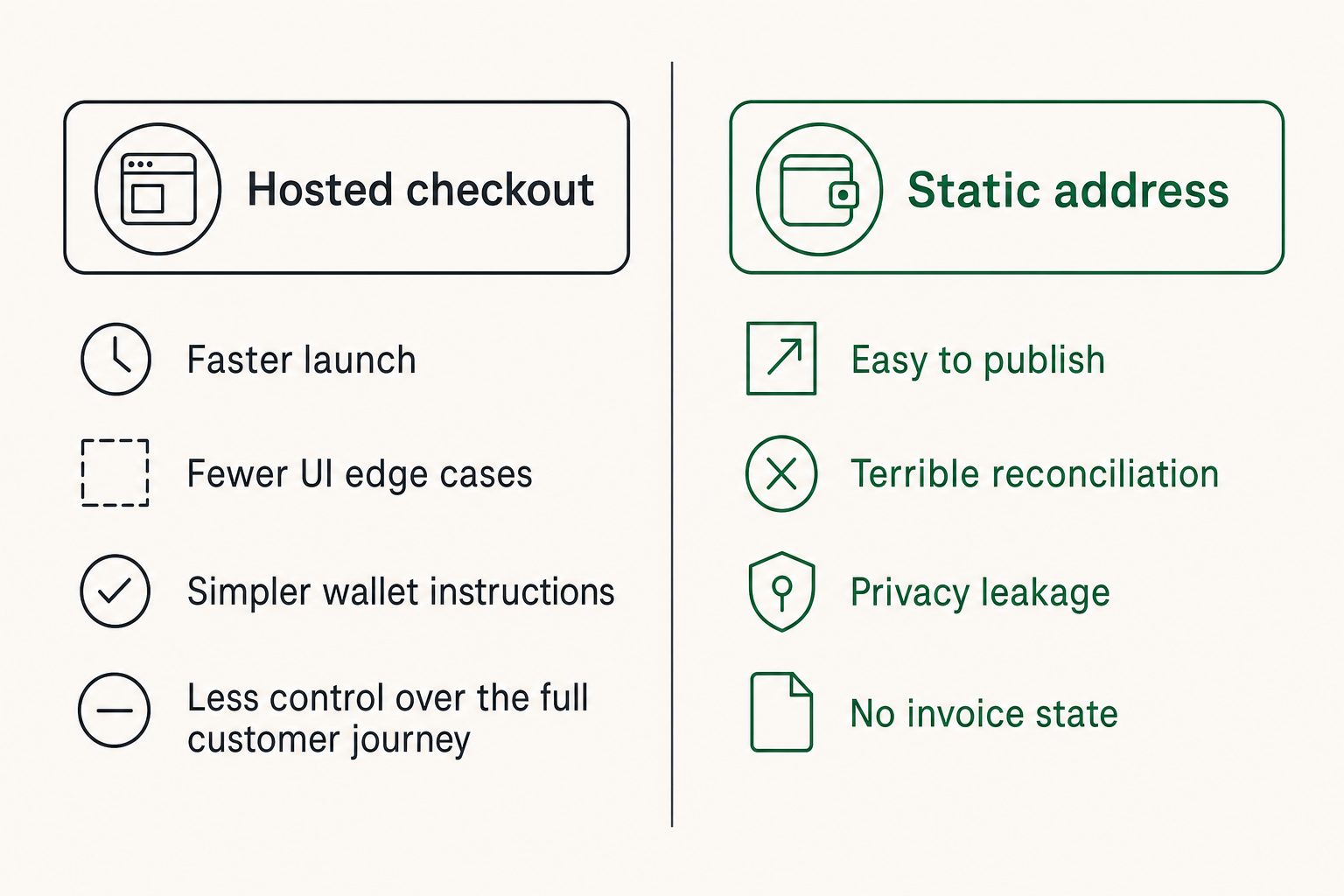
Hosted checkout versus embedded checkout
Most teams start with a choice: hosted checkout or embedded checkout.
Hosted checkout is usually faster to launch. The customer leaves your store, pays on a payment page, and returns after completion. Embedded checkout keeps the customer inside your application but requires more frontend and backend work.
| Approach | What works | What fails | Best fit |
|---|---|---|---|
| Hosted checkout | Faster launch, fewer UI edge cases, simpler wallet instructions | Less control over the full customer journey | Merchants that need reliable payment acceptance quickly |
| Embedded checkout | More control, native UX, custom customer education | More engineering, more state handling, more support burden | Teams with developers and mature order systems |
| Static wallet address | Easy to publish | Terrible reconciliation, privacy leakage, no invoice state | Almost never acceptable for production commerce |
Practical rule: If your team cannot reliably answer which order a payment belongs to, you do not have a checkout system. You have a donation address.
Quote, invoice, and order records
Do not collapse quote, invoice, and order into one row too early. They are related, but they change for different reasons.
A quote represents a price offered to the customer at a moment in time. An invoice represents the payment request created from that quote. An order represents the commercial commitment and fulfillment workflow.
For Alpha Omega Peptide crypto checkout, that separation matters because price volatility and payment timing can create edge cases:
- Customer starts checkout but pays after the quote expires.
- Customer sends the right crypto asset but the wrong amount.
- Customer sends payment on the wrong network.
- Customer pays twice after retrying from a wallet.
- Customer contacts support with only a transaction hash.
If you separate these records, support can reason through the incident. If you merge them into one status field, the incident becomes a Slack thread.
Expiration windows and underpayments
Quote expiration is not cosmetic. It is a risk control.
For volatile assets, your system should create a payment window. Inside that window, the invoice amount is valid. Outside the window, the customer should refresh the quote or receive a clear instruction.
Underpayments need policy, not vibes. Decide in advance whether to:
- Accept small underpayments under a threshold.
- Ask for a top-up payment.
- Cancel and refund.
- Route to manual review.
Your policy may differ by asset, chain, order value, customer history, and fulfillment risk. The important part is that the policy is encoded in the system rather than reinvented by support.
State management for Alpha Omega Peptide crypto orders
Use explicit payment states
Alpha Omega Peptide crypto orders need explicit states because the payment process is asynchronous. The customer can leave. The blockchain can lag. The webhook can arrive twice. The warehouse system can poll before finality.
A simple state model is better than a clever one:
| State | Meaning | Fulfillment action |
|---|---|---|
| created | Invoice exists, no payment detected | Do not fulfill |
| pending | Transaction detected, waiting for confirmations or policy checks | Hold |
| paid | Payment met amount and confirmation policy | Eligible for fulfillment |
| underpaid | Payment detected but amount is short | Hold or request top-up |
| overpaid | Payment exceeds invoice amount | Fulfill and record adjustment |
| expired | Quote window closed before valid payment | Do not fulfill |
| disputed | Support or escrow issue exists | Manual review |
| refunded | Refund or reversal process completed | Close out |
The exact names are less important than the discipline. Every service should know what each state means.
Treat confirmations as policy
Confirmations are not just a blockchain detail. They are a business policy.
For low-value orders, you may accept fewer confirmations to reduce friction. For higher-value orders, you may wait longer. For chains with different finality assumptions, you adjust accordingly. This policy should be visible in logs and order records.
Do not bury confirmation thresholds inside a webhook worker where only one developer knows they exist. Store the threshold applied to the payment. That gives support and finance a record of why the system released or held an order.
Practical rule: Confirmation policy should be recorded per invoice. If the rule changes later, historical orders still need to explain themselves.
Make webhooks boring
Webhooks are where many crypto payment integrations become unreliable. The payment provider sends an event. Your app updates the order. Then the event is retried, arrives out of order, or lands while your database is under load.
Make webhooks boring by following a few rules:
- Verify the webhook signature before doing any work.
- Store the raw event ID and payload reference.
- Use idempotent processing.
- Never ship directly from the webhook request thread.
- Translate provider events into your internal state model.
- Emit your own internal event for fulfillment, finance, and support systems.
If your webhook handler cannot safely process the same event twice, it is not production-ready.
Settlement, custody, and reconciliation
Non-custodial boundaries
Custody is not a branding detail. It defines who controls funds, who signs transactions, who carries operational risk, and what happens if a provider account is interrupted.
Some merchants want a payment gateway that never takes custody. Others prefer managed workflows where the provider abstracts more complexity. Neither is universally right. The point is to make the boundary explicit.
For peptide merchants, non-custodial architecture can be useful because it reduces dependence on a third party holding funds. But it also means the merchant must understand wallet security, key management, payout routing, and recovery processes.
If you are evaluating a gateway, read the integration flow and custody assumptions before you redesign checkout. The CoinPayPortal docs are the right place to start when mapping how API calls, payment sessions, and merchant-side order logic should fit together.
Wallet routing and payout records
A production merchant should not route every payment into one hot wallet forever. At minimum, you need a policy for receiving addresses, treasury movement, and operational wallets.
Common routing patterns include:
- Unique address per invoice for cleaner reconciliation.
- Merchant-controlled receiving wallet with periodic sweeps.
- Separate wallets by brand, region, or fulfillment entity.
- Treasury wallet separated from operational payout wallets.
The wallet decision affects privacy, accounting, and support. A unique address per invoice is easier to reconcile than a shared address, but it requires address management. A shared address is simpler to display, but support must work harder to match payments.
Related reading from our network: architecture decisions from older compute systems still map surprisingly well to modern payment infrastructure, especially around queues and separation of concerns, as discussed in computing in the 1970s.
Daily reconciliation
Reconciliation is where weak payment architecture gets exposed.
At the end of each day, finance should be able to answer:
- Which invoices were created?
- Which invoices were paid?
- Which payments are pending confirmation?
- Which orders were fulfilled?
- Which payments do not map cleanly to an order?
- Which refunds, adjustments, or top-ups were created?
- Which wallet balances changed and why?
This should not require exporting three CSV files and asking an engineer to inspect a block explorer. Build the records from the start.
Escrow and trust workflows for sensitive peptide orders
When escrow changes the risk model
Escrow is not necessary for every Alpha Omega Peptide order. For repeat customers and straightforward products, direct payment may be enough. But escrow can help when trust is asymmetric: new buyer, higher-value order, delayed shipping, custom sourcing, or dispute-prone fulfillment.
Escrow changes the workflow from pay and ship to pay, hold, verify, release. That adds steps, but it also creates a structured process for exceptions.
The point is not to make every transaction heavier. The point is to have a path for orders where both sides need confidence before funds move permanently.
Release conditions and disputes
A usable escrow workflow defines release conditions before the order is placed. Examples include:
- Seller confirms stock and shipping eligibility.
- Buyer payment reaches confirmation threshold.
- Tracking number is added.
- Delivery window expires without dispute.
- Manual mediator decision releases or refunds funds.
The mistake teams make is treating escrow as a vague promise that support will sort it out. That creates the same manual burden you were trying to avoid.
If escrow is part of your model, the workflow should include statuses, timestamps, evidence attachments, dispute windows, and release logs. CoinPayPortal’s escrow workflow is relevant when you need a structured trust layer rather than a simple one-step payment.
Reputation signals
Reputation can reduce friction, but only if it is tied to operational facts. A customer who has completed ten clean payments may deserve a smoother flow than a first-time buyer using a new wallet for a high-value order. A merchant with consistent fulfillment history may need fewer manual reviews.
Useful reputation signals include:
- Completed payments without disputes.
- Refund history.
- Support escalation history.
- Delivery confirmation patterns.
- Account age and verified contact methods.
Do not turn reputation into a black box. Use it to choose workflows: direct payment, escrow, manual review, or additional confirmation.
Implementation workflow for developers
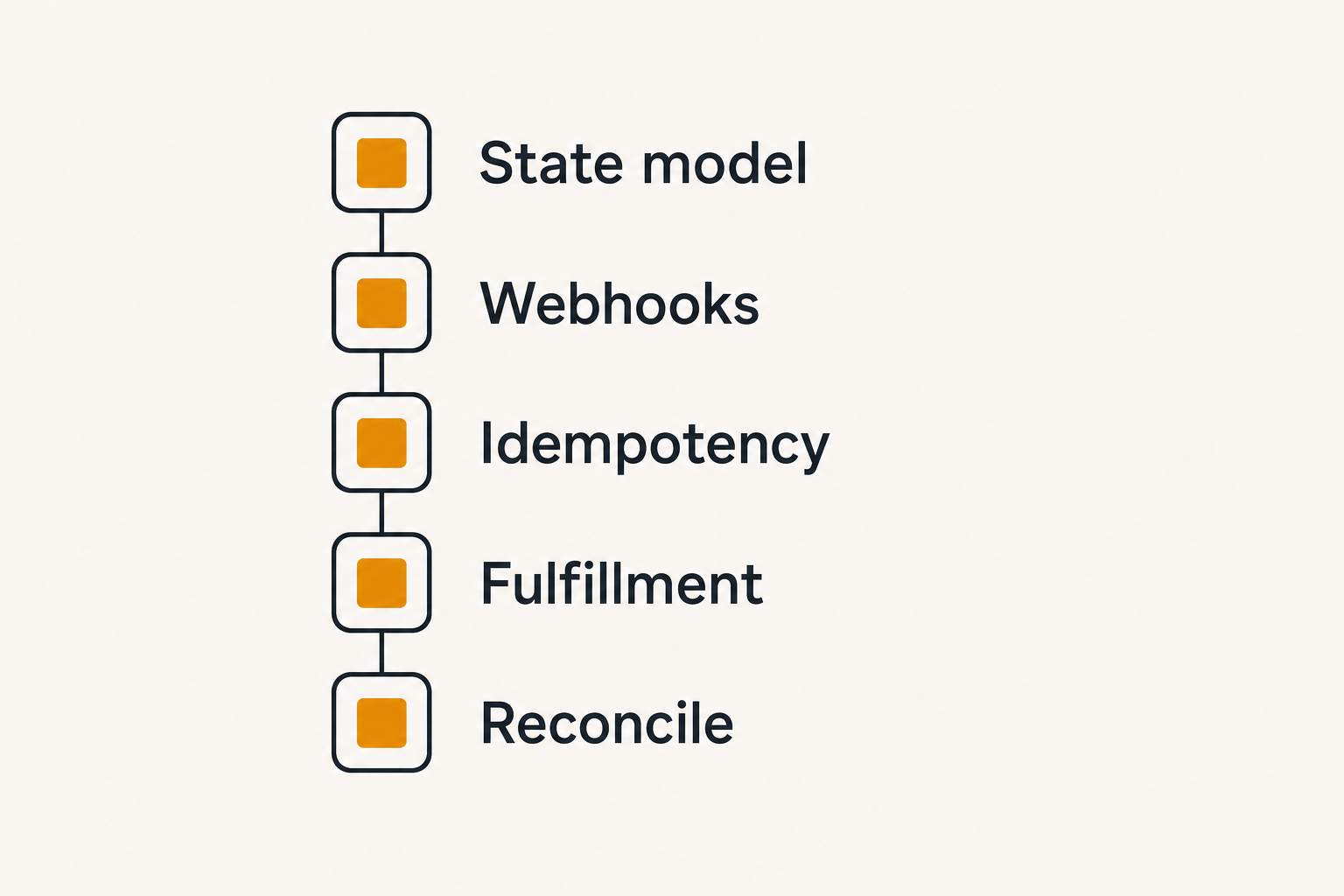
Step-by-step integration sequence
A clean implementation sequence prevents most production pain. Do not start with frontend design. Start with the state machine.
- Define order, quote, invoice, payment attempt, transaction, and settlement records.
- Decide supported assets, chains, confirmation thresholds, and expiration windows.
- Create checkout sessions from your backend, not directly from the browser.
- Store the provider invoice ID beside your internal invoice ID.
- Display payment instructions and expiration clearly.
- Receive webhooks and verify signatures.
- Process webhook events idempotently into internal payment states.
- Trigger fulfillment only from internal paid state, not raw provider events.
- Reconcile invoices, transactions, and wallet balances daily.
- Add support tools for lookup by order ID, invoice ID, wallet address, and transaction hash.
That sequence sounds basic. In production, basic wins.
Idempotency and retries
Payments are asynchronous, so retries are normal. Your system should assume:
- The customer may click pay twice.
- The wallet may broadcast later than expected.
- The provider may retry a webhook.
- Your application may time out after processing successfully.
- A support agent may manually refresh payment status.
Use idempotency keys for checkout creation and event processing. A good idempotency key might combine merchant ID, order ID, and checkout attempt number. For webhooks, use the provider event ID plus the internal invoice ID.
Do not use only customer email or cart ID. Those fields are not payment attempts.
Minimal webhook handler example
The structure matters more than the language. A webhook handler should verify, store, lock, transition, and emit.
async function handlePaymentWebhook(req) {
  const event = verifySignature(req.headers, req.body)

  await db.insertWebhookEvent({
    provider: 'coinpayportal',
    eventId: event.id,
    invoiceId: event.invoiceId,
    receivedAt: new Date(),
    status: 'received'
  }).onConflictDoNothing()

  const invoice = await db.findInvoiceForUpdate(event.invoiceId)
  if (!invoice) return { ok: true }

  const nextState = mapProviderEventToState(event, invoice)
  if (!isValidTransition(invoice.state, nextState)) {
    await db.markWebhookEvent(event.id, 'ignored')
    return { ok: true }
  }

  await db.updateInvoiceState(invoice.id, nextState)

  if (nextState === 'paid') {
    await queue.publish('invoice.paid', { invoiceId: invoice.id })
  }

  await db.markWebhookEvent(event.id, 'processed')
  return { ok: true }
}
Notice what this does not do. It does not ship the order inside the HTTP request. It does not assume the event is unique. It does not trust the provider state without mapping it to internal policy.
What works, what fails, and what breaks in production
What works
What works is boring architecture that gives every team the same source of truth.
For Alpha Omega Peptide merchants, the strongest pattern is:
- Backend-created payment sessions.
- Explicit invoice states.
- Unique payment references.
- Clear expiration and underpayment policy.
- Verified webhooks.
- Fulfillment triggered from internal state.
- Daily reconciliation.
- Support tools that expose the full payment timeline.
This reduces noise. It also shortens investigation time. When a customer sends a transaction hash, support should not need an engineer to answer whether the order is paid.
What fails
What fails is usually not the blockchain. It is the glue around it.
Common bad patterns include:
- Posting a wallet address on the checkout page with no invoice ID.
- Treating detected as paid before confirmation policy is met.
- Updating order status directly from a webhook without validation.
- Letting support manually override payment states without audit logs.
- Allowing expired quotes to accept old amounts without review.
- Keeping settlement records outside the order system.
Related reading from our network: SOC teams see a similar failure pattern when tooling triggers actions without clear ownership or workflow boundaries, covered in fleet response architecture.
Failure modes to test
Before launch, test the ugly cases. They are not edge cases for long.
- Payment arrives after invoice expiration.
- Customer underpays by a small amount.
- Customer overpays.
- Customer sends the right asset on the wrong chain.
- Webhook arrives twice.
- Webhook arrives before your checkout success page loads.
- Provider API is temporarily unavailable.
- Fulfillment service is down after payment is confirmed.
- Support manually marks an order for review.
- Refund requires approval from a different role.
Practical rule: If you have not tested late payments, duplicate webhooks, and underpayments, you have not tested crypto checkout.
Operating metrics merchants should actually watch
Conversion and payment completion
Do not measure only visits to checkout. Measure the full funnel:
- Checkout sessions created.
- Payment instructions displayed.
- Payments detected.
- Payments confirmed.
- Orders fulfilled.
- Orders abandoned after invoice creation.
A drop between instructions displayed and payments detected usually means customer confusion, wallet friction, unsupported assets, or quote expiration that is too short. A drop between detected and confirmed may indicate chain congestion, policy thresholds, or customers using low fees.
Support load and exception rate
Support metrics tell you whether the system is understandable.
Track:
- Tickets per 100 invoices.
- Manual review rate.
- Average time to resolve payment questions.
- Underpayment rate.
- Expired payment disputes.
- Refund and adjustment volume.
If support keeps asking engineering to inspect payments, your internal tooling is missing a view. Build an order timeline that shows quote, invoice, payment attempt, transaction hash, confirmations, state transitions, and fulfillment events.
Liquidity and network fee exposure
Even if you are non-custodial, you still have treasury operations. Someone must decide when funds move, how fees are paid, which assets are held, and how accounting values are recorded.
Track wallet balances by asset, expected settlement amounts, network fees paid, and pending movement. For merchants operating on tight margins, fee policy matters. A small network fee issue repeated across many orders becomes a finance problem.
The practical question is whether crypto payment operations are visible enough for the business to manage. If not, the stack is incomplete.
Product fit: where CoinPayPortal fits
Architecture fit, not magic
CoinPayPortal fits when a merchant wants crypto payment infrastructure rather than a loose collection of wallet addresses, screenshots, and manual checks. That includes developers building checkout flows, merchants managing high-risk categories, and founders who need a payment rail that maps to real order operations.
This is not magic. You still need product policies, fulfillment rules, customer communication, and accounting discipline. The gateway can provide payment sessions, webhook-driven state, and workflow structure. Your business still owns what it sells, where it ships, and how it supports customers.
That is the right division of labor.
When to build custom
Build custom when payments are core IP, your volume justifies dedicated infrastructure, or your compliance model requires highly specific controls. Even then, do not custom-build everything. Use strong primitives where they save time and reduce failure.
Use a gateway when:
- You need to launch faster than a full internal build allows.
- You want cleaner payment session management.
- You need webhook integration without reinventing every provider edge case.
- You want escrow or trust workflows available for higher-risk orders.
- You need developers focused on commerce logic, not block explorer plumbing.
The mistake teams make is assuming build versus buy is ideological. It is operational. Choose the architecture that gives you reliable state, clear custody, and manageable support load.
Closing checklist
Before you accept Alpha Omega Peptide payments through crypto checkout, make sure you can answer yes to these questions:
- Can every payment be matched to exactly one invoice or reviewed as an exception?
- Does each invoice store the quote, asset, chain, amount, expiration, and confirmation policy?
- Are webhook events verified, stored, and processed idempotently?
- Does fulfillment wait for your internal paid state?
- Can support search by order ID, invoice ID, address, and transaction hash?
- Do finance users have a daily reconciliation report?
- Are escrow and dispute workflows defined before they are needed?
- Is the custody boundary clear to the technical and business teams?
Alpha omega peptide payment processing is not solved by adding a crypto logo to checkout. It is solved by building a payment workflow that can tolerate volatility, prove what happened, and keep orders moving without manual chaos.
Try coinpayportal.com
CoinPayPortal is for developers and merchants building crypto payment infrastructure. If you need payment sessions, webhook-friendly order flows, and merchant-side crypto checkout without hype, Try coinpayportal.com.
Try CoinPay
Crypto payments, escrow, and wallets — multi-chain, Lightning-ready, and fast to integrate.
Get started →