AI Publishing Cryptocurrency: Payment Architecture for AI-Scaled Content Businesses

AI publishing cryptocurrency sounds like a niche keyword until you are the team shipping it. You have AI-generated reports, newsletters, research briefs, trading education, media assets, or gated communities. You also have users who want to pay in USDT, USDC, BTC, ETH, or a local stablecoin rail because cards are unavailable, expensive, or operationally painful.
Teams think the problem is content generation. The real problem is payment state, entitlement state, settlement, and support.
The mistake teams make is treating the checkout button as the product. In production, the hard part is knowing who paid, what they bought, whether the AI output was delivered, whether access should renew, and what happens when a webhook arrives twice or a wallet payment lands late.
This guest contribution from the team at bl0ggers.com looks at AI publishing cryptocurrency as an architecture problem for developers, merchants, and fintech operators. The practical question is not whether AI can publish more content. It can. The question is whether your payment workflow can handle that scale without creating a reconciliation queue your team hates.
Table of contents
- Why AI publishing cryptocurrency is an operations problem
- The reference architecture for AI publishing cryptocurrency
- Decide what users are actually paying for
- Wallet, identity, and entitlement design
- Checkout and settlement flows that survive production
- Pricing AI content in crypto without creating support debt
- What breaks when teams implement it badly
- Implementation workflow for developers
- Where CoinPayPortal fits
- Closing: make AI publishing cryptocurrency boring
Why AI publishing cryptocurrency is an operations problem
The UI is not the system
A landing page that says pay with crypto is easy. A wallet connect button is easy. A payment address is easy.
What breaks in practice is everything after the user sends funds.
The publisher has to answer operational questions:
- Did the user pay the exact amount, underpay, or overpay?
- Which chain and asset did they use?
- Did the payment confirm before the offer expired?
- Should access unlock immediately or after settlement?
- Was the AI report generated before or after payment?
- Can support prove what happened three weeks later?
That changes the conversation. You are not designing a crypto checkout widget. You are designing a state machine that connects AI production, payment confirmation, entitlement, delivery, and accounting.
For AI publishing, this matters more than for a static ebook or one-time download. AI content can be generated on demand. It can be personalized. It can be regenerated. It can have usage limits. It can be sold as a subscription, a bundle, a credit pack, or a per-report purchase. Each model creates different payment and fulfillment states.
Practical rule: Treat every paid AI output as a financial event and a content event. If you cannot trace both, you do not have a production system.
Why merchants care in 2026
In 2026, many content businesses are not just blogs. They are AI-assisted publishing operations with research products, paywalled market commentary, automated newsletters, private communities, data dashboards, and generated media.
Crypto payments show up for practical reasons:
- Global customers want to pay without card friction.
- Stablecoins reduce currency conversion pain for some merchants.
- High-risk or cross-border niches may face card processor limits.
- Developer audiences already hold crypto and expect wallet-native checkout.
- B2B buyers sometimes prefer invoice-like payment flows over card forms.
None of that removes the normal merchant problems. You still need invoices, receipts, refunds, customer records, support tooling, tax exports, and settlement visibility.
The mistake teams make is assuming crypto removes payment operations. It changes them. You trade chargeback workflows for confirmation logic, address monitoring, refund policy, network fees, asset support, and reconciliation.
The reference architecture for AI publishing cryptocurrency
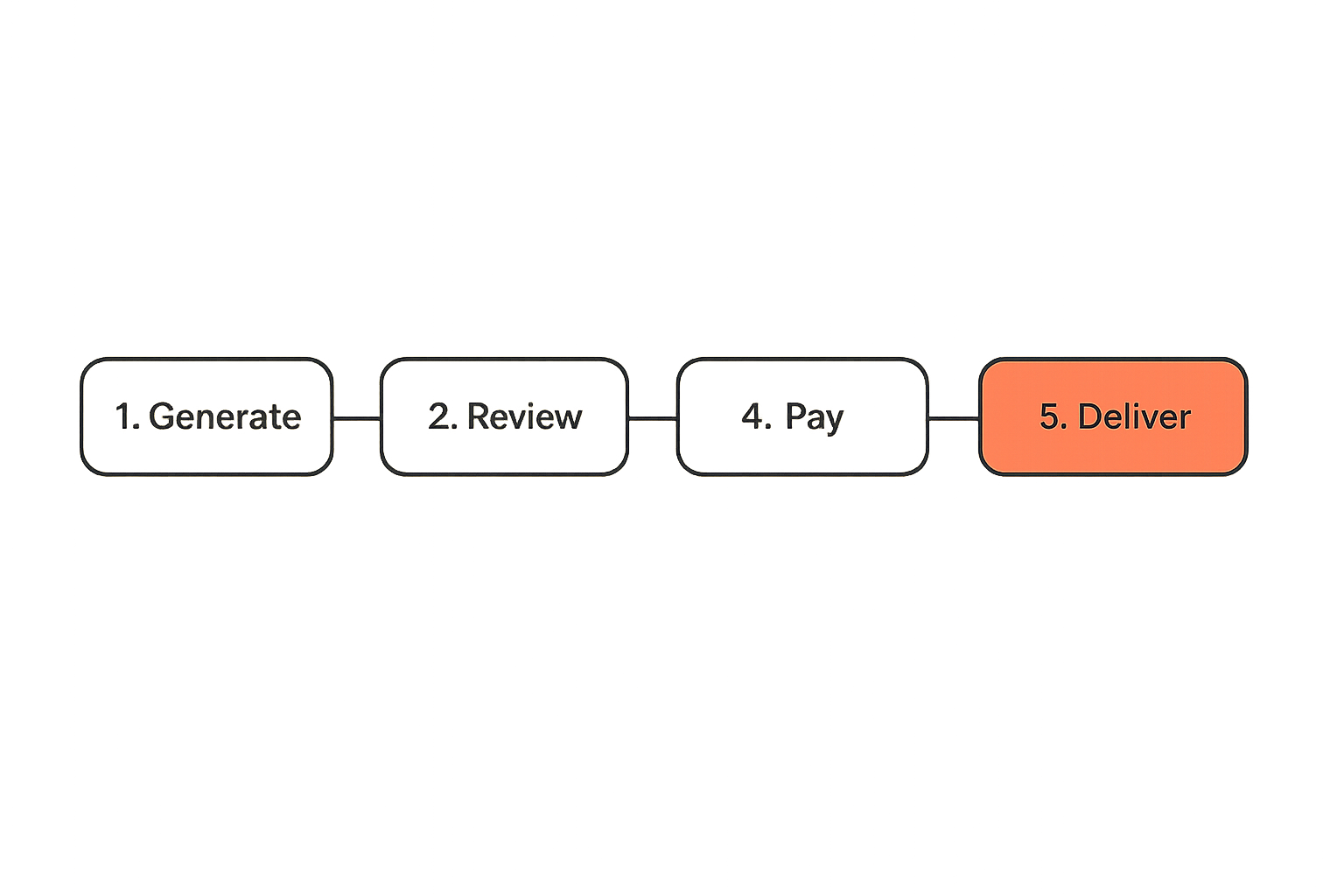
Content pipeline
A useful way to think about it is to split the system into three planes: content, payment, and control.
The content pipeline handles everything related to AI production:
- Input collection from the user or editorial team.
- Prompt assembly and policy checks.
- Model execution or retrieval-augmented generation.
- Human review when required.
- Output storage, versioning, and delivery.
For a simple publisher, the output might be a generated report PDF. For a more technical merchant, it might be an API response, a premium dataset summary, or a personalized crypto tax explainer. Either way, the content pipeline should not decide whether the user paid. It should ask the entitlement system.
That boundary matters. If the AI worker directly checks wallet transactions, you will eventually duplicate payment logic across jobs, workers, and support scripts. Keep the content worker focused on content.
Payment pipeline
The payment pipeline handles checkout, payment creation, confirmations, settlement status, and merchant notifications.
A typical crypto payment object needs fields like:
payment_id: pay_92k3
order_id: ord_18fa
customer_id: cus_77p
asset: USDC
network: polygon
amount_requested: 49.00
amount_received: 49.00
status: confirmed
expires_at: 2026-05-30T18:30:00Z
idempotency_key: ord_18fa_usdc_polygon
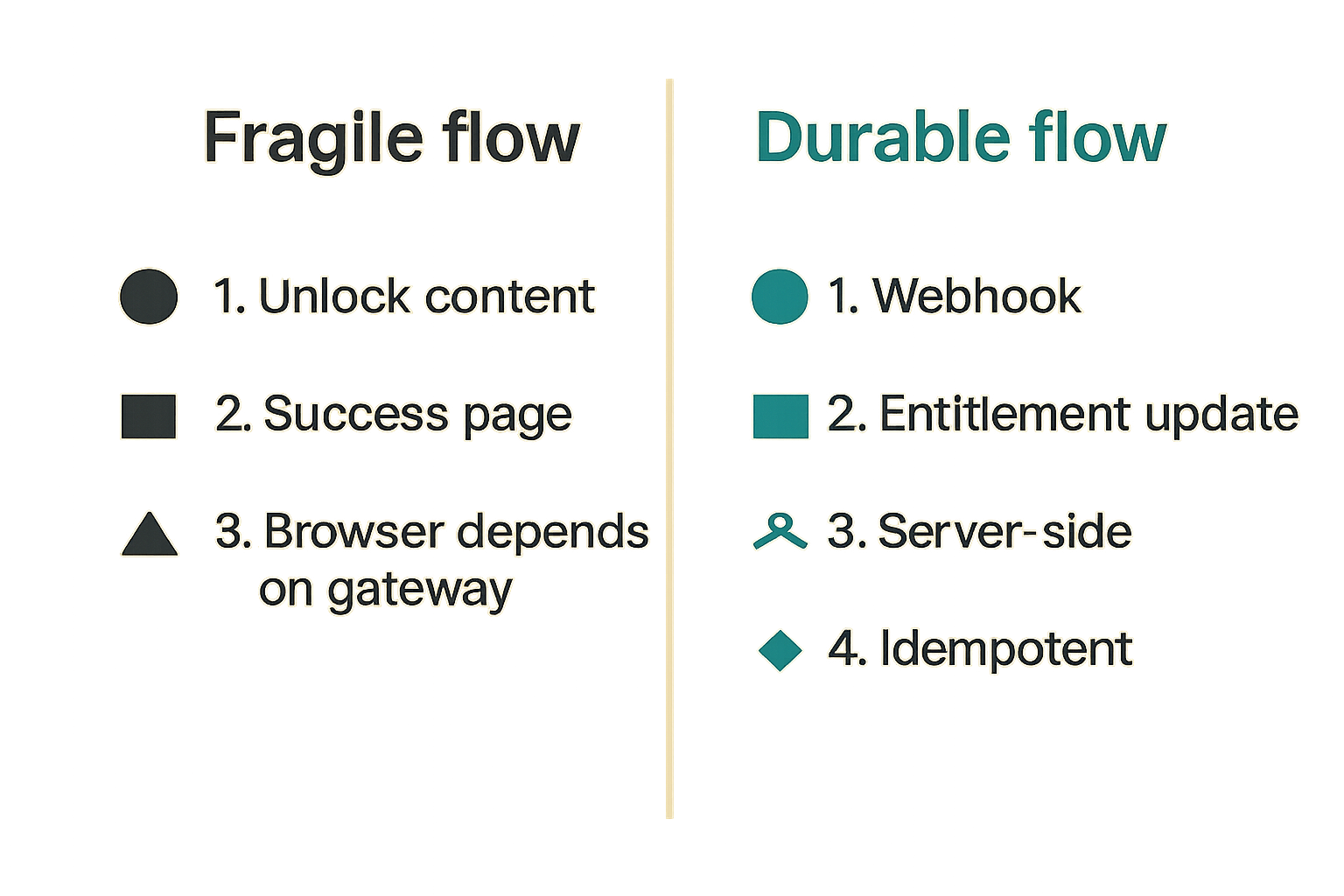
The content platform should not infer payment status from a client-side redirect. Redirects are convenient for UX, not authoritative for accounting. The authoritative path is server-side: checkout session created, payment observed, confirmation reached, webhook received, entitlement updated.
Practical rule: Never unlock paid AI content from a front-end success screen alone. Unlock from a verified server-side payment event.
Control plane
The control plane is where publishing operations become manageable. It includes admin dashboards, support tools, logs, audit trails, retry queues, and reconciliation jobs.
For AI publishing cryptocurrency businesses, the control plane answers questions like:
- Which outputs were generated for this customer?
- Which payment unlocked the output?
- Which model or prompt version created it?
- Was there a refund?
- Did the entitlement expire?
- Did a webhook fail?
- Did a moderator override access?
This is the part many teams skip because it does not look like growth. Then the first support spike arrives, and nobody can tell whether a customer paid or whether the AI job failed.
Decide what users are actually paying for
Access
The simplest model is access. A user pays and receives access to a library, article, report, course, community, or dashboard.
Access is clean because the payment event maps to an entitlement:
- one month of membership
- one premium article
- one research report
- one private feed
- one dashboard tier
For this model, build your entitlement system around time windows and product IDs. Do not attach access only to a wallet address. Wallets change. Users lose keys. Teams rotate custody. Email, account ID, and payment ID are better long-term anchors.
Access works best when the AI system produces content ahead of time or publishes on a schedule. The payment unlocks an existing asset or feed.
Usage
Usage-based AI publishing is more complex. A user buys credits and spends them on generated outputs. This is common for personalized research, AI writing tools, custom market briefs, translation, summarization, and data-enriched reports.
The payment creates a balance. The AI pipeline consumes that balance. Now you have a ledger problem.
A simple credit ledger might include:
ledger_entry_id: led_2049
type: debit
reason: generated_report
credits: 5
payment_id: pay_92k3
content_job_id: job_661a
balance_after: 45
The practical question is whether credits are refundable, transferable, expiring, or asset-denominated. If a user pays 50 USDC for 100 credits, refunding unused credits is operationally possible. If a user pays 0.001 BTC during a volatile market, refund logic becomes more sensitive.
Do not hide these rules in application code. Write them as merchant policy and then implement them as explicit ledger behavior.
Rights
Some AI publishing products sell rights, not just access. A buyer may purchase commercial use of an AI-generated article, image pack, report template, newsletter issue, or data summary.
Rights require a stronger audit trail:
- buyer identity
- payment record
- generated asset hash or version
- license terms at purchase time
- permitted usage
- revocation or refund rules
This is where crypto payment records can be useful, but they are not enough by themselves. A blockchain transaction does not describe your license terms unless you connect it to a contract, invoice, or signed record in your own system.
The mistake teams make is assuming on-chain payment equals legal clarity. It does not. The transaction proves value moved. Your publishing platform must prove what was sold.
Wallet, identity, and entitlement design
Email first, wallet second
Wallet-first design sounds native. It also creates support debt.
If a customer pays from an exchange, a shared wallet, a multisig, or a temporary address, wallet identity becomes messy. If they later ask for access from another device, your support team needs something more stable than a transaction hash.
For most merchants, the better default is email or account first, wallet second:
- Create an account or checkout identity.
- Create an order tied to that identity.
- Let the user pay with a supported asset and network.
- Record the paying address as payment metadata.
- Unlock entitlement on the account, not the wallet alone.
Wallet address still matters. It helps with fraud review, refunds, analytics, and customer support. It should not be the only identity key unless your product is deliberately anonymous and you accept the tradeoffs.
Entitlement state machine
Entitlements should be explicit. A Boolean field called paid is not enough.
Use states that reflect real operations:
| State | Meaning | Common trigger | User experience |
|---|---|---|---|
| pending_payment | Order created, no confirmed payment | Checkout opened | Show payment instructions |
| payment_seen | Transaction detected but not final | Network observation | Show waiting confirmation |
| active | Payment confirmed and access granted | Webhook processed | Unlock content |
| grace | Subscription renewal delayed | Late payment window | Keep limited access |
| expired | Access period ended | Scheduled job | Lock premium content |
| refunded | Payment reversed by merchant process | Refund recorded | Remove or adjust access |
| failed | Payment or fulfillment failed | Timeout or job error | Show support path |
This table is not glamorous, but it prevents ambiguity. When support asks why a user cannot access a generated report, the answer should be in the state, not in a Slack thread.
Practical rule: If your entitlement cannot be represented as a state transition, support will invent the state manually.
Guest checkout
Guest checkout can improve conversion, especially for one-time AI reports or downloadable assets. But guest checkout needs a recovery path.
At minimum, capture an email before showing the payment address. If the user closes the browser, pays late, or sends funds from a mobile wallet, you need a way to notify them and attach the payment to the order.
A production guest flow usually looks like this:
- User enters email and selects product.
- Server creates an order and crypto payment session.
- User pays from any wallet.
- Server receives payment confirmation.
- System emails the receipt and access link.
- User can convert guest access into an account later.
This keeps the checkout lightweight while still giving operations a stable customer handle.
Checkout and settlement flows that survive production
Hosted checkout vs embedded wallet flow
There are two common approaches to crypto checkout for AI publishing products.
| Approach | What works | What fails |
|---|---|---|
| Hosted checkout | Faster to launch, easier asset support, cleaner merchant operations | Less control over UI, depends on gateway experience |
| Embedded wallet flow | More native experience, useful for wallet-heavy audiences | More engineering work, higher risk of state bugs |
| Manual address display | Simple for testing and invoices | Easy to misattribute payments, weak UX, high support load |
Hosted checkout is usually the right first move for merchants selling content, subscriptions, or reports. Embedded wallet flows make sense when the wallet is part of the product, such as token-gated apps, DeFi analytics, or developer tooling for crypto-native users.
The practical question is where you want complexity to live. If your differentiation is AI content and publishing workflow, do not spend six months rebuilding payment monitoring unless you have a strong reason.
Webhooks and idempotency
Webhooks are where clean diagrams meet production reality. They can arrive late, arrive twice, arrive out of order, or fail because your server is down during deployment.
Your webhook handler should be boring and strict:
- Verify the webhook signature.
- Parse the event type and payment ID.
- Check whether the event was already processed.
- Load the order and current entitlement state.
- Apply one valid state transition.
- Write an immutable event record.
- Return success quickly.
- Trigger slower fulfillment work asynchronously.
Do not generate expensive AI output inside the webhook request. Use the webhook to update payment state, then enqueue a job. This prevents timeouts and gives you retry control.
A minimal idempotency pattern:
webhook_event_id: evt_81c9
payment_id: pay_92k3
processed_at: null
handler_version: 3
unique_key: evt_81c9
If the same event arrives again, the unique key blocks duplicate processing. If a different event arrives for the same payment, your state machine decides whether it is valid.
Refunds, disputes, and failed fulfillment
Crypto refunds are not card refunds. The merchant needs a refund address, a policy, and a record of what was refunded. Network fees may apply. Exchange-rate differences may matter.
For AI publishing, refunds can be especially awkward. If the user already received a generated asset, can they refund? If the output was poor, do you regenerate, credit, or return funds? If a subscription was active for ten days, do you prorate?
Write these rules before launch:
- Refund original asset amount or fiat-denominated value?
- Who pays network fees?
- Are generated outputs refundable after delivery?
- Are unused credits refundable?
- What happens if AI generation fails after payment?
- How long do users have to claim a failed order?
What works is a clear policy implemented in the ledger. What fails is deciding case by case in support messages.
Pricing AI content in crypto without creating support debt
Stablecoins vs volatile assets
For most AI publishing merchants, stablecoins are operationally simpler than volatile assets. They map better to subscription pricing, invoices, refunds, and content margins.
BTC and ETH can still be useful, especially for audiences that prefer them, but volatility creates edge cases. If a user pays for an annual subscription in ETH and requests a refund three months later, what is fair? The original asset amount? The fiat value at purchase? The fiat value at refund time?
That does not mean you should avoid volatile assets entirely. It means you should define pricing currency, settlement currency, and refund currency separately.
A useful model:
- Price products in fiat or stablecoin terms.
- Accept selected crypto assets at checkout.
- Record the exchange rate used for the invoice.
- Settle or account in the currency your business uses.
- Refund according to a published policy.
This reduces ambiguity for both merchant and customer.
Micropayments, subscriptions, and bundles
AI publishing invites small purchases. One report. One summary. One generated chart pack. One research brief. Crypto can support these models, but network fees and operational overhead still exist.
Compare the common models:
| Model | Good fit | Risk |
|---|---|---|
| One-time purchase | Premium reports, templates, issue downloads | Many small support cases |
| Credit pack | On-demand generation and API usage | Ledger complexity |
| Subscription | Newsletters, communities, dashboards | Renewal and expiration logic |
| Bundle | Research packs and content libraries | Partial refund rules |
| Enterprise invoice | Teams buying access or rights | Manual approval workflows |
Micropayments sound attractive, but the minimum viable transaction size depends on asset, network, gateway fees, support cost, and fulfillment cost. A one-dollar AI report is not profitable if every tenth order creates a manual ticket.
Fees, minimums, and rounding
Rounding is not a detail. It is a source of orphaned payments.
If your checkout asks for 12.345678 USDC and a wallet or exchange sends 12.34, what happens? If the user sends 13.00, do you over-credit? If network fees are deducted before receipt, does the order fail?
Set tolerances deliberately:
- Define an underpayment threshold.
- Define an overpayment handling policy.
- Show exact asset and network clearly.
- Expire quotes after a reasonable window.
- Do not reuse payment addresses across unrelated orders unless your gateway safely supports it.
Practical rule: Small rounding errors become big support problems when entitlement logic is binary.
What breaks when teams implement it badly
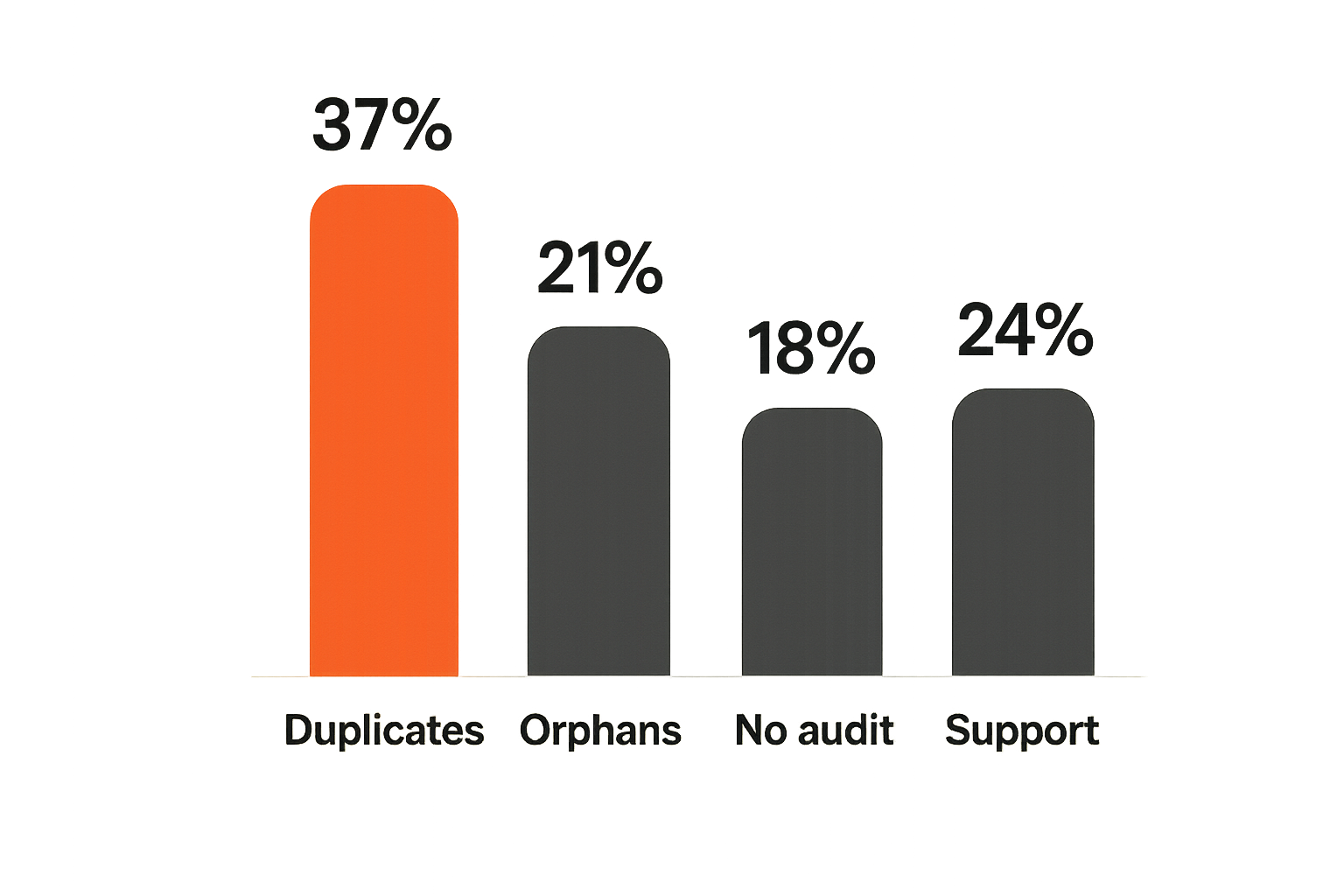
Duplicate fulfillment
Duplicate fulfillment happens when the same payment event unlocks the same product twice or triggers two AI jobs.
For static content, this might be harmless. For AI generation, it can cost money, produce conflicting outputs, or create duplicate license records. If the product is a credit pack, duplicate fulfillment can credit the user twice and create accounting drift.
Common causes:
- Webhook retries without idempotency.
- Client-side success callbacks and server-side webhooks both granting access.
- Manual support overrides without event records.
- Background jobs retried without checking content_job_id.
The fix is not a bigger if statement. The fix is a single entitlement transition path and unique event processing.
Orphaned payments
An orphaned payment is money received without a clean order match. Crypto makes this common when users pay late, send the wrong amount, use the wrong network, or copy an old address.
You need an orphan resolution workflow:
- Detect unmatched incoming payment.
- Store asset, network, amount, address, transaction hash, and timestamp.
- Search candidate orders by amount, customer, and expiration window.
- Let an operator attach the payment or mark it refundable.
- Record the decision.
Without this workflow, support becomes archaeology. Someone searches block explorers, screenshots, payment logs, and email threads until they guess.
AI content with no audit trail
AI adds another failure mode: content without provenance.
A user may ask why their paid report changed. A business customer may ask which data source was used. A license buyer may need proof of what they purchased. A regulator or partner may ask how financial claims were generated.
You do not need an academic provenance system. You do need practical records:
- prompt version or template ID
- model provider and model family
- generation timestamp
- source document IDs when relevant
- reviewer ID if human approval occurred
- payment ID and entitlement ID
- output hash or stored version
This is not about hype around AI transparency. It is about support, refunds, and merchant risk.
Implementation workflow for developers
Event model
Start with events. If you get the events right, the rest of the system becomes easier to reason about.
A practical event list:
- order.created
- checkout.started
- payment.detected
- payment.confirmed
- payment.expired
- entitlement.activated
- content_job.queued
- content_job.completed
- content.delivered
- refund.requested
- refund.completed
- entitlement.expired
Each event should have an ID, timestamp, actor, related IDs, and payload. Do not rely only on mutable rows. Mutable rows show current state. Events show how you got there.
A simple implementation sequence:
- Define products and entitlement rules.
- Create orders server-side before checkout.
- Create crypto payment sessions tied to orders.
- Process verified webhooks into payment events.
- Transition entitlements from payment events.
- Queue AI generation or delivery jobs from entitlements.
- Record content output versions.
- Run reconciliation on a schedule.
- Expose order and entitlement state to support.
This sequence keeps payment truth upstream of content delivery.
Reconciliation job
Even with webhooks, run reconciliation. Webhooks are not a database backup plan.
A reconciliation job should check:
- payments marked pending past expiration
- payment confirmations missing entitlement activation
- active entitlements with failed content delivery
- completed content jobs without delivery email
- refunds that did not adjust access
- credit balances that do not match ledger entries
Run it frequently enough to catch issues before customers do. For many merchants, every few minutes is enough for operational checks, with a deeper daily accounting reconciliation.
The output should be actionable: create an alert, open an admin task, or auto-repair safe cases. Do not generate a CSV nobody reads.
Observability checklist
Metrics should map to merchant pain, not vanity dashboards.
Track these:
- checkout sessions created
- payments detected
- payments confirmed
- payments expired
- webhook failures
- duplicate webhook attempts blocked
- average time from payment to access
- content job failures
- support tickets by payment state
- orphaned payments count
- refund requests by product
Logs should include order_id, payment_id, customer_id, entitlement_id, content_job_id, and webhook_event_id. If these IDs are not in the same trace, debugging will be slow.
The practical question for every log line is simple: can support use this to explain what happened to a paying customer?
Where CoinPayPortal fits
Gateway layer
CoinPayPortal sits in the gateway layer of this architecture. That means it should help merchants accept cryptocurrency payments without forcing the publishing application to become a blockchain monitoring system.
For AI publishing cryptocurrency projects, the gateway layer should handle payment creation, supported assets, checkout presentation, confirmation tracking, and merchant notifications. Your application should consume those events and translate them into orders, entitlements, credits, and content delivery.
This separation is important. The AI publishing stack changes quickly: models, prompts, editorial rules, product packaging, and customer segments all evolve. Payment confirmation and settlement rules should be stable infrastructure, not scattered across prompt workers and CMS plugins.
Keep custody and publishing boundaries clear
Do not let payment architecture blur business boundaries.
Your publishing app owns:
- product catalog
- customer account
- entitlement rules
- AI job orchestration
- content storage
- license terms
- support decisions
Your payment gateway owns or supports:
- checkout session
- payment address or payment request
- asset and network handling
- payment status
- confirmation events
- merchant payment records
The cleaner this boundary, the easier it is to change either side. You can revise AI products without rewriting checkout. You can add payment assets without changing how content jobs run.
Start small
The best first version is not a universal AI marketplace with every token, every chain, streaming micropayments, wallet login, token gating, and automated licensing.
Start with one or two products:
- a paid AI-generated report
- a stablecoin subscription
- a credit pack for generated summaries
- a premium newsletter archive
Support one or two payment assets. Build the entitlement state machine. Add webhook idempotency. Add support visibility. Then expand.
The mistake teams make is trying to launch the whole crypto-native publishing future before they can reliably answer whether one customer paid for one report.
Closing: make AI publishing cryptocurrency boring
What works
AI publishing cryptocurrency works when the architecture is boring in the right places.
Use AI where it creates leverage: generation, personalization, summarization, translation, editorial workflows, and packaging. Use crypto payments where they reduce payment friction for your customer base. But connect them with conservative infrastructure: orders, payment events, idempotent webhooks, entitlement states, ledgers, reconciliation, and support tooling.
What works is separation of concerns:
- content systems generate and deliver
- payment systems confirm and settle
- entitlement systems decide access
- support systems explain state
- reconciliation systems catch drift
That is not flashy, but it survives real customers.
What fails
What fails is coupling everything to a front-end payment success screen. What fails is treating a wallet address as a complete customer record. What fails is generating paid AI outputs without version history. What fails is accepting five chains and ten assets before your team has refund rules.
The keyword is AI publishing cryptocurrency, but the business problem is simpler: can a user pay, receive what they bought, and get a clear answer if something goes wrong?
If the answer is yes, you have a system. If the answer is no, you have a demo.
Try coinpayportal.com
CoinPayPortal helps developers and merchants add cryptocurrency payment flows without turning the publishing app into payment infrastructure. Start with a clean checkout, verified payment events, and merchant-friendly operations: Try coinpayportal.com.
Try CoinPay
Crypto payments, escrow, and wallets — multi-chain, Lightning-ready, and fast to integrate.
Get started →