AI Content Blockchain: Practical Payment Architecture for Publishers, Creators, and Merchants

AI content blockchain sounds like a content problem until the first invoice, takedown, refund, or royalty dispute lands in support.
A publisher wants to sell AI-assisted research. A marketplace wants creators to license generated images. A SaaS product wants to charge for premium AI outputs and prove which model, prompt policy, and license were used. Everyone starts by asking how to put content on-chain.
Teams think the problem is proving that a file existed. The real problem is coordinating trust, access, payment, licensing, and settlement across systems that do not share one database.
That changes the conversation. AI content blockchain is not a magic authenticity layer. It is an architecture decision about how content rights move through checkout, how buyers receive access, how creators get paid, and how your team resolves disputes when the chain, the database, and the customer story disagree.
Table of contents
- AI content blockchain is a workflow problem, not a proof-of-existence trick
- Where AI content blockchain meets crypto payments in 2026
- Reference architecture for an AI content blockchain system
- The payment layer: checkout, webhooks, and settlement
- Provenance and licensing design choices
- What works in production
- What fails when teams implement AI content blockchain badly
- Implementation workflow for developers
- Operational metrics for an AI content blockchain program
- Where CoinPayPortal fits in the stack
AI content blockchain is a workflow problem, not a proof-of-existence trick
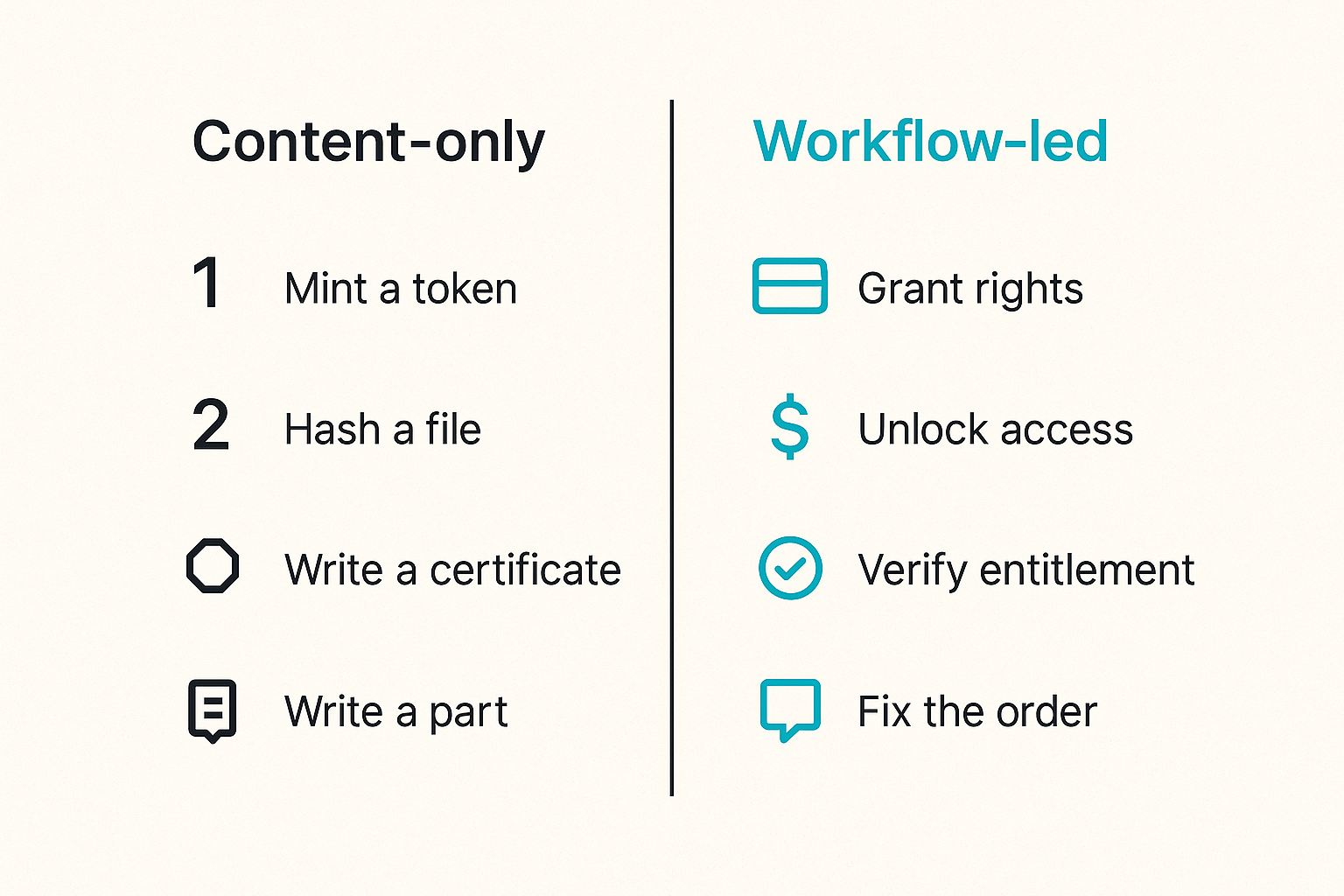
The mistake teams make is starting with the ledger. They mint a token, hash a file, or write a certificate, then assume the market will infer trust from the artifact.
In practice, buyers do not care that a hash exists. They care whether the content is usable, whether the license is clear, whether the seller can grant rights, whether payment unlocks access, and whether support can fix the order if something breaks.
A useful way to think about it is this: blockchain can anchor evidence, but it does not run the workflow. Your application still owns identity, checkout, content delivery, entitlement checks, refunds, dispute handling, and reporting.
What the buyer actually needs to trust
For AI-generated or AI-assisted content, trust has several layers:
- The content is what the seller says it is.
- The license allows the buyer's intended use.
- Payment creates a durable entitlement.
- The entitlement can be verified later.
- Revenue splits and royalties are handled consistently.
- If a claim is challenged, there is an audit trail.
The blockchain part helps most when it provides a tamper-resistant timestamp, a shared settlement record, or a transferable access credential. It helps least when it is used as a public dumping ground for files, prompts, or private customer data.
As the team at bl0ggers.com often sees with content operations, the hard part is not generating more assets; it is keeping editorial control, rights, review, and monetization aligned as volume increases.
Why payments teams should care
Payments teams become involved because licensing is not complete until value moves. If a customer pays in crypto for an AI-generated asset, your system has to answer operational questions:
- Which wallet paid?
- Which invoice did that transaction satisfy?
- Which content item or license was unlocked?
- Was settlement final enough to deliver the asset?
- Who receives the creator share?
- What happens if the customer underpays, overpays, or pays late?
Practical rule: Do not treat provenance as separate from payment state. If the buyer cannot connect proof, license, invoice, and delivery, the system will fail in support even if the chain data is correct.
Where AI content blockchain meets crypto payments in 2026
AI content blockchain becomes useful when the content has economic behavior: access, resale, subscription, escrow, revenue share, usage limits, or royalties. Without payment or permission logic, the chain record is usually just an expensive timestamp.
The practical question is where crypto payment rails improve the workflow rather than adding theater. The answer is usually in cross-border settlement, programmable revenue splits, wallet-native access, or machine-readable audit records.
Licenses, royalties, and access rights
Common merchant workflows include:
- Selling AI-generated media with commercial-use licenses.
- Charging for premium prompts, datasets, templates, or research packs.
- Letting buyers unlock token-gated archives.
- Paying creators or reviewers when content sells.
- Tracking derivative works and revenue shares.
- Selling subscriptions where wallet ownership acts as the access key.
These are not just content features. They are commerce features. A license sale has the same problems as any digital checkout: quote, payment, confirmation, fulfillment, entitlement, receipt, support, and accounting.
If you skip those states and jump straight to minting, the operational system is incomplete.
Why on-chain state alone is not enough
On-chain state can tell you that an address transferred value or holds a token. It will not tell you everything a merchant needs to know.
It usually will not know whether the buyer accepted terms, which tax profile applies, whether the file was delivered, whether the buyer is sanctioned, whether the creator passed review, or whether a support agent granted a replacement license.
That does not make blockchain useless. It means the chain should be one source of truth for specific events, not the only source of truth for the whole business.
| Layer | Good use of blockchain | What should stay in the application |
|---|---|---|
| Provenance | Hash, timestamp, issuer signature | Drafts, prompts, private reviews |
| Payment | Transaction reference, settlement proof | Cart, invoice, customer support notes |
| Licensing | Tokenized entitlement or license ID | Full legal text, regional rules, policy changes |
| Royalties | Payout event or split contract | Creator onboarding, tax forms, exceptions |
| Access | Wallet-held credential | Download URLs, rate limits, abuse controls |
Reference architecture for an AI content blockchain system
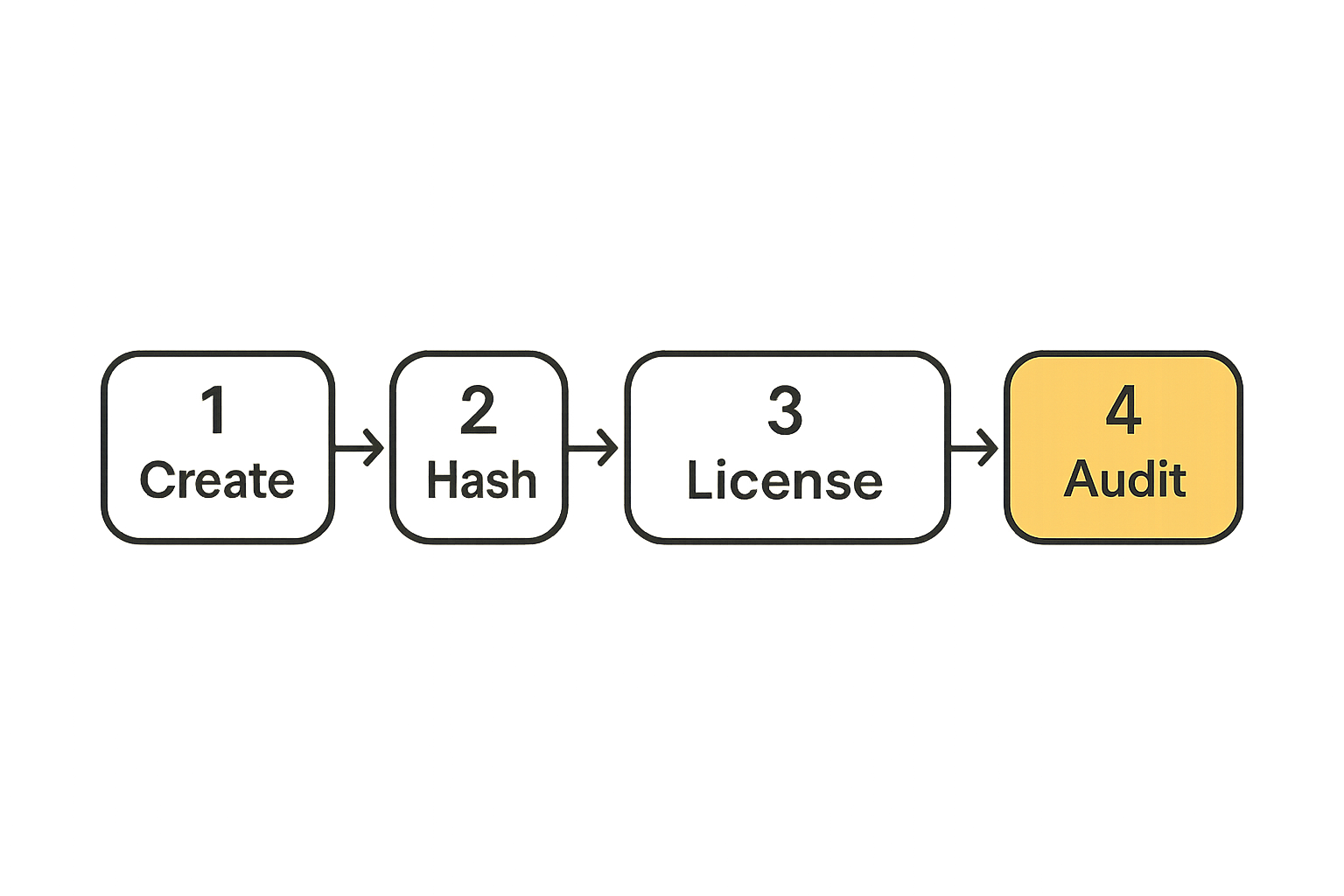
A production design needs boring parts. That is a compliment. Boring systems have clear states, retry rules, logs, and ownership.
The architecture should make it easy to answer one question: for this piece of AI content, who can use it, under what license, because of which payment, and what proof exists?
Core components
A practical stack usually includes:
- Content service: stores canonical content records, versions, review state, and asset locations.
- AI generation service: produces drafts or outputs and logs model, policy, and generation metadata where appropriate.
- Provenance service: creates hashes, signatures, attestations, or token records.
- Checkout service: creates invoices, payment addresses, expiration windows, and quote amounts.
- Payment gateway: detects blockchain payments and sends webhooks.
- Entitlement service: grants access after payment confirmation.
- Royalty service: calculates creator payouts and platform fees.
- Admin console: lets operators investigate orders, disputes, and failed deliveries.
The mistake is trying to collapse all of this into a smart contract. Smart contracts are good at deterministic rules. They are poor places for private customer data, mutable business policy, manual approvals, and support exceptions.
Data that should stay off-chain
Keep these off-chain by default:
- Raw content files.
- Prompts containing customer or business data.
- Internal editorial feedback.
- Personally identifiable information.
- Full legal agreements that may need updates.
- Moderation decisions and appeal notes.
- Download links or signed URLs.
Store references, hashes, and signatures on-chain only when they have a clear verification purpose. If the data needs deletion, correction, privacy controls, or access restrictions, it probably does not belong on a public ledger.
Practical rule: Put proofs on-chain, not your operating database. The chain should verify selected facts, not expose every fact.
Event model and payment states
Your event model matters more than the token standard you choose. At minimum, define states for content, license, payment, and entitlement.
Example lifecycle:
- content.created
- content.reviewed
- provenance.anchored
- invoice.created
- payment.detected
- payment.confirmed
- license.issued
- entitlement.granted
- royalty.accrued
- payout.sent
What breaks in practice is ambiguous state. If payment is detected but not confirmed, do you deliver? If the license is issued but the download fails, is the order complete? If a refund happens, is the entitlement revoked?
Write those answers down before writing contract code.
The payment layer: checkout, webhooks, and settlement
The payment layer is where most AI content blockchain projects become real or break. A glossy content UI can hide weak infrastructure during a demo. It cannot hide failed invoices, duplicate unlocks, missing creator payouts, or confused support agents.
Treat content rights like order fulfillment
A license purchase should behave like a fulfillment flow:
- Buyer selects a content item and license tier.
- Merchant creates an invoice with amount, currency, expiration, and metadata.
- Buyer pays from a wallet or checkout session.
- Payment gateway observes the transaction and sends an event.
- Merchant waits for the required confirmation policy.
- Entitlement service grants access.
- Provenance or license service records the issued right.
- Receipt and audit records are created.
The content right is the product. The blockchain transaction is the payment evidence. The entitlement record is what your app uses to serve the buyer tomorrow.
Idempotency and retries
Crypto payments are asynchronous. Webhooks can arrive more than once. Users can refresh pages. Chain confirmations can lag. Nodes can disagree briefly. Your system needs idempotency at every boundary.
Use idempotency keys for:
- Invoice creation.
- Payment confirmation handling.
- License issuance.
- Entitlement grants.
- Royalty accrual.
- Payout scheduling.
A webhook handler should be safe to run twice. The second run should detect that the invoice is already settled and avoid issuing a duplicate license or double-counting a royalty.
Practical rule: Every payment event handler should be replayable. If replay creates duplicate value, the handler is not production-ready.
Reconciliation for creators and merchants
Reconciliation is not optional. If creators expect revenue share, they will ask why one sale paid out and another did not. If merchants sell subscriptions, they will need to match wallet payments to account access.
A basic reconciliation table should include:
| Field | Why it matters |
|---|---|
| invoice_id | Connects checkout to payment |
| content_id | Identifies what was sold |
| license_id | Identifies the issued right |
| buyer_account_id | Supports customer service |
| buyer_wallet | Supports wallet-based verification |
| tx_hash | Connects payment to chain activity |
| settlement_asset | Explains currency exposure |
| creator_share | Supports payout reports |
| platform_fee | Supports revenue reporting |
| entitlement_status | Shows whether access was delivered |
Do not rely on a block explorer as your finance system. It is a useful diagnostic tool, not a merchant ledger.
Provenance and licensing design choices
Provenance is evidence. Licensing is permission. They overlap, but they are not the same thing.
A file can have a valid provenance record and still be licensed incorrectly. A buyer can have a valid license to use a file without owning the copyright. A token can represent access without transferring intellectual property.
That distinction matters when you design the schema.
Hashes, signatures, and metadata
A common pattern is to hash the canonical asset or manifest, then sign the hash with the issuer's key. The manifest can include:
- content_id
- version_id
- creator_id or issuer_id
- generation method category
- review status
- license template ID
- timestamp
- storage pointer
- hash algorithm
The hash proves that the referenced content has not changed. The signature proves that a known issuer anchored it. The metadata explains what the proof is supposed to mean.
Do not overclaim. A hash does not prove originality. A signature does not prove legal ownership. A timestamp does not prove the content is safe to use.
License terms as business rules
License terms should be represented in a machine-readable way inside your application, even if the full legal text lives elsewhere.
For example:
- personal_use: true
- commercial_use: true
- resale_allowed: false
- sublicensing_allowed: false
- attribution_required: true
- max_seats: 5
- territory: global
- expires_at: null
These fields drive entitlement checks and support decisions. They also help developers avoid hard-coding legal assumptions into UI copy.
If you tokenize the license, the token should point to a license record or manifest. Do not make the token carry every policy detail unless those details are immutable and simple.
Handling edits and derivatives
AI content changes quickly. A creator may regenerate an image, edit a transcript, update a research brief, or create a derivative pack from an earlier asset.
Treat every meaningful change as a new version. Link versions together rather than overwriting history.
A derivative graph can be simple:
- asset A is the original approved item.
- asset B is a localized version of A.
- asset C uses A and B in a bundle.
- license L grants access to C but not raw A.
This matters for royalties. If a bundle sells, which creators are paid? If a derivative is disputed, which downstream assets need review? Your provenance model should support those questions.
What works in production
Production systems reduce ambiguity. They do not try to solve every possible content-rights problem on day one.
The teams that make progress usually narrow the workflow, define clear states, and keep humans in control of policy decisions until the data proves automation is safe.
Start with one paid workflow
Pick one transaction type:
- One-time purchase of a commercial license.
- Subscription to an AI content library.
- Token-gated access to premium research.
- Creator marketplace sale with revenue share.
- Escrowed commission for custom AI content.
Then design the complete path from quote to settlement. Do not start with ten license types, five chains, and a complex royalty tree. That is how teams create systems nobody can debug.
A narrow first workflow lets you test the important assumptions: checkout completion, confirmation timing, entitlement grants, refund policy, creator payout, and support tooling.
Use stable settlement units
AI content buyers often think in fiat terms. Creators may want predictable payouts. Merchants need clean revenue reporting. Volatile settlement assets can create confusion if pricing, invoices, and payouts are not designed carefully.
For many businesses, stablecoins are operationally easier than volatile assets. If you accept volatile coins, define your quote window and underpayment policy explicitly.
Examples:
- Invoice amount is fixed for 15 minutes.
- Underpayments remain pending until resolved.
- Overpayments create a credit or manual refund.
- Payouts are calculated from settled value, not displayed cart value.
The UI should not hide these rules. Buyers need clear instructions, and support needs consistent policy.
Keep human approval in the loop
AI content workflows create edge cases. A generated image might resemble a brand. A dataset might include restricted material. A derivative work might create a licensing conflict. A creator might dispute attribution.
Automation should route these cases, not pretend they do not exist.
Use review states:
- draft
- pending_review
- approved
- restricted
- disputed
- retired
Only approved content should be eligible for automated sale. Restricted or disputed content should block new purchases while preserving records for prior buyers.
What fails when teams implement AI content blockchain badly
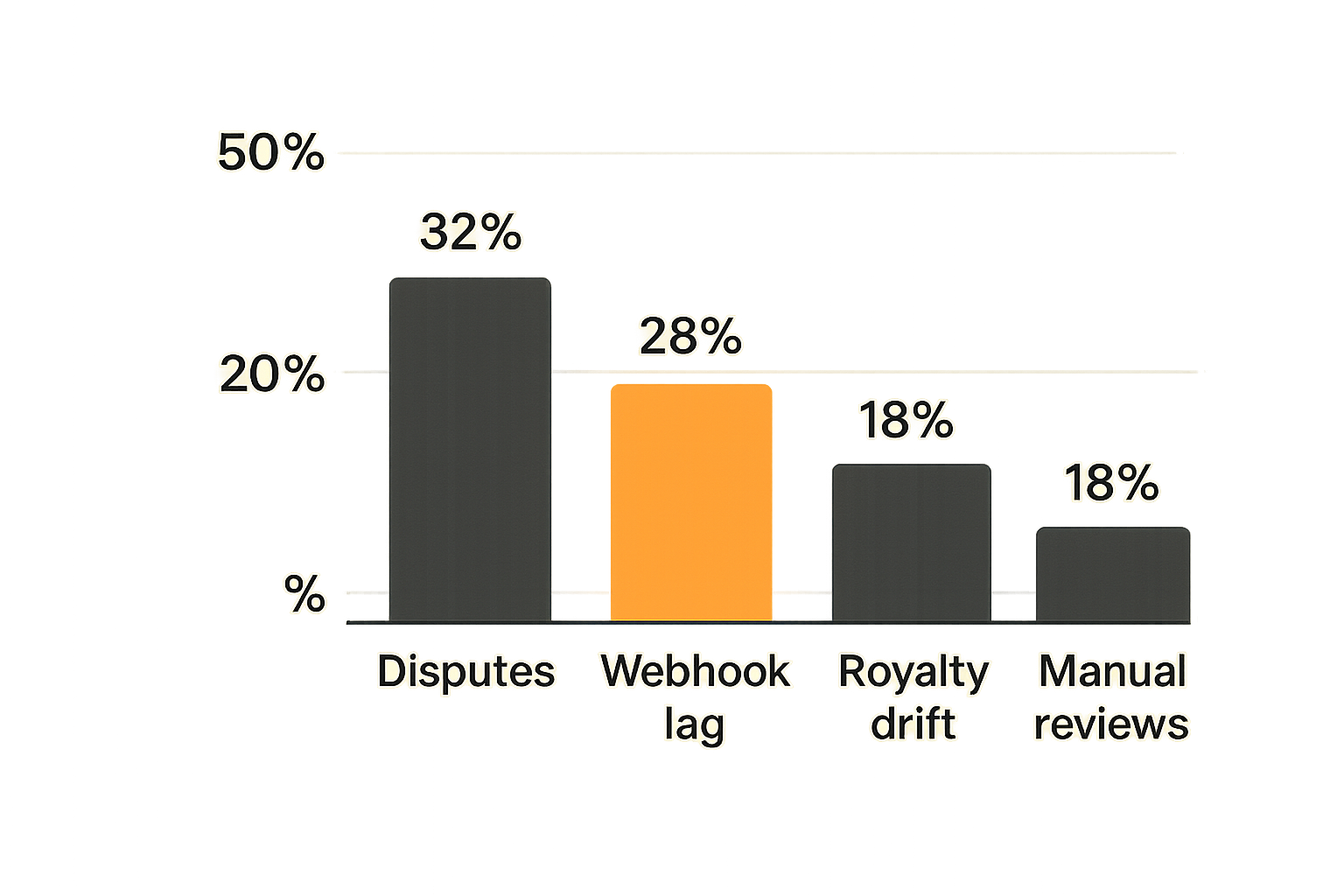
The failure modes are predictable. They usually come from confusing a blockchain artifact with an operating model.
A token is not a support process. A smart contract is not a licensing department. A hash is not a refund policy.
Storing too much on-chain
Putting raw content or sensitive metadata on-chain creates long-term problems. Public chains are hard to edit. Even if you use encrypted data, key leakage or future policy changes can create risk.
What fails:
- Customer data becomes visible or permanently referenced.
- Content cannot be removed after a legal request.
- Prompts reveal internal strategy or private inputs.
- The team cannot correct bad metadata.
- Gas costs rise with unnecessary data writes.
What works:
- Store content in controlled storage.
- Put hashes and manifest references on-chain.
- Use signed URLs for delivery.
- Keep mutable policy in the application.
- Record only the proof needed for verification.
Confusing ownership with permission
Many users hear token and assume ownership. That is dangerous if your token only grants access or a limited license.
Make the distinction explicit:
- Access token: proves the holder can access content.
- License token: represents a specific permission set.
- Royalty token: represents a claim on revenue share.
- Ownership token: may represent transfer of a defined asset, if legally supported.
Do not let UI copy imply copyright transfer unless that is actually what your legal and business process supports.
Ignoring support and refunds
Support is where architectural shortcuts become expensive. A buyer paid from the wrong wallet. A transaction arrived after invoice expiration. The content download failed. A creator was not paid. A license was issued with the wrong tier.
If your only answer is look at the chain, your system is not merchant-ready.
Support needs:
- searchable invoices
- wallet and transaction lookup
- entitlement override controls
- refund or credit workflows
- creator payout audit trails
- content version history
- dispute notes
Build these tools early. They do not need to be beautiful, but they need to exist.
Implementation workflow for developers
The practical question is how to build without overengineering. Start with the minimum architecture that can sell one content right, prove what was sold, deliver access, and reconcile payment.
A numbered build sequence
- Define the commercial product. Decide whether you are selling access, a license, a subscription, a commission, or a royalty-bearing asset.
- Create content and version records. Assign stable IDs before thinking about tokens.
- Define license templates. Keep legal text and machine-readable business rules linked.
- Build checkout metadata. Every invoice should include content_id, license_template_id, buyer_account_id, and expected settlement asset.
- Configure payment confirmation rules. Decide when payment is final enough to grant access.
- Implement idempotent webhook handling. Use event IDs and database constraints.
- Issue the license record. Optionally mint or anchor a token after payment confirmation.
- Grant entitlement. Store access status separately from the payment event.
- Accrue royalties. Calculate creator share from the settled order.
- Build admin views. Let operators search by invoice, wallet, transaction, content, buyer, and creator.
- Test failure paths. Simulate duplicate webhooks, late payments, underpayments, refund requests, and content disputes.
- Run reconciliation. Compare invoices, chain transactions, entitlements, and payouts before scaling.
This sequence keeps the blockchain piece inside the workflow instead of letting it dominate the workflow.
Minimal event payload
A webhook event does not need every field in your system. It needs enough to update payment state safely.
{
  "event_id": "evt_123",
  "event_type": "payment.confirmed",
  "invoice_id": "inv_456",
  "tx_hash": "0xabc...",
  "asset": "USDC",
  "amount": "49.00",
  "confirmations": 12,
  "occurred_at": "2026-06-04T12:00:00Z"
}
Your handler should load the invoice, verify expected amount and asset, check whether the event was already processed, update payment state, and trigger downstream fulfillment.
Keep downstream actions behind queues where possible. Payment confirmation should not fail because a storage provider had a temporary issue generating a download URL.
Testing edge cases
Test the paths users actually create:
- payment arrives after invoice expiration
- payment is slightly under the required amount
- buyer sends two payments for one invoice
- webhook arrives before the UI success page loads
- webhook arrives twice
- license issuance succeeds but email delivery fails
- content is disputed after purchase
- creator payout wallet is invalid
- refund is approved after entitlement was granted
The goal is not to eliminate all manual work. The goal is to make manual work safe, logged, and rare.
Operational metrics for an AI content blockchain program
Metrics should tell you whether trust and payment operations are improving. Vanity metrics like total minted items do not say much if buyers cannot use the licenses or creators cannot reconcile payouts.
Metrics that show trust is improving
Track metrics tied to buyer confidence and content governance:
- percentage of paid assets with anchored provenance
- percentage of assets with complete license metadata
- number of disputed assets by category
- average review time for AI-assisted content
- percentage of derivative assets with parent references
- support tickets per 100 purchases related to license confusion
If license confusion is rising, your token design may be fine while your product language is broken.
Metrics that show payment ops are healthy
Track payment and settlement health:
- checkout completion rate
- payment confirmation latency
- webhook retry count
- duplicate webhook handling rate
- underpayment and overpayment frequency
- entitlement grant latency
- payout reconciliation exceptions
- manual refund volume
These metrics show where the real friction lives. If webhook lag is low but entitlement latency is high, your payment gateway is not the bottleneck. If payouts reconcile poorly, your royalty rules or ledger model need work.
Practical rule: Measure the handoffs, not just the chain writes. Most production failures happen between systems.
Where CoinPayPortal fits in the stack
For merchants and developers, the payment gateway should reduce moving parts. It should not force your team to become a blockchain monitoring company just to sell a digital license.
CoinPayPortal fits where crypto checkout, payment events, and merchant operations meet the AI content workflow.
Payment infrastructure should stay boring
A good crypto payment layer should help you:
- create invoices with clear metadata
- accept wallet payments for digital products
- receive reliable payment notifications
- map transactions back to orders
- handle confirmation timing
- support settlement and reporting workflows
- reduce custom chain-watching code
That leaves your product team free to focus on content quality, license design, access control, and creator economics.
For an AI content blockchain system, that separation is important. Your app should own rights and business logic. The payment layer should make value movement observable, reliable, and easy to reconcile.
Closing thought on AI content blockchain
AI content blockchain is useful when it connects proof to commerce. It is weak when it becomes a decorative token layer around an unclear product.
Start with the workflow: who creates the content, who approves it, who can buy it, what payment confirms the right, how access is granted, how creators are paid, and how support resolves exceptions.
Then add blockchain where shared proof, wallet-native access, or crypto settlement improves the system. That order keeps the architecture practical and keeps AI content blockchain tied to business value instead of hype.
Try coinpayportal.com
CoinPayPortal helps developers and merchants accept crypto payments and build reliable checkout workflows for digital products, subscriptions, and content commerce. Try coinpayportal.com.
Try CoinPay
Crypto payments, escrow, and wallets — multi-chain, Lightning-ready, and fast to integrate.
Get started →